
14 min 39 sec
Available in: English
 ไทย
EnglishไทยHow To: Absurd Scientific Advice for Common Real-World Problems
Randall Munroe answers absurd how-to questions, from landing a plane on a submarine to powering Mars with a moon. He uses real math, science and history to show how silly problems reveal the rules the world runs on.
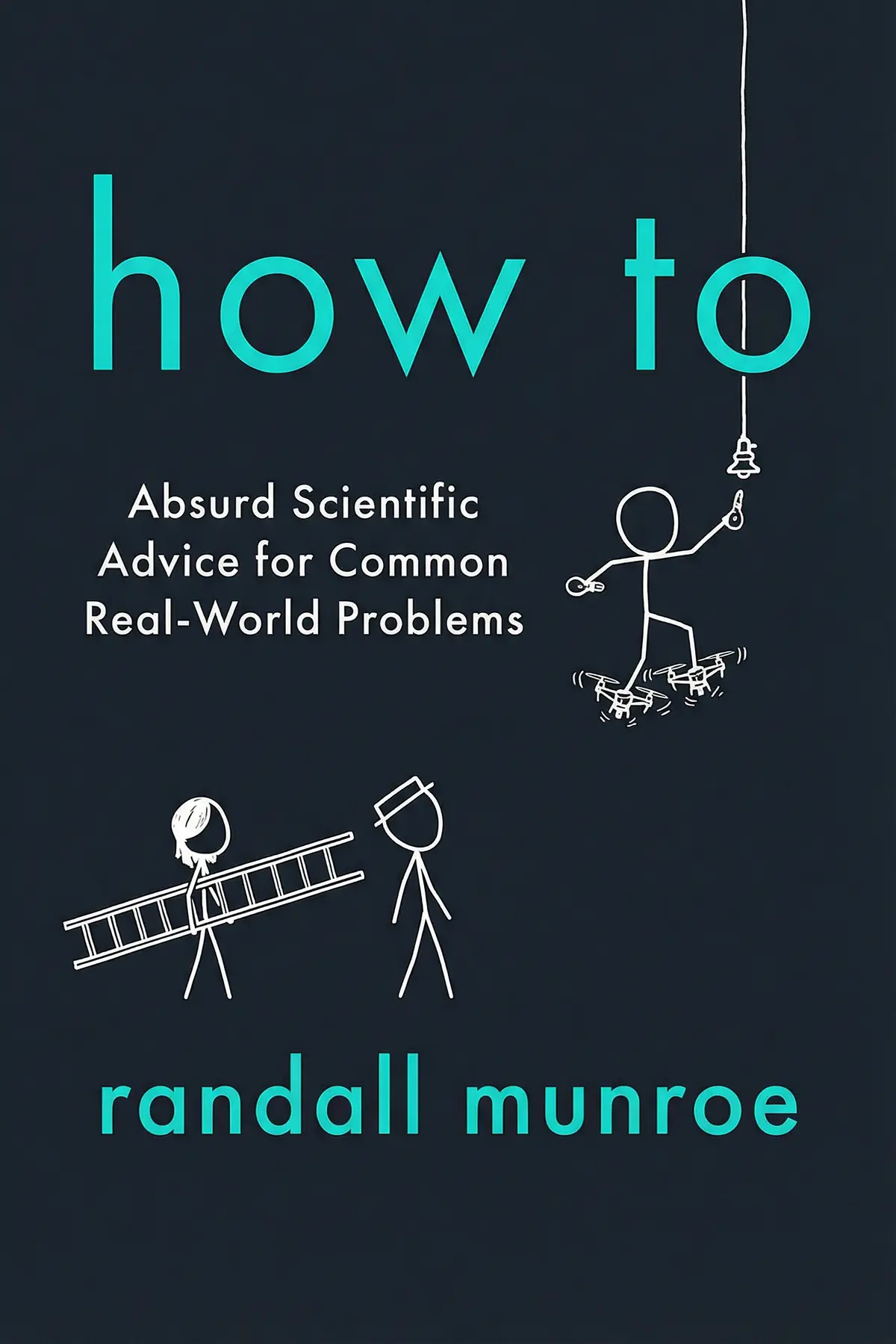
Table of Content
1. Introduction
55 sec
Most people hear a ridiculous question, laugh and move on. In How To, former NASA roboticist and cartoonist Randall Munroe works such questions out with real numbers, and the answers teach more than sensible ones would. Take a pilot whose small plane fails over the ocean: the best runway may be a surfaced submarine steaming hard into the wind.
Munroe makes his case one absurd project at a time. Follow a silly goal all the way through with honest math and real history, and it reveals the rules the world actually runs on. Speed, time, heat, energy and even voting each get their turn.
What stays with you is a set of thinking habits that work on ordinary problems. Compare relative speeds. Hunt for the slowest step. Price the upkeep as well as the start, and read the clues the past left behind.
2. Match the speed and almost any landing works
1 min 29 sec
A plane with a dying engine over the ocean seems to have no runway in sight. One principle turns a moving ship into a landing strip, and it applies far beyond flying.
3. Find the slowest step before you spend
1 min 37 sec
A quarter of a million dollars buys enough bottled water to fill a pool by tonight. Paying for it turns out to be easy. The obstacle that really stops the party hides in plain sight.
4. Pick a tool that matches the size of the hole
1 min 29 sec
A shovel, a giant vacuum and a mining crew can all dig a hole. The one you choose decides whether you end up with a garden bed or an entire island turned over in search of treasure.
5. Learn what a lava moat costs to run daily
1 min 30 sec
Melting rock is the simple part of guarding a home with lava. The number that should frighten an owner shows up later, and it holds a lesson for any project that has to keep running.
6. Power a Mars home by borrowing a moon
1 min 33 sec
Mars has no rivers, no fuel and weak sunlight, and its wind can barely turn a blade. A rope 5,820 kilometers long offers a way out, with one alarming side effect.
7. Cover light-years faster than light, almost
1 min 36 sec
Physics forbids outrunning light, yet a steady push and a strange property of time let one traveler cross billions of light-years. The price is paid by everyone, and everything, left behind.
8. Read a stranger's birth decade in their teeth
1 min 39 sec
Cold War bomb tests, leaded gasoline and a vanished disease each left marks on human bodies. Know which mark to look for and you can guess someone’s generation without asking a thing.
9. Discover how a name alone can confuse a ballot
1 min 37 sec
A Canadian candidate rebuilt his name around the ballot, and Pennsylvania has seen a crowd of men named Bob Casey run for office. One trick failed on a single detail, while the other story ends with a governor.
10. Conclusion
1 min 14 sec
Munroe’s advice is useless on purpose, and that is exactly why it teaches. Each absurd goal forces an honest calculation, and the calculation exposes the rule that was there all along. A plane lands on a submarine because relative speed is what counts. A bottled-water pool stalls on twisting caps, while the money is the easy part. A lava moat drains its owner through upkeep. Time stretches for a fast traveler, and the past stays written in people’s teeth.
Those patterns carry into ordinary work. When a plan looks impossible, change the frame of reference and see whether the problem shrinks. Before spending, find the slowest step, the way 86,400 seconds in a day rule out opening 150,000 bottles by hand. For anything that must keep running, price a single day of operation before committing to it. And when the obvious resources are gone, look for energy or information already present in the world, as a tether borrows a moon’s orbit.
Just remember Phobos. Every clever shortcut has a cost, and sometimes the cost comes falling out of the sky.
About this book
What is this book about?
Most advice books promise sensible answers to everyday problems. Randall Munroe offers the opposite: completely impractical solutions to tasks nobody asked to do, each one worked out with real numbers, real science and real history. He explains where a failing plane can make an emergency landing, even on a submarine that has surfaced, and he works out the price of filling a swimming pool using 150,000 bottles of Fiji water. He shows how open-pit mining could tear apart a whole island while hunting for buried pirate treasure, and why a moat of lava would run its owner roughly $60,000 daily. He powers a home on Mars with a tether hung from the moon Phobos and uses relativity to cross billions of light-years in a few decades of a traveler's time. He reads people's birth decades from nuclear fallout in their teeth and recounts the many Bob Caseys of Pennsylvania politics. The jokes carry genuine lessons. Readers get a feel for relative speed, bottlenecks, running costs, energy and time. They also pick up a lasting habit: putting numbers on a problem before deciding it cannot be solved.
Book Information
Who it's for
Professionals who enjoy science
Curious professionals who enjoy science but want it delivered through jokes and real numbers.
Teachers and students
Students and teachers looking for playful examples of relativity, energy and estimation.
Fans of xkcd
Fans of xkcd and What If? who want more absurd problems solved with honest math.
About the Author
Randall Munroe
Randall Munroe was born in Easton, Pennsylvania, and grew up near Richmond, Virginia. He studied physics at Christopher Newport University and later worked on robots at NASA Langley Research Center. In 2006 he left NASA to draw the comic xkcd full time. His work has earned Hugo Award nominations, and the asteroid 4942 Munroe carries his name. His other books include xkcd: Volume 0, What If?, Thing Explainer and What If? 2, and both What If? and Thing Explainer reached the New York Times bestseller list.
Ratings & Reviews
Ratings at a glance

What people think
Listeners find the work incredibly funny, with one review noting its blend of science and humor. Furthermore, they appreciate its educational merit, as one review highlights its perfect balance of displaying scientific concepts. The book is also praised for being a silly and entertaining experience suitable for families, and listeners value it as a gift for nerdy people. They further commend the intellectually stimulating material, with one review noting how it inspires outside-the-box thinking and fosters a deeper curiosity about the world. Listeners deem it a top-quality, fast-paced read that is well worth the money.
Top reviews
Katya
Randall Munroe has a gift for taking the most basic human activities and making them needlessly, hilariously complicated. I bought this as a gift for my engineer father, but ended up devouring it myself before I could even wrap it. The logic used to explain things like how to jump really high or how to land a plane is technically sound, which makes the absurdity even funnier. Truth is, I actually learned a lot about physics and ballistics while laughing at the stick-figure carnage. It’s the perfect blend of high-level scientific inquiry and total nonsense. If you enjoy xkcd or just like thinking outside the box, this is a must-read for your coffee table.
Show moreSomsri
Finally got around to reading this and I can say it's officially my favorite way to learn about the world. I listened to the audiobook narrated by Wil Wheaton, and his enthusiastic delivery makes the complex physics sound like a grand adventure. The idea of using butterflies to transmit data is something I will never forget, even if it’s entirely impractical for my home internet setup. The book manages to be educational without feeling like a textbook, which is a rare feat in popular science writing. It encourages you to ask 'why not?' instead of 'how?', and that kind of mental exercise is incredibly refreshing. Highly recommended for nerds and normal people alike.
Show moreRay
Picked this up on a whim and was immediately sucked into the strange logic of Randall Munroe’s brain. The book is an excellent reminder that science isn't just about finding the 'right' way to do things, but about exploring every possible way, no matter how absurd. I loved the chapter on how to power your house on Mars, mostly because it made me realize how much I take my terrestrial utilities for granted. The drawings are iconic and add so much personality to the text. Frankly, we need more books that encourage this level of creative, technical problem-solving. It's an excellent quick read that I'll likely return to.
Show moreSuvannee
Ever wonder how to move a house or build a lava moat to keep the neighbors away? This book provides those answers with a level of detail that is both impressive and deeply concerning. I found the chapter on how to tell if you’re a 90s kid to be particularly clever, though some of the math-heavy sections on orbital mechanics slowed me down a bit. It’s a quick read if you skim the formulas, but you’ll want to linger on the drawings. My only gripe is that it feels a bit more structured than What If, which makes it slightly less spontaneous. Still, it’s a brilliant display of curiosity.
Show moreJoe
After hearing my brother rave about it for weeks, I decided to see what all the fuss was about. It is a ridiculous, fun read that works surprisingly well for the whole family, assuming your family likes talking about the mass of the atmosphere. The way Munroe models a football team as a gas with large molecules is peak comedy for anyone who suffered through high school physics. Some of the solutions are so convoluted that you can't help but smile at the dedication to the bit. It's a bit too sciencey at times, which might scare off some readers, but the humor usually saves it. Worth the money for the laughs.
Show morePawinee
This book is basically a fever dream written by someone with a PhD and a very dark sense of humor. The instructions for digging a hole or crossing a river are so needlessly dangerous that you should probably keep this away from impressionable children. That being said, the section on building a giant teakettle was a highlight for me, even if it might upset a homeowner's association or two. Munroe has this dry wit that makes even the most boring logistical problems seem fascinating. It's a great gift for anyone who likes to overthink things to an extreme degree. It’s fast-paced, witty, and surprisingly thought-provoking.
Show moreBunyarit
To be fair, you have to be in a certain frame of mind to appreciate why someone would spend ten pages calculating how to drop a ring into a volcano using a drone. If you’re looking for actual life hacks, you are in the wrong place. However, if you want to know the physical limits of human achievement—or just how to cheat at the high jump—this is gold. The pacing is a bit uneven, with some chapters feeling much more inspired than others, but the high points are brilliant. It's the kind of book you can dip into for ten minutes and come away feeling slightly smarter.
Show moreSangduan
Not what I expected, but in a good way. I thought this would be a parody of 'for dummies' books, but it’s actually a deep dive into the weirdest corners of engineering and physics. The instructions on how to land a plane by yourself are terrifyingly detailed, yet I still feel like I’d crash immediately. The humor is consistent with his other work, though I do miss the reader-submitted questions from his first book. It feels a bit more personal this way, like we're just hanging out in his lab. A solid choice for anyone who likes their science with a side of stick figures.
Show moreWin
Gotta say, as someone who usually avoids math, I was surprised by how much I enjoyed this. The trick is to not let the equations intimidate you; the real meat of the book is in the bizarre logic and the hilarious diagrams. I especially liked the segment on how to make an emergency exit from a building using a vacuum cleaner. It’s a very quick read, perfect for a plane ride or a lazy Sunday afternoon. While it's not quite as groundbreaking as his first book, it’s still a fantastic example of how to make STEM accessible and funny. It’s definitely worth picking up if you need a laugh.
Show moreAmelia
Look, I’m a huge fan of the author’s webcomic, but this one didn't quite hit the same heights as his previous book. While What If felt like a community-driven project with wild questions, How To feels a bit more like Munroe just picking topics that allow him to show off his math skills. Some parts are genuinely funny, like the section on throwing a pool party, but other chapters felt a bit dry and overly technical for a casual read. I ended up skipping several pages of equations just to get back to the jokes. It’s still a decent book, but maybe wait for the paperback version or just stick to the website.
Show moreQuestions about this book
What is How To by Randall Munroe about?
Munroe takes absurd goals seriously and solves them with real math, science and history. He puts a plane down on a submarine and works out how to fill a swimming pool using 150,000 bottles of Fiji water. He prices a lava moat at about $60,000 a day, powers a Mars home with a tether from the moon Phobos and uses relativity to cross billions of light-years. Each joke hides a real principle about how the world works.
Is How To a real how-to book?
Only in a playful sense. Munroe deliberately offers impractical solutions to everyday or imaginary problems, such as digging up all of Oak Island to find pirate treasure. The numbers and facts behind them are real, though: the cost of keeping lava hot, the speed of a tether hung from Phobos, the strontium-90 left in teeth by nuclear tests. The value lies in the reasoning more than in the advice itself.
How can I apply the ideas in How To to everyday problems?
The book models a few useful habits. Judge speed relative to the thing you are meeting, as a pilot does when landing on a moving ship. Find the slowest step before spending, as unscrewing bottle caps turns out to be the real limit on the Fiji water pool. Price the daily running cost of anything that must keep going. When obvious resources run out, look for energy or information already in motion.
Who should read How To?
It suits curious readers who like science best when it comes with jokes, and students or teachers who want lively examples of estimation, energy and relativity. Fans of Munroe’s comic xkcd and of his book What If? will recognize the approach. Anyone who enjoys stories like the five Bob Caseys of Pennsylvania politics, or reading a birth decade from someone’s teeth, will find plenty to retell.
Readers also enjoyed


A Life Decoded: My Genome: My Life
J. Craig Venter

A Planet of Viruses
Carl Zimmer

A Short History of Nearly Everything
Bill Bryson

A Thousand Brains: A New Theory of Intelligence
Jeff Hawkins




Alien Earths: The New Science of Planet Hunting in the Cosmos
Lisa Kaltenegger

AUDIO SUMMARY AVAILABLE
Listen to How To in 15 minutes
Get the key ideas from How To by Randall Munroe, plus 5,000+ more nonfiction titles.
- 5,000+ titles
- Listen as much as you want
- 7-day free trial
- Cancel anytime









