
13 min 31 sec
Available in: English
 ไทย
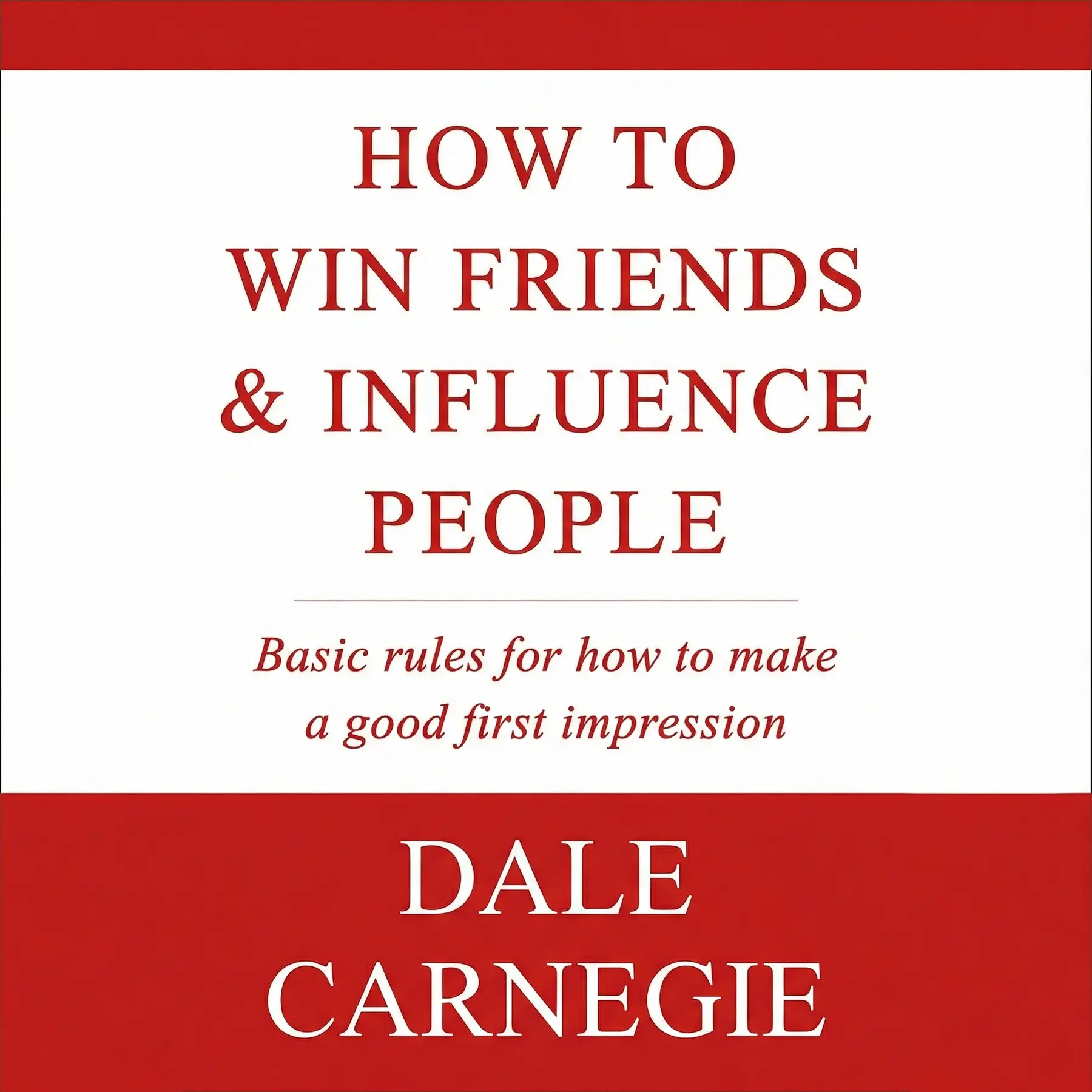
EnglishไทยHow to Win Friends and Influence People
Shows how to get along with people and change their minds without pushing, by trading criticism for praise, listening more than you talk, seeing the other side and letting people claim good ideas as their own.
Table of Content
1. Introduction
1 min 00 sec
If people at work tune you out, or every disagreement turns into a standoff, the fix may be smaller than you think: stop telling people they are wrong. In How to Win Friends and Influence People, first published in 1936, teacher and trainer Dale Carnegie argues that criticism almost never changes anyone, because even Al Capone believed he was a good man.
People act on how you make them feel about themselves. Make them feel valued, heard and understood, and they move toward you. Make them feel attacked, and they dig in. Carnegie builds that case through stories, from Abraham Lincoln’s long evening with an old neighbor to a fourth-grade teacher in Brooklyn and a troublemaker named Tommy.
Along the way he hands over small, specific moves: a sentence that calms an argument, a way to plant an idea so someone else claims it, and a note that fixes sloppy work without a word of blame. Each one fits into an ordinary workday.
2. Trade criticism for praise and get better results
1 min 43 sec
A notorious mobster who terrified Chicago saw himself as a good man and a public benefactor. His self-image explains why pointing out faults so rarely works, and what a steel magnate did instead.
3. Make strangers warm to you within minutes
1 min 27 sec
Trying to impress people at a new job or a networking event usually backfires. A family dog and a gift of an expensive puppy show what wins people over far faster.
4. Become the listener people remember
1 min 41 sec
In the middle of a war, a president called an old friend to the White House for advice, then sent him home without hearing any. What he wanted instead is what most people want from you.
5. See their side and win the request
1 min 38 sec
A hotel manager would allow two hours. The repair needed a whole day. The repairman got his eight hours without a fight, by talking about the one thing the manager cared about most.
6. Disagree without making an enemy
1 min 37 sec
You can have every fact on your side, win the debate and still lose the person. Carnegie offers one short sentence that lowers the temperature before the argument even starts.
7. Let others reach your conclusion as their own
1 min 43 sec
A presidential advisor rarely gave the president direct advice, yet the president often came to believe the advisor’s plans were his own. The method traces back to an ancient philosopher and a simple rule about the word no.
8. Give people a reputation worth living up to
1 min 37 sec
A teacher inherited the worst-behaved boy in her school and a dentist faced a dirty cup holder. Neither said a critical word, and both got better behavior than any warning could produce.
9. Conclusion
1 min 05 sec
What Carnegie offers adds up to a different idea of influence. It turns on how the other person feels when they leave the conversation. Capone, convinced of his own goodness, stands at one end of the book. Tommy, rising to a reputation he had not yet earned, stands at the other. Both show the same truth: people defend the picture they hold of themselves, and they will go a long way to protect or improve it.
That suggests what to try. Replace your next correction with honest appreciation, and if a problem must be named, frame it around the standard you believe the person can meet. In a disagreement, open by admitting you could be wrong, and begin your proposals with points the other side already accepts.
When a whole team seems flat, Carnegie suggests one more lever. Find a way to measure performance and recognize the best people in public. Often no prize is needed, because a little friendly competition is enough to wake people up.
None of this costs money, only attention. Hand people a better version of themselves, and most will try to become it.
About this book
What is this book about?
Most of us try to persuade people the hard way. We point out their mistakes, line up our facts and win the argument, and then we wonder why nothing changes. Dale Carnegie argues that this approach fails because people defend their picture of themselves before anything else. Even Al Capone believed he was a good man. Carnegie's alternative is to work with that instinct. He makes his case through stories: the steel magnate Charles Schwab, who ran his business on praise; Abraham Lincoln, who needed a listener more than an advisor; a Brooklyn teacher who turned the school's worst troublemaker around with one compliment; and a man from an elevator maintenance company who got a full-day shutdown by seeing the problem through a hotel manager's eyes. Readers get small, specific moves for everyday life and work. They include a sentence that calms an argument, a way to plant an idea so someone else claims it, and a habit of opening with agreement. There is also a note that fixes sloppy work without blame, a way to improve someone's behavior by giving them a reputation to live up to, and a way to rouse workers through friendly competition.
Book Information
Who it's for
Managers and team leads
Managers and team leads who want better work from people without constant correction.
Early-career professionals
Young professionals and new hires who want colleagues and clients on their side quickly.
Disagreements turning into standoffs
Anyone whose disagreements at work or at home keep turning into standoffs.
About the Author
Dale Carnegie
Dale Carnegie was born into a poor farming family in Maryville, Missouri, in 1888, and died in 1955. He taught courses in salesmanship, corporate training, public speaking and interpersonal skills. How to Win Friends and Influence People, first published in 1936, became a bestseller and is still widely read. He also wrote How to Stop Worrying and Start Living and Lincoln the Unknown. His books share one idea: you change how others act by changing how you act toward them.
Ratings & Reviews
Ratings at a glance
What people think
Listeners find this work to be an enduring masterpiece packed with useful teachings and actionable tips that help improve social connections. The core concepts are straightforward but powerful, and listeners view it as a transformative experience that aids in personal growth. They value how easy it is to consume, with one listener mentioning it is mandatory study in high school, while another emphasizes its deep understanding of human nature.
Top reviews
Ploy
Finally got around to reading this foundational text, and I see why it hasn’t left the best-seller lists in nearly a century. Carnegie manages to break down the complex machinery of human interaction into simple, digestible habits that anyone can master. While some of the corporate examples from the 1930s feel a bit dusty, the core psychology remains startlingly accurate. People want to feel important, and acknowledging that isn't being fake; it's being decent. I've started applying the principle of becoming genuinely interested in others during my morning meetings. The shift in the room's energy was immediate and undeniable. It is a life-changing resource for anyone looking to navigate the world with more grace and less friction.
Show moreHazel
As someone who struggled with social anxiety for years, Carnegie’s advice provided a concrete framework for interacting with others without feeling like a total fraud. I used to think that being social was an innate talent you were either born with or lacked entirely. This book proved me wrong by treating conversation as a skill that can be practiced. The focus on listening rather than talking was a revelation for me. It’s not about flattery; it’s about shifting your focus from your own insecurities to the needs of the person standing in front of you. This should be required reading in high school. It’s a classic that truly helps you become a better version of yourself.
Show moreAir
Ever wonder why some people just seem to 'get' people? After reading this, I realized it’s because they instinctively follow the principles outlined in these pages. Carnegie explains that the deepest urge in human nature is the desire to be appreciated. When you stop complaining and start looking for sincere things to praise, the world opens up to you. I’ve noticed a massive difference in how my subordinates respond to me since I stopped criticizing them publicly. It’s about de-escalating bad situations and seeking harmony over being 'right.' The examples involving historical figures like Lincoln add a nice weight to the lessons. Truly a masterpiece of interpersonal wisdom.
Show moreSomporn
Wow, it’s rare to find a book that feels like it should be mandatory reading for every human being on the planet. I was surprised by how much I learned about leadership and the art of influence. The advice to 'don’t criticize, condemn, or complain' is so simple, yet so few people actually do it. It’s a profound insight into how our egos get in the way of our success. The book taught me that you can’t win an argument, because even if you win, you lose the other person's goodwill. I feel more equipped to handle difficult personalities now. It’s a timeless classic that genuinely makes you want to be a kinder, more attentive person.
Show morePooja
It’s easy to dismiss this as a manual for manipulation, but once you apply the principles of genuine interest, your perspective shifts entirely. This book isn't about tricks; it's about training yourself to see the value in every person you meet. Carnegie challenges us to be more human in a world that often feels cold and indifferent. My relationships with my family have improved significantly just by implementing the habit of giving honest, sincere appreciation. It takes patience and tact to master these skills, but the payoff is a much richer social life. This book is a gift to anyone willing to put their ego aside and actually listen to others. Highly recommended.
Show moreNew
The chapter on remembering names actually changed the way I walk into a networking event, even if the technique feels a bit repetitive at times. I’ll admit that the book can be quite wordy, and the author often uses five anecdotes when one would have sufficed to prove his point. If you find yourself getting bored, just skip to the 'In a Nutshell' summary points at the end of each chapter. They contain the high-value takeaways without the filler. Despite the occasionally condescending tone, the advice on avoiding arguments is pure gold for your career. It’s a practical handbook that turns soft skills into a hard science, provided you can look past the archaic phrasing.
Show moreMaksim
Not what I expected from a book written in the thirties, but the core human psychology here remains strikingly relevant today. To be fair, some of the advice on being agreeable to everyone can lead you into a trap of never standing your ground. You have to balance Carnegie's 'nice guy' approach with a bit of your own grit, or you’ll get walked over. However, his rule about never saying 'you're wrong' has saved my marriage more than once. The writing style is definitely dated and a bit charmingly archaic, which makes for a quick and pleasant read. It’s a solid 4-star book that provides a great foundation for any professional, even if it’s a bit idealistic.
Show moreTod
Picking this up felt like a chore at first because I usually despise the self-help genre, yet Carnegie’s archaic charm won me over. He definitely has a bit of a condescending tone, acting as the ultimate authority on success, but the results speak for themselves. I tried his tip about letting the other person do a great deal of the talking during a recent sales call. Not only did I close the deal, but the client actually thanked me for the 'great conversation' where I barely spoke. Some examples are ridiculous, but the underlying mechanics of human ego are spot on. It’s a useful tool for your belt, even if it feels a bit like a sales manual.
Show moreAkosua
Truth is, the 'In a Nutshell' boxes at the end of each section are the only parts truly worth your time because the rest is pure filler. The author repeats himself constantly, hammering the same three points for two hundred pages. It’s tedious. While I agree that smiling and being kind are good traits, the book pushes a level of agreeableness that feels dated and slightly manipulative. In a modern office, being this 'soft' might actually hurt your credibility if you aren't careful. It’s an interesting historical artifact of the self-help genre, but it isn't the groundbreaking revelation people claim it is. Read the summaries and save yourself four hours of repetitive anecdotes.
Show moreAmara
Look, if you want to turn into a sycophantic robot who uses verbal-mental tricks to climb the corporate ladder, this is your bible. This book is essentially a sales manual masquerading as a guide to empathy. It encourages a brand of toxic people-pleasing that left me feeling drained and utterly dishonest with myself. By trying to find something to like about everyone, I ended up ignoring glaring red flags in people who were clearly just using me. The advice to constantly use someone’s name sounds patronizing in a modern context. It feels like a guide on how to manipulate yourself and others just to get what you want. I’d rather be rejected for who I am than accepted for a persona.
Show moreQuestions about this book
What is the main idea of How to Win Friends and Influence People?
Dale Carnegie argues that people defend their picture of themselves, so criticism makes them dig in while appreciation makes them open up. Influence comes from making others feel valued, heard and understood. He shows this through stories, from Al Capone believing he was a good man to steel magnate Charles Schwab running his business on praise rather than complaint.
How does Dale Carnegie say you should handle an argument?
Avoid full arguments when you can, because winning one leaves the other person resentful. When you must disagree, never tell someone flatly that they are wrong. Open by admitting you might be mistaken and suggest checking the facts together. If you turn out to be wrong, admit it quickly. If you turn out to be right, do not gloat, since nobody changes their mind when it feels like humiliation.
How can I get people to accept my ideas, according to Carnegie?
Carnegie points to Socrates, who began with statements everyone accepted and moved gradually to harder points, keeping people saying yes. A public no is hard to reverse. People also prefer ideas they think of themselves, so help them reach your conclusion. Colonel Edward House did this with President Woodrow Wilson, mentioning proposals casually until Wilson believed they were his own.
How do you motivate someone without criticizing them?
Give them a reputation to live up to. Teacher Ruth Hopkins told her most troublesome student that she had heard he was a born leader and was counting on him, and his behavior improved quickly. Dr. Martin Fitzhugh thanked his cleaner warmly for her care instead of complaining about a dirty cup holder, and her work improved without any overtime.
Who should read How to Win Friends and Influence People?
It suits anyone who deals with people and wants better results from those dealings: managers who rely too much on correction, new employees building relationships, salespeople facing difficult clients, and anyone stuck in repeated arguments. Its advice is small and practical, such as using a person’s name, asking open questions, and saying you understand how someone feels before making your case.

Readers also enjoyed










AUDIO SUMMARY AVAILABLE
Listen to How to Win Friends and Influence People in 15 minutes
Get the key ideas from How to Win Friends and Influence People by Dale Carnegie, plus 5,000+ more nonfiction titles.
- 5,000+ titles
- Listen as much as you want
- 7-day free trial
- Cancel anytime









