

Ali: A Life
Jonathan Eig
 English
A rating-by-rating guide that takes a complete beginner to confident club-level play: how games are won, lost and drawn, how to open well, and how to spot winning tactics.
1 min 03 sec
Chess can easily overwhelm beginners, and no wonder: after just two moves each, there are already close to 200,000 possible moves. In How to Win at Chess, International Master Levy Rozman, whose YouTube channel was the first in chess to pass a billion views, offers a calmer route: learn a few principles in the right order, and the board stops feeling like a maze.
Rozman wrote the book because his students kept asking which chess book to read, and he had nothing to recommend. Older books, he felt, were built on notation, read like encyclopedias and needed a physical board. His version is staged by rating, from a total beginner up to roughly 1200, and it is meant to be read without a board at all.
The path runs from how a game ends, through the pieces and the opening, to tactics and the endgame. Follow it and you swap random moves for a plan in the opening and a routine for spotting the move that wins.
1 min 51 sec
Three pieces are enough to finish a game, and plenty of games are lost without any checkmate at all. Knowing the full scoreboard changes which risks are worth taking and when you should never give up.
1 min 41 sec
The most powerful piece on the board is not the one you must protect most. Learning what each piece does, and what counts as a real attack, clears up much of the early confusion.
1 min 38 sec
With twenty possible first moves, beginners often pick one at random. One simple goal tells you which moves are worth making, even when your opponent refuses to cooperate.
1 min 42 sec
A beginner can win the center and still lose because most of the army never left home. The fix is to treat your pieces like a team of specialists, each needing the right job.
1 min 39 sec
One special move tucks the king away and wakes up a rook in a single turn. Pair it with a patient queen, and your opponent has far less to aim at and far less to read.
1 min 43 sec
Rozman treats tactics as essential practice, advising anyone who wants to get good at chess to solve a great many puzzles, even thousands. A three-word routine makes those moments far easier to find.
1 min 42 sec
Rozman deliberately keeps players under 1200 away from deep opening study. What he puts in its place, and why he teaches every topic twice, shapes how fast a newcomer improves.
1 min 21 sec
What Rozman offers is mostly a sense of order. Chess looks endless because the possibilities multiply with every move, yet a beginner never has to face them all. You learn what ends a game, what each piece can reach and what to aim for in the opening, then add a scanning habit, a few endings and some strategy, and you go over each layer twice.
The book is honest that this is a foundation, not a finished building. It covers a lot of ground across its diagrams, and one reviewer found it broad more than deep. For someone who has never played, that breadth is the point: enough of everything to stop losing to the same mistakes.
The habits it supports are small enough to try tonight. In your next game, fight for the center with your first moves, develop your knights and bishops, castle, and leave your queen at home until the rest of the army is out. Before every move, scan checks, captures and attacks for both sides, and never resign a bad position you might still save. Then solve puzzles, many of them. Remember the three-piece checkmate from the book’s early section on ways to win: a queen, two kings, nothing else. Every game you play from here aims at that small picture.
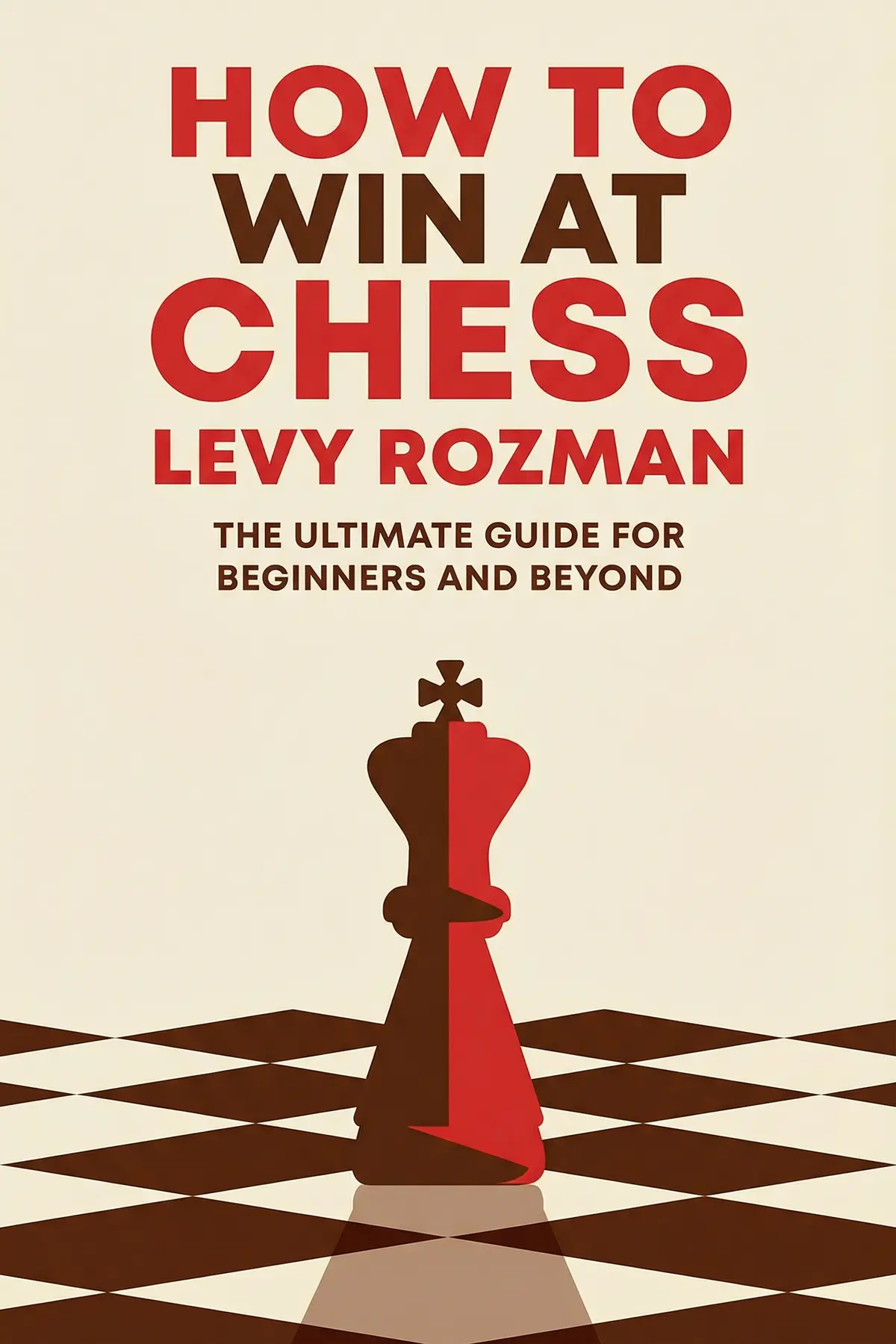
Chess has a reputation for being hard to learn, and the classic books do little to help. Levy Rozman, an International Master who teaches millions online, kept getting the same question from students: which book should I read? He had no good answer, because the older titles leaned on notation, read like encyclopedias and assumed you had a board in front of you. How to Win at Chess is his answer. It is built in two stages by rating, first for players from zero to 800 and then for those from 800 to about 1200, and the second half returns to the same topics at greater depth. Beginners learn every way a game can end, what each piece can do, and the opening principles that set up a good game: take the center, develop your pieces, castle, and keep the queen back. From there the book moves to the skills that decide most amateur games: a simple routine for finding tactics, basic and intermediate endgames, and first ideas about strategy. More than 500 diagrams let readers follow along without a physical board, and every chapter links to extra lessons online.
Complete beginners who know a few moves but lose without understanding why.
Casual online players stuck below a 1000 rating who want a clear plan.
Parents and coaches who need a modern, board-free first chess book.
Levy Rozman is an International Master, a title he earned in 2018, and is often called the Internet's Chess Teacher. Born in Brooklyn in 1995, he played his first tournament at age seven and began teaching chess while still in high school. By 2015 he ran his own K-12 chess program. He moved his teaching online in 2020, and his YouTube channel became the first chess channel to pass one billion views.
Listeners find this chess guide to be a thorough educational resource that simplifies core principles while gradually introducing more advanced strategies. Written in a direct and succinct style, the text features clear illustrations and beneficial diagrams, ensuring the content is accessible and easy to digest. Furthermore, they value how the material caters to both novices and intermediate-level players, assisting them in refining their skills. The integrated QR codes are also praised as a standout feature.
Finally got around to reading Levy's book after watching his YouTube for years. It's exactly what I expected: punchy, helpful, and surprisingly deep for its size. The way he breaks down complex concepts like notation and positional play is just brilliant for someone like me who gets overwhelmed by old-school theory. I particularly loved the QR codes; they bridge the gap between a physical book and the digital game perfectly. The diagrams are sharp, making it easy to follow along without a physical board nearby. Frankly, if you're rated under 1000, this is the gold standard. It feels like having a private lesson with Levy without the shouting. My game has already seen a tangible boost in the opening phase, and I feel much more confident navigating the early game transitions.
Show moreThis book is a masterclass in modern chess pedagogy. Gone are the days of staring at dense walls of text and obscure notations that require a second book to decipher. Instead, Rozman uses clear, concise language and high-quality diagrams to illustrate his points effectively. Truth is, most chess books are boring, but this one actually keeps you engaged with its snappy pacing. The QR codes are a stroke of genius, allowing you to jump straight into interactive puzzles or games to reinforce what you just read. It’s a comprehensive tool that covers everything from piece values to basic mating patterns. It’s supportive, well-written, and undeniably helpful for anyone looking to transition from simply knowing how pieces move to actually playing chess with a cohesive strategy.
Show moreWow, Levy actually pulled it off. Creating a chess book that feels like a conversation rather than a lecture is no small feat, but the tone here is spot on. It’s snappy, informative, and occasionally 'in your face' in the best way possible. I found the section on beginner-friendly openings for White and Black to be incredibly practical for building a solid repertoire quickly. The book doesn't just tell you what to do; it explains the 'why' behind the moves, which is crucial for long-term improvement. It’s dense enough to be informative but light enough to read in a few sittings without feeling burned out. Definitely the most accessible manual I’ve ever owned. Pure 5-star material for the target audience of new players and hobbyists.
Show moreThe chapter on tactics alone makes this a must-buy for any aspiring player. Levy takes his signature 'Gotham' energy and translates it into a structured, educational format that actually works for a book. It’s concise, well-illustrated, and avoids unnecessary jargon that usually confuses newcomers to the 64 squares. Gotta say, I was skeptical about how well a YouTuber could write a technical manual, but he’s proven himself to be a legitimate teacher. The QR integration is seamless, adding a layer of interactivity that traditional books lack. It’s a solid effort that delivers exactly what it promises: a solid foundation for your personal chess journey. If you're under 1200, stop looking at other books and just get this one.
Show moreLook, the truth is that chess is hard, but Levy makes it feel doable. The way the book is organized is genuinely interesting, guiding you through the sixty-four squares with a patient and knowledgeable hand. I’ve read a lot of chess literature, and many authors take six books to cover what Rozman manages in one. The inclusion of QR codes for further study is a brilliant touch that modernizes the learning process for the digital age. It’s clear, direct, and doesn't pull any punches when it comes to correcting bad habits. While the claim of being for 'intermediate' players is debatable, it's an absolute powerhouse for beginners. A very polished and professional debut from the world's most popular chess creator.
Show moreAs a casual player who has been stuck at the 800 ELO mark forever, this guide feels like a lifesaver. The structure is logical, moving from absolute basics into more intricate tactics without losing the reader in the process. Levy’s voice comes through clearly on every page—it’s snarky yet encouraging, which keeps the material from feeling too dry. However, to be fair, the 'intermediate' tag is a bit of a stretch. If you're already 1400+, you probably know 90% of this stuff. But for the rest of us? The chapters on common mistakes and fundamental endgames are worth the price alone. The layout is clean, and the illustrations really help visualize the lines during analysis. It is a solid manual for those of us trying to escape the beginner bracket.
Show moreAfter hearing so much about the 'Fischer frenzy' era books, it’s refreshing to see a modern take that rivals the classics like Chernev's 'Logical Chess'. Rozman has a way of distilling the vastness of chess into manageable chunks. He avoids the pitfall of many GMs who forget what it's like to be a beginner. The path to improvement is clearly laid out, starting with the rules and building up to more complex tactical motifs. I particularly appreciated the boxes with fun facts; they provide a nice mental break between the heavier analysis sections. While it might not be the most exhaustive encyclopedia of chess history, it is certainly one of the most readable guides currently available on the market for the average adult learner.
Show moreEver wonder why you keep losing games despite knowing the basic rules? This book answers that question by focusing on the 'how' of winning rather than just the 'what' of the pieces. It’s an all-around volume that covers everything from scoring to endgame theory. Personally, I found the analysis of thousands of games boiled down into key takeaways to be the most beneficial part of the experience. The writing is clear and the supportive vibe makes you want to keep practicing. It might feel a bit surface-level for the seasoned club player, but for the average enthusiast, it’s a goldmine of information. The physical design is also beautiful, making it a great addition to any library or coffee table.
Show morePicked this up as a gift but ended up reading the whole thing myself first. In my experience, most instructional books are either too simple or way too advanced, but this hits a nice sweet spot for the 400-1000 ELO range. The explanations are logical and the move-by-move analysis is easy to follow without needing a physical board in front of you. However, I did find some of the humor a bit 'bitchy' at times, which might not be everyone’s cup of tea. It’s clearly a labor of love, and the information is dense enough to be useful without being overwhelming. A solid resource for the modern player, though more advanced players might find it a bit light on hardcore theory.
Show moreNot what I expected given the massive hype surrounding GothamChess. While the production quality is high and the diagrams are easy on the eyes, the content is extremely basic. If you've watched more than five of his videos, you've probably heard all of this before. My biggest gripe is the marketing toward intermediate players; it just isn't that deep. Look, if you know what a 'pin' or a 'skewer' is, the first half of the book will be a repeat for you. Also, I noticed some oddities in the translation for the non-English editions that felt a bit rushed or unpolished. It’s a fine gift for a child or a total novice, but it lacks the analytical depth I was hoping for to really push my club-level rating higher.
Show moreIt is a step-by-step chess course for beginners and improving players. Rozman starts with the rules and every way a game can end, then teaches opening principles: control the center, develop your pieces, castle and keep the queen back. Later chapters cover tactics, endgames and strategy. The book is split by rating, first zero to 800 and then 800 to about 1200, with the second half revisiting the same topics in more depth.
No. Rozman designed the book to be read without a physical board, since he felt older chess books demanded one. It has more than 500 diagrams that look like online screenshots, with arrows and highlighted squares. Each chapter also has a QR code linking to extra material on Chessly, his teaching platform, and some links show complete games he has annotated.
Rozman cares more about principles than memorized lines: fight for the center, develop knights and bishops, castle early and hold the queen back. For intermediate players he suggests the Vienna and the London System as White, and the Caro-Kann and Scandinavian as Black against 1.e4. He deliberately avoids deep preparation so that players under 1200 do not get lost in opening study.
CCA is Rozman’s heuristic for finding tactics, and it comes down to three things to look at: checks, captures and attacks. It narrows the huge number of possible moves to the forcing ones most likely to win or lose material. He pairs it with the advice that anyone who wants to improve should solve a great many tactics puzzles, even thousands.
It suits people with little or no chess experience, as well as casual players rated below about 1200 who want structure. Rozman claims a total newcomer can use it to get comfortably past a 1000 rating. Reviewer Nick Visel rated it 4.5 out of 5 and called it an ideal first chess book, though another reviewer found it broad rather than deep.
Jonathan Eig

Billie Jean King
Ben Reiter
Christopher McDougall
AUDIO SUMMARY AVAILABLE
Get the key ideas from How to Win at Chess by Levy Rozman, plus 5,000+ more nonfiction titles.









