

13 min 19 sec
Available in: English
How to Untie a Balloon: A Negotiator's Guide to Avoid Popping Under Pressure
By Ryan Dunlap
Shows why people lose their composure in conflict and crisis, and gives three short frameworks from hostage negotiation for spotting your limit, sorting out pressure and cooling down before you say or do something you regret.
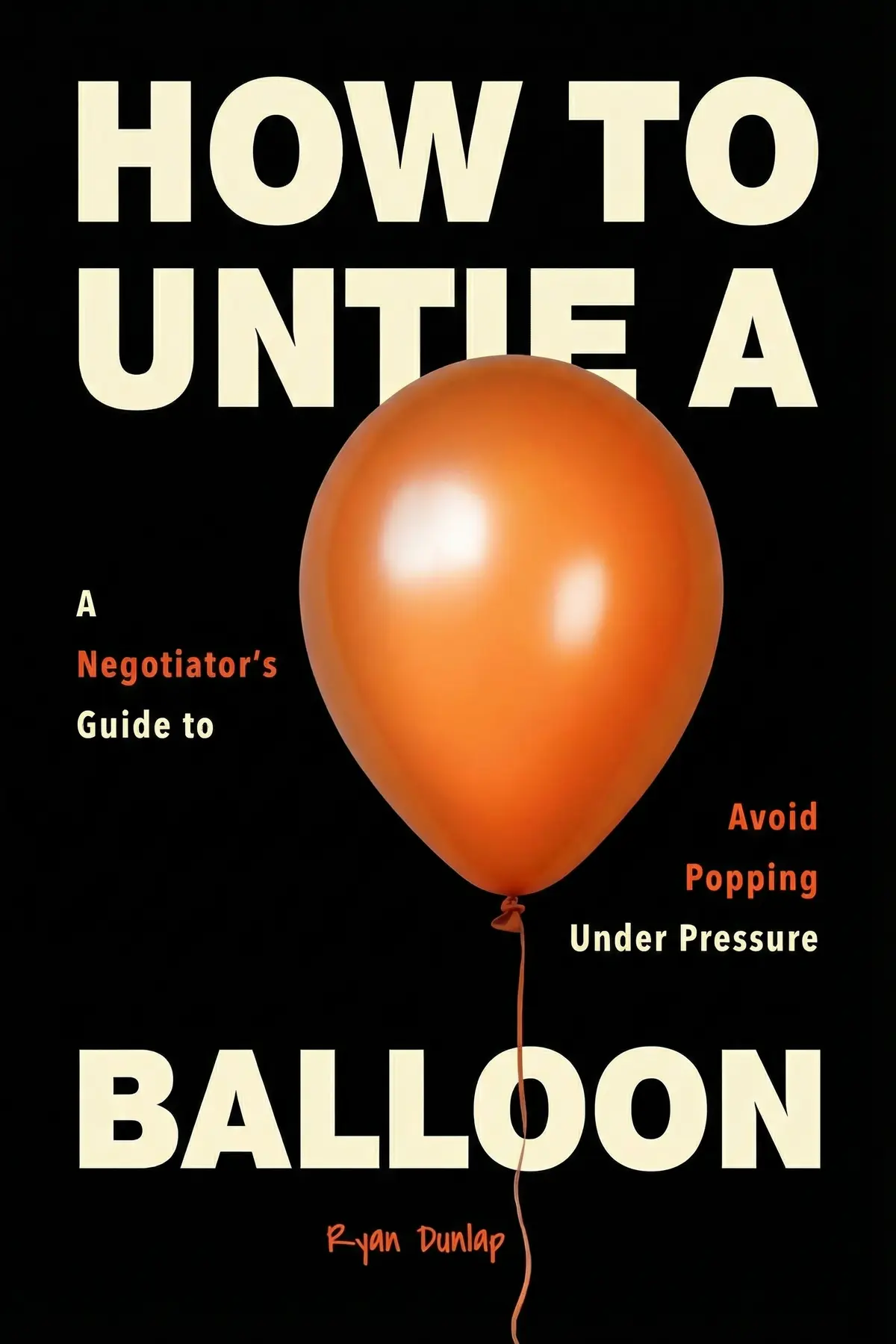
Table of Content
1. Introduction
1 min 09 sec
Most people who blow up in a tense meeting or freeze in a hard conversation already know what they should say. What fails them is access: under enough strain, the skill is still there but out of reach. Ryan Dunlap, a onetime hostage negotiator on a SWAT team who also worked as a detective in a Special Victims Unit, argues in How to Untie a Balloon that many problems that look like conflict are really problems of pressure. His picture for it is a balloon. Air goes in fast, comes out slowly, and the moment of bursting gives almost no warning.
Dunlap, who now trains business leaders through his consultancy Conflictish, turns lessons from crisis negotiation into tools anyone can carry into a budget fight, a product crisis or an argument at home. His case is simple: understand how pressure builds, plan how to release it, and you stay effective exactly when it counts. Ahead are the signals that you are near your limit, three short frameworks, and a way to cool down without walking away from the problem.
2. Calm returns slowly, so give it the time it needs
2 min 09 sec
Workshop volunteers inflate a balloon with ease, then discover the second half of the task is far harder. Their struggle explains why a surgeon explodes over a small schedule change and why making up too soon backfires.
3. Read the signals that you are close to bursting
2 min 18 sec
Experienced police officers, not nervous rookies, were the ones Dunlap watched lose their composure. The early signs were there each time, and one detail from firearms training shows what most of us do wrong when talking fails.
4. Turn one crushing problem into five manageable parts
2 min 26 sec
A hospital administrator faces a budget fight that feels like an attack on everything she has built. A five-part check borrowed from SWAT negotiators changes what she sees, and what she decides to handle first.
5. Move forward in a crisis without freezing or rushing
2 min 08 sec
Officers outside a barricaded bedroom had three choices, and two of them could get people killed. The path they took offers leaders a way through emergencies where every option looks wrong and information is missing.
6. Step away from pressure without walking out on the problem
2 min 02 sec
Leaving a heated argument can calm things down or quietly make them worse. Dunlap draws the line between a useful pause and plain avoidance, and shows what the return conversation should look like.
7. Conclusion
1 min 07 sec
Dunlap’s book grows from a plain observation made in rooms where lives were at stake: under pressure, even skilled people lose access to what they know, because the strain grew faster than they noticed and they tried to release it all at once. The balloon makes that visible. Every tool he offers is a way to watch the air going in and to let it out slowly enough that nothing bursts.
That puts hard moments within reach of ordinary people. Calm becomes something you prepare in advance: knowing your own early signs, seeing a crisis as feelings, interests, relationships, situation and tolls, and acting in small loops when you cannot wait.
The practice can begin this week. Note the first signal that tells you your limit is near, whether it is a sharper voice or a careless error. After the next flare-up, give your body its 20 to 30 minutes before you try to fix anything, then return at a time you have chosen, ready to talk.
A balloon stays whole when someone thinks about the knot before the air goes in.
About this book
What is this book about?
Most people who snap in a tense meeting or freeze in a hard conversation already know what they should do. Under enough pressure, they simply cannot reach that knowledge. Ryan Dunlap, a former SWAT hostage negotiator and detective, argues that many problems that look like conflict are really problems of pressure. His central picture is a balloon. Air goes in quickly, comes out slowly, and the burst arrives with almost no warning. From that image he builds a practical toolkit: the signs that you are close to your limit, the F.I.R.S.T. framework for splitting overwhelming pressure into feelings, interests, relationships, situation and tolls, the 3R loop of Realize, Respond and Realign for crises that cannot wait, and the S.T.O.P. pause of space, time and opportunity. The examples move from police calls and hostage situations to a hospital budget fight, a product launch in trouble and an argument about household chores. Readers get a clear account of why calm fails and a set of steps for staying effective in the moments that matter most.
Book Information
Who it's for
Leaders losing their cool
Managers and team leads who lose their composure in tense meetings or budget fights.
Professionals who handle crises
Professionals in health care, education or government who handle conflict and crisis as part of the job.
Families with recurring arguments
Partners and parents whose arguments flare up again the moment they try to make peace.
About the Author
Ryan Dunlap
Ryan Dunlap began his career in law enforcement, serving as a SWAT hostage negotiator and as a Special Victims Unit detective. He later worked in ministry and executive leadership and has carried out hundreds of negotiations, interrogations and crisis interventions. A certified leadership coach, he founded Conflictish, a consultancy that trains leaders in conflict resolution for clients in biotech, health care, government and education.
Ratings & Reviews
Ratings at a glance

What people think
Listeners find this an exceptional experience full of deep observations, and one listener points out that it includes diagnostic questions. They value the hands-on methodology and direct delivery, calling it essential material for people in leadership roles.
Top reviews
Tod
This book is the leadership manual I didn't know I needed for my professional development. Dunlap has a unique way of distilling complex emotional reactions into simple, actionable steps that anyone can follow regardless of their professional background. I loved the 'untie a balloon' metaphor; it perfectly captures the delicacy needed when handling high-pressure situations before they pop. My only wish is that there was already a Spanish version available so I could share these insights with my entire team immediately. If you need a straightforward guide to managing your own pressure points and leading with more clarity, this is definitely it.
Show moreArm
Wow, Ryan Dunlap has managed to write something that is both deeply personal and universally applicable to anyone dealing with human beings. I actually bought copies for my high schoolers because I think these lessons on emotional management are vital for adulting in today's polarized world. The way he blends his faith-based background with his law enforcement experience creates a tone that is both authoritative and incredibly compassionate. I spent a lot of time with my journal while going through the exercises, and the insights I gained about my own triggers were worth the price. This is the kind of resource you keep on your desk to flip through whenever things get tense.
Show moreChai
As someone who follows the Conflictish videos, I was curious to see if Ryan could sustain that energy in a full-length book. Truth is, the transition works remarkably well because he includes these incredibly useful diagnostic questions that force you to look inward. While some of the advice mirrors his online content, having the frameworks written down makes it a lot easier to study and apply to real-world leadership scenarios. I found the law enforcement anecdotes particularly grounding, as they provide a high-stakes context for the conflict management strategies he suggests. It’s a quick read, but you’ll want a notebook nearby to actually work through the exercises provided at the end of the sections.
Show moreNoi
Ever wonder why your first instinct in an argument is to either explode or shut down completely? Dunlap explores those reactions with the precision of someone who has spent years in high-stakes environments, and his preacher-like cadence makes the lessons stick. I’ve started using his strategies for recognizing pressure points during my morning commute, and it’s honestly changed my entire outlook on the workday. The structure of the book is very rhythmic, almost like a series of long homilies, which might not be for everyone but I found it quite comforting. It’s practical, direct, and doesn't waste time with unnecessary fluff or academic jargon that usually bogs these books down.
Show moreUbolwan
The chapter on identifying internal pressure points really hit home for me as a middle manager. Often, we focus so much on the external conflict that we forget to analyze our own internal temperature before engaging with others. Ryan’s writing style is very conversational and accessible, which makes it an easy read for a busy professional who doesn't have time for a dry textbook. Personally, I appreciated the nuggets of wisdom scattered throughout the text, even if a few points felt a bit repetitive by the end. It’s a great diagnostic tool for leaders who want to improve their soft skills without feeling like they are being lectured by an academic.
Show moreTang
Gotta say, the way this is structured makes it incredibly easy to digest and implement immediately. I’m a visual learner who usually struggles with self-help books, but the clear frameworks and specific questions kept me engaged from start to finish. I particularly liked the focus on untieing rather than bursting a situation, which is a subtle but powerful shift in mindset for anyone in a high-pressure job. The book reads very much like a mentor talking to you over coffee, sharing his best stories and hardest lessons. It’s not a revolutionary text, but it’s a very practical one that I’ll likely revisit when I feel my stress levels rising.
Show moreSarocha
Picked this up on a whim and found myself highlighting half the pages by the time I reached the third chapter. The truth is, most of us are terrible at managing our emotions when we feel cornered, and Dunlap’s law enforcement background gives him a unique perspective on de-escalation. I found the diagnostic questions to be the most valuable part of the whole experience, as they forced me to confront my own biases. While the tone can feel a little bit like a sermon at times, the advice is grounded in such practical reality that it’s hard to argue with. It’s a must-read for any leader looking to build a healthier culture within their team.
Show moreGun
Finally got around to reading this after hearing Ryan speak at a conference last year. Look, he’s a phenomenal communicator with a lot of heart, but the book feels a little thin on new material if you already follow his social media channels. It serves as a great summary of his core philosophy, but I didn't find many 'aha' moments that I hadn't already heard in his Conflictish videos. That said, the diagnostic questions are top-tier and provide a great framework for self-reflection that is hard to get from just watching a three-minute clip. It’s a solid read for fans, but maybe a bit redundant for the die-hard followers.
Show moreNoppadol
In my experience, books by public speakers often struggle to find a balance between inspiration and instruction. Ryan is clearly a gifted orator, but the written word doesn't quite capture the same charisma you get from his videos or live talks. There is a lot of good stuff here regarding personal reactions in conflict, but the pacing felt a little uneven at times. Some sections are packed with great anecdotes from his career, while others feel like they are just filling space to get to the next framework. It’s a decent guide for basic conflict management, but I think I still prefer his video content for a quick daily dose of wisdom.
Show moreMingkwan
Not what I expected based on the massive amount of hype I've seen on social media lately. To be blunt, this felt a bit like a transcript of a keynote speech rather than a fully developed book on conflict resolution. The law enforcement stories were interesting, and frankly, I wish the whole book was just a memoir of his time in uniform. Those specific sections were far more engaging than the general advice. The actual how-to portions felt a little too obvious for anyone who has read more than one self-help book in their life. It’s fine for a total beginner, but it didn't offer the deep dive I was truly hoping for.
Show moreQuestions about this book
What is the main idea of How to Untie a Balloon?
Ryan Dunlap argues that many conflict problems are really pressure problems. Like air in a balloon, pressure builds quickly, drains slowly and bursts with little warning. Drawing on his years as a SWAT hostage negotiator, he offers tools for recognizing your limit, breaking pressure into parts, acting in emergencies and pausing on purpose, so you can stay effective in the moments when composure usually fails.
What is the F.I.R.S.T. framework?
It is Dunlap’s five-part check for overwhelming pressure: Feelings, Interests, Relationships, Situation and Tolls. You name your emotion, clarify the outcome that matters, map the people involved, state the bare facts and count the costs so far. In his example, a hospital administrator facing a 12 percent budget cut uses it to focus on staffing and morale and to see that her situation needs action now.
How do you know you are close to your breaking point?
Dunlap names three signs: your social mask slips, your performance drops and your thinking becomes less rational. A skilled administrator starts making arithmetic errors, or a negotiator who weighed every side starts making one-sided demands. Physical signals often come with them, including sudden anger, irritability, brain fog, poor sleep and a strange feeling of disconnection.
How can I apply the book after an argument?
Use the S.T.O.P. pause of space, time and opportunity. Step away from the source of pressure, then calm your body with slow breathing or a short walk, remembering that stress chemicals take 20 to 30 minutes to clear. Come back with a clearer mind at a set time, as a couple might by planning a weekend talk about chores, but do not wait so long that the pause becomes avoidance.
What is the 3R framework for crisis decisions?
Realize, Respond, Realign is Dunlap’s loop for emergencies that cannot wait. You lay out the options, choose one and act despite uncertainty, then honestly judge whether it worked and adjust. A product manager who delays a flawed launch by two weeks, then adds a workaround when customers object, is running the loop. Each pass brings new information and avoids both paralysis and reckless action.
Readers also enjoyed






AUDIO SUMMARY AVAILABLE
Listen to How to Untie a Balloon in 15 minutes
Get the key ideas from How to Untie a Balloon by Ryan Dunlap, plus 5,000+ more nonfiction titles.
- 5,000+ titles
- Listen as much as you want
- 7-day free trial
- Cancel anytime









