

14 min 45 sec
Available in: English
 ไทย
EnglishไทยHow to Talk to Anyone: 92 Little Tricks for Big Success in Relationships
By Leil Lowndes
A practical kit of small conversational habits, from a slowly spreading smile to saying we and us, that helps shy or busy people make strong first impressions, build rapport quickly and sound confident at work.
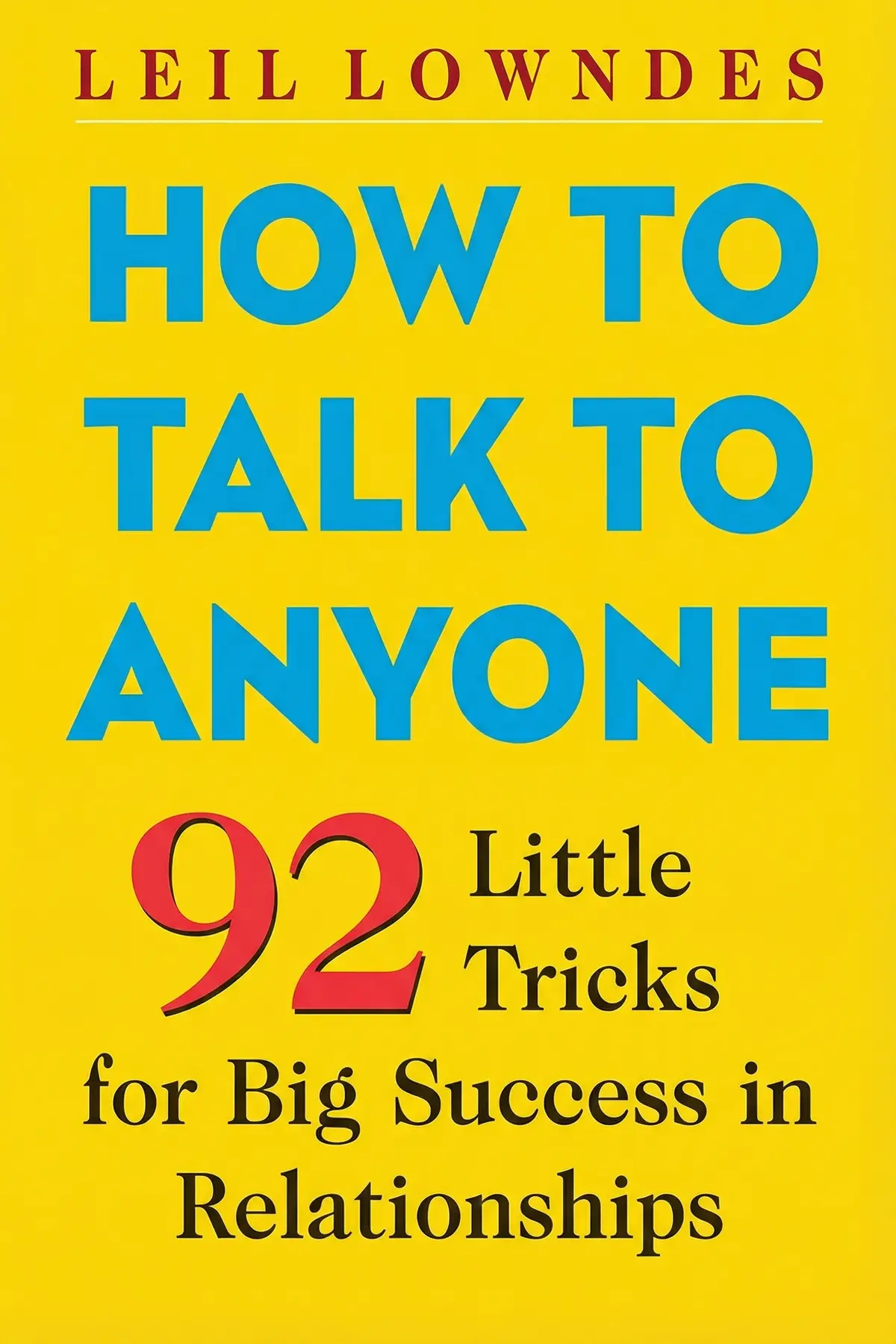
Table of Content
1. Introduction
49 sec
If a room full of strangers makes you freeze, the fix may be smaller than you expect. In How to Talk to Anyone, communication author Leil Lowndes argues that warmth comes from tiny learnable moves, starting with a smile you allow to spread slowly, so it reads as meant for this one person.
Lowndes was shy all the way through college, then spent years meeting people as a flight attendant, a cruise director and a stand-in radio host. Her case is that charm is a craft: a set of small habits that make the other person feel noticed, at ease and important.
What follows is a working kit for the moments that tend to go wrong, from entering a party and keeping small talk alive to praising a colleague, impressing a boss and getting past a gatekeeper on the phone.
2. Win people over before you say a word
1 min 37 sec
People judge you before you have finished saying hello, and that judgment lingers. The timing of a smile, where your eyes rest and what your hands are doing can tip the first meeting either way.
3. Walk into any room and find your way in
1 min 32 sec
Most people at a party wait for someone else to make the first move, and many go home having met almost nobody. A pocket watch and a pause in the doorway can change that.
4. Turn throwaway small talk into real conversation
1 min 34 sec
The questions everyone asks at the start tend to get answers that end the exchange on the spot. A little preparation, and a habit of saying less, can make you the person others remember enjoying.
5. Make a stranger feel like an old friend
1 min 36 sec
Close friends share certain words, rhythms and jokes without thinking about it. Borrowing those signals on purpose can shrink the distance between you and a new contact faster than months of polite chat.
6. Give praise that people actually believe
1 min 31 sec
A compliment delivered straight to someone’s face can sound like flattery, however kindly meant. Lowndes suggests routes that feel more genuine, including one where the praise reaches them through somebody else.
7. Keep goodwill alive with small acts of consideration
1 min 32 sec
Relationships can cool after an interrupted story or a favor asked at the wrong moment. Four everyday habits keep people feeling respected, including one that involves pretending you noticed nothing at all.
8. Sound like a leader at work
1 min 51 sec
Ambitious people often lose ground through habits they never notice, from a cheerful outburst to a badly timed business topic. Lowndes shows how to sound credible to bosses and clients, and how to stay at the top.
9. Come prepared, even when nobody can see you
1 min 43 sec
One businessman lost his footing in Brazil with a single friendly hand sign. Careful preparation prevents moments like that, and a few phone habits make up for everything a caller cannot see.
10. Conclusion
1 min 00 sec
What Lowndes adds up to is a reassuring claim: the people who seem born good with others are mostly doing small, visible things for the person in front of them. They smile slowly, borrow the other person’s words, pass along kind remarks and return to the story the waiter interrupted. None of it needs a new personality, only attention pointed outward, which is how a woman who stayed shy through college could build a career on meeting people.
Begin before your next meeting. Picture yourself smiling, holding eye contact and standing open; Lowndes suggests that such a picture tends to make itself come true. Then, as you talk, file away one personal detail the other person shares, and mention it the next time you meet. Few gestures tell someone more plainly that they matter.
Every move in her kit is small enough to try tomorrow, and each one shifts your attention from how you are doing to how they are feeling.
About this book
What is this book about?
Many people dread parties full of strangers, freeze when small talk runs dry or worry that they sound unpolished in front of a boss or client. Leil Lowndes argues that the people who seem naturally gifted with others are mostly doing small, visible things that anyone can learn. Drawing on years of watching what makes conversations stall or flow, she offers dozens of concrete techniques. They cover the face and body in the first moments of meeting, ways to get introduced and enter a room, replies that keep small talk alive, and habits that build rapport, such as echoing someone's own words and using we and us. She also shows how to give praise people believe, how to handle favors, how to sound professional, how to prepare for meetings and how to make up on the phone for everything a listener cannot see. Readers get a practical set of moves they can try at their next meeting, party or call, each aimed at making the other person feel noticed and comfortable.
Book Information
Who it's for
Professionals who dread networking
Shy professionals who dread networking events and conversations with strangers.
Young employees wanting credibility
Young employees who want to sound credible in front of bosses, clients and senior colleagues.
Managers and sales professionals
Managers and salespeople who want warmer working relationships and smoother calls and meetings.
About the Author
Leil Lowndes
Leil Lowndes has written ten books on communication, including the bestsellers How to Talk to Anyone and How to Be a People Magnet. She was very shy as a child and through college. After six years of teaching, she chose work that put her in front of many kinds of people: international flight attendant, Broadway actor and cruise director. She also filled in as a host on a New York radio talk show, interviewing celebrities and political figures. Today she leads seminars for major corporations and speaks at conventions.
Ratings & Reviews
Ratings at a glance
What people think
Listeners find this book full of valuable suggestions and thoughts, providing specific pointers for becoming a more skilled conversationalist. Because the text is brief and straightforward, it is a quick, pleasant experience, especially for people in sales. They value the quality of the content—one listener mentions that every chapter clarifies a simple concept—and feel the techniques are both practical and helpful. Furthermore, listeners consider the book worth its weight in gold.
Top reviews
Nim
Picked this up on a whim after a colleague recommended it, and I have to say that the 'Whatzit' strategy is worth the price of the book alone. I wore a unique lapel pin to my last networking mixer as suggested, and it was shocking how many people used it as an icebreaker. The writing is concise and energetic, which kept me engaged throughout the entire 92 tips. Look, some people might call these techniques manipulative, but in the world of high-stakes sales, these small adjustments to body language and tone are essential tools. I loved the 'Big-Baby Pivot' because it’s such a simple way to show someone they have your undivided attention. It doesn't take much to stand out in a crowd of people who are staring at their phones. This book gives you the edge to be the most memorable person in the room by focusing on how the other person feels.
Show moreTak
Frankly, this is one of the most useful books I’ve ever read for navigating high-pressure social situations. I’ve always been awkward at parties, but the 'Whatzit' and 'Whoozat' techniques gave me a concrete plan of action instead of just standing by the snack tray. I love how the book focuses on the 'Swiveling Spotlight'—keeping the focus on the other person to make them feel special. It’s a simple concept, but Lowndes explains the mechanics of it so clearly that it becomes easy to implement. Some critics say it’s manipulative, but I see it as being intentional about your kindness. If shifting my body 100% toward someone makes them feel heard, why wouldn't I do it? The writing is snappy and the 92 mini-essays are perfect for someone with a short attention span. It’s a fantastic resource for anyone looking to polish their professional image and build instant rapport.
Show moreSuda
Wow. I wasn't expecting to get this much out of a book that’s been around for so long, but the 'Nutshell Résumé' advice has already changed how I introduce myself. I used to give the same boring one-word answer when people asked what I do, but now I tailor my 'bait' to the listener’s interests. The results have been immediate. People are more engaged, and conversations flow much more naturally. The book is incredibly concise, with each chapter explaining one simple concept without unnecessary fluff. Got to say, the tip about 'Eavesdropping In' was a bit intimidating at first, but it actually works if you have the right 'opening' line. While the author is definitely overconfident and her anecdotes can be a bit 'Big Apple' centric, the underlying psychology of the tips is sound. If you’re looking to boost your social EQ, this is a top-tier choice.
Show moreErn
As someone who frequently attends corporate conferences, I found the 'Never the Naked Job' tip to be a total game-changer for my networking game. Instead of just stating my title, I’ve started offering small, bite-sized details about my daily projects, which instantly gives the other person something to grab onto. The book is organized into 92 mini-essays, making it incredibly easy to digest during a commute or a lunch break. Truth is, while some of the 'Big Cat' vs. 'Little Cat' terminology feels a bit dated and slightly elitist, the core advice on non-verbal communication is solid. Leil Lowndes emphasizes how your posture and eye contact speak volumes before you even open your mouth. I particularly appreciated the 'Flooding Smile' technique, which suggests a delayed reaction to make your warmth feel more genuine and targeted. It’s a practical guide for anyone in sales who needs quick, actionable strategies to build rapport without overthinking the process.
Show moreRome
After hearing so much about this classic communication guide, I finally dove in and was pleasantly surprised by the brevity of the chapters. Lowndes doesn't waste time with long-winded theories; she gets straight to the point with actionable 'tricks' that you can use immediately. I’ve already started using the 'Never the Naked Thank You' rule, and it’s amazing how much more sincere a simple 'thanks for the coffee' sounds compared to a generic 'thank you.' Personally, I think this book is a must-read for anyone in a client-facing role because it highlights the importance of the receiver's experience. You have to match their mood and voice tone before you can lead the conversation anywhere. While I did find the section on 'Sticky Eyes' a bit intense for casual settings, the general emphasis on posture—like 'Hanging by Your Teeth'—is brilliant for boosting your own confidence. It’s a solid 4-star read that offers practical social engineering for the modern professional.
Show moreAraya
Finally got around to finishing the audiobook version, which the author narrates herself with a ton of energy. She definitely comes across as a 'Super Somebody,' and while that might be off-putting to some, I found her enthusiasm for the subject matter quite infectious. The tips on 'Scramble Therapy'—doing something totally out of your comfort zone once a month—really resonated with me as a way to expand my conversational repertoire. It’s a very practical book for people who want to improve their 'Jobbledygook' and sound like an insider in any industry. I did notice the audiobook only covers 62 of the 92 tips, so I might need to buy the physical copy to get the rest. My only real gripe is that some of the non-verbal advice, like the 'Exclusive Smile,' feels a bit disingenuous if you overthink it. Still, for a salesperson or a frequent flyer on the networking circuit, this is gold.
Show moreMia
In my experience, most people forget that 80% of an impression is made before you even say a word. Lowndes hammers this point home with her 'Flooding Smile' and 'Hang by Your Teeth' posture tips. I started practicing the 'Broken Record' technique with a persistent telemarketer yesterday, and it worked exactly like she described! It's these little tactical moves that make the book so valuable. To be fair, the author’s obsession with 'Big Cats' and 'Little Cats' can get a bit tiresome, and I think her view of social hierarchy is a little narrow. Not everyone is trying to close a million-dollar deal; sometimes we just want to have a nice chat at a barbecue. However, the advice on 'Parroting' and 'Word Detective' work just as well for making friends as they do for business. It’s a quick, easy read that will definitely make you more aware of your own social habits.
Show moreNatchaya
The division between 'Big Cats' and 'Little Cats' throughout the narrative feels a bit too black-and-white for my tastes. In my experience, human interaction is far more nuanced than just winning or losing a conversation, and the author's tone can be quite boastful at times. However, I can't deny that there are some gems hidden among the 92 tricks. The 'Hans’s Horse Sense' tip about monitoring your listener's reactions while you speak is something most people completely ignore. I also found the 'Nutshell Résumé' advice helpful for tailoring my background to whoever I’m speaking with. On the downside, some of the analogies—like the one about NYC subway riders—felt incredibly dated and missed the mark. It’s a decent collection of tips for business networking, but if you're looking for advice on how to build deep, meaningful friendships, you might find this a bit too superficial. It's okay, but definitely take the author’s 'overconfident' persona with a grain of salt.
Show moreSom
Ever wonder why some social self-help books feel like they were written for a different species? This one is packed with 'tricks' like 'Sticky Eyes' and 'Epoxy Eyes' that actually made my skin crawl when I tried to imagine doing them in real life. To be fair, I am more on the introverted side, but a lot of this content feels like a manual for manipulation rather than a guide for human connection. The author’s constant focus on becoming a 'Big Winner' by treating others like 'Little Cats' is frankly exhausting and feels quite condescending. Many of the anecdotes are incredibly vapid, featuring high-powered friends who apparently never make a social gaffe. While the idea of 'Parroting' or using a 'Whatzit' to spark conversation has some merit, most of the 92 tips are either common sense or just plain weird. I’d recommend reading a condensed version on an app like Headway if you really want the highlights without the cringe-inducing fluff.
Show moreUbolwan
Not what I expected at all. The truth is, I found the author’s writing style to be incredibly offensive and shoddily constructed, often needing to take breathers between chapters just to deal with the arrogance. Lowndes spends way too much time mocking her 'little cat' friends who make social mistakes while bragging about her own 'Big Winner' circle. Some of the advice is actually terrible, like the instructions on how to trap a 'bore' with someone else just so you can escape. That’s not being a good communicator; that’s just being a jerk. The anecdotes are bombastic and often feel totally invented to serve her own ego. Most of the '92 tricks' are either basic manners or weirdly specific moves that would make you look like a robot if you actually did them in sequence. If you want to learn about social skills, stick to Dale Carnegie. This tome is mostly filler and vanity.
Show moreQuestions about this book
What is the main idea of How to Talk to Anyone?
Leil Lowndes argues that being good with people is a learnable craft built from small habits. Her techniques, such as letting a smile spread slowly, echoing someone’s own words and using we and us, all aim to make the other person feel noticed, comfortable and important. The book applies that idea to first impressions, small talk, praise, favors, professional speech, meeting preparation, phone calls and parties.
How do you make a good first impression according to Leil Lowndes?
Lowndes starts with the face: let your smile grow slowly so it seems personal, and vary it from person to person in a group. Hold steady eye contact, even while the other person is silent. Greet a stranger as you would an old friend, turning your whole body toward them, and keep your hands still and away from your face, which studies she cites link with seeming less credible.
How can I keep a conversation going with someone I just met?
Prepare fuller answers to the questions everyone asks, so where you are from or what you do opens a new topic rather than closing one. Then keep the spotlight on the other person: when they pause, repeat the last thing they said so the turn passes back to them. Lowndes also suggests replacing grunts like um and yep with short sentences that show you understood.
How does Lowndes suggest giving compliments?
She favors indirect praise. Pass kind words through a mutual acquaintance, or slip a compliment into casual talk, such as remarking that someone has obviously been well. Asking for a restaurant recommendation also signals respect for their taste. Direct praise works best small and immediate, especially right after a colleague’s presentation, while for loved ones she recommends naming one specific trait you sincerely admire.
Who should read How to Talk to Anyone?
It suits people who feel awkward with strangers, dread parties or networking, or want to sound more professional at work. Because the advice comes as small, separate techniques, a reader can try one at the next meeting or call, whether that means entering a room with a pause at the doorway, using we and us to build closeness, or asking an assistant whether someone is in today.
Readers also enjoyed










AUDIO SUMMARY AVAILABLE
Listen to How to Talk to Anyone in 15 minutes
Get the key ideas from How to Talk to Anyone by Leil Lowndes, plus 5,000+ more nonfiction titles.
- 5,000+ titles
- Listen as much as you want
- 7-day free trial
- Cancel anytime









