

14 min 16 sec
Available in: English
How to Make People Like You in 90 Seconds or Less: Make Instant, Meaningful Connections for Interviewing, Selling, Managing, Pitching
Shows how to make a stranger feel at ease within a minute and a half. You set a clear goal, turn your body toward them, match their rhythm and ask questions that keep them talking.
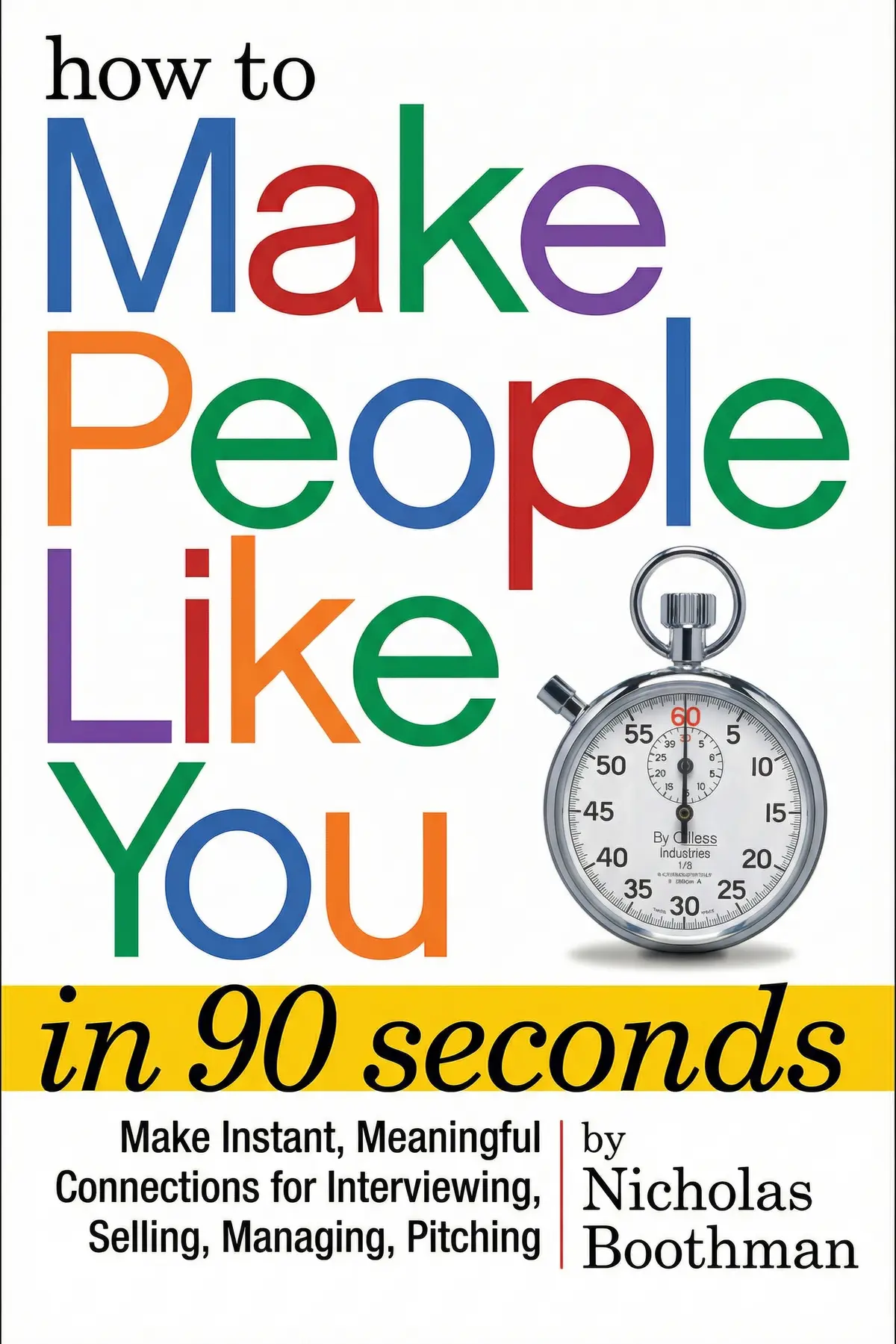
Table of Content
1. Introduction
59 sec
Most people meet a stranger, struggle through some small talk and leave without any real connection. That is why so many of us stay with the friends we already have. In How to Make People Like You in 90 Seconds or Less, Nicholas Boothman, a fashion photographer who became a communication coach, argues that the window is short but learnable. A new person decides in about a minute and a half whether they want to know you. If the spark does not catch then, it rarely catches later.
Boothman’s case is that people can come to like you by design, even when you share none of their interests. It starts with knowing what you want from the conversation. After that, your posture, face, voice and questions all need to send the same open message, tuned to the person in front of you.
What you get is a working routine for your next interview, sales call or party. It covers where to point your body, what to ask first and how to sound like the person you’re talking to.
2. Make the first ninety seconds count
1 min 36 sec
Most adults avoid meeting strangers because it feels awkward and pointless. A nine-year study of 7,000 people suggests the avoidance has a price, and the time you have to change a first impression is shorter than you think.
3. Decide what you want before you speak
1 min 27 sec
Two travelers face the same cancelled flight at the same airline counter. One gets help and one gets nowhere, and the difference started before either of them said a word.
4. Win trust before you say a word
1 min 40 sec
People start forming an opinion of you before you open your mouth. A few seconds of deliberate posture, eye contact and timing can decide whether that opinion is warm or wary.
5. Make your words, voice and body agree
1 min 46 sec
A friend says he is fine while staring at the floor with his arms crossed, and nobody believes him. The same mismatch can quietly ruin your credibility in an interview or a pitch.
6. Put people at ease by matching their rhythm
1 min 47 sec
A pushy art dealer grabs a quiet visitor’s shoulder and loses the sale. The instinct the dealer ignored is one you have had since birth, and you can use it on purpose.
7. Keep a stranger talking with better questions
1 min 45 sec
Asking someone whether they come here often almost guarantees a dead end. Changing one small word, and paying attention to the feeling behind the answer, turns that dead end into a real conversation.
8. Speak to the sense each person trusts most
2 min 04 sec
Some people need to see the plan, others want to talk it through and some have to feel it out. Where someone’s eyes go when they remember something may tell you which kind of person they are.
9. Conclusion
1 min 12 sec
Boothman’s method rests on a simple bet. People can come to like you in the time it takes to order a coffee, and you can arrange that. Each piece of his advice sends the same message from a different direction. A clear goal settles your mind, and a settled mind opens your posture. Your posture agrees with your words. Your words then match the other person’s pace, volume and favorite sense. When all of that lines up, a stranger feels safe enough to stay.
The stakes go beyond any one party. Berkman’s nine-year study links strong social ties to a longer life, and a wide circle of people is how jobs, partners and lucky breaks find you.
You can test the approach this week. Before one meeting with someone new, decide what you want from it. When you arrive, turn your chest toward them, smile first and repeat their name. Ask one open question and notice whether they see, hear or feel their answer. If they speak softly and you rush, breathe low into your belly until your voice slows down.
Ninety seconds is not much time, but Boothman insists it is enough if you spend it facing the other person.
About this book
What is this book about?
Most people find meeting strangers awkward enough to avoid it, and they stay inside the circle of friends they already have. Nicholas Boothman thinks this habit costs them. He cites research linking strong social ties to a longer life, and he points out that a wide network is how people hear about jobs, partners and lucky breaks. His warning is that a new acquaintance decides about you in roughly 90 seconds. If you don't spark their interest in that time, you probably won't get another chance. His answer is what he calls rapport by design, a way to connect even when you share no interests. It begins with a useful attitude, which means focusing on what you want from the conversation. That attitude shows up as open body language. From there Boothman covers the first greeting, making your words, voice and body agree, discreetly matching the other person's gestures and tone, and asking questions that invite real answers. He closes with a sensory model taken from neuro-linguistic programming. Readers come away with a short routine they can use at an interview, a sales call, a pitch or a party.
Book Information
Who it's for
Job hunters and graduates
Job seekers and graduates who freeze in the first minute of an interview.
Salespeople, founders and managers
Salespeople, founders and managers who pitch, sell or lead people they barely know.
Shy professionals skipping networking
Shy professionals who skip networking events because small talk with strangers feels awkward.
About the Author
Nicholas Boothman
Nicholas Boothman worked for about 25 years as a fashion and advertising photographer before changing careers. He started out coaching students to do well in job interviews, then moved on to speaking for companies and business schools around the world. He teaches methods he calls Rapport by Design and Spontaneous Success. His first book, How to Make People Like You in 90 Seconds or Less, came out in 1999, and his books have been translated into more than 30 languages.
Ratings & Reviews
Ratings at a glance

What people think
Listeners find the book provides excellent practical details and is simple to grasp, resulting in an entertaining and intriguing experience. Furthermore, they value how it acts as a solid primer for communication basics and aids in fostering upbeat connections. The material also receives acclaim for its clear concepts, with one listener highlighting its scientific approach, and listeners find it empowering, with one individual noting its benefits for social anxiety.
Top reviews
Omar
Ever wonder why some people just light up a room instantly? This book dives into the mechanics of that charisma, specifically through the lens of Neuro-Linguistic Programming. Boothman argues that the first minute and a half of any interaction determines the trajectory of the relationship. I found the breakdown of visual, auditory, and kinesthetic preferences particularly enlightening as it helps tailor your communication style to the person in front of you. While some of the synchronization techniques feel a bit manipulative at first, they actually lead to more genuine rapport once you get the hang of it. It’s an empowering read that makes the daunting task of meeting new people feel like a manageable science project. If you're looking for a quick, practical guide to boost your social confidence, this is a solid choice.
Show morePor
As someone who has struggled with social anxiety for years, finding a guide that breaks things down into 90-second increments was a game-changer. The book provides a clear roadmap for those of us who find small talk terrifying. I loved the section on VAK preferences—visual, auditory, and kinesthetic—because it gave me a concrete way to analyze a conversation rather than just panicking. In my experience, practicing the intonation exercises helped me sound more confident even when I wasn't feeling it. This book is empowering because it makes social success feel like a skill you can practice rather than a trait you're born with. It’s a great introduction for anyone who feels conversationally challenged or just wants to create more positive interactions in their daily life.
Show moreSiraporn
Finally got around to reading this classic and it’s surprisingly easy to digest for a self-help book. Boothman has a way of taking complex NLP concepts and making them accessible for the average person who just wants to be more likable. The chapter on different sensory preferences—visual, auditory, kinesthetic—is probably the most valuable part of the whole text. It really changed how I approach my coworkers, especially when I'm trying to explain new projects or resolve minor conflicts. Not gonna lie, some of the specific phrases he suggests feel a bit dated, but the underlying principles are sound. It’s a quick read that you can probably finish in a single afternoon, yet the lessons stick with you. Definitely recommended for those who want to polish their social skills.
Show moreLucia
Nicholas Boothman brings his perspective as a photographer into the realm of human connection, focusing on how we frame ourselves to others. The book is packed with practical information regarding body language and the subtle art of making eye contact without being intimidating. Truth is, most of us forget the basics of open-ended questions and active listening, so having them laid out so clearly is helpful. I appreciated the scientific approach to why certain behaviors trigger trust or suspicion. However, the author’s focus is primarily on one-on-one communication, so it’s less useful if you’re looking to command a large audience or a boardroom. Still, it’s a fun and interesting read that serves as a great introduction to general communication principles for anyone feeling a bit rusty.
Show moreChon
The section on mirroring and active listening alone made this worth the purchase price for me. I’ve started practicing open-ended questions and focusing on my body language during work meetings, and the general response from others is already changing. It is all explained really simply and is very user-friendly for a layman. The author’s tone is encouraging and light, making it a quick and interesting read. My only real gripe is that it feels a bit geared toward sales-type personalities, which might not resonate with everyone. However, the core concept of creating rapport quickly is undeniably useful in today’s fast-paced world. I’ll likely revisit the chapters on synchronization before my next big networking event.
Show moreWit
Picked this up to help with networking and found the concept of sensory preferences really fascinating. Nicholas Boothman does a great job of putting a lot of complex NLP concepts together in a fairly digestible manner. Personally, I found the intonation exercises and the emphasis on open body language to be the most practical takeaways. It’s a fun, quick read that doesn't take itself too seriously while still providing actionable advice. I’ve noticed a difference in how I approach new clients, especially by being more acutely aware of when I’m doing a bad job of listening. It isn't a miracle cure for introversion, but it provides a solid foundation for anyone wanting to improve their social standing.
Show moreTaw
To be fair, a lot of what's here feels like basic social etiquette dressed up in new, fancy terminology. You learn about things like beaming and mirroring, which are essentially just ways to show you’re paying attention. The author's background as a fashion photographer gives a unique spin on the visual aspects of communication, but some sections felt stretched out to meet a page count. I was hoping for more advanced psychological insights, but instead, it felt like a primer on manners most people should have learned in grade school. It isn't a bad book by any means, and it serves as a nice reminder of the power of a smile. Just don't go into it expecting a groundbreaking scientific treatise on human behavior.
Show moreVipawan
Look, if you already have a strong grasp of how to talk to strangers, you won't find anything groundbreaking here. It was an ok read that serves as a great reminder of how important first impressions really are. I liked the focus on the first 90 seconds, but I wish there was more depth regarding long-term relationship maintenance. The stuff about matching your breathing and posture with others is interesting but can feel a bit creepy if you overthink it. It felt like the author took a few good ideas and stretched them out just to fill the pages. It’s a nice enough refresher on manners and social cues, but it's nothing exceptional compared to other books in the genre.
Show morePita
Not what I expected given the hype surrounding this title in self-help circles. While the book claims to be a scientific approach to connection, it often feels like a collection of commonsense parables from real life. Some of the stock phrases suggested for breaking the ice felt like something out of a foreign language phrase book, lacking any natural flow. I found the advice to be not broadly applicable to every professional situation, especially in more formal environments. It’s an easy read, but I honestly felt like the content was too thin to justify an entire book. If you have any baseline level of social awareness, you likely already do most of what is suggested here. It was of low value for me personally.
Show moreTippawan
Frankly, this book felt like a collection of anecdotes stretched thin to fill out a few hundred pages. I was disappointed that so much of the advice was just common sense, like smiling and standing up straight. The author frequently references his time as a photographer, which is interesting, but it doesn't always translate into broad application for other careers. Many of the examples felt like they belonged in a gag store manual rather than a serious guide to human interaction. For someone looking for deep psychological insights, this is way too superficial. I think you could find most of this information in a five-minute blog post online without spending the money on the full book.
Show moreQuestions about this book
What is the main idea of How to Make People Like You in 90 Seconds or Less?
Nicholas Boothman argues that a new acquaintance decides about you in roughly 90 seconds, and that you can shape that decision on purpose. It starts with a useful attitude, meaning you focus on what you want from the conversation. That attitude then shows in open body language, a consistent voice and face, subtle matching of the other person, and open questions followed by attentive listening.
What does Boothman mean by a useful attitude?
A useful attitude focuses on the outcome you want from a conversation, while a useless one focuses on what you want to avoid. In his cancelled-flight example, the traveler who dreads being stranded ends up shouting at airline staff. The one who concentrates on finding someone to rebook them stays open and pleasant. Boothman says the right attitude produces likable body language without any extra effort.
How should you greet someone to make a good first impression?
Boothman recommends turning your heart and chest directly toward the person, making eye contact and smiling before they do. Then say a simple hello, give your first name and invite theirs. Repeat their name right away so you remember it. Lean in slightly, either with a firm handshake or with your hands relaxed at your sides.
What is mirroring or synchronizing in Boothman's book?
Synchronizing means mirroring another person’s gestures, posture, facial expressions, breathing and vocal tone, without making it obvious. Boothman says people naturally prefer those who are in step with them. In his art gallery example, a loud, pushy salesperson puts off a calm, quiet visitor. A practical tip is that if you speak too fast, breathing into your belly slows your speech.
How do you tell if someone is visual, auditory or kinesthetic?
Drawing on NLP founders Richard Bandler and John Grinder, Boothman suggests asking a question that makes someone remember, such as what they liked about a vacation. Visual people tend to glance up to one side, auditory people look sideways in the direction of their ears, and people who are kinesthetic look down. Their phrases also give them away, such as I see, tell me more or how do you feel.
Featured in
Readers also enjoyed





AUDIO SUMMARY AVAILABLE
Listen to How to Make People Like You in 90 Seconds or Less in 15 minutes
Get the key ideas from How to Make People Like You in 90 Seconds or Less by Nicholas Boothman, plus 5,000+ more nonfiction titles.
- 5,000+ titles
- Listen as much as you want
- 7-day free trial
- Cancel anytime









