

13 min 24 sec
Available in: English
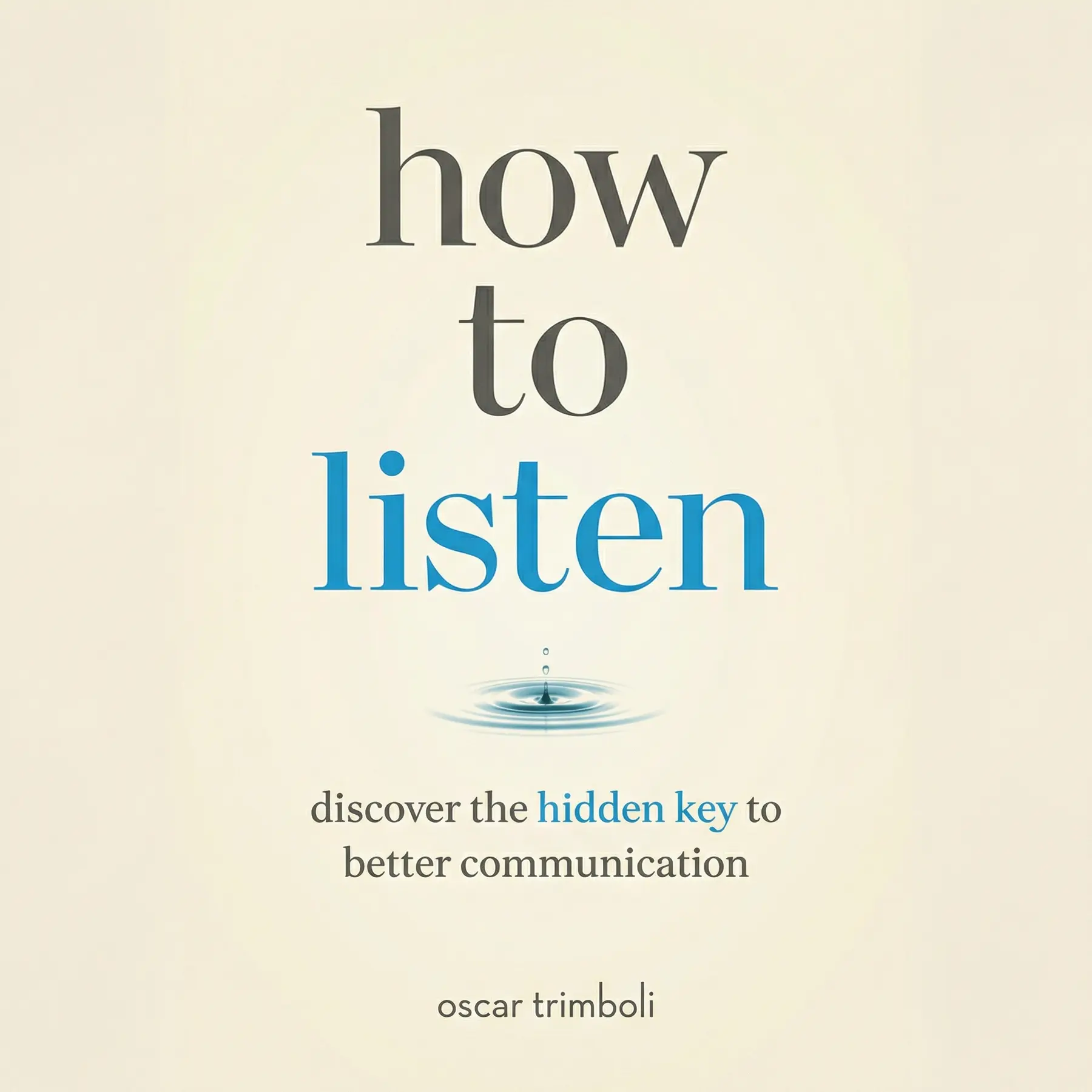
How to Listen: Discover the Hidden Key to Better Communication
Shows why most of us listen far worse than we think, and gives a step-by-step practice for preparing, paying attention and asking the questions that help people say what they really mean.

Table of Content
1. Introduction
1 min 04 sec
Most people are sure they listen well, and the research Oscar Trimboli cites says otherwise: we rate ourselves six times more effective as listeners than others judge us to be. In How to Listen, Trimboli, a podcast host who works with boards and executive teams on how leaders listen, argues that this blind spot shows up as repeated conversations, failed projects and people who stop speaking up. His definition sets a high bar. To listen is to stay willing to let what you hear change your mind.
That turns listening into a practice with stages. It starts before anyone speaks and finishes only when the speaker has reached what they really mean. Along the way come a percussionist who lost her hearing, a warning that bankers chose to ignore and a breakfast in New York that revealed why one donor gave. What you take from it is a ritual for before meetings, a few words to listen for and one question that draws out the answer behind the answer.
2. Arrive tuned before the first word is spoken
1 min 44 sec
You can nod, keep eye contact and still be somewhere else entirely, and the other person usually knows it. Trimboli borrows a habit from professional musicians to fix the problem before the conversation even begins.
3. Hear the warning everyone else filters out
1 min 45 sec
A room full of experts heard a clear prediction of disaster and shrugged it off. The information was right in front of them, so something else failed, and the same failure plays out in ordinary meetings every week.
4. Catch what words miss with eyes, body and room
1 min 59 sec
A percussionist who could no longer hear became one of the world’s recognized performers. Her story points to signals most listeners walk straight past, from a sudden change in breathing to the shape of the room itself.
5. Ask for the backstory before judging the headline
2 min 01 sec
People almost never start a story at its beginning, and listeners rush to fill the gap with guesses. A famous tennis final shows how much the missing first act can change the meaning of everything that follows.
6. Read where a mind sits from its small words
1 min 56 sec
A highway patrol sergeant learned to hear hope returning in the way people on a bridge described things. Ordinary speech carries the same clues every day, hidden in words most listeners never register.
7. Move past first answers to hear what truly matters
1 min 50 sec
What someone says first is rarely what they most need to say. A fundraiser’s breakfast with a wealthy stranger shows how one patient question can turn small talk into the real reason behind a person’s choices.
8. Conclusion
1 min 05 sec
Trimboli’s case comes down to a change in what you think listening is for. It is not waiting politely for your turn. It is giving another person enough room, and yourself enough openness, that what they say can change your mind. The bankers who waved Rajan away heard every word he said. They simply never let it in.
Done his way, listening saves time. Conversations get shorter and clearer, less effort is wasted, and people who usually go unheard finally speak.
The practice can start small this week. Before your next important meeting, take two minutes to tune yourself, phone silenced, and notice what is pulling at your attention. During the conversation, jot one word every few minutes and pay attention to the pronouns. When someone leads with the crisis, ask when they first noticed it. And when they finish, pause before replying, ask what it means for them, and sit through the silence.
The donor at that New York breakfast had money to give from the start. What turned it into a story worth hearing was someone who asked why.
About this book
What is this book about?
Most people believe they are good listeners. Oscar Trimboli points to research suggesting we rate ourselves six times more effective than others find us, and he argues that this blind spot is costly. People repeat themselves, warnings get dismissed, projects fail and trust wears thin. Trimboli defines listening as the willingness to have your mind changed, and he breaks it into stages. It starts before a word is spoken, with a short ritual to tune your own attention. It continues with deliberate focus on differences instead of confirmation, and with reading eyes, posture, breathing and even the acoustics of the room. Then the work shifts to the speaker: asking for the backstory behind a headline moment, tracking the adjectives, pronouns and time frames people use, and helping them reach what their words really represent. The stories range from a percussionist who plays barefoot to feel sound to a highway patrol sergeant on the Golden Gate Bridge and a donor's breakfast in New York. Readers get small, specific practices to try in their very next conversation, including one question to ask once the other person stops talking.
Book Information
Who it's for
Managers and team leads
Managers and team leads whose meetings run long because people repeat themselves or hold back.
Client-facing professionals
Professionals in client, sales or fundraising roles who need to hear the reason behind a request.
Told they seem distracted
Anyone told they seem distracted, who wants simple habits for being fully present in conversations.
About the Author
Oscar Trimboli
Oscar Trimboli is an author, speaker and host of the Deep Listening podcast. He works with chairs, boards of directors and executive teams on the way leaders listen, and through the Deep Listening Ambassador Community he aims to create 100 million deep listeners in the workplace. His background is in marketing and technology, including roles at Microsoft, PeopleSoft, Polycom and Vodafone, and he has consulted for organizations such as American Express, Google, HSBC and Siemens. His other books include Deep Listening and Breakthroughs.
Ratings & Reviews
Ratings at a glance
What people think
Listeners find the book deeply perceptive for honing listening abilities, and one review goes into detail regarding the five levels of focus. The information is praised as well, with one listener specifically noting the inclusion of real-life examples. The content is transformative, helping listeners become more intentional, and one listener observes that it builds stronger empathy in relationships. Additionally, listeners appreciate its value for money.
Top reviews
Darawan
This wasn't just a business read for me; it actually changed how I interact with my partner and children. Gotta say, the emphasis on empathy and 'listening to what isn't said' has made me much more intentional in my daily life. The book provides a transformative look at how we show up in spaces, using real-life examples that make the five levels of focus easy to visualize. I especially loved the section on how silence is like a tuning fork for the ear. It’s rare to find a self-help book that feels this grounded in humanity while still being applicable in a high-stakes corporate environment. For the price, the value here is incredible. It’s a manual for anyone who wants to build deeper, more authentic connections through the simple, yet difficult, act of truly hearing another person.
Show moreViolet
I’ve gone through countless communication manuals, yet this one finally broke down the actual how of the process in a way that feels sustainable. Not gonna lie, I was skeptical about a whole book dedicated to just listening, but the five levels of focus provided a roadmap I didn't know I needed. The knowledge base here is deep, and the real-life examples make the concepts of 'content vs. context' stick in your brain. I found the section on 'listening to the meaning' particularly helpful for strategic decision-making. It’s not just about being nice; it’s about being effective and uncovering the real issues that people are often too hesitant to voice directly. This is an essential tool for any leader's toolkit and offers massive value for the money spent.
Show moreIsabella
Leadership is often sold as a speaking skill, but Trimboli argues convincingly that it's actually about your ears. The truth is, the higher you go in an organization, the more your listening influences the culture around you. This book provides a profound yet practical manual for mastering that foundation. I found the insights into 'Listening for the Unsaid' to be particularly transformative for my one-on-one meetings with my team. It helps you move past the 'first explanation' to get to the real thoughts hiding underneath. The activities included are great for turning these insights into actual habits. If you are a leader, or aspire to be one, this book is an absolute must-read. It’s a masterclass in empathy and strategic communication that will pay dividends in every relationship you have.
Show moreKru
Did you know we can hear four times faster than people speak? That single insight from Oscar Trimboli changed my entire perspective on why my mind wanders during Zoom calls. Truth is, I always considered myself a 'good' listener because I stay quiet, but this book exposed my inner 'Listening Villains'—specifically my tendency to be the 'shrewd' listener who is already solving the problem before the speaker finishes. The framework for preparing your mindset before a conversation is practical, though some of the illustrations felt a bit thin and could have used more depth. I appreciated the specific micro-rituals suggested for resetting between meetings. It’s a solid 4-star read that offers immediate value if you're willing to actually practice the exercises rather than just skimming the text.
Show moreConnor
The chapter on listening for what isn't being said was a total game-changer for my client meetings. Frankly, I used to focus so much on the words being spoken that I missed the emotional undercurrents and the hidden assumptions driving the conversation. Trimboli’s breakdown of the 'Listening Villains' helped me identify my own habits of interrupting and assuming I knew the ending of the story. The book is well-researched and the stories, like the one about the doctor who identified the COVID-19 strain, add a powerful emotional layer to the data. My only gripe is that it can feel a bit theory-heavy in the middle. You really have to be disciplined about applying the 'rituals' he suggests, or it just becomes another book sitting on your shelf. Still, it's a highly recommended read for any professional.
Show moreUdom
Finally got around to finishing this, and the 'listening battery' concept is what stayed with me the most. Look, we all know we should listen better, but Trimboli explains why we actually fail to do so—it’s a capacity issue as much as a skill issue. The book is a welcome addition to the genre, providing a layered model that moves from the self to the speaker and then to the broader meaning. I liked the focus on micro-rituals, like taking a breath and clearing your desk before a call. It’s practical, actionable, and less 'fluffy' than a lot of other self-help books out there. While some of the formatting felt a bit disjointed, the 'gold' you find in the insights makes it well worth the read. It’s challenged me to be a better listener regardless of the environment.
Show morePensri
Trimboli clearly knows his stuff, but the book feels a bit disjointed in places, almost like a collection of podcast transcripts that weren't quite smoothed out by an editor. To be fair, there is plenty of gold to be mined here, especially regarding the levels of meaning and the importance of silence. But you really have to work for it. I found several sections where a sub-heading would introduce a fascinating concept, only for the text to move on to something else entirely without enough elaboration. The lack of an index is a major oversight for a book that positions itself as a reference manual for leaders. It is a decent resource if you have the patience for the choppy flow, but it definitely isn't a seamless read.
Show moreTanawan
As a project manager, I’m always looking for ways to improve communication protocols, and this book came highly recommended. Personally, I found it to be a bit of a mixed bag. The stuff about the gap between speaking and hearing speeds is great—stuff you might 'know' intuitively but haven't seen framed so clearly. However, the later chapters on 'leading by listening' felt a bit repetitive and recycled common leadership tropes. The book is very much in Trimboli’s specific voice, which is great if you like his podcast, but it can feel a bit rambling at times. Look, it’s a helpful framework for practicing a skill we all take for granted, but it didn't quite blow me away. It's a solid 3.5 stars, but I'm rounding down because of the lack of an index and some clunky transitions.
Show moreSom
Useful, but it could have been a long-form essay and achieved the same result. In all honesty, the core insights about the 125/400 rule (speaking vs. listening speed) are fantastic, but the book spends a lot of time circling the same drain in the later chapters. I appreciated the 'Listening Villains' quiz and the framework for 'Hear, See, and Sense,' but I found myself skimming through the repetitive calls to action. To be fair, the author’s voice is encouraging and the stories are engaging, but the structure feels a bit loose. It’s a good reminder of things we often forget, but don't expect a revolutionary new theory in every chapter. It’s a decent 3-star book that serves as a good reminder to slow down and pay attention.
Show moreUraiwan
The first three chapters of this book are genuinely insightful, providing a solid foundation based on established communication research. However, once I hit Chapter 4, the quality took a massive dive into territory that felt ungrounded and, frankly, a bit ridiculous. In my experience, the transition from presenting external studies to the author's own theoretical framework was jarring and lacked the intellectual rigor found in the opening pages. I found myself scribbling frustrated notes in the margins because the 'unsaid' layers felt more like guesswork than actionable strategy. While the concept of the 'listening battery' has some merit, the later half of the book loses the plot. It feels like the author had enough material for a great long-form article but stretched it into a repetitive manual that doesn't quite hold up under scrutiny.
Show moreQuestions about this book
What is the main idea of How to Listen by Oscar Trimboli?
Trimboli argues that most people overrate their listening, citing research that we judge ourselves six times more effective than others do. He defines listening as the willingness to have your mind changed and treats it as a staged practice: tune your attention before a conversation, focus on differences and nonverbal signals, ask for the backstory, track the speaker’s language and help them move past their first answer to what really matters.
What is the one question Trimboli recommends asking?
Once the other person has finished speaking, Trimboli suggests pausing instead of replying or solving, then asking what it means for them. The key is to stay silent long enough for them to think. Because we think far faster than we talk, a first answer is usually only part of the picture, and the second answer is often where the real meaning appears.
How do you prepare to listen before a conversation?
Trimboli compares it to an orchestra tuning before a performance. He suggests a three-minute exercise: sit still and calm, set your phone to do not disturb, and ask which of your own thoughts and feelings you have been ignoring. Naming them stops them from hijacking your attention later. If distractions keep showing up, bring yourself back with one breath, a short pause, or some small physical anchor in the room.
What language clues does How to Listen teach you to notice?
Trimboli points to adjectives, which often carry emotion, and pronouns, since a speaker fixed on I may be looking inward while we or they signals a wider view. He also listens for absolutes like always and never, for frequent comparisons and for whether a story is told in the past, present or future. If someone is stuck on I, he suggests asking a question about we or they.
Who should read How to Listen?
It suits leaders, team members and anyone in client-facing work who wants conversations to be shorter and more useful. Its practices are small and concrete, from noting one word every few minutes in a meeting to raising your camera to eye level on video calls and asking a colleague when a problem first started.
Featured in
Readers also enjoyed









AUDIO SUMMARY AVAILABLE
Listen to How to Listen in 15 minutes
Get the key ideas from How to Listen by Oscar Trimboli, plus 5,000+ more nonfiction titles.
- 5,000+ titles
- Listen as much as you want
- 7-day free trial
- Cancel anytime









