

16 min
Available in: English
How to be Heard: Secrets for Powerful Speaking and Listening
Shows why the surest way to be listened to is to listen better yourself. It also gives practical tools for trustworthy speech, clear messages and a voice that holds attention, at home or at work.
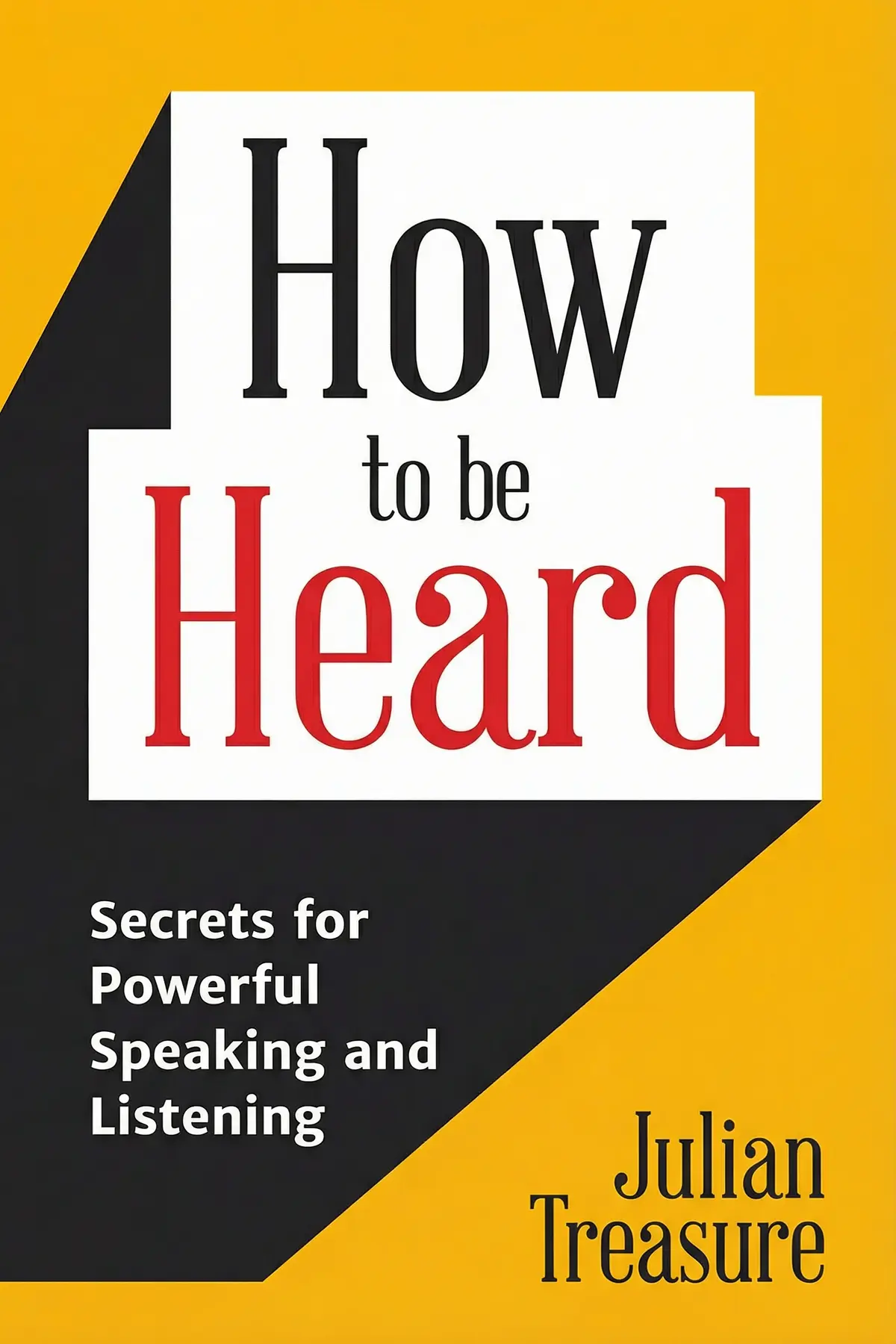
Table of Content
1. Introduction
59 sec
Most people who feel ignored at work try to talk louder or better. Julian Treasure, a sound and communication expert with five TED talks behind him, argues in How to be Heard that the surest way to be listened to is to become a better listener, because speaking and listening are two halves of one skill. In one study, doctors cut patients off about 18 seconds into what they were saying, and most of us do little better.
From there Treasure shows how sound shapes our health and behavior, which habits make listeners switch off, what makes speech trustworthy, and how simple exercises sharpen both ear and voice. Along the way come a jeweler who erased £500 million with one joke, a mayor who fought crime with birdsong, and a one-minute posture test you can do against any wall. The reward is a practical method for becoming the person others actually hear.
2. Make the sound around you work for you
1 min 58 sec
A noisy day can leave you drained without any obvious reason, and a California town found that changing what people heard on one street changed how they behaved. Sound reaches further into us than most of us suspect.
3. Drop the habits that make people tune out
2 min 07 sec
Some speaking habits feel friendly, harmless or even clever while you use them. One of them wiped £500 million off the value of a British jewelry chain, and most of us use a few every day.
4. Four foundations that make people trust your words
1 min 48 sec
A family’s silence after one painful day at a hospital shaped how its members spoke for years. Treasure uses stories like it to name what listeners quietly check for before they decide to believe you.
5. Understand how everyone listens in their own way
1 min 57 sec
Two identical twins raised in the same home can grow up listening in completely different ways. That finding explains why a point that seemed perfectly clear to you can arrive somewhere else entirely.
6. Listen so the other person feels heard
2 min 14 sec
Most of us are already composing a reply while the other person is still talking. Treasure names that habit, shows what it does to a conversation, and offers a short exercise named after a Sanskrit word to replace it.
7. Give people content worth their attention
1 min 57 sec
Asked to choose between brilliant delivery and strong material, the head of TED did not hesitate. His answer, and a study of 1,737 works of fiction, point to what makes a message stay with people.
8. Train a voice people want to keep hearing
1 min 50 sec
A man on a phone call once turned a peaceful airport lounge against him in seconds. Treasure uses scenes like that, and a one-minute test against a wall, to show how much of your message your body carries.
9. Conclusion
1 min 10 sec
Treasure’s book takes a familiar complaint, that nobody listens, and hands it back to the person making it. Ear and voice form one system. Noise wears on body and mood, one careless joke can wipe out a company’s value, and every listener hears through filters the speaker cannot see. Being heard starts with listening, then grows through honest, plain speech and a voice you have trained.
The habits are small enough to start tomorrow. Silence your alerts and check messages at set times, so your attention belongs to you. In the next tense conversation, receive, appreciate, summarize and ask before you reply, and notice how the heat drains out of it. Before a talk, think about the mood of the people you are speaking to, and pick plain words over impressive ones. Spend a minute at a wall every day with your chin tucked.
And remember those doctors who cut in after 18 seconds. Most people never get past that point with anyone. Give someone the nineteenth second, and the twentieth, and they will begin to give you theirs.
About this book
What is this book about?
Most people who feel ignored try to talk louder, longer or more cleverly. Julian Treasure, a sound and communication expert with five TED talks behind him, argues that this gets the problem backward. Speaking and listening are closely linked, he says, so becoming a conscious listener is the first step to being heard. Treasure starts with sound itself, which affects our bodies, moods, thinking and behavior even when we ignore it. He names the seven deadly sins of speaking that make people tune out, and the four foundations of trustworthy speech, which he spells HAIL. He then separates hearing from listening, explains why no two people listen alike, and offers exercises such as RASA for building rapport. The later material turns to the speaker: content worth hearing, plain language, story and intention, and a vocal toolbox led by prosody, with a one-minute posture check and a warning about loud talkers. Readers get a practical method for listening so people feel heard and speaking so people want to listen.
Book Information
Who it's for
Professionals feeling talked over
Professionals who feel talked over in meetings and want their ideas to land.
Caught in recurring misunderstandings
Managers, parents and partners whose conversations keep turning into misunderstandings or arguments.
Facing a presentation
Anyone facing a presentation who wants clearer content and a steadier, more engaging voice.
About the Author
Julian Treasure
Julian Treasure is an international speaker who has given five TED talks on sound and communication, including How To Speak So That People Want To Listen, watched more than 20 million times on the TED website. His first book, Sound Business, dealt with intentional sound in business. How to be Heard draws on his 30 years as a speaker. He is a Fellow of the Royal Society of Arts, a Liveryman of the Worshipful Company of Marketors and a longtime musician.
Ratings & Reviews
Ratings at a glance
What people think
Listeners find the material simple to grasp and a worthwhile investment, with one listener remarking that it is full of useful details. The communication skills sections also receive positive remarks, including one listener’s mention of the pre-speech routine. Furthermore, listeners find the content interesting from beginning to end.
Top reviews
Cha
After hearing Julian Treasure’s iconic TED talk, I knew the audiobook was the only way to experience this. The vocal warm-up routine he suggests doing before a speech is a game-changer for my morning meetings. It feels high-value because Treasure doesn't just talk at you; he demonstrates the power of pitch and tonality in real-time. Personally, I think the transition from listening skills to public speaking mechanics is handled with a lot of grace. It is easy to understand without being patronizing. While some of the 'noise' science in the beginning feels a bit long-winded, the practical takeaways for interpersonal communication are worth every penny. This is a must-buy for any professional.
Show morePisit
Finally got around to finishing the audio version, and the expert interviews at the end are worth the price of admission alone. Treasure speaks so wisely about the 'lost art' of truly listening, emphasizing that being heard is actually a byproduct of how well we receive others. I loved the technical breakdown of how fast music impacts our heart rate and eating habits. It’s a very thorough guide that covers everything from the physical mechanics of breath to whether or not you should memorize your content. Not gonna lie, I’ve already started using the 'HAIL' acronym in my daily conversations. This is an excellent resource for students and professionals alike who want to improve their language skills and empathy.
Show moreAim
Wow, this was far more comprehensive than the average self-help book I've picked up recently. I was particularly impressed by the level of detail regarding Neuro-Linguistic Programming (NLP) and the psychological impact of different listening styles. Treasure explains how to appeal to different types of listeners, which has already changed how I prep my sales presentations. The book is incredibly easy to understand and the structure is perfect for busy people who only have twenty minutes a day to read. If you’re looking to improve your professional skills and speak with more empathy, this is a must-read. Five stars for the practical storytelling tips and the breakdown of 'rags to riches' narratives alone!
Show moreSirichai
The first few chapters caught me off guard because they deal almost entirely with the physics of sound and how environmental noise affects our health. It's an interesting angle, even if it’s not what I originally expected when I bought a book on communication. I particularly liked the deep dive into Neuro-Linguistic Programming (NLP) and how voice volume can change the way an audience perceives your authority. Truth is, the middle section is the real meat of the book. It offers a very thorough look at the physical mechanics of breathing and posture. Some of the storytelling tips felt a bit basic, but the overall structure makes it a very easy read for anyone looking to polish their presence.
Show moreNong
As someone who spends half their day in Zoom meetings, I found the sections on voice tonality and pitch surprisingly applicable to the digital workspace. The book helps remove the intimidation factor surrounding public speaking by breaking it down into manageable physical habits. I appreciate how Treasure moves from the 'why' of listening to the 'how' of speaking without losing momentum. The chapters on posture and body language are particularly valuable for anyone who feels invisible in professional settings. It’s a very interesting read throughout, though I could have done without some of the more technical jargon regarding acoustics in the beginning. Overall, it's great value for money and quite easy to understand.
Show moreSomsak
Ever wonder why some people just command a room the moment they open their mouth? This book attempts to deconstruct that magic, and for the most part, it succeeds. The routine to do before a speech—specifically the vocal warm-ups—is incredibly practical for those of us with 'thin' voices. To be fair, some of the advice on empathy and active listening is stuff we've all heard before, but Treasure packages it in a way that feels fresh and urgent. The emphasis on how sound impacts our sleep and productivity was a highlight for me. It’s a solid investment and definitely provides good value for money if you actually apply the techniques daily.
Show moreLincoln
Look, the section on Amy Cuddy’s power poses felt a bit dated given the current replication crisis in social psychology, but the rest of the book holds up well. Treasure is a master of his craft, and his passion for the 'world of sound' is contagious throughout the text. I found the tips on managing volume and accenting certain words to be the most helpful part of the entire experience. It’s a thorough exploration of communication that doesn't just focus on the speaker, but also the environment in which we speak. Even the parts about bird sounds and public safety were fascinating to think about. It's a great book for anyone who wants to communicate with more intention and less noise.
Show moreHassan
Is it groundbreaking? Not exactly, but Treasure offers a solid, readable framework for anyone struggling to keep an audience's attention. I was intrigued by the claim that playing bird sounds in public spaces could actually reduce crime rates—that’s the kind of weird trivia that keeps things interesting. However, a lot of the 'secrets' for powerful speaking are just polished versions of things you’d find in any Toastmasters handbook. The focus on 'rags to riches' storytelling as a primary tool felt a bit cliché and simplified. Still, the book is easy to navigate and provides a decent routine to do before a speech if you’re prone to nerves. It's a middle-of-the-road guide that occasionally touches on brilliance but often stays in the shallow end.
Show moreTaweesak
Frankly, I expected more from a world-renowned communication expert than a collection of elementary tips like 'make eye contact' and 'don't use jargon.' I read this shortly after finishing a much more profound work on sound, and Treasure's book felt like a lightweight self-help warmup in comparison. The 'secret' that our society is getting noisier isn't exactly a revelation to anyone living in a modern city with two-stroke motorcycles and beeping microwaves. He plops over several topics with the same practiced sincerity of a TED talk, which makes the writing feel a bit artificial and repetitive at times. It’s not a total waste of money, but it definitely feels like it was written to capitalize on his viral fame rather than to break new ground.
Show moreSumalee
This book is the perfect example of why some presentations should never be expanded into 300-page volumes. The author undermines his own credibility early on by citing the widely debunked Amy Cuddy power pose research as if it’s settled science. It's frustrating to see such filler in a book about 'being heard.' I found the opening sections about environmental noise to be incredibly repetitive—yes, we know loud appliances are annoying and that society is noisy. You’re essentially paying for common sense advice like 'make eye contact' and 'be empathetic' wrapped in a slick TED-style package. Just watch his 10-minute video online and save yourself the time and money. It's basically a self-help warmup that never reaches a main event.
Show moreQuestions about this book
What is the main idea of How to be Heard by Julian Treasure?
Treasure argues that speaking and listening are closely linked, so the best way to be listened to is to become a good listener yourself. He builds on that with the seven deadly sins of speaking, four foundations for trustworthy speech called HAIL, conscious listening exercises such as RASA, advice on clear content and a vocal toolbox led by prosody.
What does HAIL stand for in How to be Heard?
HAIL stands for honesty, authenticity, integrity and love, the four foundations Treasure names for powerful speech. He says they apply to listening as well. Integrity gets his sharpest definition: being your word, so that what you promise actually happens and your words keep their weight over time.
What is the RASA listening method?
RASA is a Sanskrit word for juice and one of seven listening exercises in the book, offered as a way to build rapport. It stands for receive, appreciate, summarize and ask. Treasure says repeating back what someone said lowers the temperature in conflict, and that asking people to tell you more draws them out and earns respect.
What are the seven deadly sins of speaking?
Treasure lists gossip, judging, negativity, complaining, excuses, exaggeration and dogmatism. Exaggeration cheapens strong words like amazing or genius until they stop working, and dogmatism means confusing your opinion with fact. Spotting which of these slips into your own talk is a simple first step toward being heard.
How can I apply How to be Heard at work?
Turn off email and message alerts and check them three times a day. In meetings, make eye contact and stop drafting your reply while others talk. Before a presentation, ask what mood your audience is in, use plain language and a story shape, and check your posture against a wall for one minute a day.
Readers also enjoyed









AUDIO SUMMARY AVAILABLE
Listen to How to be Heard in 15 minutes
Get the key ideas from How to be Heard by Julian Treasure, plus 5,000+ more nonfiction titles.
- 5,000+ titles
- Listen as much as you want
- 7-day free trial
- Cancel anytime









