

59 Seconds: Change Your Life in Under a Minute
Richard Wiseman
 English
Explains why fear is the brain's default response to uncertainty and how to act anyway. It covers six learnable habits for individuals and three conditions that make whole teams willing to take risks.
1 min 02 sec
Most people freeze well before they meet any real danger. The boss calls without warning, an idea needs pitching or a line gets crossed, and their nerve drains away. In How to Be Bold, Harvard Business School professor Ranjay Gulati argues that the trouble is rarely the danger itself. It is uncertainty, and the fear the brain switches on when it cannot predict what comes next.
His answer is that courage never meant the absence of fear. It means acting while afraid, and it can be trained. Gulati’s case runs from the single person to the whole company: courage grows like a muscle through small deliberate acts, and teams can grow it together when belonging, energy and trust make risk feel survivable. What follows is a set of moves you can use this week: questions that shrink a fear, habits that keep you steady under pressure, and the signals a leader sends that make a team brave enough to speak.
1 min 55 sec
Many people hold back until the nerves settle, convinced that the brave never feel what they feel. Gulati points to the two ingredients that set fear off, and to what really separates the people who move anyway.
1 min 38 sec
Your body reacts to an awkward meeting much as it would to a hungry predator. Gulati explains why that alarm keeps firing, and offers a short set of questions that change what it means.
1 min 55 sec
Bold people often look ordinary until the moment arrives. What they carry into it is a set of mental habits, and the first three change how a risky moment looks before anyone takes a step.
1 min 44 sec
A good story and a clear purpose can still collapse when you feel alone and rattled. Gulati’s last three habits are the ones you prepare in advance, long before the hard moment arrives.
1 min 56 sec
One person’s brave act can give a whole room permission to follow, or it can be the last anyone tries. Gulati names three conditions that decide which way a team goes.
1 min 49 sec
Courage can look like a gift some people are simply born with. Gulati argues it develops the way muscle does, in people and in whole companies, and that waiting for it to strike is the surest way to stay stuck.
1 min 06 sec
Gulati moves courage away from character and toward practice. Fear will keep arriving whenever uncertainty meets a loss of control, in a meeting room as surely as in the wild. What can change is the response. A person who names the fear, retells its story, clears some of the fog and calls on a few allies can act while still afraid, and each time the next act gets a little easier. A team whose leader thanks the bearer of bad news learns that risk is survivable, and starts taking more of it.
The book supports a handful of concrete moves. When fear rises, ask what exactly you are afraid of and how much of it is story. Before a hard moment, rehearse the worst case and remember something difficult you already came through. If you lead others, watch the signals you send when someone admits a mistake or challenges your view. Then repeat the small stretch until it stops feeling like one.
The bold, in Gulati’s telling, still feel the fear. They have simply walked through it more often, and that practice is open to anyone willing to start small.
Most people believe they would be brave when it counts, yet they freeze over far smaller things: a sudden call from the boss, an idea that needs pitching, a moral line someone crosses. Ranjay Gulati argues that the real trigger is uncertainty. When the future is unclear and control seems to slip away, the brain switches on fear, and boldness disappears. His answer is that courage was never the absence of fear. It means acting while afraid, and anyone can learn it. Gulati describes six habits that bold people practice: the stories they tell themselves, the way they cut uncertainty down to size, the support they gather, the purpose that drives them, a modest confidence built from small wins, and rituals that keep them calm. He then moves from the person to the group, showing how belonging, emotional energy and the everyday signals of a culture make whole teams willing to speak up and experiment. Readers get questions for taking a fear apart, habits to rehearse before hard moments, and a clear view of how leaders either teach courage or quietly train it out of their people.
Professionals who go silent in meetings or put off hard conversations because the outcome feels uncertain.
Managers and team leads who want people to speak up, flag problems and try new ideas.
Anyone facing a career change or a moral choice who keeps waiting to feel ready.
Ranjay Gulati is an organizational sociologist at Harvard Business School, where he holds the Paul R. Lawrence MBA Class of 1942 chair in Business Administration, and he earned his Ph.D. at Harvard University. His research looks at how people and organizations reach their potential and how companies keep growing in good times and bad. His earlier books include Deep Purpose, and his awards include the 2024 CK Prahalad Award for putting theory and research into practice.
Listeners view this work as an influential manual for brave leadership that broadens their perspective on bravery and explains how to develop personal courage muscles. They value the actionable techniques and useful advice, with one listener pointing out that the content is grounded in science. The storytelling style is highly regarded, with one listener noting the integration of real-life stories, and listeners describe it as an entertaining read.
The stories coming out of Ukraine in this book gave me chills and provided a rare level of authenticity you don't usually see in business literature. Gulati shows that boldness isn't about being fearless; it’s about having a purpose so deep that you act in spite of that fear. I was especially moved by the foreword from the Dalai Lama, which sets a spiritual yet practical tone for the rest of the work. Truth is, we often think of courage as a solo act of heroism, but this book proves it’s a collective effort nurtured through culture. The writing is engaging and the narrative style keeps you moving through the heavier theoretical sections quite easily. This isn't just a manual for CEOs; it's a guide for anyone trying to navigate a world that feels increasingly uncertain and frightening.
Show moreWow, Gulati really changes the conversation by treating courage as a science that can be studied and replicated in any organization. As an investor, I’m always looking for leadership teams that show this kind of conviction, and this book provides the best framework I’ve seen for identifying it. The distinction between 'Deep Purpose' and this 'Bold' action is clear and complementary. The stories are diverse, ranging from the hospitality industry to wartime leadership, which keeps the narrative fresh and engaging throughout. Personally, I found the sections on empathy to be the most surprising, as we often associate boldness with being tough or unyielding. This book proves that true courage is much more nuanced and human than we typically give it credit for. A must-read for the modern era.
Show moreAfter hearing Ranjay Gulati speak on a podcast, I knew I had to pick up this book, and it did not disappoint. It provides an incredibly relevant perspective on how to lead when the world feels like it's constantly shifting under your feet. The emphasis on acting through fear rather than waiting for confidence to arrive is a game-changer for anyone in a high-stakes environment. I loved the connection to Amy Edmondson’s work on psychological safety; it really helps ground the idea of boldness in actual team dynamics. The book is both an emotional journey and an analytical breakdown of what makes great leaders tick. It’s the kind of book you’ll want to keep on your desk and refer back to whenever you’re facing a tough decision. Simply excellent work.
Show moreEver wonder why some leaders stay cool while everything is falling apart around them? Gulati’s deep dive into the 9C’s framework—covering things like Calm, Clan, and Comprehension—provides a solid roadmap for building what he calls 'courage muscles.' The research is clearly extensive, drawing on everything from Aristotle to modern corporate giants like the Tata Group. I particularly liked the section on psychological safety and how bold action requires a foundation of trust within a team. My only gripe is that some of the case studies go on for a few pages too long when the point was already made. Still, the Courage Playbook at the end is a brilliant addition for anyone who wants a concise summary of the core concepts. It’s a thoughtful, well-constructed argument for leading with both empathy and conviction.
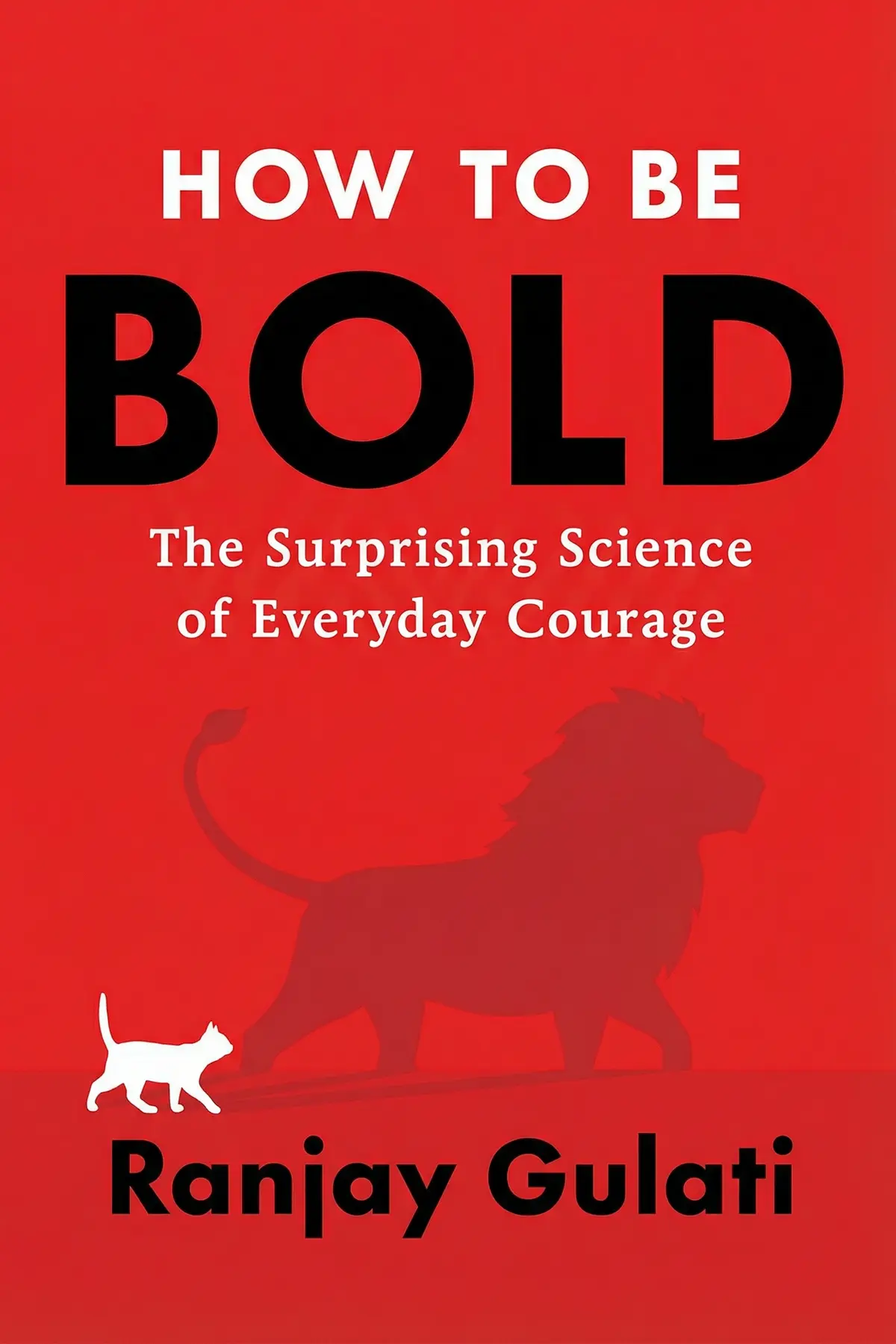
Show moreFinally got around to finishing this, and I have to say the 'Courage Playbook' at the back is worth the price of admission alone. Gulati does a great job of explaining how boldness can be cultivated through practice, much like any other professional skill we value. The visual of the red cover—signaling urgency and momentum—is a perfect match for the energy contained in these pages. I appreciated the balance between intellectual theory and the visceral, real-world examples from military and business leaders alike. In my experience, most leadership books ignore the emotional toll of making big decisions, but Gulati addresses it head-on with his sections on coping and calm. It’s a little long-winded in places, but the core message is incredibly powerful for anyone looking to make a change. Definitely a solid addition to any manager's bookshelf.
Show moreLook, the 9C’s framework is where the real value lies in this book, even if the academic tone is a bit dry at times. Ranjay Gulati has managed to bridge the gap between ancient virtue ethics and modern management practice in a way that feels surprisingly fresh. I particularly enjoyed the comparison between different leadership styles and how they foster—or stifle—innovation through their approach to risk. While the book is quite detailed, the structure allows you to jump around to the chapters that resonate most with your current challenges. It’s a very practical set of levers for anyone trying to lead a transformation in a large, legacy-driven organization. I would recommend this to anyone who feels stuck in a culture of 'playing it safe' and needs a roadmap to get out.
Show moreThis book offers a fascinating look at courage as a skill rather than a trait, but I found the translation to daily life somewhat difficult. While the stories are incredibly inspiring, many of them feel like extreme outliers that don't quite fit a standard office environment. I appreciate the academic rigor Gulati brings to the table, yet the text occasionally feels like a slog through dense leadership theory. To be fair, the distinction between individual bravery and organizational culture is handled well toward the end. If you are a high-level executive, you might find this revolutionary. For those of us in mid-management, it takes a lot of effort to find the 'how-to' hidden within the heavy anecdotes. It’s an interesting read, just not the quick self-help guide the title might suggest to some. Personally, I would have liked more focus on smaller, everyday acts of boldness.
Show moreAs someone who manages a small team, I found the concepts of collective courage and psychological safety to be the most relevant parts of this book. However, the sheer volume of detailed examples occasionally overwhelmed the actual advice being given. I would have preferred a bit more focus on the 'how' rather than the 'why' in several of the central chapters. Gotta say, the 9C’s framework is a bit of an acronym-overload at first, even if the logic behind each point is sound. It’s a decent read if you have the time to sit down and really digest it, but it’s not something you can breeze through in a weekend. I enjoyed the bits about building a courageous culture, but I'm still trying to figure out how to apply the Marine Corps' tactics to a local marketing agency.
Show moreFrankly, I struggled with the density of this book and found it hard to stay engaged through the middle chapters. I picked this up hoping for a practical guide on personal boldness, but it felt much more like a textbook on high-level corporate strategy. The examples are undoubtedly impressive, yet they often feel too distant from the average person's lived reality to be truly useful. Not gonna lie, I found myself skimming several sections just to get to the summary points at the end of the chapters. It’s clearly well-researched, and the author is obviously an expert, but the 'fun read' promised by some other reviewers wasn't my experience at all. If you enjoy academic deep dives into leadership philosophy, you’ll love it. If you want a punchy, actionable self-improvement book, you might want to look elsewhere.
Show moreNot what I expected based on the title. I was looking for a motivational boost, but instead, I got a very long lecture on organizational theory and historical case studies. The writing style is quite formal, which made it a bit of a chore to get through after a long day at work. To be fair, the research is top-notch and the author is clearly brilliant, but it just didn't click for me on a personal level. Many of the anecdotes felt like extreme examples that don't translate well to someone working in a regular 9-to-5 job. If you’re a CEO or a business school student, you’ll probably find this essential. For the average reader looking for personal growth tips, it’s probably a bit too 'corporate' for my liking.
Show moreGulati argues that courage does not mean having no fear. It means acting while afraid. Fear is the brain’s default response when uncertainty and a loss of control arrive together, so most people freeze or retreat. He holds that courage is a learnable skill that grows like a muscle through small deliberate acts, and that organizations can build it too by designing cultures where risk feels survivable.
Gulati describes six. Bold people tell themselves a story built on meaning instead of self-protection, and they reduce uncertainty by gathering information and asking questions. They lean on a support network and act from a personal purpose. Their confidence comes from small wins and rehearsing the worst case, and they keep calm through rituals such as reframing, humor or breathing. These habits work best in combination.
The three Cs describe how groups become bold. Clan means belonging and trust, so people know speaking up will be heard instead of punished. Charisma means emotional energy, often brought by leaders who frame challenges as openings. Culture is the unseen operating system that signals what is safe and rewarded, built through daily actions such as rewarding curiosity and letting feedback flow both up and down.
When fear rises, ask what exactly you fear, what story you are telling yourself and how much of it is real risk. Before a hard conversation, rehearse the worst reply, recall something tough you already handled and take a few slow breaths. Then choose one small stretch each week, such as raising a doubt in a meeting, and repeat it until it feels normal.
It suits professionals who hold back in meetings, avoid difficult conversations or hesitate over career moves because the outcome is unclear. It also serves team leads and managers who want their people to speak up and experiment, since Gulati spends real time on how leaders’ signals, belonging and shared purpose decide whether a team takes risks or censors itself.
Richard Wiseman





William B. Irvine


Andrew D. Thompson


Deepak Chopra
AUDIO SUMMARY AVAILABLE
Get the key ideas from How to Be Bold by Ranjay Gulati, plus 5,000+ more nonfiction titles.









