

11 min 11 sec
Available in: English
How Highly Effective People Speak: How High Performers Use Psychology to Influence With Ease
By Peter Andrei
Shows how persuasive speakers shape their words around five mental shortcuts, from first impressions to fear of loss, so your ideas get trusted, remembered and acted on, even if speaking makes you nervous.
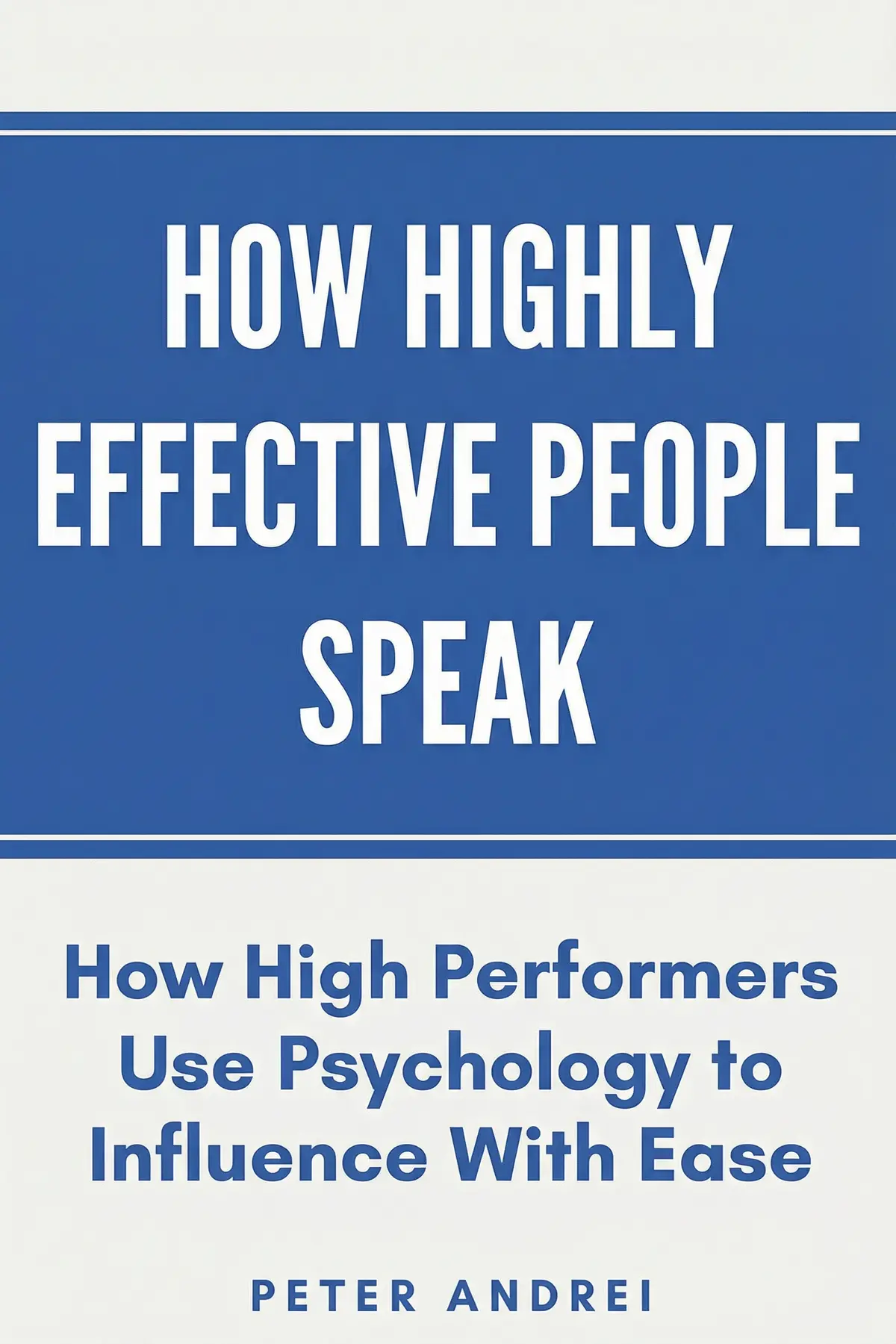
Table of Content
1. Introduction
1 min 03 sec
If your ideas are sound but rarely move a room, the trouble may lie in how they reach the listener’s mind. In How Highly Effective People Speak, presentation coach Peter Andrei argues that persuasive speakers send their messages in the shape human brains are built to receive.
That shape is set by a handful of cognitive biases, the mental shortcuts behavioral economics describes, and anyone can learn to work with them. Andrei, once an anxious speaker himself, takes his examples from speeches by Ronald Reagan and John F. Kennedy, from money-back guarantees and from a Cold War survival trick.
His promise is modest in a useful way. You do not need all five biases to stand out. Learning to use a single one well already puts you ahead of most speakers.
What follows shows how to win trust before your first point, make a fact stick in memory, frame a choice so the right answer looks obvious, and remove the fear that stops people from saying yes.
2. Win the room before your first point
1 min 45 sec
A president about to ask his country for something enormous spent his opening lines on compliments. That choice reveals how much an audience decides about you before you have said anything that matters.
3. Earn agreement by sharing your audience's view
1 min 45 sec
Ask yourself how often you agree with someone you already dislike. The honest answer exposes a lazy habit of the mind, and a speaker who understands it can turn it from an obstacle into an advantage.
4. Turn your facts into stories people recall
1 min 55 sec
Two people asked about shark attacks give opposite answers, and both feel completely sure. Their disagreement shows why a careful table of statistics can lose to a single image, and what a speaker should do about it.
5. Set your idea against its opposite
1 min 45 sec
Ronald Reagan refused to describe politics as left versus right and offered another pair of directions instead. His reframing shows how placing the right alternative beside your idea can make listeners choose it themselves.
6. Remove the risk that stops a yes
1 min 45 sec
Offered a certain $900 or a slightly uncertain $1,100, most people grab the sure thing, even though the math says otherwise. That instinct shapes every pitch you make, and it can work in your favor.
7. Conclusion
1 min 13 sec
Andrei’s book adds up to a reassuring claim for anyone who dreads speaking. Charisma is less a gift than a fit: the best speakers learn how listeners’ minds sort information, then shape what they say around it. Kennedy praising his hosts before asking for the moon, Reagan placing freedom beside an ant heap, a company offering a refund it can afford: each worked because it met a shortcut the audience was already using.
Andrei himself started out as a nervous speaker who struggled to finish a speech, which makes his point about learned skill easier to believe.
The practical move is to pick the bias that fits your next conversation. If you are presenting numbers, find the single story behind them and lead with it. If you are asking someone to commit, look for the risk you can honestly bring to zero. If you are meeting someone new, plan your first impression, from the room to your clothes to your opening words of respect.
Andrei warns that every one of these tools serves dishonest causes too, and his answer is for truthful people to master them first. You do not need all five. One shortcut, used well and used honestly, is enough to make people hear what you came to say.
About this book
What is this book about?
Many capable people have good ideas that never seem to land. They prepare the facts, make the case and watch the room stay unmoved. Peter Andrei argues that fluent, compelling speech is not a talent you either have or lack. It is a skill, and its core is simple: influential speakers deliver their messages in the form human minds are built to receive. Andrei, a presentation coach who began as an anxious speaker, builds the book around five cognitive biases studied in behavioral economics. They are the halo effect, attribute substitution, the availability bias, the contrast effect and the zero-risk bias. For each one he explains how it bends the way people take in information, then turns it into tactics for a meeting, a pitch or a stage. His examples run from speeches by Ronald Reagan and John F. Kennedy to money-back guarantees and a Cold War trick for judging radiation danger. Readers get a short, usable toolkit and a reassuring promise: you do not need to master all five. Using one well, and honestly, is enough to stand out.
Book Information
Who it's for
Professionals feeling unheard
Professionals with solid ideas who leave meetings and pitches feeling unheard.
Needing prospects to commit
Founders and salespeople who need prospects to trust them quickly and commit.
Nervous about a talk
Nervous speakers preparing a talk who want a few concrete techniques instead of vague tips on confidence.
About the Author
Peter Andrei
Peter Daniel Andrei is a presentation coach and communication and public speaking consultant, and the founder of Speak Truth Well LLC. He was once an anxious speaker who struggled to finish a speech. As a competitive speaker he went on to win 37 awards and the Massachusetts Debate League State Championship. He has coached hundreds of people, including entrepreneurs, trial lawyers and CEOs, run seminars at Fortune 500 companies, and written the 15-book Speak for Success series.
Ratings & Reviews
Ratings at a glance

What people think
Listeners find the work’s investigation into cognitive biases and behavioral economics to be an enlightening and useful manual for perfecting influential communication. They value the straightforward analysis of techniques like the contrast effect and the zero-risk bias, which aid in forming more convincing messages. Although some listeners view the absence of formal citations and source documentation as a downside, they still prize the practical strategies for use in everyday life. Additionally, they point out the usefulness of the included psychological examples, with one listener remarking that the book effectively shows how to speak with eloquence by leveraging natural patterns of human behavior.
Top reviews
Parichat
This is a must-read for anyone who feels like their message is getting lost in the noise of everyday life. I found the concept of 'Attribute Substitution'—where the brain swaps a hard question for an easy one—to be a genius observation on human nature. Andrei explains how to simplify complex ideas so that your audience doesn't have to work so hard to agree with you. It’s a thin book, but every page is packed with tactics that you can use immediately. Some might complain about the formatting, but I liked that it didn't feel like a dry textbook. It’s fast-paced, insightful, and highly practical. I’ll definitely be re-reading this before my next big presentation to keep the info fresh.
Show moreViolet
After hearing so much about cognitive biases, I finally found a book that actually explains how to use them in real-time conversation. The secret behind effective communication isn't just about what you say, but how you frame it to match how our brains are wired. I especially loved the advice on making messages memorable through drama and conflict rather than just data. It’s a powerful realization that an emotional story wins over accuracy every single time in the eyes of an audience. This book takes the complex world of behavioral economics and makes it accessible for the average person. If you want to move people to action, you need to understand the psychological levers Andrei describes here. Five stars for the utility alone.
Show moreSuthida
To be fair, there is some solid psychological theory buried in here if you can get past the lack of formal citations. I found the chapter on the 'Halo Effect' particularly enlightening, especially the breakdown of John F. Kennedy’s 1962 moon speech. It really shows how first impressions and early compliments can prime an audience to be more receptive to a complex message. The author’s writing style is punchy and direct, which makes the concepts easy to digest. While some critics point out the lack of academic rigor, the practical application of these cognitive biases is where the book shines. Not gonna lie, I’ve already started using some of these techniques in my weekly team meetings and noticed a difference in how people respond.
Show morePrapaiwan
Finally got around to finishing this, and I have to say the section on the 'Zero-Risk Bias' was a total game-changer for my sales pitches. Understanding that people value a 0% chance of a small failure over a high chance of a massive success is such a subtle but powerful realization. The book is structured in a way that makes it easy to jump around to the parts you need most. My only real gripe is that it feels a bit repetitive at times, and the author’s 'voice' can come across as a bit condescending. But if you can look past that, the strategies for crafting a message that taps into human behavior are genuinely helpful. It’s a practical toolkit for anyone who needs to be more persuasive.
Show moreMoo
The way Andrei breaks down the science of persuasion makes it feel much less like a 'gift' and more like a learnable craft. I loved the examples using figures like Ronald Reagan to illustrate the 'Contrast Effect.' It’s fascinating to see how high performers use antithesis to make their recommendations look like the only logical choice. In my experience, most communication books are too fluffy, but this one gets straight to the behavioral economics. Yes, the lack of an index and the strange graphics are a bit annoying, but the core message is sound. It’s about understanding the shortcuts our brains take and using them to ensure our message is actually heard. Definitely worth a look for those in leadership roles.
Show moreJin
Is this really how highly effective people are supposed to communicate? I found the content to be a bit of a mixed bag, with some genuinely interesting insights on cognitive biases buried under a very aggressive, almost arrogant tone. Personally, I think the breakdown of the 'Contrast Effect' was useful, and I can see how applying it could make a presentation more punchy. However, the technical names for everything got a bit tiresome, and the references were squeezed directly into the text instead of being organized in an appendix. It really disrupted my reading flow. Also, be warned that the website link at the end of the book is a dead end. It’s a decent primer, but don't expect a scholarly masterpiece.
Show morePracha
Frankly, I have mixed feelings about this one. On one hand, Peter Andrei does a solid job of explaining how humans are wired to receive information, which is the heart of persuasive speech. The concepts like 'Attribute Substitution' and the 'Availability Bias' are clearly explained and easy to grasp. On the other hand, the book is quite short and feels like it could have been a series of blog posts. The truth is, if you’ve ever taken an introductory psychology or marketing class, a lot of this will feel like a refresher. It’s not a bad book, but it lacks the depth I was hoping for. It’s a quick read for a weekend, just don’t expect a life-changing revelation.
Show moreWillow
Ever wonder why some people can talk their way into or out of anything? This book tries to solve that puzzle by looking at the science behind persuasion. I appreciated the section on the 'Availability Bias' and how using vivid, emotionally-charged stories is always going to beat out a boring list of statistics. However, I’ve got to say, the lack of a reference page is a major red flag for me. If you’re going to quote independent studies, you need to provide the receipts. The content itself is actionable, but the presentation feels a little amateur. It’s a good starting point for someone who wants to be more influential, but you’ll probably want to supplement it with more reputable research.
Show moreSoontorn
I’m genuinely baffled by the recommendations for this one, as it mostly feels like an over-hyped infomercial for common sense advice. The back cover promises fifty-seven 'revolutionary' psychological studies, yet I struggled to find any legitimate citations or a proper reference page to back up the author’s big claims. Frankly, the writing style is repetitive and the graphics look like they were made in a basic Word document from a decade ago. It’s hard to take a book on 'highly effective' speaking seriously when it focuses so much on masculine bias, like suggesting you need a deep voice to be influential. If you want to understand behavioral economics, there are much better, more academic sources out there. This felt more like a collection of high school debate notes than a professional guide.
Show moreCameron
The back cover makes some pretty big promises that the actual content fails to deliver in any meaningful way. Look, I wanted to like this, but the lack of formal evidence really killed my interest halfway through. Every time the author mentioned a 'proven technique' or a 'groundbreaking study,' I looked for a footnote and found absolutely nothing. It makes the whole thing feel like a 'trust me, bro' kind of guide. Plus, the advice seems heavily skewed toward a very specific type of male speaker, which felt outdated. The formatting is cluttered and the constant repetition of the same five biases started to feel like filler after the third chapter. There is some value here if you are a total beginner, but for anyone who has read even a little bit about psychology, it’s a letdown.
Show moreQuestions about this book
What is the main idea of How Highly Effective People Speak?
Peter Andrei argues that persuasive speaking is a learnable skill, not an inborn gift. Effective speakers deliver messages in the form human minds naturally receive, which means working with a few cognitive biases: the halo effect, attribute substitution, the availability bias, the contrast effect and the zero-risk bias. He shows how each one shapes the way people judge information and turns it into tactics, adding that mastering even one sets a speaker apart.
How does the halo effect help when speaking in public?
Andrei explains that a good first impression leads listeners to assume other good qualities, while a poor one invites assumptions of further faults. So he advises managing the opening: arrive early to learn the room and equipment, speak clearly, use open body language and dress slightly above the average. He points to John F. Kennedy, who praised his hosts at Rice University in 1962 before making the case for the moon.
Why are stories more persuasive than statistics, according to Peter Andrei?
Because of the availability bias. People give extra weight to whatever they can recall quickly, and a vivid story is easier to recall than a number. Andrei suggests framing information as a story with clear characters, ideally a hero and a villain, and real conflict. One gripping account of a man fighting a shark, he argues, persuades more than a long list of figures about shark attacks.
How can I use the zero-risk bias in a pitch without overpromising?
Andrei notes that people strongly prefer options with no risk, partly because studies show losses hurt about twice as much as equal gains please. If you cannot offer a guarantee, highlight secondary things that truly carry zero risk. His example is an ethical investment portfolio emphasizing no failed transactions, no long hold times and no money in unethical businesses. He stresses making only promises you can keep.
Who should read How Highly Effective People Speak?
It suits people who speak to persuade: managers presenting proposals, founders pitching investors, salespeople and anyone preparing a talk. It is especially useful for nervous speakers, since Andrei began as one himself. The book is practical, giving one cognitive bias at a time with a clear tactic, so readers can start with a single technique, such as leading with a story, and use it in their next meeting.
Readers also enjoyed









AUDIO SUMMARY AVAILABLE
Listen to How Highly Effective People Speak in 15 minutes
Get the key ideas from How Highly Effective People Speak by Peter Andrei, plus 5,000+ more nonfiction titles.
- 5,000+ titles
- Listen as much as you want
- 7-day free trial
- Cancel anytime









