

15 min 19 sec
Available in: English
 ไทย
EnglishไทยHiroshima
By John Hersey
Follows six ordinary residents of Hiroshima through the atomic bombing of August 1945 and the decades after, turning a vast death toll into human stories of luck, courage, radiation sickness and very different ways of rebuilding.
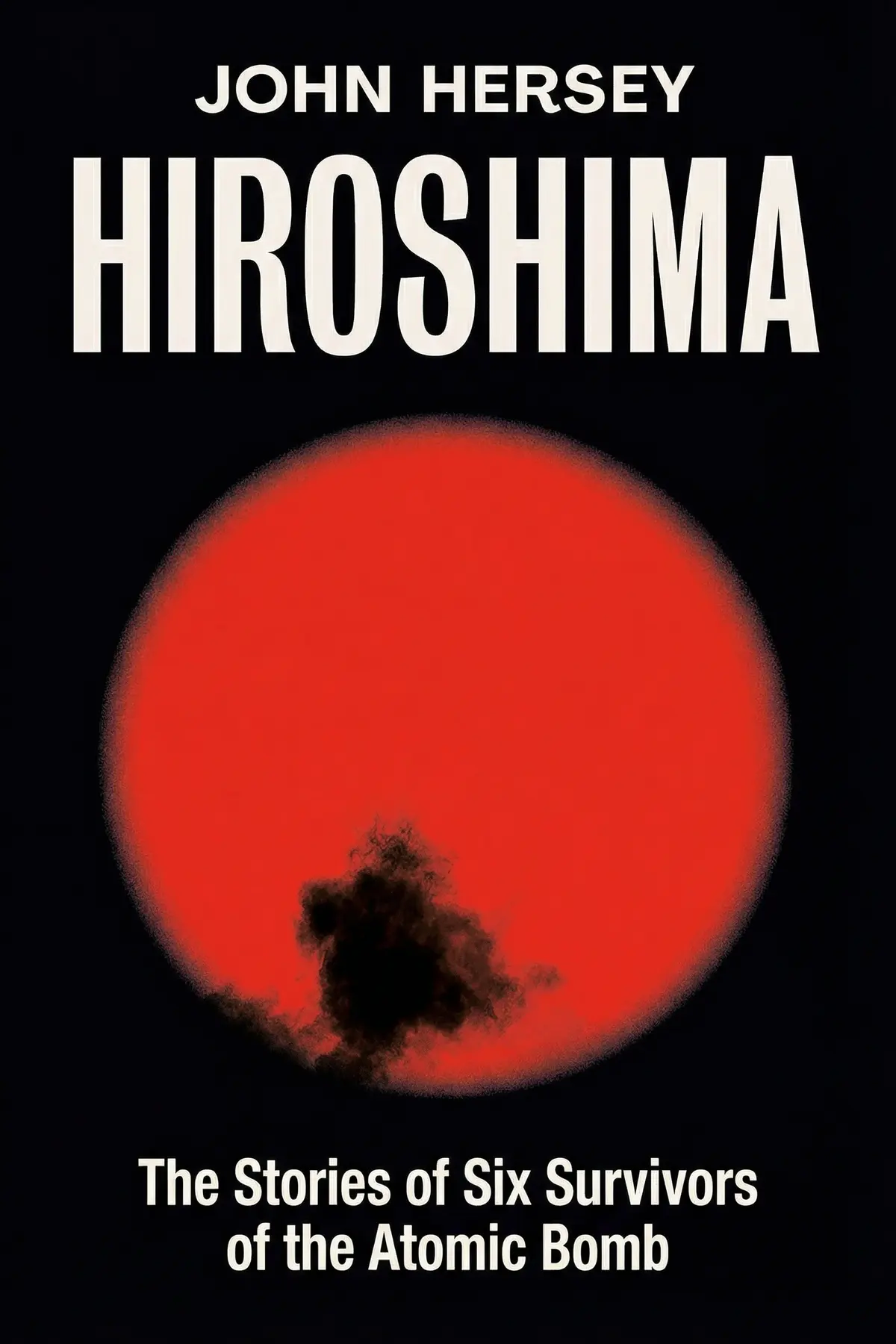
Table of Content
1. Introduction
1 min 07 sec
Hiroshima is usually remembered as a number, more than a hundred thousand dead, and numbers are easy to set aside. In Hiroshima, journalist John Hersey refused that distance. One year after America dropped an atomic bomb on the Japanese city, he traced six survivors from that August 6, 1945 morning into the weeks that followed, recounting their real experiences with the techniques of a novelist.
The six were a pastor, a widowed mother of three, two doctors, a German priest and a young office clerk. None was saved by planning. Each was saved by where they happened to be at 8:15. What they did next, and how differently they lived with it for decades, is Hersey’s real subject: a catastrophe is lived one person at a time, and each response shapes what survives. He went back in 1985 to learn their fates. Some of what follows is distressing. By the end, a statistic becomes six faces, and a clearer picture of what ordinary people do when the worst arrives.
2. Learn how a few inches decided who lived
2 min 03 sec
Six people stood, sat or leaned in different places at 8:15 one August morning, and those small accidents decided their fate. Hersey starts there for a reason, and it changes how you judge every survivor who follows.
3. What one man's run reveals about courage and guilt
1 min 54 sec
A pastor walked away from the flash almost unhurt and felt ashamed of it. What he did with that shame over the next hours says a lot about how people respond when they are spared.
4. Do the next useful thing when everything falls
2 min 11 sec
With no rescue coming, a mother, a priest and two doctors each improvised in the ruins. Some choices were wise, some were strange, and one young doctor’s rule for spending his strength still holds.
5. Kindness that holds when rescue never comes
2 min 04 sec
In a crowded park, a promised hospital ship never arrived and a fire crept closer. One man’s long night with a small boat shows both how far care can stretch and where it fails.
6. See how the damage kept arriving after the fire
2 min 25 sec
Weeks after the blast, survivors who seemed fine began losing hair and bleeding under the skin, while their ruined city burst into unexpected color. Nobody yet knew what had hit them.
7. Two ways survivors carried the bomb for decades
2 min 23 sec
Decades later, one survivor toured the United States raising funds and met a bomber pilot on television, while another simply went back to work. Their opposite answers raise a hard question about living after the unthinkable.
8. Conclusion
1 min 12 sec
Hiroshima works because Hersey never asks anyone to imagine a hundred thousand deaths at once. He asks them to follow six people: a pastor ferrying the dying across a river, a mother sinking her sewing machine in a water tank, a doctor working until he collapses outside his hospital. Through them, the bomb becomes something you can picture and describe to someone else.
The book also refuses easy comfort. Chance chose who lived. Courage could not save everyone, and the tide took the people Tanimoto had carried. Survival itself brought radiation sickness, suspicion from neighbors and years of waiting for help.
What remains is the range of human response. The next time you read about a disaster, look past the total to the people inside it, and notice how differently they act: some run toward others, some endure, some rebuild loudly and some in silence. Give endurance like Mrs. Nakamura’s the same respect as Tanimoto’s activism.
When Miss Sasaki finally saw her ruined city, it was covered in flowers.
About this book
What is this book about?
On August 6, 1945, an American atomic bomb destroyed the Japanese city of Hiroshima, and more than a hundred thousand people died. Figures that large are hard to feel. A year later, journalist John Hersey set out to make the event human by following six survivors who happened to be far enough from the center to live. His cast includes a pastor, a war widow with three young children, two doctors, a German Jesuit priest and a young clerk trapped under fallen bookcases. Hersey tracks them through the flash, the fires and the crowded riverside park where the injured gathered. He then follows them through the strange weeks when radiation sickness appeared and nobody knew what had hit them. First published in the New Yorker, the account uses the techniques of fiction to tell a true story. In 1985 Hersey returned to learn what had become of the six. Readers get a vivid, humane picture of the bombing and a clear look at the many ways people respond to catastrophe, from public activism to patient endurance.
Book Information
Who it's for
Wanting Hiroshima's human side
Readers who know Hiroshima only as a date and a death toll and want to understand it through real people.
History and journalism students
Students of history or journalism exploring how true events can be told with a novelist's craft.
Facing grief or crisis
People facing grief or crisis who want to see the different ways others have carried catastrophe.
About the Author
John Hersey
Born in Tientsin, China, in 1914, John Hersey came to the United States in 1925 and died in 1993. He studied at Yale University, where he later taught, and his novel A Bell for Adano won the Pulitzer Prize in 1945. He was one of the earliest practitioners of New Journalism, which applies fiction's techniques to factual reporting. In 1999 a panel of 36 people tied to New York University's journalism department chose Hiroshima as the finest work of American journalism in the 20th century.
Ratings & Reviews
Ratings at a glance
What people think
Listeners consider this work gripping and expertly crafted, especially valuing the way it follows the experiences of 6 different survivors. Furthermore, they view it as a necessary read, particularly for those in high school, and praise the depth of research and historical precision. However, the production quality gets varied reviews; several listeners pointed out typos and noted that certain parts were omitted, specifically chapter 5 and the 1985 Aftermath section.
Top reviews
Palm
This book doesn't just list statistics; it breathes life into them. John Hersey manages to take the incomprehensible scale of the atomic bomb and shrink it down to the size of a human heart by following six specific survivors. I was particularly moved by the story of the young factory worker, Miss Sasaki, and her long road to recovery. To be fair, the prose is quite sparse and detached, but that almost makes the descriptions of skin "hanging from faces" more visceral because the author isn't trying to manipulate your emotions with flowery language. It is a haunting, gut-wrenching account that should be mandatory reading for every human being. The way it transitions from the morning of the blast to the long years of radiation sickness afterward provides a complete picture of a tragedy we often only see in black-and-white photos.
Show moreNarongrit
As a history buff, I thought I knew what happened in 1945, but reading this was a completely different experience. We always hear about the "big" numbers—100,000 dead—but Hersey forces you to look at the individual faces of those who were just trying to survive. Seeing the world through the eyes of a German priest and a Japanese doctor provides a unique perspective on the chaos of that day. Frankly, the descriptions of the burns and the "silent" victims fleeing the city will stay with me for a long time. It’s not an easy read by any means, but it is a necessary one. We need to remember that these were people with families and dreams, not just enemies or statistics on a page.
Show moreVilaiporn
Wow, I was not prepared for how deeply this would affect me. John Hersey doesn't rely on flashy adjectives to tell his story. He just presents the facts as they happened to Father Kleinsorge, Dr. Fujii, and the others. This "matter of fact" style makes the reality of the atomic bomb so much more terrifying because it feels so real. You feel the heat of the flash and the confusion of the citizens who had no idea what had just hit them. Personally, I found the section on radiation sickness to be the most disturbing part of the book. It’s one thing to survive a blast, but quite another to watch your body waste away from an invisible poison weeks later. Truly a life-changing read.
Show moreCharlotte
The sheer resilience of the human spirit documented here is nothing short of miraculous. Even in the face of "hell on earth," you see people like Dr. Sasaki working for days without sleep to help others. This book is a powerful testament to our ability to endure the unthinkable. Hersey’s prose is spare, but it captures the spirit and resolve of the Japanese people with incredible dignity. I was moved to tears by the final sections detailing how the survivors' lives turned out decades later. It makes you realize that survival isn't just about staying alive during the blast; it's about the courage to keep living every day after. Truly a masterpiece of reporting.
Show moreLek
Hersey's journalistic approach creates a chilling distance that somehow makes the horror feel more immediate. Instead of a sweeping political analysis of Truman’s decision, we get the granular details of a doctor trying to function in a hospital where most of his colleagues are dead. Truth is, I found the first half covering the immediate blast much more engaging than the later updates added in the 1980s. Some might find the matter-of-fact tone a bit dry, but I think it was necessary to avoid turning such a catastrophe into a melodrama. My only gripe is that my copy seemed to have some formatting issues, with a few typos that pulled me out of the narrative. Still, it is an essential piece of historical reporting that gives a human face to those who were silenced.
Show moreAlice
Following the lives of two doctors, a seamstress, and three others gives a panoramic view of the tragedy that no textbook could ever provide. I picked this up because I wanted to understand the human side of the Manhattan Project's aftermath. The writing is reminiscent of Yasunari Kawabata—simple, direct, and incredibly powerful in its restraint. It’s fascinating how the book was originally suppressed in Japan by the US military; you can see why they’d want to hide the sheer level of suffering depicted here. My version was missing the famous Chapter 5 "The Aftermath" section, which was a huge disappointment since I wanted the full scope of their lives decades later. Despite that, the initial four chapters are a masterclass in narrative non-fiction.
Show moreOwen
The second half of the book, which delves into the long-term effects of radiation sickness, is where the true terror lies. It’s moving to see how these survivors—the "hibakusha"—tried to reclaim their lives in a world that often wanted to forget them. I think Hersey did a brilliant job of humanizing the victims without making the book feel explicitly like a political lecture. He lets the tragedy speak for itself. In my experience, most war books focus on the soldiers, so focusing on a widowed seamstress or a young clerk felt refreshing and deeply grounding. It’s a somber reminder of why world peace should be our only goal.
Show moreSomrutai
After hearing about this book for years, I finally sat down with it and realized why it's required reading in so many schools. It’s one thing to know the date August 6th, 1945, and quite another to understand the "complete and utter chaos" that occurred at 8:15 am. The way Hersey weaves the six narratives together is seamless. You see the same events from different corners of the city, which helps you grasp the scale of the devastation. I think every high school student should have to read this to understand the true cost of war. It’s a short book, but it carries a weight that lasts much longer than the time it takes to read.
Show moreKamol
While the content is undeniably vital for everyone to read, this specific digital edition was a bit of a mess. I encountered numerous typographical errors and even noticed that sections of the 1985 update seemed to be cut off mid-sentence. Look, Hersey's work itself is five stars, but the presentation here makes it hard to recommend this particular version. The stories of the six survivors are heartbreaking and offer a "vision of hell on earth" that everyone should confront. However, when you're trying to immerse yourself in such a serious subject, a glaring typo every ten pages is a major distraction. If you're going to read this classic, do yourself a favor and find a high-quality physical copy instead of a cheap e-book.
Show moreTim
I really wanted to appreciate this classic, but I found the dry, clinical tone almost impossible to get through. Not gonna lie, I expected something a bit more emotional given the subject matter. Instead, it felt like reading a very long newspaper article from the 1940s. While I understand that Hersey was a journalist and was intentionally being objective, I struggled to form a real connection with any of the survivors because the narrative kept jumping around so much. Also, my edition was missing Chapter 5 entirely! It just ended abruptly. I recognize the historical importance of this book, but as a reading experience, it just didn't click for me.
Show moreQuestions about this book
What is Hiroshima by John Hersey about?
It tells the story of the atomic bomb dropped on Hiroshima on August 6, 1945, through six survivors who were far enough from the center to live. Hersey follows them through the flash, the fires, the crowded refuge of Asano Park and the arrival of radiation sickness. In 1985 he returned to the city and added an account of how each of them lived in the decades after.
Who are the six survivors in Hiroshima?
They are the Reverend Kiyoshi Tanimoto; Hatsuyo Nakamura, a war widow with three young children; Dr. Masakazu Fujii, who had been living in a private hospital; Father Wilhelm Kleinsorge, a German Jesuit priest; Dr. Terufumi Sasaki, the only doctor at the Red Cross Hospital who escaped injury; and Toshinki Sasaki, who worked as a young clerk in a tin factory and has the same surname as the doctor but no family tie to him.
What happened to the survivors after the bomb in Hiroshima?
Their lives went in very different directions. Miss Sasaki became a nun who cared for the dying. Father Kleinsorge became a Japanese citizen named Makoto Takakura. Both doctors built successful practices. Mr. Tanimoto became a spokesperson for the hibakusha and toured the United States raising funds. Mrs. Nakamura worked for years at a mothball company, avoided politics and summed up her outlook as it can’t be helped.
Why is Hiroshima considered important journalism?
First published in the New Yorker and then as a book, it used novelistic techniques to report real events, helping pave the way for the New Journalism of writers such as Truman Capote decades later. In 1999 a panel of 36 people connected to New York University’s journalism department chose it as the best American journalism of the 20th century.
What can readers learn from Hiroshima?
The book shows that disaster is lived person by person. Chance decided who survived, but what people did next varied widely, from Dr. Sasaki’s 19-hour shift to Mr. Tanimoto ferrying the injured across a river. It also suggests that very different responses, public activism and private endurance, are both real ways of carrying a catastrophe.
Readers also enjoyed
Alexander Hamilton
Ron Chernow

Alexander the Great
Philip Freeman


A History of Iran: Empire of the Mind
Michael Axworthy

A History of the World in 6 Glasses
Tom Standage

A Long Way Gone: Memoirs of a Boy Soldier
Ishmael Beah


AUDIO SUMMARY AVAILABLE
Listen to Hiroshima in 15 minutes
Get the key ideas from Hiroshima by John Hersey, plus 5,000+ more nonfiction titles.
- 5,000+ titles
- Listen as much as you want
- 7-day free trial
- Cancel anytime









