

59 Seconds: Change Your Life in Under a Minute
Richard Wiseman
 English
Shows that exceptional people are built rather than born, and teaches the habits of thought behind them: training creativity, choosing discomfort, telling your own story, leading quietly and finding yourself by elimination.
1 min 11 sec
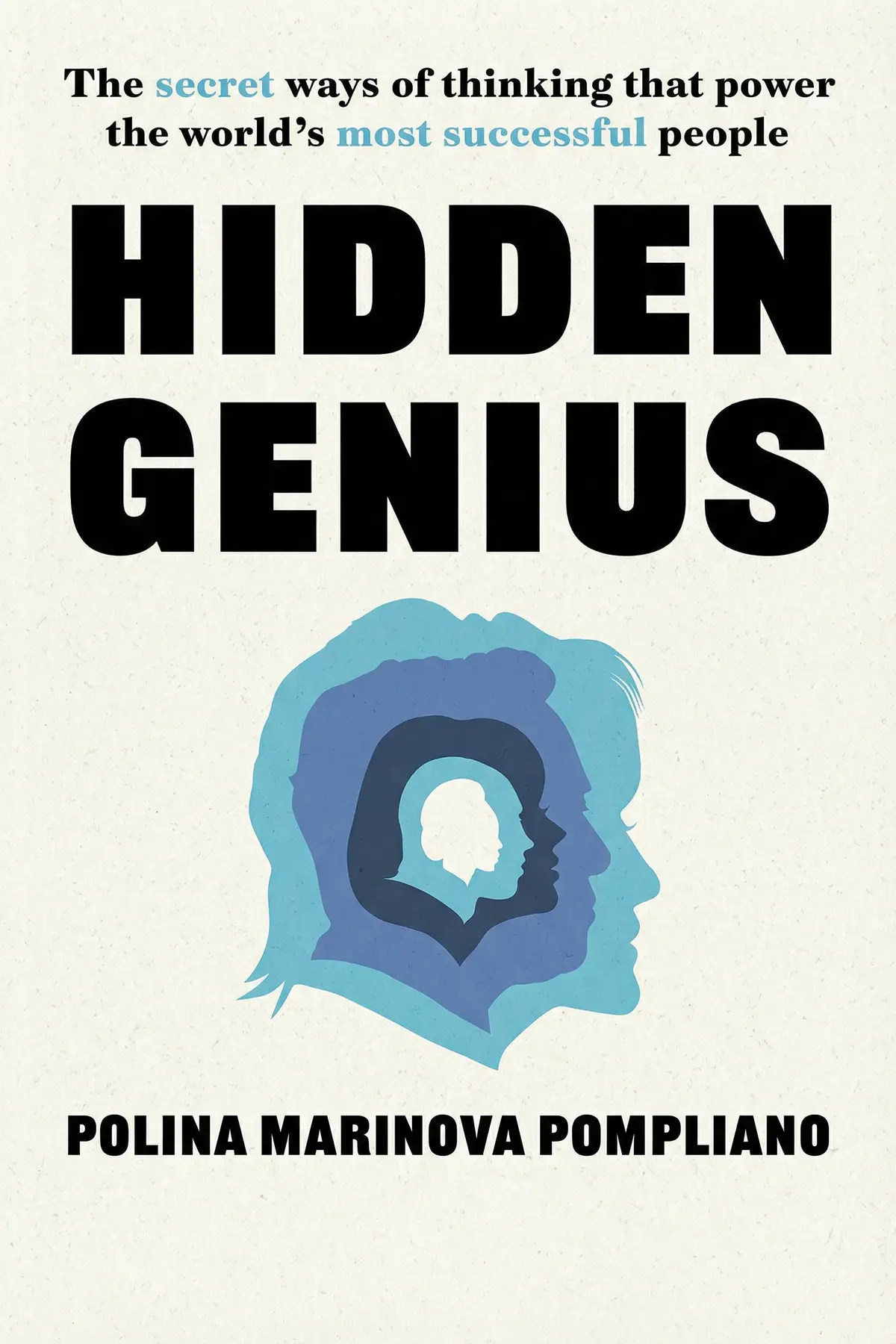
If you have ever filed yourself under not creative, not a leader or not tough enough, Polina Marinova Pompliano thinks you have misread how exceptional people get that way. In Hidden Genius, the founder of the media company The Profile argues that remarkable people are built rather than born. They practice particular ways of thinking that make them see the world differently, and those habits can be copied.
Her evidence is a gallery of lives. Leonardo da Vinci hears church bells over a rippling well. An unfit pest control technician becomes a Navy SEAL. A fighter who left Cameroon as a poor young man becomes a UFC heavyweight champion. A shy singer invents a bolder self for the stage.
Each one shows a mental move you can borrow: connecting unrelated ideas, choosing discomfort on purpose, taking charge of your own story, leading without the spotlight and finding who you are by ruling out who you are not. Learn those moves and genius starts to look like a practice, something you can begin on an ordinary weekday.
2 min 09 sec
Most people decide early whether they are the creative type, then stop trying. A walk past a well and the doubts of a Pixar co-founder suggest that verdict was never theirs to make so soon.
2 min 05 sec
Nobody signs up to suffer. Yet a former pest control worker turned his worst training days into three rules for mental toughness, and one of them claims you usually quit far too early.
1 min 55 sec
When a worry sits too close, it fills the whole picture. A global pop star and a therapist each found a way to put some distance between a person and their fear, and both take minutes.
2 min 09 sec
A showrunner’s rule and the street questions behind Humans of New York can turn a dull pitch or an ordinary stranger into something people lean in to hear. The trick is knowing where to look for the tension.
1 min 50 sec
The loud chief executive is the picture most people carry of a leader, and it keeps many from trying. Two tech company leaders show a quieter model, one that goes after the root cause so similar problems stop recurring.
1 min 51 sec
Searching for your true self can stall for years. A UFC champion who grew up poor in Cameroon found his direction another way, by deciding exactly who he would never become.
1 min 07 sec
Hidden Genius adds up to a democratic claim: the distance between ordinary people and exceptional ones is mostly a matter of habits of thought, and habits can be learned. Da Vinci found his insight in a ripple and a bell heard at the same moment. Goggins started as an unfit pest control technician and chose the harder option again and again. Beyonce kept her shyness and gave her courage a separate name. Ngannou began with only a clear picture of who he refused to become.
The way to use the book is to start small. When your mind says stop, remember the 40 percent rule and keep going a little further. When worry takes over, write the situation through someone else’s eyes. When a project stalls, look for the system that allowed the failure and change it. And when a label like not creative comes up, swap it for a question.
None of these people were finished when their stories began. Whatever genius they had was hidden in what they practiced every day, and that place is open to anyone willing to start.
Many capable people rule themselves out without ever saying so. They decide they are not creative, not tough, not natural leaders, and they treat genius as something handed to a lucky few at birth. Polina Marinova Pompliano argues the opposite. In her view, the people we call exceptional share mental frameworks and qualities that let them see the world differently, and those can be studied and copied. She builds the case from lives. Leonardo da Vinci links a rippling well to ringing church bells. David Goggins turns from an unfit pest control technician into a Navy SEAL with three rules for mental toughness. Beyonce invents a bolder stage self. Aaron Sorkin and Brandon Stanton show how to find the story in anything, Spotify's Daniel Elk leads from below while Canva CEO Melanie Perkins fixes systems instead of single problems, and Francis Ngannou finds his path by refusing to become his father. Readers get a set of small, usable practices: a writing exercise for anxiety, a rule for pushing past the urge to quit, three questions that draw out anyone's story, and a way to define who you want to be by removing who you are not.
Professionals who have labeled themselves not creative or not a leader and want proof those labels can change.
Young people early in their careers looking for practical habits of resilience and self-belief.
New team leads who want a quieter, systems-focused way to lead.
Polina Marinova Pompliano founded The Profile, a media company that studies how successful people and businesses work. Before that she spent five years at Fortune, where she published more than 1,300 articles and wrote and edited Term Sheet, the magazine's dealmaking newsletter. Her interviews there included Melinda Gates, Steve Case and Chamath Palihapitiya, which gave her a close view of how high performers think.
Listeners find this work engaging and simple to digest, noting that the chapters merit being read over and over. Additionally, they value the useful guidance and rich information, with one listener observing that it functions as a roadmap for reaching top potential. Furthermore, the narrative quality is excellent, and listeners prize the functional concepts, with one listener mentioning its effectiveness in building mental toughness.
Ever wonder how the world's most resilient people actually handle pressure without breaking? Hidden Genius dives into the psychology of high performers by breaking down their thought patterns into digestible, bite-sized lessons that anyone can use. I found the storytelling to be fantastic, especially when Polina discusses how to personify fear as a bully to take away its power. Not gonna lie, I’ve already started applying the 'five positive interactions' rule in my own marriage and the results were almost immediate. This isn't just a book you read once; it’s a toolkit you’ll want to revisit when you’re facing a period of uncertainty. The focus on becoming a 'risk technician' rather than a reckless gambler is the kind of practical advice missing from most self-help fluff. If you want a roadmap to reach your top potential, this is it.
Show moreWow. I didn't think a book could change how I view my own failures so quickly, but the chapter on mental toughness did exactly that. Polina writes with a clarity that only comes from years of studying high-level performers, and her ability to synthesize their habits is remarkable. Personally, I was most struck by the idea of 'deliberate wondering' to generate new ideas—it’s such a simple shift in mindset. The book is essentially a roadmap for personal excellence, filled with actionable ideas like the 40% rule and the trust battery. I’ve already highlighted several sections to share with my team at work. It feels less like a dry business book and more like a conversation with a very smart friend who has done all the research for you. If you’re looking for nuggets of inspiration that actually stick, this is your book.
Show moreThis book is basically a roadmap for anyone looking to bridge the gap between where they are and their top potential. I loved how Polina emphasizes that we all have a bit of 'amazing' in us, provided we know how to unlock it. The storytelling is fantastic, drawing on such a wide range of individuals that you're bound to find someone whose path mirrors your own. I found myself taking pages of notes on how to improve my own content diet and how to be a more effective leader. It’s a superb book that manages to be both entertaining and deeply practical without being boring. I’ll definitely be keeping this on my desk to revisit whenever I need a reminder to focus on the next play instead of the scoreboard. Truly a great read for anyone looking to level up their life.
Show moreThe chapter on optimizing your content diet really hit home for me because it forced me to look at what I'm actually consuming. Truth is, most of us are just passive observers, but Polina challenges you to mix fashionable news with unfashionable, timeless wisdom. While some sections felt a bit like a Skittles bag of ideas—fun but light—the actionable advice on building habits is genuinely useful for anyone feeling stuck. I especially liked the concept of the 'trust battery' in relationships; it’s a simple metaphor that makes perfect sense for long-term consistency. Even if you've heard some of this before, the way she packages these insights makes them feel fresh and urgent. It’s a quick read that doesn't overstay its welcome, though I wish some of the success stories had a bit more grit. Overall, it’s a solid roadmap for personal growth.
Show moreAs someone who struggles with delegation, Pompliano's insights on leadership and 'playing the next play' were incredibly timely. She has a way of distilling complex career trajectories into simple patterns of behavior that feel attainable rather than intimidating. The writing style is punchy and direct, which makes it easy to breeze through a couple of chapters in one sitting. I did find the first half of the book, particularly the stuff on creativity and cross-disciplinary thinking, much more compelling than the later chapters on community. To be fair, the 'trust battery' concept is something I'll be thinking about for a long time in my professional life. It’s a sincere book that avoids the preachy tone often found in this genre. It might be a bit of a pastiche, but the pieces fit together well enough to be highly valuable for young professionals.
Show moreFinally got around to finishing this over the weekend, and it’s a solid toolkit for young professionals looking for a boost. Polina uses her experience at Fortune to cull information from an incredible variety of sources, making this a diverse read. The idea that competence breeds confidence resonated with me deeply because I often wait to feel ready before I act. However, some of the stories felt a bit short, leaving me wanting more detail on the struggle rather than just the success. I loved the section on storytelling—using 'but' and 'therefore' instead of 'and then' is a game-changer for my own presentations. While some bits are a bit trite, the overall package is an inspiring collection of essays. It’s a great gift for anyone on the brink of a creative leap in their career.
Show moreAfter hearing Polina speak on several podcasts, I was curious if the book would just be a rehash of her interviews. It actually offers a much more structured approach to her research, grouping these 'genius' traits into logical chapters that build on one another. The concept of being a 'risk technician' who observes their breathing during uncertainty is a specific, practical tip I haven't seen elsewhere. I do think the book can be a bit superficial at times, moving from one anecdote to the next without much pause for breath. But the core message—that creativity is a muscle rather than a gift—is one that many people need to hear. Frankly, the questions at the end of each chapter are worth the price of the book alone. They forced me to examine where I was being a slave to my own beliefs.
Show moreTo be fair, this feels more like a curated collection of newsletter highlights than a cohesive, deep-dive manual for life. Look, the anecdotes are certainly entertaining and well-written, but the book occasionally struggles with the standard problem of survivorship bias. It’s easy to point at successful people and say 'do this,' but what about the thousands who tried the same thing and failed? The chapter on mental toughness and the 40% rule was interesting, but it felt a bit like a surface-level summary of things you might find in a longer biography. I did appreciate the '10 Questions to Discover Your Hidden Genius' at the end of the chapters, as they provided a moment for actual reflection. It is a pleasant pastiche of ideas, yet it might leave readers who want rigorous frameworks feeling slightly underwhelmed. It’s better as a starting point for further research rather than a final destination.
Show morePersonally, I found the first half of the book significantly more compelling than the sections on community building or content diets. The opening chapter on unleashing creative potential through flexibility was brilliant, but the momentum seemed to stall toward the end. I’ve been a fan of The Profile for a while, so some of this felt like a rehash of material I had already seen in her newsletters. Look, the writing is likable and the tone is encouraging, but it lacks a bit of the analytical 'meat' I was hoping for. It’s a quick trip through the minds of successful people, yet it doesn't always provide the 'how-to' for those of us who aren't world-class athletes or CEOs. It’s a fun, light read, but perhaps not the groundbreaking manual the marketing suggests. It’s more of a highlight reel than a deep dive into the human psyche.
Show moreNot what I expected given the hype surrounding the author’s Profile newsletter. The book comes across as a bit superficial, offering tiny tastes of advice without ever really digging into the difficult 'how' of it all. Frankly, it’s a bit of a string of quotes from famous people that we’ve all heard before, and it lacks the depth of a proper investigative study. I was hoping for more original frameworks, but instead, I got the standard talk about persistence and self-confidence. The section on community building missed the mark for me entirely; it felt vague and didn't offer the 'tried and true' methods promised on the jacket. It’s a fast read, sure, but I didn't feel like I gained any new, unhidden secrets. For a book titled Hidden Genius, the insights felt pretty common. If you are already a heavy consumer of self-improvement content, you might find this redundant.
Show morePolina Marinova Pompliano argues that exceptional people are made, not born. They share ways of thinking that help them see the world differently: treating creativity as a trainable skill, choosing discomfort, controlling their own story, leading through systems and finding their identity by ruling out who they are not. Because these are habits, she argues, anyone can learn them.
Goggins’ 40 percent rule rests on a scientific claim: the brain often pushes us to quit a daunting task when we are only about 40 percent through it, out of self-preservation. Knowing this lets you treat the urge to stop as a false limit and keep going. He pairs it with an accountability mirror and a daily habit of doing something unpleasant on purpose.
The book borrows Aaron Sorkin’s rule that strong stories sit where intent meets conflict: what the characters want, what blocks them and how it resolves. For finding stories in ordinary people, it cites Brandon Stanton of Humans of New York, who asks about someone’s biggest struggle, what makes them feel guilty and how life differed from what they expected.
It suits people who doubt they are creative, tough or natural leaders and want concrete habits to change that. Early-career professionals get tools for resilience and self-belief, new managers get a model of quiet, systems-based leadership drawn from Spotify and Canva, and anyone feeling stuck gets a method for defining themselves by elimination.
Start with small practices from the book. Connect two unrelated ideas this week. Push past the first urge to quit. Write about a worry from another person’s point of view. Ask what system allowed a mistake rather than patching it once. Replace a label you use about yourself with a question, and act like the person you want to become.
Richard Wiseman





William B. Irvine


Andrew D. Thompson


Deepak Chopra
AUDIO SUMMARY AVAILABLE
Get the key ideas from Hidden Genius by Polina Marinova Pompliano, plus 5,000+ more nonfiction titles.









