

A River in Darkness: One Man’s Escape from North Korea
Masaji Ishikawa
 English
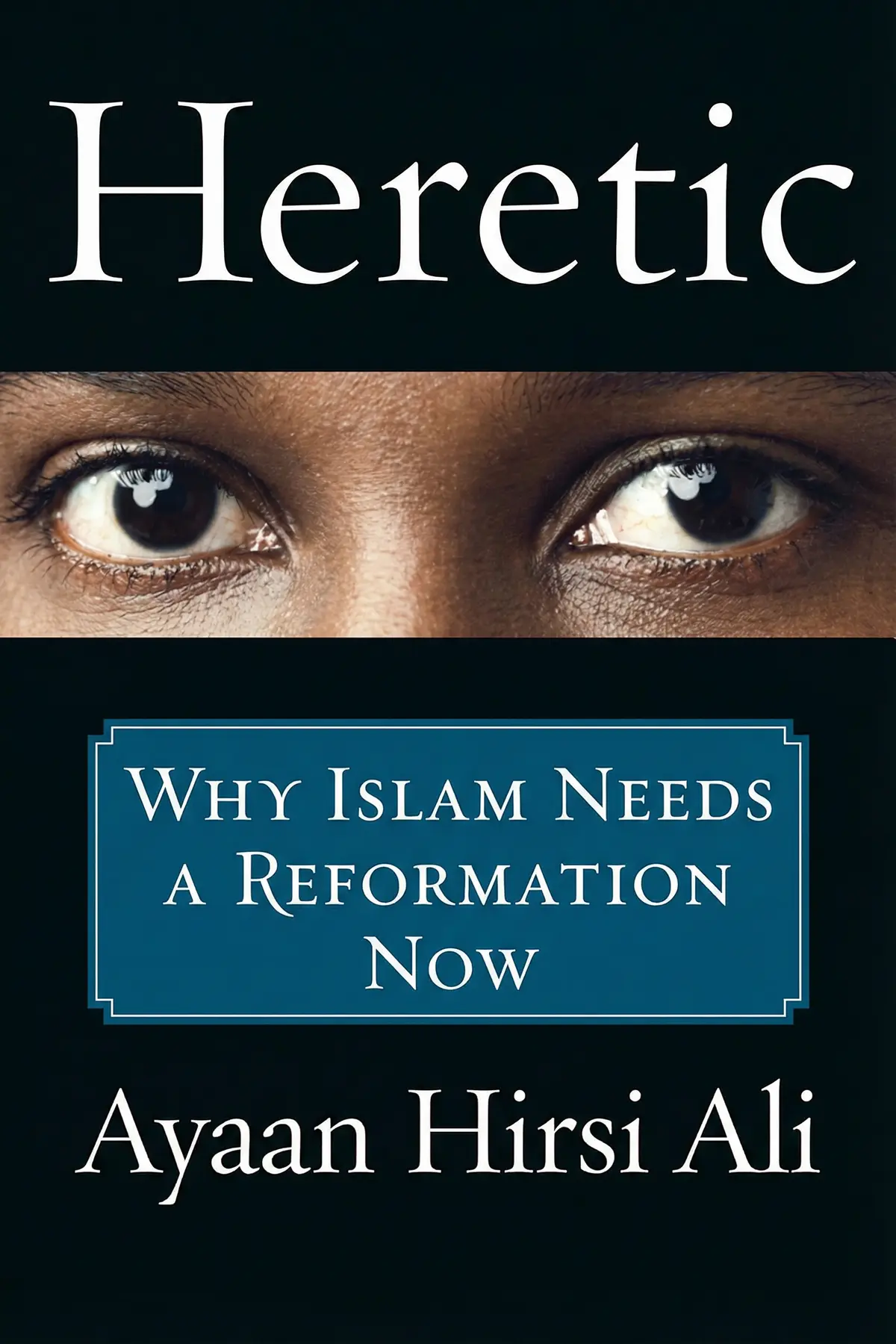
Hirsi Ali explains why she believes violence committed in Islam's name is tied to the faith's own texts. She names the five tenets she wants reformed and the signs that suggest change has begun.
1 min 01 sec
If news of attacks carried out in the name of Islam leaves you unsure what to think, or wary of saying it, Ayaan Hirsi Ali offers a blunt answer. In Heretic, the Somali-born former member of the Dutch parliament argues that this violence cannot be dismissed as a few people misreading their faith, because the attackers, and some governments, point to the religion’s own texts. She stresses that most Muslims are peaceful, and she pins her hopes on believers who question their tradition from within.
Her central claim is that Islam can become a religion of peace only if Muhammad’s status, sharia law and jihad are openly criticized and reinterpreted. She also believes the moment for that has come. By the end, you will be able to explain exactly which five tenets she wants changed, why she thinks earlier reform efforts stalled and which signs of change she sees, whether or not you share her conclusions.
1 min 58 sec
After every attack, someone insists the killers have nothing to do with their faith. Hirsi Ali thinks that comforting reply only gives authorities an excuse not to act, and two brothers who attacked a magazine gave her a reason.
2 min 02 sec
Speaking of Muslims as one block makes almost every debate go wrong. Hirsi Ali offers a three-way map instead, and it begins with a turn in the Prophet’s own life.
2 min 00 sec
Christianity and Judaism both accept that human hands shaped their scriptures. Hirsi Ali argues that one difference in how Islam sees its prophet and its book explains why reformers keep falling silent.
2 min 04 sec
A father in Arizona killed his daughter for liking makeup and Western music, and some neighbors approved. Hirsi Ali uses the case to show how a seventh-century legal code still reaches into family life.
1 min 56 sec
Calls for an Islamic reformation are old, yet they rarely say what should actually change. Hirsi Ali writes the list down, and she finds an unexpected tool for change inside the tradition itself.
2 min 00 sec
Many people assume terrorists twist scripture to suit themselves. Hirsi Ali argues the texts need no twisting at all, and she asks outsiders to stop repeating one reassuring phrase.
2 min 02 sec
Failed governments, smartphones and long lines of voters do not look like a religious movement. Hirsi Ali reads them as the early shape of one, and explains why she expects it to win.
1 min 09 sec
Heretic is finally a book about the right to argue. Hirsi Ali holds that the violence committed in Islam’s name cannot be cut away from the religion or blamed only on brainwashed individuals. In her view it will fade only when Muslims can question the Prophet’s status, sharia and jihad without fearing for their lives. Her other claims grow from that one: the split between Medina, Mecca and Modifying Muslims, the five tenets, the honor codes, and her hope in social media and in Afghan women lining up to vote.
The practical lesson she draws reaches well beyond religion. Do not let anyone pressure you into keeping your doubts to yourself, whether the subject is how to read a holy book or what to do with nuclear waste. Say the critical thing, and then keep the conversation peaceful. Supporting the reformers she describes starts with that same habit: making room for people to question what they were taught, and listening when they do.
Reform, in her account, begins on the day criticism stops being treated as a crime.
After the attacks of September 11, 2001, groups including Boko Haram, Al Qaeda and Islamic State have committed violence in the name of Islam, and some states punish blasphemy with death and homosexuality with hanging. A common response is to say the killers have nothing to do with the religion. Ayaan Hirsi Ali rejects that view. She argues that the attackers and those states rely on the Qur'an, the Hadith and sharia law, and that the faith itself must change. Her case rests on a map of three kinds of Muslims: Medina, Mecca and Modifying. She also gives a precise list of five tenets she wants reformed or abandoned, from the semi-divine status of Muhammad to the authority to wage jihad. She explains why reform has stalled, pointing to blasphemy laws, the belief that the Qur'an is perfect, honor codes and the close bond between religion and state. Readers get a clear account of one of the most debated arguments about religion and violence, and the reasons Hirsi Ali gives for hope. She sees them in social media, in disappointment with Islamist governments, in Afghan women voting despite threats, and in one government, the United Arab Emirates, naming extremism as a threat.
Readers who follow news about terrorism and religion and want to understand one of its most debated arguments.
Students of politics, religion or the Middle East looking for a clear statement of the case for Islamic reform.
Anyone who feels pressured to stay silent on hard topics.
Ayaan Hirsi Ali was born in Somalia in 1969 and grew up moving through several countries in Africa and the Middle East. At 23 she received political asylum in the Netherlands, and in 2003 she was elected to the lower house of the Dutch parliament. Time magazine named her one of the hundred most influential people in the world in 2005. She later moved to the United States and joined the American Enterprise Institute, a conservative think tank. Her books Heretic, Infidel and Nomad were all bestsellers.
Listeners find this work to be profound and articulate, offering a transparent look at Islamic doctrines and the issues with political Islam. Additionally, they regard it as a necessary read for international leaders, pointing to the author's fearlessness and the deep ideas presented. Nevertheless, the book gets varied feedback on how scary it is, with several listeners characterizing it as frightening.
Ayaan Hirsi Ali has produced a work that is both terrifying and deeply necessary for our current geopolitical climate. She breaks down the complexities of political Islam with a level of clarity that is often missing from mainstream media discussions today. Her distinction between 'Mecca Muslims' and 'Medina Muslims' provides a helpful framework for understanding why some adherents remain peaceful while others are drawn to violence. Truth is, the book is incredibly well-written and logical, even if the implications are enough to keep you up at night. I found her five points for reformation to be a pragmatic roadmap, though I wonder if the Western world has the stomach to support such a shift. This is a must-read for anyone who cares about the future of global democracy and religious freedom.
Show moreIt takes a remarkable amount of guts to write a book like this knowing the personal risk involved for the author. Hirsi Ali isn't just complaining; she’s proposing a structural overhaul of how Islam interacts with the 21st century. The chapters regarding the status of Muhammad and the literalist reading of the Qur'an are particularly poignant and well-argued. Look, some people will find this book offensive, but ignoring the problems she highlights won't make them go away. I was moved by her optimism that a reformation is possible through the power of the internet and global communication. It’s a sobering look at the clash between medieval doctrine and modern values that every world leader should have on their desk.
Show moreThe division between the three types of Muslims that Hirsi Ali outlines is perhaps the most useful part of this entire work. By categorizing believers based on their philosophical approach rather than just their sect, she makes the issue much more accessible to a general reader. I was particularly struck by her argument that we must stop tolerating intolerance in the name of multicultural sensitivity. We often give a free pass to oppressive practices because we are afraid of being labeled, but she challenges us to stand up for liberal values. The writing is sharp, direct, and doesn't waste any time with fluff or unnecessary jargon. This is easily one of the most thought-provoking books I have read in the last decade.
Show moreWow, this was a heavy read. Hirsi Ali describes a reality that most of us in the West prefer to ignore or pretend isn't happening. Her explanation of why 'Mecca Muslims' are often silenced by the more radical elements of the faith was particularly illuminating. The truth is, the book is frightening because it highlights a deep-seated resistance to change that has lasted for centuries. Yet, there is a thread of hope throughout the narrative that the next generation will find a way to modernize. I finished this book feeling much more informed, albeit a bit more worried about the future of global stability. It's a powerful, well-written call to action that refuses to pull any punches for the sake of politeness.
Show moreFinally got around to reading this and I’m kicking myself for waiting so long. Hirsi Ali provides a roadmap for what she calls a 'Muslim Reformation' that is both brilliant and terrifying in its simplicity. She doesn't just point out what is wrong; she offers five concrete areas where change must happen if we want a peaceful future. The section on the 'investment in life after death' was a real lightbulb moment for me in terms of understanding extremist psychology. In my experience, very few authors are willing to be this honest about the role of doctrine in conflict. It’s a must-read for anyone trying to make sense of the modern world. Regardless of where you stand politically, you cannot ignore the logic she presents here.
Show morePicked this up after hearing a lot of buzz about Hirsi Ali’s recent lectures and it did not disappoint. The author writes with a certain fearlessness that makes you question your own assumptions about multiculturalism and tolerance. Frankly, the sections describing the rigidity of Sharia law were quite eye-opening and, to be honest, a bit frightening to consider in a modern context. While she moves away from the purely autobiographical style of her earlier books, her personal scars still inform every page of this urgent plea. I don’t agree with every single conclusion she draws regarding the inherent nature of the faith, but her call for a 'Muslim Reformation' is compelling. It’s a dense read but well worth the time for the sheer insight into how doctrine can drive conflict.
Show moreIs it possible to reform a religion from within when the penalty for questioning it is so severe? That is the central question Hirsi Ali grapples with in this insightful and often scary volume. She compares the current state of Islam to the Christian Reformation, suggesting that a similar 'Martin Luther moment' is currently underway. Her focus on five specific areas of reform—including the status of Sharia and the exaltation of the afterlife—provides a clear agenda for dissidents. I did find some of her statistical claims a bit thin in places, but the overall logic of her argument remains sound. It’s a challenging book that forces you to confront uncomfortable truths about the world we live in today.
Show moreAfter finishing her previous memoirs, I wasn't sure what to expect from a more analytical work, but Hirsi Ali transitioned beautifully into this role. She manages to balance personal conviction with a structured argument about the need for a theological shift. Her critique of how Western liberals often abandon Muslim women to avoid appearing 'Islamophobic' was especially stinging and necessary. To be fair, she does focus heavily on the most extreme versions of the faith, which might skew the perception of some readers. However, her core message about the incompatibility of Sharia with modern human rights is hard to argue against. It’s a sophisticated piece of writing that demands your full attention.
Show moreThere is no denying that the prose is sharp and the author’s perspective is unique, but I walked away with mixed feelings about the content. On one hand, her defense of free speech and women’s rights within Islamic communities is vital and heroic. On the other hand, I found her dismissal of Islamic history and its various evolutions over 1,400 years to be quite reductive. Not gonna lie, the book feels a bit repetitive in the middle sections where she hammers the same points about 'Medina Muslims' over and over again. It’s a good starting point for a conversation, but it shouldn’t be the only book you read on the subject if you want a balanced view. Still, her courage is undeniable.
Show moreWhile I appreciate the author's bravery in the face of death threats, her actual analysis in this book feels surprisingly shallow and often relies on sweeping generalizations. She explicitly states that she will not 'sub-divide Islam,' which is a massive red flag for any serious academic study of a global religion. By treating the faith as a monolith, she ignores the vast differences between countries like Indonesia and Saudi Arabia. Furthermore, her historical claims about Al-Ghazali and his influence on modern jihadi groups are factually questionable at best. It felt like she was leaning into intellectual dishonesty just to make her thesis more provocative for a Western audience. I wanted to like this, but the lack of nuance makes it hard to take as a definitive authority on the subject.
Show moreHirsi Ali argues that violence committed in the name of Islam cannot be separated from the religion, because terrorists and some states rely on the Qur’an, the Hadith and sharia to justify it. She stresses that most Muslims are peaceful, but she says the faith needs a reformation. In her view, that means openly criticizing and reinterpreting core tenets, and she believes the present is the right time.
She names five linked tenets. The first is the semi-divine status of Muhammad together with a literal reading of the Qur’an. The second is the focus on life after death over life before it. The third is sharia as a system of government. The fourth is the power of individuals to enforce Islamic law. The fifth is the authority to wage jihad. She sees sharia and jihad as the most dangerous.
Hirsi Ali divides Muslims into three groups based on two periods in Muhammad’s life. Medina Muslims follow his later, militant example and want sharia imposed. Mecca Muslims, the majority, are devout and nonviolent but can clash with modern life. Modifying Muslims think critically about the faith, and at the extreme some leave it. She sees the third group as the leaders of reform and urges Western nations to support them.
She points to three forces. The internet lets reform-minded Muslims connect and spread their message safely. Islamist governments have failed their people, pushing many toward the West and, she expects, toward reform. Reform movements are also appearing in key Muslim states, from Afghan women voting despite Taliban threats to the United Arab Emirates calling extremism a transnational cancer.
Hirsi Ali’s advice is to refuse to let anyone intimidate you into silence. Conflict can only be resolved once doubts and criticism can be voiced, on any subject, followed by a peaceful discussion. In debates about religion and violence, take seriously the reasons attackers give, and engage with her five specific tenets instead of slogans.
Masaji Ishikawa

John Rawls



Miles Taylor



Daniel Goleman


AUDIO SUMMARY AVAILABLE
Get the key ideas from Heretic by Ayaan Hirsi Ali, plus 5,000+ more nonfiction titles.









