
14 min
Available in: English
Help Me, I’m Stuck: Six Proven Methods to Shift Your Mindset From Self-Sabotage to Self-Improvement
A practical set of daily habits for people trapped in routine and self-doubt: reframing setbacks, naming thought traps, practicing gratitude, eating and moving for a better mood, and listening with real empathy.
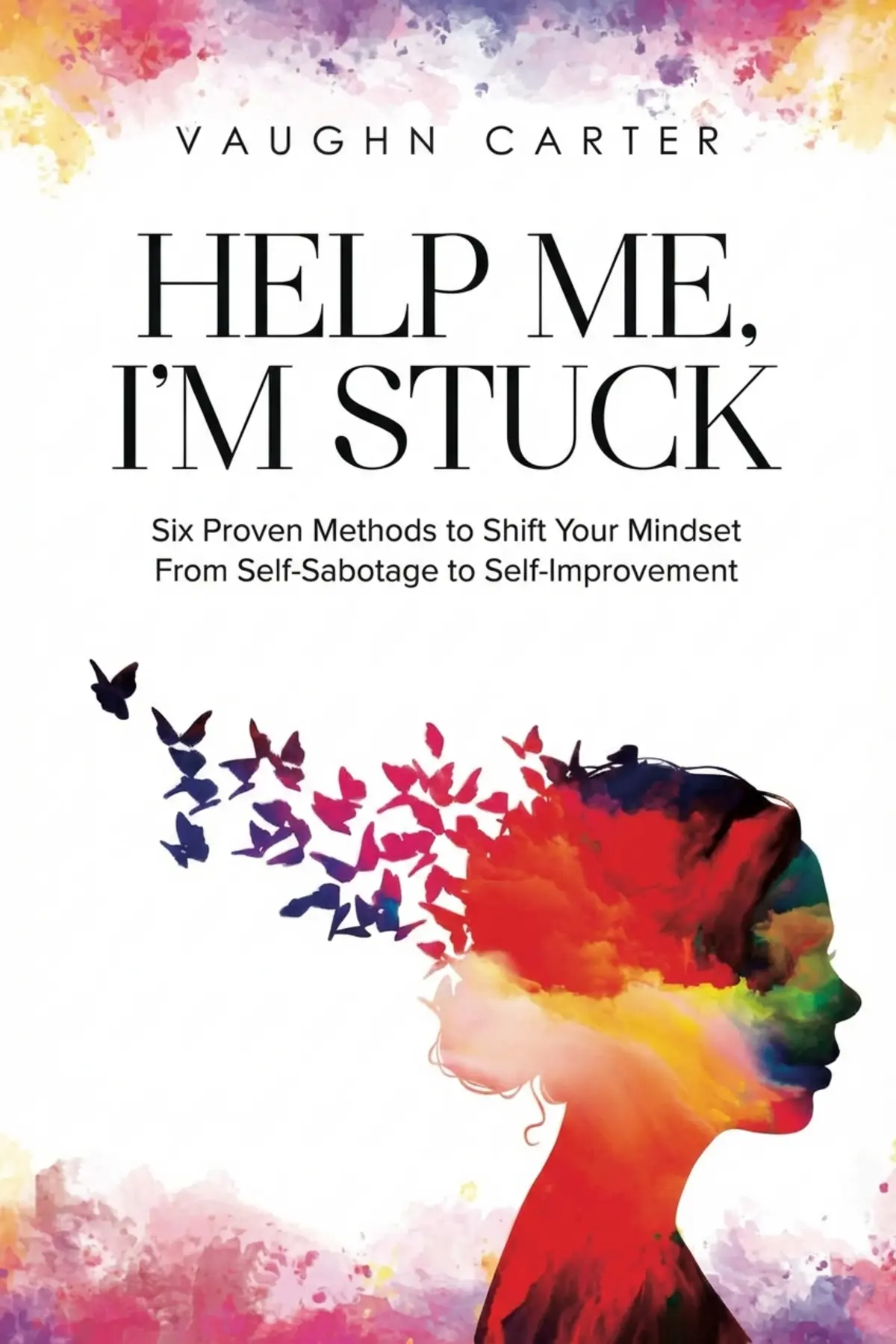
Table of Content
1. Introduction
1 min 07 sec
If you feel stuck in the same routines and the same self-doubt, the first move may be smaller than you think. It starts with seeing your circumstances as neutral, holding only the power you hand them. That is the opening claim of Help Me, I’m Stuck, by educator and consultant Vaughn Carter. Carter argues that being stuck is mostly a thinking problem, and that thinking can be retrained through small daily practices.
Those practices work on several fronts. Notice the meaning you give events, and catch the patterns that drag you down. Give good moments time to land. Look after the body and the relationships that hold your mind up. Each practice is modest on its own. Together they move a person from sabotaging their own progress to building it, one deliberate choice at a time.
What follows is a set of habits to start this week. You get a sentence to write at night and three thought traps to name when they appear. You get a way to turn a late meal into something useful, and a listening habit that makes people open up.
2. Take the power back from your circumstances
1 min 55 sec
A former partner once predicted that a future business star would fail without him. What she did with that prediction shows where being stuck really starts, and why the fix begins with one sentence written at night.
3. Spot the three thought traps by name
1 min 56 sec
Some thinking habits feel like plain realism while they shape your mood, health and relationships. Carter argues that catching them starts with knowing what they are called, and that a scrap of paper can help too.
4. Make good moments stick as long as bad ones
2 min 03 sec
A harsh remark can stay with you for days while praise fades before lunch. Carter explains why the brain plays this unfair game, and what a sunset or a favorite song can do about it.
5. Trade everyday complaints for real gratitude
1 min 53 sec
Most people would call themselves grateful, yet daily irritations crowd it out. A delayed dinner and a lost job show how the same moment can either drain your mood or lift it.
6. Feed a better mood through food and movement
1 min 54 sec
What you call yourself may shape what lands on your plate. Carter links identity, specific nutrients and a sustainable workout routine to the way you think, and shows where emotional eating fits in.
7. Listen closely enough to change a relationship
1 min 54 sec
The people others confide in share a few habits, and one of them can leave them drained. Carter shows how to build empathy on purpose, and how far it can travel, even across deep divides.
8. Conclusion
1 min 18 sec
Carter’s book is a toolkit, and its tools share one root. Being stuck, in his account, is a story you keep telling about your circumstances, your mistakes and yourself. Each practice edits that story from a different side. One works on the meaning you give events, another on the traps your thoughts fall into. Others work on the moments you let fade, the food on your plate and the people you listen to. He promises no sudden breakthrough. He promises that small, deliberate changes in habits, relationships and daily choices add up over time.
The simplest place to begin is the nightly journal line. Write down one frustration and remind yourself that it does not define you. The next time a thought spirals, name it: filtering, personalizing or polarizing. If it keeps replaying, put it on paper and throw the paper away. And when something small goes right, stay with it a little longer than feels natural.
Corcoran’s former boyfriend made a prediction about her future. She treated it as something she was free to reject, and she built a business instead. That is the book in a single move: the circumstance gets a vote, and you decide what it means.
About this book
What is this book about?
Plenty of people know the feeling of being stuck: the same routines, the same doubts, the same habits that lead nowhere. Even a small change starts to look impossible. Vaughn Carter, an educator and consultant, argues that the problem usually sits in the mind, and that the mind can be trained out of it. His starting point is that circumstances are neutral and hold only the power we give them. From there he builds a set of modest, repeatable practices. Readers learn to reframe a mistake instead of spiraling over it. They learn to spot thought traps by name, to give good moments as much attention as bad ones, and to turn complaints into gratitude. Carter also covers food and exercise choices he links to a steadier mood, and active listening that builds empathy and connection. The result is a short, practical playbook for moving from self-sabotage to self-improvement. It offers no overnight breakthrough. It offers small deliberate changes that add up over time.
Book Information
Who it's for
Stuck students and professionals
Professionals and students caught in repetitive routines and self-doubt who want small, concrete habits to start moving again.
Prone to self-criticism
People prone to self-criticism or rumination looking for simple tools to interrupt negative thinking.
Exploring mood and habits
Anyone who wants to link mood to daily food, exercise and listening habits.
About the Author
Vaughn Carter
Vaughn Carter is an educator and consultant who writes about mindset and communication strategies for succeeding in any field. Across his career he has worked to raise morale for individuals and for teams. He draws on his own experiences to help people feel safe while they make changes. He is also the author of Help Me Talk to Anyone.
Ratings & Reviews
Ratings at a glance

What people think
Listeners find this book accessible and skillfully composed, offering clear material and useful guidance. They value the inspiring tone, with one listener mentioning that encouragement is woven into every part. The guide earns praise for its perspective, as one review points out how it assists listeners in thinking about things differently.
Top reviews
Chloe
Wow, I didn't expect a book about "getting unstuck" to resonate with me this deeply. I am definitely "Girl A" from the scenarios, always letting my anxiety and self-loathing take the wheel. Vaughn Carter feels like a friend talking you through a crisis. The way he breaks down how to process negative emotions instead of just ignoring them is vital. I’ve started implementing the gratitude journaling and the "stop and reflect" technique during my morning walks. It’s amazing how much my mood improves just by intentionally focusing on a sunset or a quiet moment of peace. This book is filled with encouragement and truly helpful insights that don't require rocket science to understand. It’s straightforward, well-written, and exactly what I needed to shift my mindset. I’ll be keeping this on my nightstand for whenever I start to feel that quicksand feeling again.
Show moreHannah
The chapter on gratitude and its biological impact on the brain completely shifted my perspective. I’ve read a lot of self-help, but Carter has a way of making these concepts feel fresh and achievable. He acknowledges that while the habits are simple, they do require effort, which I found very honest. Not gonna lie, I was skeptical about the fitness and diet section at first, but he ties it back to brain health in a way that makes sense. It’s not about weight loss so much as it is about fueling your mind to resist negative spirals. The whole book is incredibly uplifting and lacks the dense jargon that usually makes these types of books a chore to read. If you’re dealing with a mid-life crisis or just feeling stuck in a rut, this is a must-read. It’s one of those rare books that actually motivates you to take action immediately.
Show moreMoo
Not what I expected from a book with such a simple title, but I am so glad I picked it up! I was feeling very insecure and stagnant in my career lately, and this book provided the exact mindset shift I needed. The advice isn't just "be happy"—it’s about the deliberate practice of gratitude and the importance of hope as a tool for resilience. I loved the part about maximizing our happy moments by being fully present. For me, that means actually putting the phone down and enjoying the view instead of just scrolling. The writing is clear, concise, and incredibly motivating. Carter manages to take complex psychological ideas and turn them into easy-to-digest habits. This is a great resource for anyone who feels like they are just spinning their wheels. Truly an exceptional guide to living a more intentional and upbeat life!
Show moreKofi
Finally got around to reading Carter's work and found it surprisingly digestible. As someone who often feels overwhelmed by information overload, the simplicity of this book was actually its greatest strength. The author doesn’t use a lot of "fluff," which I really appreciated. He gets straight to the point about how our circumstances don’t actually hold power over us unless we allow them to. I especially liked the section on empathy and how it can act as a bridge to understanding others, provided you maintain your own self-care. It’s an encouraging read that makes you feel like change is actually possible through small, deliberate steps. My only gripe is that some of the citations felt a bit hit-or-miss, which made me question some of the more "scientific" claims. Still, it’s an insightful book that helped me reframe a few of my own negative thought patterns this week.
Show moreEleanor
As someone who struggles with a constant internal monologue of self-doubt, these six methods were quite refreshing. Truth is, I’ve been feeling stagnant for months, and Carter’s take on how habits shape our mindset really clicked for me. The advice on "filtering"—where we only see the negatives—was a major "aha" moment. I’ve definitely been guilty of that! The book is very easy to read and the tone is incredibly supportive throughout. I loved the suggestion to take pictures of things that make us happy, like the deer and fawn story mentioned in the text. It sounds simple, but it actually works to prolong those feelings of bliss. While I agree with other reviewers that some of the gendered examples are a bit dated, the core strategies for overcoming self-sabotage are genuinely helpful. It’s a practical, no-nonsense guide that offers a lot of hope.
Show moreVarinee
After hearing about the "red silk dress" example, I was skeptical, but the core message is actually quite solid. The author emphasizes that our reactions to obstacles define our path, not the obstacles themselves. This was a powerful reminder for me. I’ve been stuck in a cycle of "polarizing"—viewing everything as either a total success or a complete failure. Carter’s breakdown of these negative thought patterns helped me identify exactly where I was sabotaging myself. The book is an easy read, very well-paced, and full of practical tips that you can start using today. I particularly enjoyed the stories of successful people like Barbara Corcoran; it made the advice feel more grounded in reality. It’s not a perfect book, and some of the language is a bit "old school," but the actual techniques for mental clarity are top-notch.
Show moreMichael
Picked this up during a particularly low week when I felt like I was sinking in quicksand. I have a strong familiarity with that "stuck" feeling, and Carter does a decent job of describing it in relatable terms. The "two islands" analogy was a highlight for me; it really helped visualize how our internal attitude dictates our survival. However, the book isn't without its flaws. To be honest, some of the sections, like the one on positive thinking, felt a bit repetitive and didn't offer anything I haven't heard a dozen times before. The nutrition advice also felt a little out of place—I wasn't really looking for a diet plan in a mindset book. It’s a quick read with some nice moments, like the bit about watching sunsets to rewire the brain, but it’s not groundbreaking. It's a solid 3-star choice for someone brand new to self-help who needs a gentle, straightforward nudge.
Show moreDaranee
Frankly, the content here is a bit of a mixed bag for me. On one hand, I appreciated the focus on small, actionable habits like practicing active listening and finding joy in simple things like kitten videos. On the other hand, the gendered language felt very restrictive. Why focus so much on women specifically when these "six methods" are universal? I found the Barbara Corcoran example interesting, but it felt a bit like name-dropping rather than integrated advice. The writing style is definitely uplifting and encouraging, which helps you power through the chapters quickly. But I couldn't shake the feeling that the book was a bit too subjective based on the author's own limited perspective. It’s a well-written guide for beginners, but if you’ve read any other self-improvement books, you might find this one a bit too basic. It's fine for a quick afternoon read.
Show moreLaddawan
Ever wonder why self-help books for women are so often written by men who don't seem to get it? Vaughn Carter’s latest attempt at mindset shifting left me feeling more annoyed than motivated. The advice is essentially common sense—think positive, eat well, be grateful—and it lacks any real depth or new research. Look, the "bum boyfriend" rhetoric is tired and frankly insulting to readers looking for serious life changes. I also found the focus on physical fitness and weight as a metric for "success" to be quite harmful and potentially dangerous for those struggling with body image. The book is easy to read, I’ll give it that, but "easy" usually means "oversimplified" in this context. While the intentions might have been good, the execution is messy and the examples provided feel extreme and unrealistic for the average person. It’s hard to feel "unstuck" when the instructions are this superficial.
Show moreGrace
This book was a massive letdown from the very first chapter. I found the advice to be incredibly outdated, particularly the strange obsession with fitting into a "red silk dress" as some kind of ultimate goal for women. To be fair, I tried to stay open-minded, but the tone felt patronizing coming from a male author who clearly doesn't grasp the systemic issues women face daily. The writing is riddled with poor editing and wild, unsubstantiated claims that make it hard to take the "proven methods" seriously. Instead of providing deep psychological insight, it reads like a collection of shallow Buzzfeed articles or basic Google search results. The hetero-normative language and constant focus on "husbands" and "wives" felt very out of touch for a 2022 publication. I was hoping for something substantial, but this was just surface-level fluff that prioritizes weight-shaming over actual mental health. If you are looking for inclusive, modern self-improvement, look elsewhere.
Show moreQuestions about this book
What is the main idea of Help Me, I'm Stuck?
Vaughn Carter argues that feeling stuck usually comes from the meaning we give our circumstances, which he sees as neutral in themselves. By reframing setbacks, naming negative thought patterns, savoring good moments, practicing gratitude, eating and exercising for a better mood and building empathy, a person can move from self-sabotage to self-improvement through small, deliberate daily changes.
What negative thought patterns does Vaughn Carter describe?
Carter names three common habits. Filtering means focusing only on the negative side of a situation. Personalizing means blaming yourself for events outside your control. Polarizing means seeing everything in extremes with no middle ground. He argues that recognizing these patterns by name is the first step to replacing them, and he adds tools such as detailed distraction and writing a thought down and throwing it away.
How can I apply Help Me, I'm Stuck in daily life?
Start with a nightly journal entry about one frustrating moment, ending with a reminder that it does not define you. When a mistake happens, such as an error in a sent email, use it to learn and talk openly about the fix. Savor small joys longer, turn complaints into gratitude, swap processed snacks for nuts or vegetables, and practice listening without interrupting.
What does the book say about food and mood?
Carter links specific nutrients to mental health. Vitamin C from bell peppers and oranges, omega-3 fats from salmon and flaxseed, and magnesium from leafy greens all appear in his account as supports for mood and thinking. He connects high sugar intake to depression and inflammation, recommends a food journal to spot emotional eating, and cites studies suggesting plant-based diets can improve mood and focus.
Who should read Help Me, I'm Stuck?
It suits readers who feel trapped by routines, self-doubt or unproductive habits and want short, practical exercises instead of theory. People who struggle with self-criticism, rumination or emotional eating will find specific tools. Those who want stronger relationships at work or at home will find its advice on active listening and empathy useful.
Readers also enjoyed

59 Seconds: Change Your Life in Under a Minute
Richard Wiseman





A Guide to the Good Life: The Ancient Art of Stoic Joy
William B. Irvine


A High-Performing Mind: Strengthen Your Mind and Live Your Best Life
Andrew D. Thompson


Abundance: The Inner Path to Wealth
Deepak Chopra
AUDIO SUMMARY AVAILABLE
Listen to Help Me, I’m Stuck in 15 minutes
Get the key ideas from Help Me, I’m Stuck by Vaughn Carter, plus 5,000+ more nonfiction titles.
- 5,000+ titles
- Listen as much as you want
- 7-day free trial
- Cancel anytime









