

12 min 21 sec
Available in: English
Happiness: A History
Follows how the idea of happiness changed over the centuries, from a gift handed out by the gods to a goal for reason, a heavenly reward, a natural right and a shared community project.
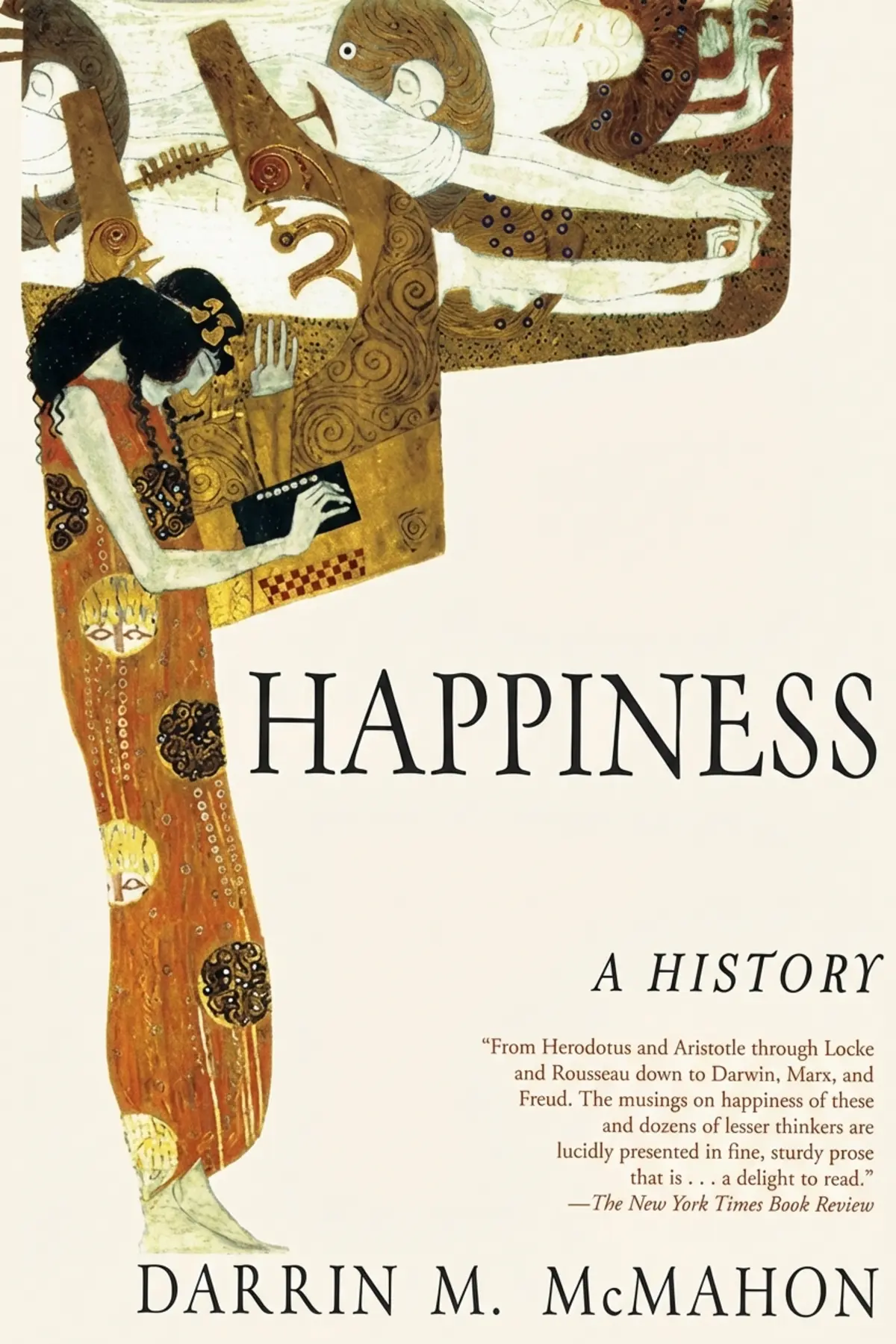
Table of Content
1. Introduction
55 sec
Most of us treat happiness as something we are entitled to, a mood we can repair with a better weekend or a bar of chocolate. Historian Darrin M. McMahon, in Happiness: A History, shows that this belief is surprisingly young. For long stretches of the past, people saw happiness as a gift the gods handed out at random, and something mortals were wise to leave alone.
McMahon follows how that changed, from Athenian philosophers to the American founders to the followers of Karl Marx. His throughline is simple: every era built its own idea of what happiness is and who controls it, and our conviction that it is a personal right to be chased is only the latest version. Hearing the older versions is useful. It lets you spot the assumptions behind your own search for a good life, and decide which of them you actually want to keep.
2. Discover how Athens came to see happiness as ours
1 min 46 sec
For centuries, misery seemed too powerful for any person to fight, so happiness was left to the gods. Then a political change in one Greek city made a few thinkers wonder whether people could take some of that power back.
3. What a grim Middle Ages teaches about hope
1 min 44 sec
Plague, pain and a pope who praised those never born set the mood of an era. Yet out of that gloom came a philosopher who claimed people could choose their own place in the universe.
4. Trace your sense of a right to happiness
1 min 45 sec
A bishop once tried to find the exact spot where the Garden of Eden had stood. His search sits at the start of a shift that ended with ordinary people believing joy was their birthright.
5. Sadness can be the road toward joy
1 min 43 sec
Young readers once dressed like a heartbroken fictional hero, and poets invented a word for a pain nobody could explain. Their gloom did something unexpected to the old idea of happiness.
6. Learn that the pursuit of happiness was never a guarantee
1 min 37 sec
A famous founding document promised Americans the pursuit of happiness, and hundreds of disappointed citizens took that promise to court. One founder’s reply still shapes how many people think about a good life.
7. Weigh private happiness against happiness found together
1 min 41 sec
Franklin’s advice to catch happiness yourself struck some thinkers as the very cause of human unhappiness. Their alternative asked people to look backward, and to give up the idea of a private pursuit.
8. Conclusion
1 min 10 sec
Happiness, in McMahon’s telling, has never stood still. It began as a gift the gods gave or withheld. Athenian freedom turned it into a goal for reason, medieval despair pushed it beyond the grave, and Pico pulled part of it back to Earth. The Enlightenment made it a birthright, the Romantics found it hiding inside sorrow, Franklin told people to go and catch it, and Engels insisted it could only be recovered together.
Each version answered a different worry, and each left traces in how we talk today. That is what makes the history practical. When you feel you are failing at being happy, remember that the expectation itself has a birth date, around the middle of the eighteenth century. When a bad season arrives, recall the nineteenth-century view that sadness can open the way to joy. And when you plan your own good life, notice whether you are tending Franklin’s vineyard alone or looking for it among other people.
The people who sued in the young United States wanted a guarantee. What history hands us instead is a choice about which idea of happiness to live by.
About this book
What is this book about?
Today most people assume happiness is natural, deserved and largely up to them. Historian Darrin M. McMahon shows how recent that assumption is. For long periods, people saw happiness as something the gods controlled, a matter of fate or luck that mortals had little power over. McMahon follows the idea through a series of turning points. Democratic Athens gave Socrates, Plato and Aristotle the confidence that reason could shape a good life. Medieval Europe, shaken by plague and despair, placed true happiness beyond this world, until Renaissance thinkers such as Pico della Mirandola pulled part of it back. The Enlightenment turned Earth into a kind of paradise and happiness into a natural right. The Romantics found a path to joy through sadness. In the young United States, people even sued over their right to the pursuit of happiness, while Benjamin Franklin told them to go and catch it themselves, and later communists argued it could only be regained through community. Readers get a clear map of how a feeling became a right, and a way to see which of those inherited ideas shape their own search for a good life.
Book Information
Who it's for
Pressured to be happy
Professionals who feel pressure to be happy and want to know where that expectation came from.
Curious about happiness history
Readers curious about how Greek philosophy, Christianity and the Enlightenment shaped everyday ideas of a good life.
History or philosophy students
Students of history or philosophy looking for one thread that ties these eras together.
About the Author
Darrin M. McMahon
Darrin M. McMahon is an American historian, author and public speaker, born in 1965. He is the Mary Brinsmead Wheelock Professor of History at Dartmouth College and previously held the Ben Weider professorship at Florida State University. Trained as a historian of France, he first wrote Enemies of the Enlightenment, on French resistance to the Enlightenment's legacy, and later Divine Fury: A History of Genius. His writing has appeared in The New York Times, The Wall Street Journal and The Washington Post.
Ratings & Reviews
Ratings at a glance
What people think
Listeners find the book expertly written and thoroughly researched, with one listener highlighting how it connects insights across history. It receives favorable feedback regarding its value, as listeners note that the work is worth the investment. Perspectives on readability are varied; some describe it as a highly stimulating read while others disagree. The book’s perspective on happiness also draws mixed reactions, with one listener characterizing the treatment of the subject as too mechanical.
Top reviews
Siriphen
Wow. This isn't your typical airport self-help book. McMahon has produced a staggering piece of intellectual history that tracks how we moved from seeing happiness as divine luck to viewing it as a fundamental human right. It is dense, yes, but the way he links ideas across centuries—from the tragic outlook of the Greeks to the consumerist obsession of the 21st century—is nothing short of masterful. I found myself highlighting passages on nearly every page. It’s a commitment to read, but the payoff is a much deeper understanding of why we are so restless today. This is a book that stays with you long after you've put it back on the shelf.
Show moreCamila
McMahon has crafted something truly impressive here, weaving together threads of philosophy from the ancient Greeks to the modern day. I was particularly struck by the sections on the Enlightenment and how our modern 'culture of unhappiness' actually stems from our desperate need to be happy at all times. The research is deep, the prose is elegant, and the insights into the Romantic era were particularly enlightening for me. It’s rare to find a book that feels this authoritative without being totally inaccessible. If you are interested in the history of ideas, this is an essential addition to your library. It certainly changed how I view my own pursuit of contentment.
Show moreNoppadol
After hearing about this book in a philosophy seminar, I dived in expecting a dry chronological list. Instead, I found a beautifully written, if somewhat discursive, narrative. McMahon is clearly a fan of the big picture. He manages to make the shift from Christian suffering to Enlightenment optimism feel like a high-stakes drama. My only real gripe is that the title is a bit of a misnomer; it should really be called 'A History of Western Happiness.' If you go in looking for Eastern perspectives or global philosophies, you will be disappointed. However, as a study of the European mind, it is incredibly thorough and well-worth the effort.
Show moreHenry
Picking this up felt like a commitment, but I wanted to understand how our modern obsession with 'feeling good' actually started. McMahon delivers a surprisingly rounded view of the subject. He doesn't just list dates; he explores the psychological shifts that occurred as God was slowly replaced by the idol of earthly satisfaction. Some of the chapters are quite dense and require re-reading, particularly the sections on Kant and Schopenhauer, but the clarity of his overall argument makes it worth the struggle. It is a stimulating read that challenges the idea that happiness is a simple, natural goal. To be fair, it is very long, but the depth is necessary.
Show moreAna
The chapter on the Enlightenment was a revelation for me. It’s amazing to see how recently the idea that we *should* be happy actually took hold of the human imagination. Before that, it was all about fate or the afterlife. McMahon does a great job of showing how our current frustration is a byproduct of our own high expectations. My only complaint is that the book is very long and can be quite repetitive in its critique of modern hedonism. Still, for anyone interested in ethics or the history of religion, this is a very valuable text. It links understanding across vast stretches of time in a way few other books manage.
Show moreKru
Finally got around to finishing this massive tome, and I have many thoughts. It is a truly discursive work, wandering through centuries of thought with a very keen eye for detail. I loved learning about how the ancient Greeks viewed happiness as a rare miracle of fate—it’s so different from our current 'just do it' attitude. The book is well-researched and the writing is often quite beautiful, though occasionally the author's bias against certain modern movements (like communism) peeks through a bit too clearly. It’s an academic book through and through, so don’t expect a light read, but it’s a rewarding one if you have the patience for it.
Show moreJonathan
Truth is, I found the discursive style a bit much at times, as McMahon frequently drifts into florid scene-setting that doesn't always add to the philosophical argument. But if you can look past the occasionally dense prose, there is a wealth of knowledge here. He handles the transition from the 'blessed' state of the Middle Ages to the 'pursuit' of the modern era with real nuance. It's a sobering reminder that our current obsession with happiness might actually be making us miserable. Not quite a 'definitive' history because of its narrow Western focus, but certainly a highly stimulating one for those who enjoy intellectual history. Definitely worth the price for the sheer volume of information.
Show moreWeera
Is it possible to write a definitive history of happiness while ignoring three-quarters of the globe? This book is an impressive academic feat, but its Eurocentric focus is impossible to overlook. McMahon tracks the evolution of the concept from Aristotle through to Freud with great precision, yet the lack of non-Western thought makes it feel incomplete. The writing style can also be a bit much; he spends a lot of time setting scenes and using flowery metaphors when a simple explanation would do. It’s a good resource for students of Western philosophy, but it’s definitely not the universal history the title implies.
Show moreSomsak
To be fair, the research displayed here is staggering in its depth and breadth. McMahon clearly knows his stuff, and the way he tracks the concept of happiness through the lens of the Christian Fall was fascinating. However, I struggled with the density of the text. It’s written for a well-educated audience, often using 'big words' where simpler ones would suffice. At times, the book feels like it’s drowning in its own erudition. I enjoyed the bits on the Stoics and the Epicureans, but by the time we got to the industrial age, I was feeling pretty exhausted. A solid 3.5 stars for the scholarship, even if the readability isn't always there.
Show morePor
Not what I expected based on the title, which suggests a much more universal and perhaps more human exploration. Instead, this felt like a mechanical slog through every minor Western philosopher the author could find. The tone is very academic and quite dry, making it difficult to stay engaged for long periods. I also found the author's tendency to 'set the stage' with imaginary historical details to be distracting rather than helpful. Why do I need to imagine the coughs in a room before a quote? I wanted a history of the feeling, but what I got was a very narrow history of the word as used by elite European men.
Show moreQuestions about this book
What is the main idea of Happiness: A History by Darrin M. McMahon?
McMahon argues that people have understood happiness in very different ways over time. It began as something the gods controlled, became a goal for reason in democratic Athens, moved beyond this world in the Middle Ages, and turned into a natural right during the Enlightenment. Later, Romantics linked it to sadness, Benjamin Franklin made it a personal pursuit, and communists tied it to community.
When did people start believing happiness was a human right?
According to McMahon, the shift came during the Enlightenment. Early in the eighteenth century, thinkers such as Voltaire and Claude-Adrien Helvétius began treating Earth itself as a paradise, and pleasure gardens offered music, games and refreshments. By the middle of that century, most people regarded happiness as a natural right, a purpose nature intended us to reach, which is where the modern sense of being entitled to it comes from.
Why did Americans sue the government over happiness?
The Declaration of Independence of 1776, drafted by Thomas Jefferson, lists the pursuit of happiness among rights that cannot be taken away. Some people read that as a legal promise of a happy life, and hundreds sued the government or other citizens. Benjamin Franklin replied that happiness was a right but had to be caught by each person, comparing it to growing grapes and making wine.
What did communists believe about happiness?
Friedrich Engels, an admirer of Karl Marx, argued that brute individuality had cost people their human consciousness, and that happiness would come from regaining it. The Great Soviet Encyclopedia claimed that in class societies the rulers’ pursuit of happiness overpowers the oppressed. Communists held that selfish pursuit made people indifferent to others, so happiness required a return to community, ideally a classless one.
How can I apply the ideas in Happiness: A History?
The book works as a lens on your own assumptions. Recognize that feeling entitled to constant happiness is an eighteenth-century idea, not a law of nature. Remember the nineteenth-century view that sadness can be a starting point for joy. And ask whether you seek a good life mainly through your own effort, as Franklin urged, or through community, as Engels argued.
Readers also enjoyed

A History of Iran: Empire of the Mind
Michael Axworthy

A History of the World in 6 Glasses
Tom Standage

A Long Way Gone: Memoirs of a Boy Soldier
Ishmael Beah




A Splendid Exchange: How Trade Shaped the World
William J. Bernstein

A Spy Among Friends: Philby and the Great Betrayal
Ben Macintyre

AUDIO SUMMARY AVAILABLE
Listen to Happiness in 15 minutes
Get the key ideas from Happiness by Darrin M. McMahon, plus 5,000+ more nonfiction titles.
- 5,000+ titles
- Listen as much as you want
- 7-day free trial
- Cancel anytime









