



14 min 24 sec
Available in: English
Hacking Growth: How Today's Fastest-Growing Companies Drive Breakout Success
Shows how a small cross-department team can make a company grow fast by checking that customers love the product, tracking one key number and running quick, scored experiments on attracting, converting, keeping and earning from customers.
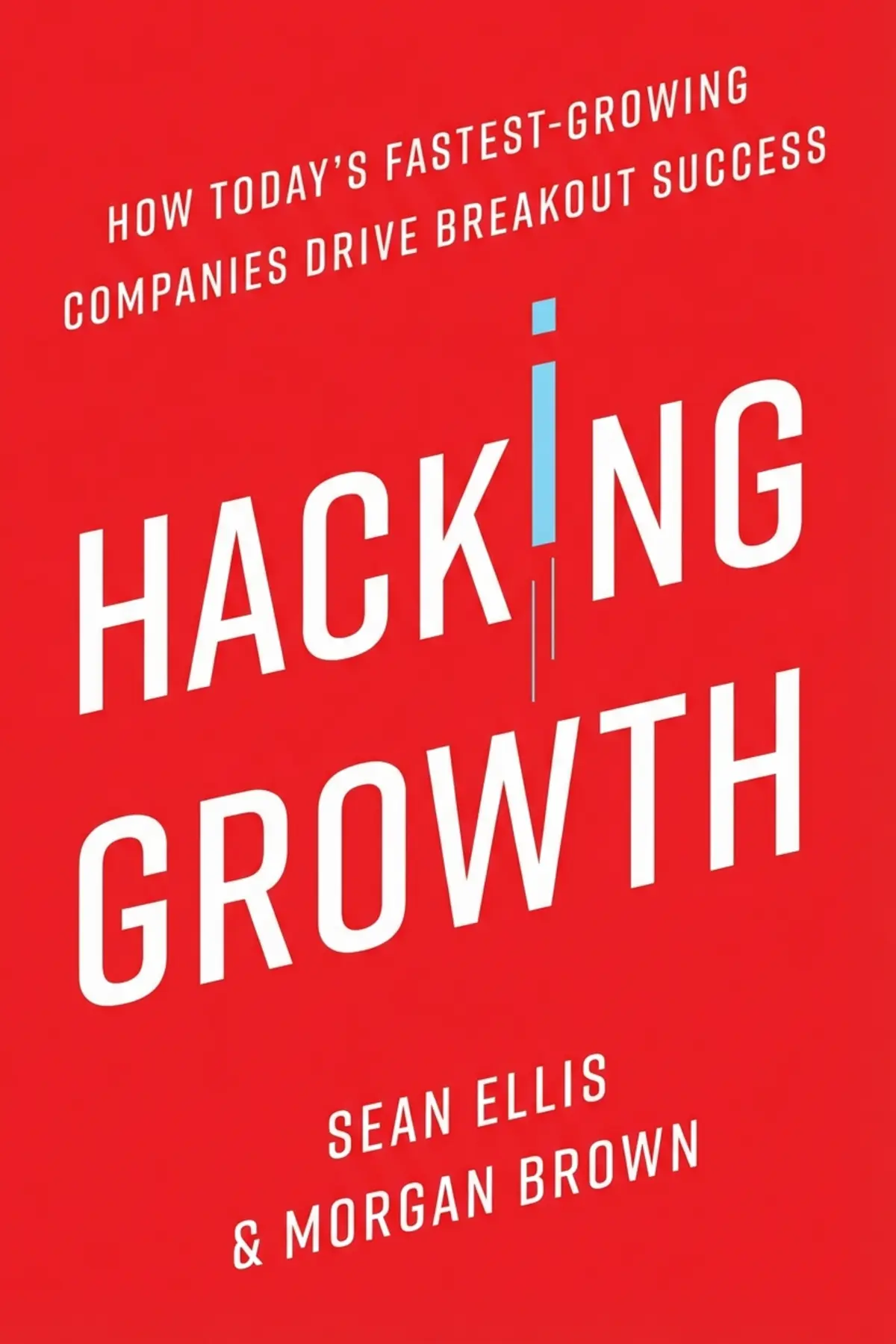
Table of Content
1. Introduction
51 sec
Plenty of companies reach a point where the product works and profits are fine, yet nothing anyone tries makes them grow faster. In Hacking Growth, Sean Ellis, who coined the term growth hacker, and Morgan Brown argue that breaking through takes a method anyone can learn. A company of any size can grow quickly by joining people from different departments into one team, aiming them at a single measure of value and testing ideas on real customers at speed.
The authors note that online businesses are well placed for this, because they gather vast amounts of data and can talk to customers directly. The book offers a one-question survey that tells you whether a product is ready to grow, a scoring system for choosing which ideas to test, and a way to see exactly where customers slip away.
2. Put one team in charge of growth
1 min 32 sec
BitTorrent kept improving its paid product, and almost nobody upgraded. The fix came from an unexpected direction, and it reveals a lot about where growth gets stuck inside ordinary companies.
3. Find out whether customers would miss you
1 min 24 sec
Ask a few hundred customers one question and you learn whether pushing for growth makes sense yet. The answer has a clear cutoff, and missing it changes what you should work on next.
4. Pick the one number that steers everything
1 min 28 sec
Facebook watches logins, time on site, posts, comments and friend requests. Yet the authors argue that one number matters more than all of them, and finding yours keeps a team from drowning in data.
5. Learn faster than rivals with a four-stage cycle
2 min 07 sec
A struggling college football team changed its tempo and started learning faster than its opponents. Applied to business ideas, the same tempo turns a messy brainstorm into a ranked list worth testing.
6. Win a stranger's attention in eight seconds
1 min 30 sec
Online, a stranger gives you only moments before moving on. The words that hold them may already be in your customer reviews, and a simple scoring method decides where to put those words.
7. Find the step where buyers give up
1 min 28 sec
Only a tiny share of website visitors ever buy anything. A worked example built around Uber shows how to find the exact point where people quit, and how to learn why they did.
8. Keep customers coming back with rewards
1 min 27 sec
More than nine in ten Amazon Prime members renew every year. The pattern behind that loyalty is simple to describe, and it starts with what happens right after a customer says yes.
9. Find the customers worth twice as much
1 min 38 sec
A last-minute hotel app sorted its users by how they connect to the internet and found a surprise in its revenue. The same kind of simple question can also help you settle on a price.
10. Conclusion
59 sec
Hacking Growth turns growth from a hope into a routine. BitTorrent found a 92 percent revenue jump by asking why free users never upgraded. HotelTonight found its most valuable customers by sorting them by how they reached the internet.
The authors are betting that any business, whatever its size or field, can work this way if it treats every idea as a guess to be tested. The one-question survey is the natural place to start. If fewer than 40 percent of customers would be very disappointed to lose your product, improve the product before chasing more users. Once you clear that bar, choose the single number that shows customers getting value. Then map your funnel and study the step where the most people drop away.
From there, the work is repetition. Baylor did not out-hustle its rivals with one perfect play; it ran more plays than anyone and learned from each one.
About this book
What is this book about?
Many companies hit a plateau. The product works and the business is profitable, yet nothing seems to push it higher. Sean Ellis and Morgan Brown argue that fast growth comes from a repeatable system any company can adopt. It rests on three habits: teams that cross departments, careful collection and analysis of data, and rapid experiments on real customers. The authors show the system at work with BitTorrent, whose revenue rose 92 percent after a growth team found that most customers did not know about the premium version and began promoting it to free users. HotelTonight is another case: it learned that customers on mobile data brought in twice as much revenue as those on Wi-Fi. The book explains how to test whether a product is a must-have, how to choose a single North Star metric and how to run a four-stage cycle of analysis, ideas, prioritization and testing. Readers also get practical tools for each stage of a customer's path. These include a scoring method for marketing channels, funnel reports that show where people drop off, engagement loops modeled on Amazon Prime and a four-question survey for setting prices.
Book Information
Who it's for
Founders and small-business owners
Founders and small-business owners whose growth has stalled and who want a testing method in place of guesswork.
Marketers and product managers
Marketers and product managers asked to lead growth work that crosses departments.
Team leads weighing ideas
Team leads who need a fair way to decide which ideas to try first.
About the Author
Sean Ellis
Sean Ellis coined the term growth hacker in 2010. He cofounded GrowthHackers.com, produces the Growth Hackers Conference and ran early growth efforts at Dropbox, Eventbrite and Lookout. He also helped LogMeIn and Uproar grow from their early days to public listings, and he hosts The Breakout Growth Podcast. Morgan Brown has held product and growth roles at startups including Qualaroo, TrueVault and ScoreBig and has worked at Facebook. He was also chief operating officer and head of product at Inman, a real estate media business.
Ratings & Reviews
Ratings at a glance
What people think
Listeners consider this title essential reading for startup founders and growth professionals, as it offers straightforward direction on expansion strategies using real-world cases and observations. Furthermore, the work successfully details the growth hacking methodology, pinpointing key drivers and exploring particular maneuvers. Listeners value the comprehensive prose and professional utility, with one listener highlighting how the advice applies to every kind of company. Finally, listeners describe the material as accessible, with one noting the way it simplifies complex ideas for any person to understand.
Top reviews
Anawin
This book is a masterclass for anyone trying to bridge the gap between product development and traditional marketing. Sean Ellis provides a clear, logical structure that moves beyond simple 'tips' and into a full-scale operational framework. I particularly appreciated the deep dive into building a cross-functional growth team—explaining exactly why you need developers, data scientists, and marketers in the same room. The way it breaks down the AARRR funnel into actionable steps makes it much less intimidating for a startup founder. To be fair, while some of the case studies like Airbnb or Dropbox are common in tech circles, the authors present them with unique internal insights I hadn't seen elsewhere. It’s an essential guide for shifting from gut-feeling marketing to a data-driven experimentation machine. If you want to identify your product's specific growth levers, start here.
Show moreRotjanee
Picked this up after seeing it on every 'must-read' list for tech founders, and it actually lived up to the hype. Most marketing books are outdated by the time they hit the shelves, but the focus here is on a permanent mindset rather than temporary hacks. The distinction between 'hacking' and traditional operations is made very clear—it’s about speed and the breakdown of silos. I loved the specific tactics for retention and referral loops that were shared. Personally, I think the advice on how to conduct weekly growth meetings is worth the price of the book alone. It keeps the team focused on what actually moves the needle instead of getting lost in vanity metrics. It’s a comprehensive overview that stays remarkably to the point. Every entrepreneur needs this on their desk.
Show moreZanya
The chapter on building a cross-functional growth team alone justifies the purchase price for any scaling business. In my experience, the biggest hurdle to growth is usually internal politics and departmental silos. This book provides the ammunition needed to convince leadership that marketing isn't just a cost center. It’s an investment in a system of constant experimentation. The authors provide real-world cases that aren't just fluff; they actually show the 'before and after' of specific changes. I appreciate how they break down complex data concepts into something anyone can grasp. Not gonna lie, I was worried it would be too 'Silicon Valley' and buzzword-heavy, but it’s surprisingly grounded. It teaches you to use the information you already have to find what your audience actually wants. Truly a must-read for any growth-minded professional.
Show moreKomsan
Ever wonder why some startups explode while others fizzle out despite having a decent product? This book argues that it isn't luck, but a rigorous process of educated trial and error. I found the methodology extremely helpful, especially the emphasis on the 'must-have' experience and finding your North Star metric. Truth is, many companies just throw money at ads without understanding their user data, and Hacking Growth provides a roadmap to stop that waste. My only gripe is that it can feel a bit repetitive in the middle sections. The authors beat the 'test, learn, repeat' drum quite hard, which is important but gets a little dry after 200 pages. Still, the fictional growth team examples were a nice touch to illustrate the theory. It's a solid, practical manual for anyone in product management or digital marketing.
Show moreAnthony
Wow, the level of detail regarding the AARRR framework was far more practical than I anticipated. Many authors just gloss over the 'Acquisition' and 'Retention' parts, but Ellis and Brown really dig into the 'how-to' of each phase. I found myself highlighting dozens of ideas to bring back to my own workplace immediately. The book does a great job explaining that growth hacking isn't just about 'going viral'—it's about the boring, necessary work of analyzing data and running small tests. Gotta say, the focus on the 'aha moment' for users changed the way I look at our onboarding flow. It’s a bit heavy on the tech-giant examples, but the principles are definitely applicable to smaller businesses too. A very useful and highly readable guide for the modern era.
Show moreUdom
Finally got around to reading Sean Ellis’s work, and the methodology he outlines is incredibly robust. The book is essentially a blueprint for setting up a culture of testing within your organization. It covers everything from the initial 'must-have' survey to specific tactics for reactivation of lost users. I found the section on 'Growth Levers' particularly eye-opening because it forces you to prioritize tasks based on potential impact rather than just intuition. My one minor criticism is the heavy focus on Airbnb and Facebook. Those stories are great, but they feel a little overused in this genre. Nevertheless, the actionable advice on how to run a growth sprint is fantastic. It’s a well-written, clear, and logical guide that provides immediate business value. Definitely worth a spot on your shelf.
Show moreSuthee
After hearing about this book for years, I’m glad I finally sat down with it. It puts purpose and direction around marketing efforts that usually feel like shots in the dark. The authors advocate for an 'educated trial and error' approach, which is a refreshing change from books that promise 'one weird trick' to go viral. Reading this sparked a lot of specific ideas for testing in my current role, which is the best compliment I can give a business book. It’s a comprehensive overview that is well-written and mostly to the point. While it can be repetitive at times, that repetition helps drive home the importance of the growth cycle. It’s a great resource for entrepreneurs who need to scale without a massive budget. A very solid 4-star read.
Show morePannipa
As someone who has been in the digital marketing trenches for a decade, I found the core message a bit repetitive. Sean Ellis is the legend who coined the term, so I expected more advanced, technical strategies. Instead, a lot of this felt like a collection of case studies that could have been summarized in a long-form blog post. Look, if you are brand new to the field or a CEO who doesn't understand why marketing needs a data budget, this is a five-star read. For a practitioner? It’s mostly stuff we’ve been doing for years under different names. To be fair, the writing style is clean and the framework is easy to follow. I just wish it dug deeper into the actual technical implementation rather than staying at the high-level strategy phase for so long.
Show moreMonthon
Look, the term 'Growth Hacking' might feel like a dusty relic from 2015, but there is still some meat on these bones. The book does a decent job of trying to 'sex up' what is essentially just rigorous marketing and operations. It’s a bit of a mixed bag for me. On one hand, the framework for iterating quickly is gold. On the other, the writing can be quite dry and at times feels like it’s stretching a few good ideas into 300 pages. In typical Silicon Valley fashion, it tries to turn common sense into a proprietary system. Frankly, if you've read much on Lean Startup or Agile, you'll recognize a lot of the DNA here. It's a solid introduction for the uninitiated, but don't expect a secret map to overnight success. It's just hard work, rebranded.
Show moreRatchada
Not what I expected from the person who literally coined the term 'Growth Hacking'. To be honest, I felt this book was a bit of a letdown for anyone who is already working as a practitioner in this space. It’s essentially a collection of case studies that have been covered elsewhere and a lot of high-level theory. It seems the intended audience is people who don't work in marketing and need to understand the basics. If you are new to digital marketing, you will likely find this revolutionary. However, if you've been running A/B tests and analyzing funnels for more than a year, you won't find much new here. The writing is way too repetitive—I lost count of how many times the authors said 'you need to test.' This could have been a much more impactful 50-page PDF.
Show moreQuestions about this book
What is the main idea of Hacking Growth?
Sean Ellis and Morgan Brown argue that fast growth comes from a repeatable system. A team drawn from several departments first checks that the product is a must-have and picks one North Star metric. Then it runs a constant cycle of analysis, ideas, prioritization and testing. The authors apply this cycle to each stage of the customer’s path: attracting people, converting them, keeping them and earning more from them.
What is the must-have survey in Hacking Growth?
It is a single multiple-choice question for at least a few hundred customers: how disappointed would you be if the product no longer existed tomorrow? The answers are very, somewhat or not disappointed. If fewer than 40 percent say very disappointed, the authors say the product is not yet a must-have. The team should keep improving the product before pushing for growth.
How does ICE scoring work?
Each idea is rated from one to ten on impact (expected growth), confidence (how likely it is to work, ideally backed by data) and ease (the time and resources a test needs). The three scores are averaged. A $10 referral credit rated seven, four and eight totals 19, an average of 6.33. Ideas are ranked by score, and the top ones go forward to testing.
What is a North Star metric?
In Hacking Growth, the North Star is the one metric that best measures the core value a product delivers to customers. Facebook tracks many core numbers, such as logins, time on site, posts and friend requests. Its North Star is daily active users, because that gives the simplest overall picture of growth. A single North Star keeps a team focused and stops it from drowning in data.
How can I apply Hacking Growth in a small business?
Start with the must-have survey. Then name the customer action that proves your product works. Map your sales funnel to find the step where most people drop off, and use short surveys to ask why. Score your ideas with impact, confidence and ease before testing them. Once customers stay, survey them on price using the authors’ four questions to find the best range.
Readers also enjoyed









AUDIO SUMMARY AVAILABLE
Listen to Hacking Growth in 15 minutes
Get the key ideas from Hacking Growth by Sean Ellis, plus 5,000+ more nonfiction titles.
- 5,000+ titles
- Listen as much as you want
- 7-day free trial
- Cancel anytime









