

15 min 37 sec
Available in: English
Guerrilla Marketing: Easy and Inexpensive Strategies for Making Big Profits from Your Small Business
Shows small business owners how to win customers with cheap, inventive methods, from free seminars to friendships with journalists, and why every campaign should be judged by the profit it leaves behind.
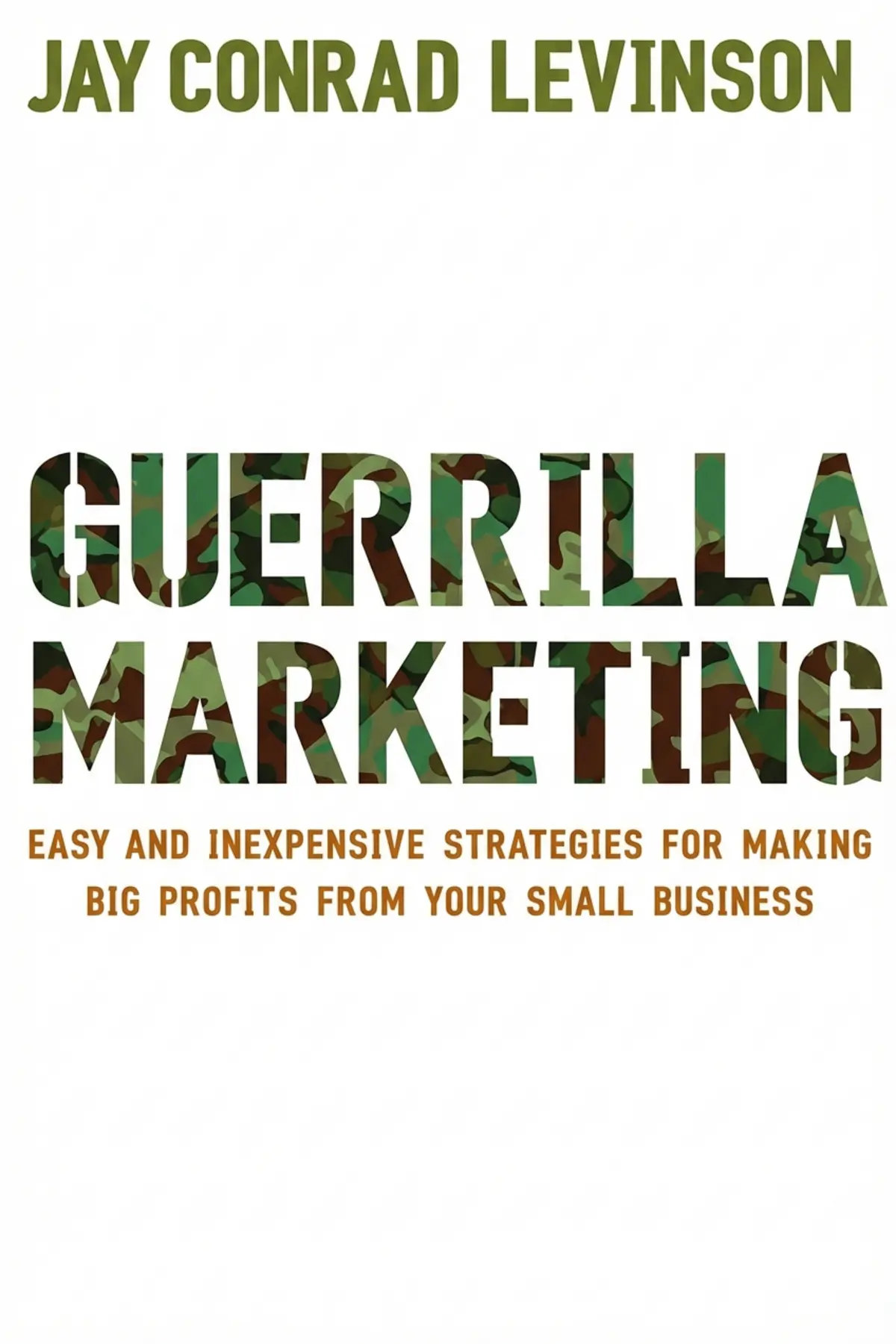
Table of Content
1. Introduction
56 sec
Owners of small businesses often assume the rival with the bigger budget will win every marketing contest. Jay Conrad Levinson disagreed, starting from a blunt fact: a campaign can set a sales record and still lose money, so the only honest score is profit. In Guerrilla Marketing, the advertising veteran credited with coining the term shows how small firms can reach customers through cheap, inventive methods that large companies tend to overlook.
His argument is that marketing is an endless conversation with customers, built on a clear position and judged by profit, and that time, creativity and personal attention can do much of what money does for bigger players. The payoff is concrete: why a free seminar can fill a customer list, how to split a website budget into three equal parts, and why lunch with one journalist beats a pile of mailed press kits.
2. See every customer touchpoint as marketing
1 min 43 sec
Most owners think marketing starts when an ad goes live and ends when it stops. Levinson draws the boundary somewhere else entirely, and it changes what you should be spending on after every campaign.
3. Judge every campaign by the profit it leaves
1 min 53 sec
A big company can celebrate record sales while its campaign drains money. Levinson explains why a small business cannot afford that kind of success, and where its real advantage over large rivals lies.
4. Position your business first and ad copy second
2 min 00 sec
One young airline launched just as air travel collapsed in popularity, yet it thrived. Levinson traces its success to a decision made long before any slogan was written, and shows which buyers are worth aiming for.
5. Settle seven decisions before spending anything
1 min 58 sec
Creativity is the guerrilla’s weapon, yet Levinson insists on a short checklist before any idea goes public. One of his questions is where many businesses disappoint customers without realizing it.
6. Put each message in the medium that suits it
2 min 02 sec
Magazines, television and the web each reward a different kind of message, and one of them costs too much for most small firms. Levinson also offers a simple formula for dividing a website budget.
7. Win buyers by giving your knowledge away
1 min 52 sec
A struggling computer-training business found hundreds of new prospects by charging nothing at all. Levinson explains the condition that turns free guests into paying customers, and how a party can do the same job.
8. Earn press coverage and community goodwill without paying for it
1 min 50 sec
Most companies reach out to the press in a way that almost always ends in the wastebasket. Levinson describes a cheaper, more personal route to coverage, and why helping your community makes customers trust your paid work.
9. Conclusion
1 min 23 sec
Levinson’s book adds up to a different way of keeping score. A big company can admire reach and record sales; a small one has to ask whether each campaign left more money than it took. Once profit is the test, the cheap tools stop looking like second choices. A customer answered by name, a free seminar that drew 500 people, a lunch with a reporter instead of a mailed press kit: each spends time and imagination where a rival would spend cash.
The work begins before any channel is chosen, with a position you can state in one sentence and honest answers about action, advantage, market, tools, niche, identity and budget. Then it keeps going, because what one campaign earns pays for the next.
Levinson’s closing advice is modest. Before committing to an expensive television or print campaign, stop and study how other small companies selling similar things have marketed themselves. Their size usually pushed them toward inventive ideas, and one of those ideas may spark yours while saving your budget for something else.
The guerrilla’s real edge is a willingness to put time into small, personal work, such as replying to each customer individually, which gives small businesses an advantage over bigger corporations.
About this book
What is this book about?
Most small businesses face rivals who can outspend them on television, billboards and full-page ads. Jay Conrad Levinson, the advertising veteran credited with coining the term guerrilla marketing, argues that money is not the deciding factor. A campaign can set a sales record and still lose money, so the only score that counts is profit, and on that score imagination often beats cash. Levinson redefines marketing as everything a customer perceives about a company, run as a cycle that never stops. He shows how to fix a clear position before designing anything, answer seven plain questions before every campaign, and match each message to the medium that suits it, with a simple rule for splitting a website budget. The heart of the book is a set of low-cost tools: two-way conversations with customers, free seminars and parties that turn guests into buyers, personal relationships with journalists, and community work that makes a business feel like an old friend. Readers get a practical way to compete with larger firms by spending time and creativity where those firms spend money.
Book Information
Who it's for
Outspent small business owners
Small business owners competing against rivals with far bigger advertising budgets.
Founders and independent professionals
Founders and solo professionals who want customers through seminars, email and press coverage rather than costly ads.
Marketers at larger firms
Marketers in larger firms looking for low-cost, profit-focused ideas to test.
About the Author
Jay Conrad Levinson
Jay Conrad Levinson (1933 to 2013) studied psychology, which led him into advertising. He was creative director at Leo Burnett in London and later a Senior Vice President at J. Walter Thompson, working on campaigns for Mercedes, Visa and Rolling Stone and developing the Marlboro Man. He is credited with coining the term guerrilla marketing, the subject of his 1984 book, and taught it for a decade at UC Berkeley Extension.
Ratings & Reviews
Ratings at a glance
What people think
Listeners find this marketing guide essential for small businesses, offering authentic perspectives and useful advice. It provides successful marketing techniques, with one listener highlighting its emphasis on low-cost promotion, and listeners value its benefits for expanding companies. Although some reviews mention that the material feels a bit dated, listeners commend its creative ideation methods and believe it is a worthwhile investment.
Top reviews
Rome
Jay Conrad Levinson basically wrote the bible for small business owners who don't have a Coca-Cola budget. The '16 Monumental Secrets' section provides a solid framework that forces you to stop thinking about marketing as an expense and start seeing it as an investment. To be fair, some of the specific tactics involving classified ads or fax machines feel like they belong in a museum, but the psychological principles behind them are gold. I particularly appreciated the emphasis on 'fusion marketing' and collaborating with partners who share your audience. It's a brainstorming goldmine. However, the author can be a bit repetitive at times, hammering the same points home across multiple chapters. If you can filter out the outdated media advice, the core strategy of using imagination over brute force remains incredibly relevant today.
Show moreOak
Picked this up during a slump in my consulting business and it was exactly the kick in the pants I needed. The core message that 'marketing is every hit of contact' changed how I view my emails and even my voicemail greeting. Levinson’s focus on 'you' marketing—making everything about the customer’s success rather than your own ego—is a lesson every entrepreneur needs to learn. I was shocked to read that 67% of lost business is just due to a lack of follow-up! That statistic alone prompted me to reach out to three former clients immediately. The book is definitely dated in parts, especially regarding the Web and 'mini-media,' but the strategy of being a 'guerrilla' who uses time and energy instead of money is empowering. It’s a great tool for sparking new ideas when you feel stuck.
Show moreGame
"Marketing is the art of getting people to change their minds." That quote from the book has stuck with me for weeks. I finally got around to reading this classic, and I see why it’s on every recommended list. Even though the 2007 edition is technically 'outdated,' the principles of commitment and confidence are universal. Levinson argues that frequency is better than reach, which is a hard truth many small business owners struggle to accept. They want to go big once, rather than small and consistent. I found the advice on 'vampire marketing' especially relevant in the era of viral videos that go nowhere. The book does have its flaws—it’s repetitive and the author is clearly in love with his own brand—but the value you get for the price is undeniable. It teaches you to be scrappy.
Show moreKai
As someone who is totally new to marketing, I found this to be a fantastic starting point. The book is structured into clear sections, making it easy to jump between 'mini-media' and 'non-media' tactics. I particularly liked the idea of giving something away to build trust—the 'give and receive' philosophy. While some of the sections on print media felt like a waste of time for my online shop, the general advice on building a 7-sentence marketing plan was super helpful. It forced me to actually define my target audience rather than just guessing. The book is more about inspiration and basic strategy than a technical manual, but for a small business owner, that’s often exactly what you need. Definitely worth the read for the mindset shift alone.
Show moreManika
The concept of 'vampire marketing' alone made this worth the purchase for me. It’s a brilliant term for those ads that are so funny or flashy that you forget the actual brand! I’ve seen so many small businesses fall into this trap. This book is a must-read for anyone trying to grow a business on a shoestring budget. While the tech advice is definitely showing its age—who still uses newspapers as their primary weapon?—the underlying logic about consistency and customer follow-up is timeless. It’s practical, direct, and very encouraging for those of us who can't afford a massive agency.
Show moreVarinee
Not what I expected, to be honest. I was looking for a tactical manual on digital growth, but this is much more about the mindset of a small business owner. The 'Sixteen Monumental Secrets' are essentially a checklist for consistency and patience. Got to admit, I found the chapters on television and radio ads pretty useless in the age of Instagram and TikTok. However, the advice on measuring effectiveness and not relying on 'blind faith' is still spot on. It’s a decent introductory text, but don’t expect a modern blueprint for SEO or social media.
Show moreWillow
Ever wonder why some tiny shops punch way above their weight class? This book explains it through the lens of 'weapons' that cost more time than money. I loved the section on 'fusion marketing' where you partner with businesses that share your prospects. It’s such a simple, cost-effective way to double your reach without doubling your spend. My only gripe is that the book is quite verbose. Levinson takes ten pages to say what could be summarized in two. Also, his definition of 'service' as 'anything the customer wants it to be' is a bit idealistic for certain industries. Still, as a brainstorming tool for someone starting a new venture, it’s incredibly valuable.
Show moreJune
After hearing about this classic for years, I finally dove in, but the results were mixed. The truth is, if you’ve already read a modern university textbook or even a few high-level marketing blogs, you might find this content a bit elementary. It often feels like a collection of common-sense ideas wrapped in a 'guerrilla' label. I was hoping for more specific 'how-to' execution steps, but instead, I got a lot of 'what' and 'why.' For instance, the section on seminars tells you to host one, but doesn't really teach you the art of the sale or how to structure the presentation for maximum conversion. Plus, Levinson constantly plugs his other books, which gets annoying after a while. It’s not a bad read for a total beginner, but professionals will likely find it to be a routine retelling of basic concepts. Not exactly the revolutionary manifesto I was expecting, though the 'vampire marketing' warning was a nice, rare insight.
Show moreWatcharee
Look, if you have a degree in marketing, you can probably skip this one. Much of what Levinson discusses is essentially Kotler for people who don't want to read Kotler. It’s simplified, blog-style information that prioritizes 'vivid imagination' over actual data-driven strategy. I found the author’s tone a bit bombastic and self-promotional, especially with the constant references to his 'other volumes.' It feels like a long-form sales letter at times. That said, if you are a local shop owner who has never thought about a marketing plan, this might be eye-opening. For everyone else, it’s mostly fluff.
Show moreA
Frankly, the author’s tone is a bit too 'rah-rah' and bombastic for my taste. It felt like I was being shouted at by a motivational speaker rather than taught by a strategist. The book is essentially a collection of ideas without much depth on execution. For example, he mentions the importance of body language but gives no tips on how to actually use it. I also found it frustrating how often he redirects you to his other books for the 'real' details. It’s okay for a quick skim to get the juices flowing, but it lacks the substance required for a serious marketing plan. Too much sizzle, not enough steak.
Show moreQuestions about this book
What is the main idea of Guerrilla Marketing by Jay Conrad Levinson?
Levinson argues that small businesses can compete with bigger rivals by using inventive, low-cost methods instead of expensive advertising. Marketing, in his view, is everything customers perceive about a company, run as a continuous cycle and built on a clear position. Every campaign should be judged by the profit it produces, because a campaign can set sales records and still lose money.
How is guerrilla marketing different from traditional marketing?
Traditional marketing, as Levinson describes it, relies on big spending such as television commercials and full-page magazine ads, and often measures success by sales or traffic. Guerrilla marketing uses cheaper channels like the street and the internet, measures only profit, and works as a dialogue. Small firms can answer each customer personally, which a corporation with millions of buyers cannot do.
What is the rule of thirds for a website budget?
Levinson suggests dividing an online marketing budget into three equal parts. One third develops a website that is engaging and useful to customers. Another third promotes the site, since a perfect site nobody visits is worthless. The final third goes to maintaining and improving the site over time, much as you would keep caring for a growing infant.
How can a small business get press coverage without paying for it?
Levinson recommends building personal relationships with journalists instead of mailing out impersonal press kits, which he says are thrown away almost 80 percent of the time. Get to know reporters who cover your field, invite them to lunch and hand over your information in person. Coverage is free and usually more credible than paid advertising, provided you offer news they actually want.
Who should read Guerrilla Marketing?
It suits small business owners facing larger competitors, founders with tight budgets, and marketing staff in bigger companies who want creative, profit-focused methods. Its tools are practical: positioning in one sentence, seven questions to answer before each campaign, free seminars and parties that turn guests into buyers, email lists of satisfied customers, and community work that builds trust.
Readers also enjoyed


7 Powers: The Foundations of Business Strategy
Hamilton Helmer



Alibaba: The House That Jack Ma Built
Duncan Clark

AUDIO SUMMARY AVAILABLE
Listen to Guerrilla Marketing in 15 minutes
Get the key ideas from Guerrilla Marketing by Jay Conrad Levinson, plus 5,000+ more nonfiction titles.
- 5,000+ titles
- Listen as much as you want
- 7-day free trial
- Cancel anytime









