

15 min 17 sec
Available in: English
Gravitas: Communicate with Confidence, Influence and Authority
Shows how to make your words carry weight at work, using simple physical and vocal techniques to sound grounded and trustworthy in meetings, presentations, phone calls, interviews and on camera.
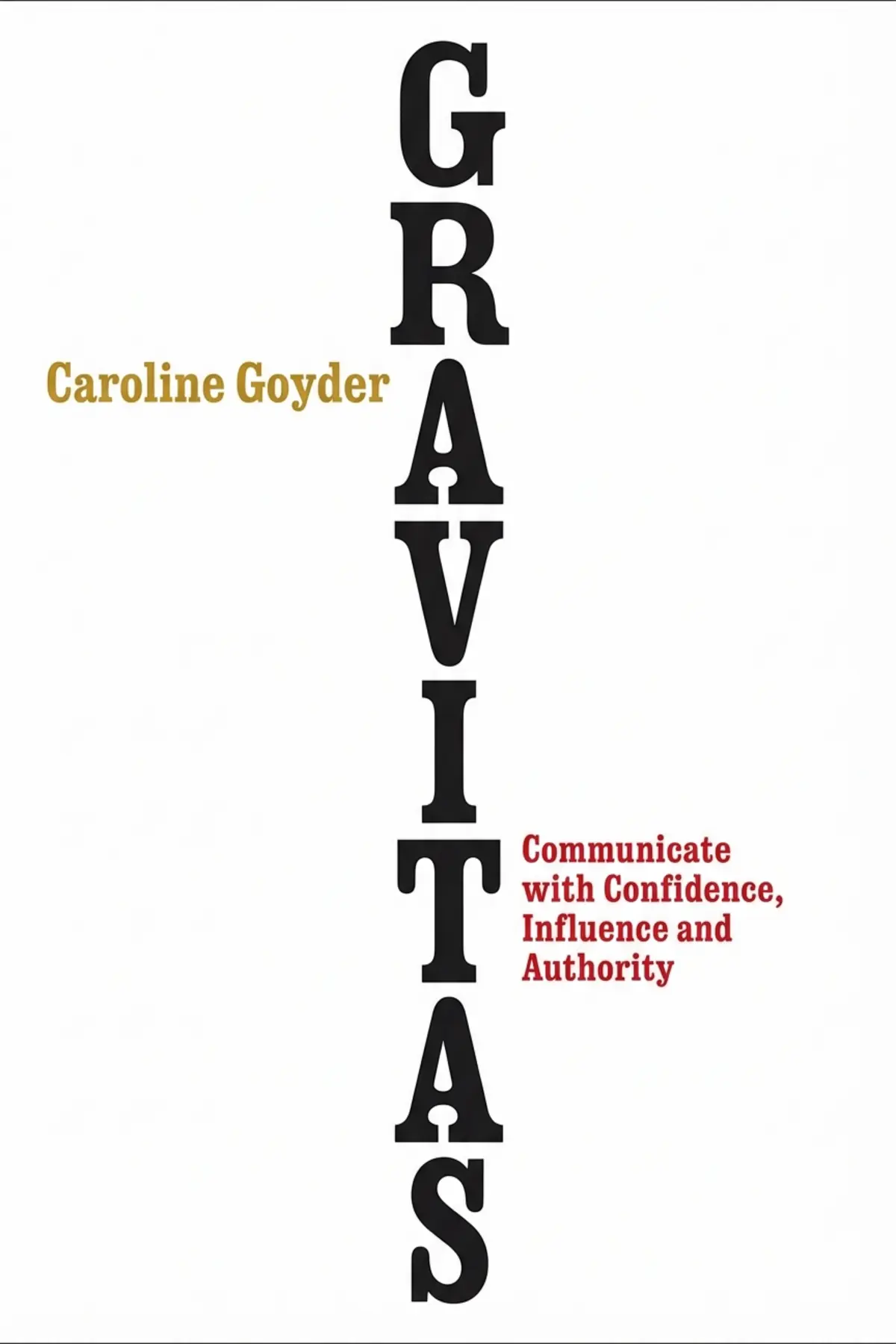
Table of Content
1. Introduction
1 min 09 sec
Plenty of capable people know their subject well and still get talked over in meetings or forgotten after interviews. In Gravitas, voice coach Caroline Goyder argues that the weight others give your words is a skill, and she sums it up in a formula: add knowledge, purpose and passion, then subtract anxiety. Gravitas, as she defines it, has nothing to do with being loud or intimidating. It is the mix of expertise, authenticity and emotional connection that makes people trust your judgment.
Her case runs in two steps. First you build a steady inside: a grounded body, a voice that starts low, and the ability to shift between authority and warmth. Then you carry that steadiness into the rooms that test it, through careful planning followed by full presence. Expect small physical moves that change how you sound within seconds, like turning your palms down or standing up during a phone call, and a plan for presentations, meetings, calls, cameras and interviews.
2. Ground your body before you speak
1 min 43 sec
Most people try to fix nervous speaking by polishing their words. Goyder starts somewhere far less obvious, with where you sit and where your thumb rests, and the change in your voice can be immediate.
3. Switch between pilot and flight attendant at will
1 min 47 sec
An airline needs both a pilot and a flight attendant, and so does anyone who wants to be followed. A tiny experiment with your hands shows which one you sound like right now.
4. Move people with feeling and stay level under fire
1 min 51 sec
Good data rarely changes minds by itself, and difficult people can knock even confident speakers off balance. Goyder’s answer to both involves planning feelings in advance and, oddly, rearranging the furniture.
5. Plan by the clock, then perform in the moment
2 min 01 sec
Some speakers over-prepare and sound wooden; others improvise and wander. Two ancient Greek words for time, plus a method borrowed from Walt Disney, show how to have the strengths of both.
6. Run meetings people leave knowing what was decided
1 min 46 sec
Meetings often turn into contests for status and airtime. Goyder shows how to change that before anyone arrives, including where to sit and which two common words to stop using.
7. Sound warm on calls and steady on camera
1 min 57 sec
Without a face to read, or with a lens magnifying every flicker of nerves, most people stiffen. Goyder points to an unexpected teacher and a single physical move that changes how authoritative you sound.
8. Answer interview questions with point, proof and benefit
1 min 51 sec
Interviewers notice more than your answers: how you structure them, how you end them and how long you wait. A three-step frame and one small silence can shift the balance of the room.
9. Conclusion
1 min 12 sec
Goyder’s book turns a quality usually treated as inborn into habits of body and mind. Gravitas, in her telling, is what remains when knowledge, purpose and passion are no longer drowned out by anxiety. The body is where that subtraction happens: feet on the floor, palms turned down or up, a voice that comes from the diaphragm, a pause long enough to breathe. The same few moves travel from the meeting room to the phone, the camera and the interview chair.
Start small this week. Before your next meeting, spend a few seconds feeling the chair and the floor, and choose your gear, pilot or flight attendant, before you speak. On your next difficult call, get on your feet. Before any talk or interview, do the planning in clock time, then let it go and be present in the room, using the freeze-frame pause if nerves rise.
None of this asks you to be louder or more forceful. Weight, in Goyder’s account, comes from steadiness. People lean toward the speaker who seems to have time, and that sense of time is something you can practice.
About this book
What is this book about?
Many capable professionals know their material but struggle to be heard. They get interrupted in meetings, sound flat on calls or rush their answers in interviews. Voice coach Caroline Goyder argues that the quality which makes people stop and listen, gravitas, is no gift reserved for a lucky few. It can be trained. Her formula is short: knowledge, purpose and passion, minus anxiety. She organizes the work into seven principles, from knowing yourself and balancing status with warmth to winning hearts as well as minds and keeping a level head in conflict. Many of her tools are physical. Grounding yourself in a chair, turning your palms down or up, tapping below the ribs to find a deeper voice and standing during a phone call all change how you come across within seconds. Goyder then applies the principles to the settings where they matter most: presentations, meetings, phone calls, job interviews and on-camera appearances. Readers get concrete routines for each, from a three-stage preparation method inspired by Walt Disney to a point, example and benefit frame for interview answers.
Book Information
Who it's for
Experts often talked over
Professionals who know their subject but get talked over in meetings or on calls.
Leaders wanting warm authority
Managers and new leaders who need to sound authoritative without seeming cold.
Candidates and presenters
Job seekers and anyone facing presentations, interviews or video appearances who wants routines that calm nerves.
About the Author
Caroline Goyder
Caroline Goyder is a British voice coach and speech expert who has worked with the Royal Central School of Speech and Drama in London. She studied English Literature at St John's College, Oxford. Her clients have included actors, news presenters, chief executives of large companies and a monarch. Her coaching focuses on breath, posture and vocal delivery as routes to confident speech, and her TEDx talk on speaking with confidence has been watched millions of times. She is also the author of Find Your Voice and The Star Qualities.
Ratings & Reviews
Ratings at a glance

What people think
Listeners value the hands-on approach to developing personal influence and poise, even if some feel the material can be slightly superficial or repetitive for seasoned orators. Furthermore, many believe the way gravitas is divided into concrete steps—like improving voice quality and physical presence—works exceptionally well for workplace environments. They also highlight the benefits of the provided physical drills, and one listener points to the "FOFBOC" (Feet On Floor, Bum On Chair) method as a particularly helpful strategy for staying centered in intense meetings. The book receives additional acclaim for its flexibility in handling current communicative hurdles, from digital conferences to telephonic interactions.
Top reviews
Sayan
After hearing Caroline Goyder’s TED talk, I knew I had to dive deeper into her philosophy on presence. Frankly, the book delivered more than I expected by breaking down "gravitas" into something actionable rather than just a mysterious trait some people are born with. I particularly appreciated the FOFBOC (Feet On Floor, Bum On Chair) technique; it sounds almost too simple, but it really does wonders for grounding your energy before a big presentation. Goyder’s background in voice coaching shines through in the chapters on vocal resonance and rhythm. The way she explains how to find your "center" helps bridge the gap between internal anxiety and external authority. It’s a very practical guide that moves beyond generic advice and gives you specific physical cues to work with. If you want to command a room without being the loudest person in it, this is your manual.
Show moreSirichai
Finally got around to reading this after a colleague in Europe wouldn't stop raving about it, and it’s now a permanent fixture on my desk. What sets this apart is how Goyder balances the internal mindset with external mechanics. She doesn't just tell you to "be confident"; she tells you where to put your hands and how to modulate your pitch to achieve it. The art of persuasion section, which pairs hard logic with emotional storytelling, changed how I structure my project pitches. The "three-chair method" has also been a lifesaver for depersonalizing some of the more toxic conflicts I’ve had to navigate recently. It’s rare to find a professional development book that is both this practical and this readable. Highly recommended for anyone in leadership or aspiring to be.
Show moreRome
Look, this isn't a quick fix, but it's a comprehensive toolkit for anyone wanting to be taken seriously in a world that’s increasingly loud and distracted. Goyder understands that true authority comes from a place of calm, not aggression. Her breakdown of the seven principles is masterfully done, especially the way she applies them to modern scenarios like video calls and interviews. I found the "signposting" technique for structured speaking to be particularly effective for keeping my audience engaged during long presentations. The book encourages a sense of "mindfulness" in communication that is often missing from corporate training. It’s a must-read for anyone who wants to lead with authenticity and heart. The advice is timeless, practical, and deeply empowering.
Show moreTong
Picked this up specifically to prep for a series of high-stakes video meetings, and I’m glad I did. The modern workplace has changed, and Goyder’s advice on adapting your presence for the camera is incredibly timely. She explains how the camera magnifies every twitch, making the need for intentional stillness even more vital. I also found the section on phone communication surprisingly helpful. Truth is, we often forget that without visual cues, our tone of voice has to do all the heavy lifting. Using a "dark brown velvet" tone might sound a bit theatrical, but it actually works to project calm authority. The writing is accessible, though a bit repetitive in the middle chapters. Still, it's a solid 4-star resource for any professional looking to sharpen their edge in a digital-first environment.
Show moreChaiwat
Goyder treats communication like an actor's craft, which is a refreshing change from the usual corporate dry-speak. In my experience, most business books focus so much on the "what" that they completely ignore the "how" of delivery. This book reverses that. The emphasis on diaphragmatic breathing and vocal "anchoring" gave me tools I hadn’t considered before. I especially liked the "freeze-frame" technique for resetting during moments of high stress. It’s about becoming more of yourself, not putting on a mask. My only gripe is that the first few chapters spend way too much time defining gravitas. We get it—it’s important. Once you get past the fluff and into the actual exercises, the value increases significantly. It’s a practical toolkit for anyone who feels they are being overlooked in meetings.
Show moreUbolwan
As someone who struggles with meeting anxiety, the "Feet on Floor, Bum on Chair" (FOFBOC) technique was a game changer for me. I used to spend entire meetings fidgeting and losing my train of thought, but Goyder's physical grounding exercises really helped me stay present. The book is full of these small, actionable gems. I also appreciated the focus on "listening with gravitas"—it’s not just about talking, but how you hold the space when others are speaking. The writing is clear and the exercises are easy to follow, even if some of the vocal drills felt a bit silly to do alone in my office. It’s a solid, practical guide that actually gives you things to do rather than just things to think about.
Show moreKamol
Ever wonder if 'gravitas' is just another buzzword for basic social skills? That was my initial thought halfway through the first section. To be fair, the book is exceptionally well-organized and Goyder is a clear communicator, but many of the insights felt like common sense repackaged with fancy Greek names. The focus on logos, ethos, and pathos is classic rhetoric that you can find in any introductory speech class. While the "three-chair method" for handling conflict was a highlight, much of the rest felt like a collection of "nice to have" tips rather than a deep psychological dive. It’s a light, readable book—perfect for a long flight—but don’t expect it to radically transform your professional presence overnight. It lacks the intellectual depth I was hoping for, though the actionable acronyms make it easy to remember the basics during a stressful meeting.
Show moreDao
Not gonna lie, if you’ve spent any time reading public speaking manuals, half of this will be a repeat. We’ve all heard about the importance of pauses, eye contact, and "owning the space" in a room. That said, Goyder does a decent job of consolidating these ideas into a single, portable framework. The structure is clear, and the inclusion of "morning pages" to find your voice was a nice, albeit slightly "woo-woo," touch. It’s the kind of book that makes you feel energized while reading it, but the challenge is actually implementing the habits. I found the section on "sifting" your ideas particularly useful for avoiding the rambling I usually do when I’m nervous. It’s a fine book, just not the groundbreaking revelation the blurb on the back makes it out to be.
Show moreMason
"Gravitas" isn't exactly what I expected from a book with such a weighty title. While it has its moments, the tone is quite breezy and the "principles" can feel a bit thin at times. I enjoyed the Greek history snippets, like the concept of 'kairos,' but they often felt like window dressing for fairly standard advice. Look, it’s not a bad book by any means—the advice on posture and "grounding" is genuinely helpful for anyone with stage fright. However, it feels more like a collection of blog posts than a rigorous study of influence. If you’re looking for a quick confidence boost before an interview, this will do the trick. If you want a deep dive into the psychology of authority, you might find it a bit lightweight.
Show moreRyan
The logic here feels a bit slipshod and lacking in any real foundation. Honestly, I expected a book about gravitas to have a bit more... well, gravitas. Instead, the writing is simplistic to the point of being patronizing. Goyder makes several sweeping claims about body language that felt like the same debunked "one-size-fits-all" theories I’ve seen in dozens of other self-help books. It jumps around from one anecdote to another without ever building a cohesive argument for why these techniques work beyond the fact that she saw an actor do it once. If you’ve ever read a decent book on public speaking or psychology, you can safely skip this one. It promises a "practical framework" but delivers a shallow list of exercises that feel like they were pulled from a basic drama 101 syllabus. Disappointing.
Show moreQuestions about this book
What is the main idea of Gravitas by Caroline Goyder?
Goyder argues that gravitas, the quality that makes people trust and listen to you, can be learned. She sums it up as knowledge, purpose and passion, minus anxiety. Volume and intimidation play no part in it; it is a balance of expertise, authenticity and emotional connection, built through seven principles and practiced in meetings, presentations, phone calls, interviews and on camera.
What are the seven principles of gravitas?
The inner three are know yourself, teach people how to treat you, and find your voice. The outward four are speaking so others listen, winning hearts and minds, keeping an open mind and a level head, and getting results. The first group builds a steady base; the second governs how you connect with and influence others, from tone of voice to handling conflict and pressure.
How can I sound more authoritative when I speak?
Goyder offers quick physical techniques. Speak with palms facing down and your voice tends to drop and sound more certain. Tap just below where your ribs part as you talk to move the voice from the throat to the diaphragm. Use short sentences with pauses. On the phone, stand up, which she says doubles vocal authority, and smile so your voice sounds warm.
How does Gravitas help with job interviews?
Goyder suggests researching your interviewers, preparing for the questions you dread, and answering in three steps: make a point, give a concrete example, then explain the benefit to this employer. Signpost with phrases like two points, first, close your mouth when you finish, and let the interviewer see you consider each question. Rushing, she warns, comes across as insecure.
Who should read Gravitas?
It suits professionals who know their material but struggle to be heard, new managers balancing authority with warmth, and anyone facing presentations, interviews, conference calls or camera appearances. Its tools are short and physical, from the Feet on Floor, Bum on Chair grounding routine to the freeze-frame pause for stressful moments, so they can be tried before the next meeting.
Readers also enjoyed








AUDIO SUMMARY AVAILABLE
Listen to Gravitas in 15 minutes
Get the key ideas from Gravitas by Caroline Goyder, plus 5,000+ more nonfiction titles.
- 5,000+ titles
- Listen as much as you want
- 7-day free trial
- Cancel anytime









