

14 min 37 sec
Available in: English
Good Arguments: How Debate Teaches Us to Listen and Be Heard
By Bo Seo
Shows how the habits of competitive debaters, from pinning down the real disagreement to building, rebutting and delivering arguments, can turn bitter quarrels at work, at home and online into useful, respectful exchanges.
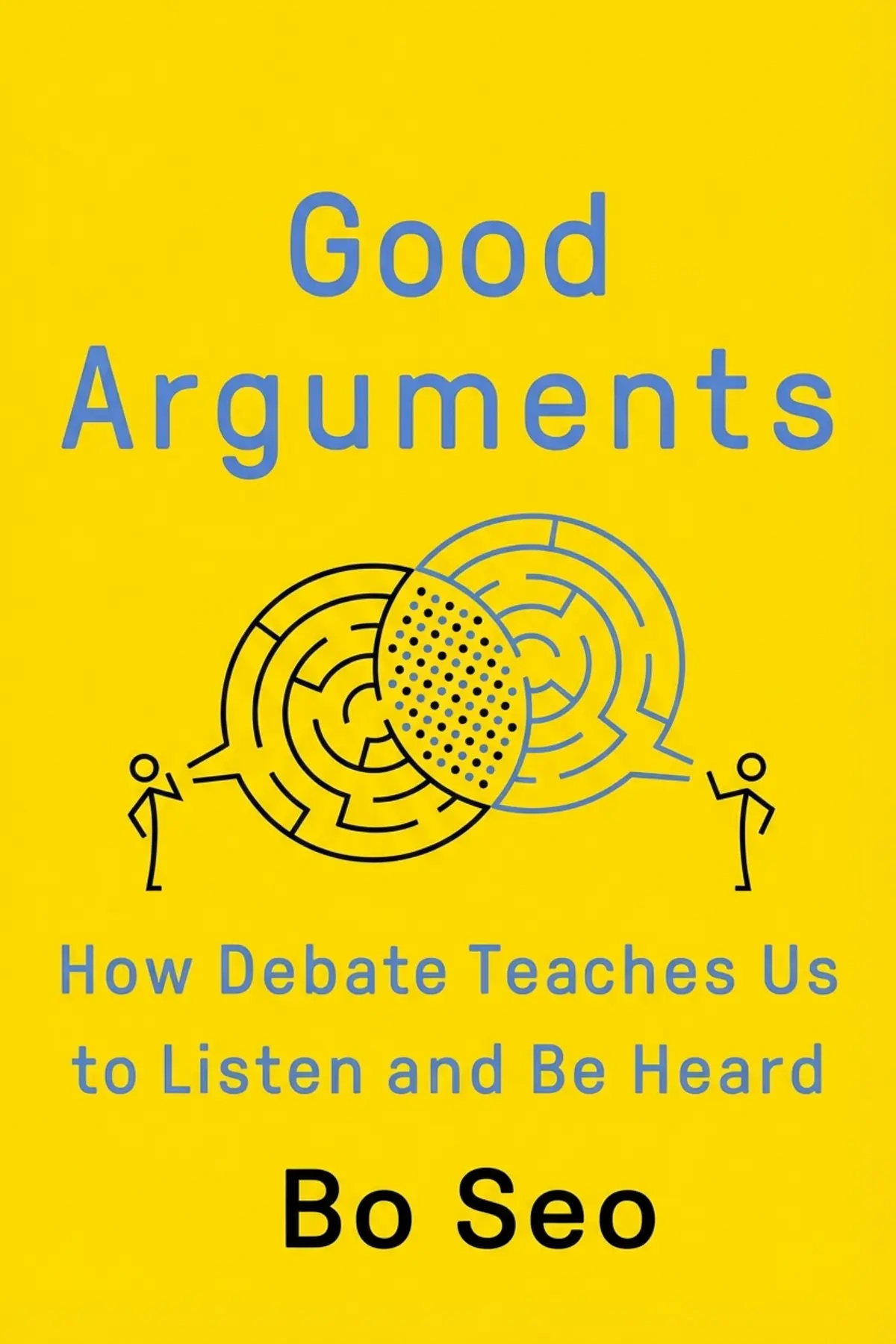
Table of Content
1. Introduction
1 min 10 sec
If your arguments tend to end in shouting or in silence, the problem may be less your opinions than your method. In Good Arguments, Bo Seo, a world champion in both school and university debating, makes the case that competitive debate already holds the method most of us are missing. Debaters have to disagree hard, under rules, while respecting the other side, and the habits that win their rounds also make ordinary disagreements more useful.
Seo sees public argument turning bitter, online and at family dinners, with many people opting out from fear. Avoiding conflict, he argues, will not heal the split. Learning to disagree well can, because disagreement handled with a debater’s skill can strengthen the ties between people who disagree.
What follows is that skill, piece by piece: a pen-and-paper way to find what you really disagree about, a structure that turns an opinion into an argument, several routes for answering a point, a preparation exercise that changes how you see opponents, and drills for speaking so people listen.
2. Treat arguing as a skill you can learn
2 min 02 sec
An eight-year-old who could not speak the language at school went silent for years. One invitation from a teacher changed that, and it shows that the confidence to disagree is built, not inherited.
3. Name the real disagreement before you argue
2 min 13 sec
Try to state, in one line, what your last argument was actually about. Many people cannot, and that gap explains why so many fights go in circles and leave nothing settled.
4. Turn an opinion into an argument that holds
2 min 18 sec
A vegetarian can describe factory farms in vivid detail and still watch a meat-eater shrug. The missing step is the one most people skip, and it decides whether a case persuades at all.
5. Five ways to push back on a point
1 min 46 sec
When someone makes a decent case against you, the usual reflex is to repeat yourself louder. A small dispute over an old hatchback shows how many better answers are hiding in plain sight.
6. Prepare by arguing your opponent's case first
1 min 37 sec
A five-minute exercise meant to help you win an argument has an unexpected side effect. Debaters who use it often walk into the room less certain, and better company for it.
7. Speak clearly enough to move people to act
2 min 09 sec
Facts on their own rarely get anyone moving. Debaters train their delivery with drills involving paper balls and fruit, and the silliness hides a serious point about why some speakers get believed.
8. Conclusion
1 min 22 sec
Seo’s book adds up to a claim about citizenship as much as conversation. Finding the real dispute, proving claims and linking them, answering fairly and speaking clearly are the habits a divided public seems to be forgetting, and competitive debate is where they get practiced. He sees signs of a return. Schools and workplaces around the world are starting to build debate into how they teach and decide, and Warren Buffett has floated hiring two advisors before any big acquisition, one to argue for it and one against. Seo hopes for more: governments that teach citizens to debate and open forums for it, such as citizen assemblies, where neighbors settle shared questions by reason, listen to each other’s concerns and compromise.
None of this needs judges or a podium. It needs people willing to argue, to treat each other with respect and to avoid taking points personally. The next time a dinner or a meeting starts to heat up, write the disagreement in one sentence and circle the words that carry it. Before a conversation you can see coming, spend five minutes arguing the other side.
The boy who moved to Australia at eight and eventually fell silent at school found his voice by learning to disagree. Seo’s wager is that a wary, quiet public can do the same.
About this book
What is this book about?
Public argument has turned harsh. Online exchanges and family dinners can end in shouting, and many people now stay out of disagreements altogether because they fear the crossfire. Bo Seo, who arrived in Australia as a silent eight-year-old and went on to win world titles in debate, argues that avoiding conflict will not heal these divisions. Learning to disagree well can. His model is competitive debate, a formal contest with fairly simple rules in which two teams try to persuade judges to take their side on an issue. Seo pulls out the skills that make debaters good and shows how they work in ordinary life. You learn to locate the actual point of disagreement and sort it into facts, judgments or prescriptions. You learn to build an argument that proves both its claims and their link to the conclusion. Then you learn how to take apart an opponent's point and how to prepare by arguing their side first. Seo also defends rhetoric as an ally of the truth and shares drills debaters use to speak clearly and fluently. Readers get a practical toolkit for tense meetings and family arguments, and a case for why debate matters to democratic life.
Book Information
Who it's for
Professionals dreading tense meetings
Professionals who dread tense meetings and want a clear method for making and answering a case.
Bitter arguments or silence
People whose family or online arguments keep turning bitter, or who have stopped speaking up at all.
Hoping to speak fluently
Students and team leads who want practical drills for thinking on their feet and speaking fluently.
About the Author
Bo Seo
Bo Seo is a South Korean-Australian journalist and author who won both the World Schools Debating Championships in 2013, as captain of the Australian team and top speaker, and the World Universities Debating Championship in 2016. He has coached the Australian national team and the Harvard College Debating Union. His writing has appeared in The New York Times, The Atlantic and CNN. He graduated summa cum laude from Harvard and holds a master's in public policy from Tsinghua University.
Ratings & Reviews
Ratings at a glance

What people think
Listeners value the book's observations, with one listener highlighting how it clarifies the forgotten craft of debate. The prose earns favorable remarks; one listener even characterizes the author as a virtuoso in his field. There are varied perspectives regarding the storytelling approach, as some listeners enjoy the compelling narrative while others feel it dwells excessively on individual anecdotes. The choice of words draws differing views, including one listener who considers the phrasing overly wordy.
Top reviews
Alejandra
Few books manage to bridge the gap between competitive sport and daily survival as effectively as this one. Bo Seo uses his journey from a quiet immigrant student to a world-class debater to illustrate how structured disagreement can actually foster intimacy. Truth is, we usually view conflict as a sign of failure, but Seo reframes it as a necessary tool for discovery. I particularly appreciated the RISA framework—checking if a fight is Real, Important, Specific, and Aligned. It has already saved me from three pointless Twitter arguments this week alone. While the prose is occasionally quite elevated, the intellectual payoff is worth the extra effort. This isn't just a manual for winning; it’s a guide for connecting in an increasingly polarized world.
Show moreSuphan
Wow, I think I’m actually smarter after finishing these pages. The author’s ability to explain the intricate craft of persuasion in an approachable manner is truly impressive. In my experience, most 'communication' books are full of fluff, but Seo gives you actual tools like the 'pivot' and the 'counterclaim.' I loved the idea that a good argument should end with a positive claim rather than just an attack. It’s a shift from being 'against' something to being 'for' something else. The story of his childhood and how debate gave him a sense of belonging was genuinely moving. It’s a rare book that provides both a mental workout and an emotional journey. Every parent should read the chapter on how debate increases graduation rates for at-risk youth.
Show moreOlivia
After hearing Bo Seo speak on a podcast, I wanted to see if his written logic was as sharp as his verbal rebuttals. It is. In my view, the most powerful part of the book is the argument that we have a 'responsibility to disagree well.' We live in a world of monologues, and Seo makes a compelling case for the return of the dialogue. The 4W structure is something I’ve already started using to prep for my weekly presentations. Even the sections on AI like AlphaGo were fascinating, showing how technology is changing the way we think about strategy. It’s an important book that challenges you to be a better listener. I’ll definitely be recommending this to my colleagues.
Show moreLaddawan
Finally got around to reading this and I am kicking myself for not joining a debate club in high school! I’ll be honest, I used to be someone who avoided conflict at all costs, but Seo shows that avoiding an argument is often worse than having a 'good' one. The book teaches you how to stand your ground while still respecting the 'equal moral standing' of the person you’re talking to. I loved the specific details about the 1960 Nixon-Kennedy debates and how television changed the game of persuasion. It’s well-structured, introspective, and even has some sparks of humor that keep it from feeling too heavy. This might be the best book I’ve read all year. It really makes a sport out of the impulse to be heard.
Show moreWararat
Picked this up thinking it would be a dry instructional manual, but it is actually more of a memoir about finding your voice. Bo Seo is clearly a master of his art, and his writing reflects a deep, almost poetic appreciation for the spoken word. Not gonna lie, I had to keep a dictionary handy because his vocabulary is incredibly dense at times. Some might find that pretentious, but I thought it added to the weight of the subject matter. The breakdown of the 'four W’s'—What is the point? Why is it true? When has it happened? Who cares?—is a simple yet brilliant way to structure any thought. I wish I had been introduced to these concepts as a teenager. It's a solid four stars for the insights alone.
Show moreSebastian
Ever wonder why we have lost the ability to disagree without hating each other? This book attempts to answer that by looking at the rules of formal debate. Look, Seo is a very talented writer, though he does have a tendency to be a bit verbose when simplicity would do. I found the RISA checklist to be a game-changer for my professional life. Knowing when to engage and when to walk away is a skill most of us never learn. My only real gripe is that the book leans a bit too heavily on his own competition stories. While they are interesting, I wanted more focus on applying these rules to everyday social media interactions. Still, it’s a very timely read for anyone exhausted by modern discourse.
Show morePear
As a debate coach, I had high hopes for this as a curriculum staple, but the reception from my students was lukewarm. To be fair, Seo provides a fascinating history of the craft, including the iconic Nixon and Kennedy televised debates. But the book suffers from an identity crisis, oscillating wildly between a personal memoir and a self-help guide. Personally, I found the sections on the 'five personas' of bullies—like the wrangler and the brawler—to be the most practical part of the text. The later chapters regarding AI and IBM’s Project Debater felt a bit tacked on and disconnected from the earlier narrative. It’s a decent read for fans of the genre, but it drags in the middle. I’m giving it three stars for the historical context.
Show moreViroj
Bo Seo is clearly a master of his craft, but the prose often prioritizes elegance over efficiency. The truth is, I struggled to stay engaged during the long sections on the history of international debate leagues. It felt a bit dry and academic for a book marketed toward a general audience. To be fair, the tips on handling 'twisters' and 'liars' in a conversation were brilliant and very applicable to my current workplace. I just wish the whole book had been as punchy as the chapters on technique. It’s a bit of a mixed bag that functions better as a memoir than a 'how-to' guide. If you enjoy linguistic flourishes and deep-dives into niche history, you’ll love it more than I did.
Show moreKae
The chapter on personal relationships felt incredibly out of touch with modern reality and research. Seo mentions that the average household has over 200 arguments a year about dishwashing and calls it 'strange' that we fight over trivial matters. Frankly, this dismisses the entire concept of the invisible load and emotional labor that many people, especially women, carry daily. If you are looking for techniques to use in a professional setting or a formal debate, his advice is top-tier. However, when he tries to apply the rigidity of competitive debating to the messy dynamics of a home, the lack of depth in his personal experience becomes glaring. It felt like he was trying to solve a human heart with a calculator. I expected more nuance from a world champion.
Show moreWan
Gotta say, this was a massive disappointment that felt more like an ego trip than a teaching tool. The author spends so much time talking about his own trophies and prestigious education that the actual 'advice' gets lost in the noise. He seems to think that every argument can be solved with a formal structure, which is just not how the real world works. His advice on household arguments was particularly tone-deaf and ignored the power imbalances that define most domestic conflicts. I found the writing style to be incredibly dense and unnecessarily flowery. It felt like he was writing to impress his professors rather than to help the average reader. Save your money and just watch a YouTube video on basic logic instead.
Show moreQuestions about this book
What is the main idea of Good Arguments by Bo Seo?
Seo argues that public disagreement has become hostile and that many people now avoid it out of fear. His answer is to borrow the skills of competitive debate: find the real disagreement, build arguments that prove both their claims and their link to the conclusion, rebut fairly, prepare by arguing the other side, and speak clearly. Handled this way, he says, disagreement can connect people instead of dividing them.
What are the three types of disagreement in Good Arguments?
Seo sorts disagreements into facts, judgments and prescriptions. Facts are claims about how things are, such as Jakarta being a megacity. Judgments involve opinion, such as calling lying wrong, and are contested through the facts or assumptions beneath them. Prescriptions say what someone should do and are argued over through likely consequences. Real arguments usually mix all three, which is why he recommends circling contested words in a written topic.
What is the Side Switch technique?
Side Switch is a debate preparation exercise. For five minutes you set your own beliefs aside and take your opponent’s position, listing every argument you can for their view. Then you write a rebuttal to each one. It helps you anticipate their points, and Seo reports a second effect: people who do it tend to see the other side more clearly and approach the argument with more openness and respect.
How do you rebut an argument according to Bo Seo?
Every argument must show that its claims are true and that they support its conclusion, so you can attack either part. You can say a claim is factually wrong, that it lacks evidence, or that its evidence is inconclusive. Or you can accept the claim and argue it is unimportant or outweighed by other factors. Seo illustrates all five with a partner urging you to replace an unfashionable hatchback.
Who should read Good Arguments?
It suits people who freeze or shout in disagreements and want a structured way to argue, from employees facing tough meetings to anyone weary of bitter family or online exchanges. Students and managers get practical drills, such as speaking for one minute while a friend throws paper balls at every stumble. Readers interested in democracy also get Seo’s case for teaching debate to citizens through forums like citizen assemblies.
Featured in
Readers also enjoyed





AUDIO SUMMARY AVAILABLE
Listen to Good Arguments in 15 minutes
Get the key ideas from Good Arguments by Bo Seo, plus 5,000+ more nonfiction titles.
- 5,000+ titles
- Listen as much as you want
- 7-day free trial
- Cancel anytime









