

14 min 10 sec
Available in: English
Get to the Point!: Sharpen Your Message and Make Your Words Matter
Shows how to turn a vague topic into one defendable claim, open with it, keep proving why it matters, say it in a confident voice and end on it, so listeners can repeat it.
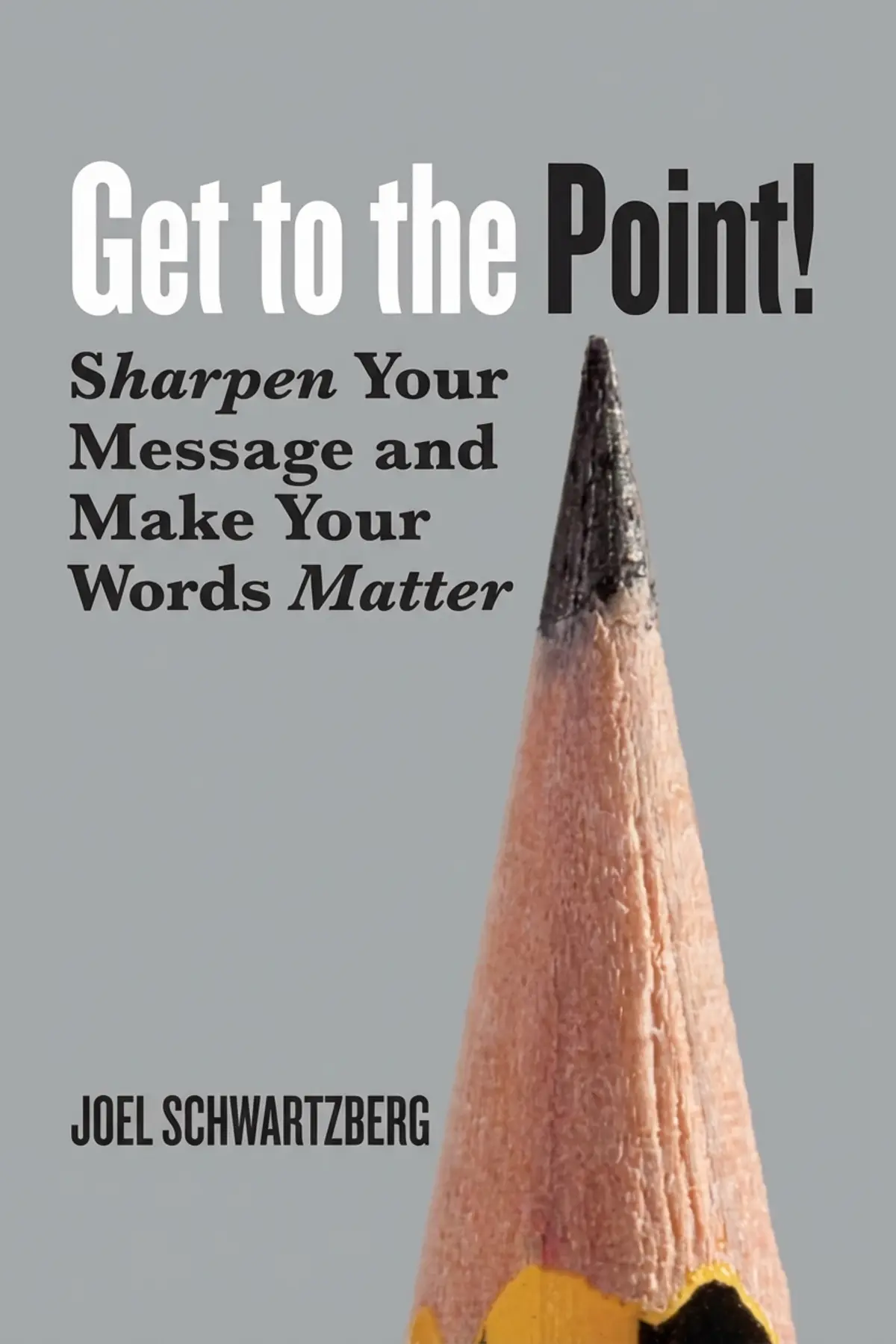
Table of Content
1. Introduction
58 sec
If you have ever finished a presentation and sensed that nobody could say what it was about, the problem was probably not your idea. In Get to the Point!, presentation trainer Joel Schwartzberg argues that many talks fail because they never contain a point: a claim someone could argue with and you could defend. A topic does not qualify, and a slogan does not either. Schwartzberg has been teaching presentation skills since 2006, with clients that include American Express and State Farm, and his whole method grows from that one distinction.
Find a single defendable claim, open with it, keep showing why it matters, deliver it in a confident voice and finish on it. Every joke, story and statistic either carries that claim or gets in its way. Ahead are quick tests for whether you have a point at all, plus habits of voice, timing and focus that keep it in a listener’s head after you stop talking.
2. Turn a vague topic into a defendable claim
1 min 37 sec
Most talks that lose their audience had plenty of content and no actual point. Three short questions reveal whether yours has one, and the first fits inside a single sentence starter.
3. Remember the argument and let the script go
1 min 22 sec
Memorizing every word feels like the safest way to prepare. Schwartzberg sees a hidden trap in it, one that can turn a single forgotten syllable into panic in front of the room.
4. Make sure listeners can repeat your claim
1 min 32 sec
A talk can be funny, polished and well researched and still fail completely. Schwartzberg’s measure of success takes one question to apply, and the opening seconds decide much of the answer.
5. Show listeners the payoff behind every fact
1 min 35 sec
A list of accurate facts can still sound like a school assignment read aloud. What moves you from reporting to persuading is a habit you keep after the opening: you go on signaling why your point matters to the people listening.
6. Shape the message around what this audience needs
1 min 33 sec
The same talk can land with one room and fall flat with another. Schwartzberg compares preparing a message to planning a dinner, and the comparison changes where you stand, in a room and on screen.
7. Sound as certain as your argument deserves
1 min 36 sec
A well-built claim can still sound like a guess. Small changes in how a sentence ends, how loud it is and what follows it decide whether a room hears confidence or doubt.
8. Use your point as a compass under pressure
1 min 26 sec
Side debates, provocative questions and drifting attention can all steal a talk away from its purpose. Schwartzberg’s defense is simple, and it involves something most speakers are afraid to do too often.
9. Stick the landing, then stop talking
1 min 22 sec
The final sentence of a talk can strengthen everything before it or quietly cancel it. Schwartzberg names two common endings that waste a good message, and both are easy to fall into.
10. Conclusion
1 min 09 sec
Schwartzberg’s book rests on a modest but demanding idea: a talk is only as strong as the single claim inside it. Voice, closeness, timing and humor all count, but each works only when it is carrying something. Once the claim exists, tools that felt like performance tricks become ways of moving one sentence from your head into someone else’s.
The speaker gains too. A defined point pulls you out of side debates, gives you a line to repeat when the room drifts and hands you a last sentence when it is time to stop. It also frees you from memorizing a script, because the argument is the only part you need to protect.
The practice starts small. Before your next meeting, write one sentence beginning I believe that, and keep asking so what and why until it holds. Plan your first words so the claim arrives inside 30 seconds, and end on the same claim, not on a shrug. Then ask one listener what your point was.
If they can tell you in their own words, you said something worth hearing.
About this book
What is this book about?
Many presentations fail even when the speaker knows the subject well. The stories are fine and the delivery is polished, yet the audience leaves unable to say what it was all about. Joel Schwartzberg argues that the cause is usually simple: there was no point, only a topic. His method rests on a single defendable claim. He gives quick tests for finding it, such as completing the phrase I believe that and then asking so what and why until the claim holds. He then shows how to state it within the first 30 seconds and sell its value to the particular audience in front of you. Delivery habits back it up: dropping uptalk, speaking up and pausing with purpose. The last part treats the point as a compass. It gets you out of side debates, and repeating it pulls drifting attention back. It also gives you a firm last line, so you don't trail off at the end. Readers get a short, practical toolkit for meetings, pitches, talks and video calls, built around one question every listener should be able to answer afterward.
Book Information
Who it's for
Staff whose pitches wander
Professionals whose meeting updates and pitches ramble and leave colleagues unsure what was asked.
First-time team leaders
New managers and team leads who present to bosses, clients or their own teams.
Video call speakers
People who speak on video calls and want to sound more certain and stay on message.
About the Author
Joel Schwartzberg
Joel Schwartzberg has taught presentation techniques since 2006, working with clients such as American Express, State Farm Insurance and the ASPCA. From 2013 to 2024 he led strategic and executive communications at a major national nonprofit, and he has held senior communications and editorial roles at Nickelodeon, PBS and Time Inc. Interactive. His articles have appeared in Harvard Business Review and Fast Company. A former competitive speaker, he won the national title in After-Dinner Speaking in 1990 and was inducted into the National Forensic Association Hall of Fame in 2002. He also wrote The Language of Leadership.
Ratings & Reviews
Ratings at a glance

What people think
Listeners find this guide educational and straightforward to grasp. They value the way it enhances their ability to communicate, with one listener noting its effectiveness in refining speeches and directions.
Top reviews
Bella
This book is a masterclass in brevity, ironically practicing exactly what it preaches. Joel Schwartzberg provides a surgical approach to communication that is desperately needed in today’s world of endless meetings and rambling emails. I found the 'I believe that...' test to be an absolute game-changer for my internal memos. It forces you to move past vague observations and actually commit to a defensible argument. Frankly, it’s refreshing to read a business book that doesn't feel the need to pad its page count with repetitive anecdotes. Each chapter hits hard and moves on. If you’re tired of people asking 'what was the takeaway?' after you speak, you need this on your desk. It’s practical, sharp, and remarkably easy to implement immediately. I’ve already started using the 'So what?' challenge to trim the fat from my project proposals, and the difference in how my team responds is palpable.
Show moreRania
Ever wonder why some people command a room while others just blend into the background noise? Schwartzberg argues it’s all about the strength of your central argument, and he’s right. I loved the distinction between 'sellers' and 'tellers.' It changed how I view my role during client pitches; I’m not just presenting data, I’m actively advocating for a specific action. The physical closeness tips were also interesting, reminding me to step away from the podium and engage directly with the audience. Personally, I found the advice on ending with the point to be the most impactful. Instead of a weak 'that’s all I’ve got,' he teaches you how to stick the landing like a gymnast. This is an essential tool for anyone who wants their ideas to actually land and stick with their listeners long after the conversation ends.
Show moreJirapat
The chapter on the 'So what?' test is probably the most useful thing I’ve read all year. It forces you to strip away the fluff and find the core value of what you’re saying. I’ve started applying this to every email I send, and I’m noticing much faster response times from my colleagues. Schwartzberg’s writing style is punchy and direct, which is exactly what you’d hope for given the topic. I appreciate that he doesn't advocate for rigid scripts but rather for preserving the essence of the argument. This allows for a more natural, engaging delivery that doesn't feel forced. Not gonna lie, I was skeptical about how much a book this short could teach me, but the focus on identifying what the audience specifically needs from you was a great reminder. It’s about them, not you. Highly recommended for anyone in a leadership or sales position.
Show moreSakura
Truth is, most business books are 300 pages of fluff surrounding a single good idea, but Schwartzberg trims all that away to give you pure strategy. The 'I believe that...' exercise is so simple yet so incredibly effective at uncovering whether you actually have a point or just a collection of thoughts. I also found the advice on repeating your point to be very validating; we often fear being repetitive, but people need that reinforcement to truly remember the message. This book teaches you how to sell your ideas with conviction rather than just reciting a script. The focus on what the audience values is key. It’s a quick, high-impact read that will definitely change how I approach my next board meeting. If you value your time and the time of others, read this book and start getting to the point.
Show moreElise
After hearing about this book in a writing workshop, I had to see if it lived up to the hype, and it absolutely does. It’s practical, actionable, and as sharp as the title suggests. As a communicator, you realize very quickly that your concept isn't the problem—it’s how you’re conveying it. Schwartzberg’s methods for distilling a message into one powerful statement are brilliant. I especially appreciated the tip about removing physical barriers like podiums to enhance engagement. It’s those small details that separate a good speaker from a great one. The 'gymnast landing' analogy for endings has stuck with me, and I’ve stopped ending my presentations with a whimper. Whether you’re a seasoned pro or just starting out, this book offers essential strategies to help you command attention. It’s a must-read for basically everyone, because at the end of the day, we’re all in the business of communication.
Show moreNina
Picked this up specifically to fix my rambling during team syncs, and the results were almost instant. The 3-step model for crafting a point is worth the price of admission alone. Schwartzberg focuses heavily on the first 30 seconds of a presentation, which really resonated with me because that’s usually where I lose my momentum with filler words like 'so' or 'well.' My only minor gripe is that some sections feel a bit like expanded blog posts rather than a cohesive narrative, but that actually makes it easier to reference later. I particularly liked the 'Why?' questions to sharpen a point—it helps eliminate those hollow adjectives that don't actually mean anything. To be fair, this is more for professional settings than creative writing, but the core philosophy of 'selling' your idea rather than just 'telling' it is universal. It's a quick read that packs a punch.
Show morePun
As someone who manages a remote team, the digital equivalent of 'removing barriers' mentioned in this book was a great takeaway. We often forget that communication isn't just about the words we choose, but how we project confidence through the screen. Schwartzberg’s focus on avoiding upward inflections really struck a chord with me, as I’ve noticed how much it undermines my younger staff. The book is incredibly actionable and focuses on making words matter. I do wish there were more examples of how to apply these techniques to long-form writing, as it feels very speech-centric. In my experience, the 'Did you get my point?' test is the ultimate reality check for any communicator. It’s a bit humbling to realize how often the answer is 'no,' but this book gives you the tools to fix that. Definitely a valuable addition to any professional's library.
Show moreRod
Finally got around to finishing this during my commute, and I've already applied the 'test of a point' to my latest project proposal. It’s amazing how much we hide behind hollow adjectives and vague comments when we aren't sure of our own argument. Schwartzberg pushes you to be bold and defendable. I liked the section on using 'Why?' questions to sharpen your focus; it’s like a workout for your brain. My only complaint is that I wanted even more examples of 'before and after' points to really see the transition. Still, the advice on avoiding filler words in the first 30 seconds is something I’ll be practicing for a long time. It’s a concise guide that helps you streamline your thoughts and communicate with way more intent. If you want to be heard, you have to be clear.
Show moreCooper
Not what I expected in terms of depth, though I suppose the title warned me it would be brief. The advice is undeniably sound, especially the bit about avoiding 'uptalk' to maintain authority, but I found the content a little thin for a full book. It feels very geared toward corporate presentations and public speaking rather than everyday communication. Look, the 3 steps + 2 enhancements method is definitely helpful and I've jotted it down on a sticky note for my next call, but I finished the whole thing in under two hours. If you want a deep dive into the psychology of persuasion, look elsewhere. However, if you just need a quick kick in the pants to stop wasting people's time with muddled messages, this does the job. It’s a solid, functional guide that identifies common slip-ups without overcomplicating the solution.
Show moreDarius
Frankly, while the core philosophy is solid, I struggled with how much this applies to normal, day-to-day writing versus high-stakes presentations. The book is very focused on 'the point,' which is great for a keynote speech, but felt a little aggressive for casual workplace collaboration. I also found the repetition of some concepts a bit much, even in a book this short. On the plus side, the 3-step process is very easy to memorize and implement. It certainly helps you refine your messaging and eliminate distractions. To be fair, the author’s background in public speaking shines through, and for that specific niche, it’s a 5-star resource. For the average person just looking to improve their general conversation skills, it might be a bit too specialized. It’s a good book, just maybe not as universal as the marketing suggests.
Show moreQuestions about this book
What is the main idea of Get to the Point! by Joel Schwartzberg?
Schwartzberg argues that effective communication starts with a point: a claim that can be argued, defended and explained, rather than a topic or a slogan. Once you have that claim, you open with it, keep showing why it matters to your audience, deliver it in a confident voice, repeat it when attention slips and end on it. Every story, joke and statistic should serve that single claim.
How do you know if you have a real point?
Schwartzberg offers three checks. Put I believe that in front of your idea and see whether it forms a logical sentence you could defend. Ask so what to remove claims so obvious nobody would dispute them. Then keep asking why to sharpen the claim and cut empty adjectives. A point that survives all three is ready to build a talk around.
How should you start and end a presentation, according to Schwartzberg?
Treat the first 30 seconds as the window that sets the tone. Skip fillers like so or well, choose your opening words in advance, introduce yourself briefly if needed and state your claim and its relevance quickly. At the end, avoid phrases like that’s all I’ve got. Restate your main claim, finish firmly like a gymnast sticking a landing, and stop once the message has landed.
How can I sound more confident when presenting?
Schwartzberg points to delivery habits. Avoid uptalk, the rising pitch at the end of sentences, and finish key lines with a firm tone he calls a power period. Speak loudly enough for everyone to hear, since very few people speak too forcefully. Use short pauses instead of uh and um, especially before your main argument. On video, look into the camera to create eye contact.
Who should read Get to the Point!?
It suits anyone who speaks to others at work or in public and wants to be remembered for one clear idea: employees giving updates, people pitching proposals, managers leading meetings and speakers on video calls. It is short and practical, built on quick tests, such as asking a listener whether they got your point, that work for a formal talk or a chat over coffee.
Featured in
Readers also enjoyed






AUDIO SUMMARY AVAILABLE
Listen to Get to the Point! in 15 minutes
Get the key ideas from Get to the Point! by Joel Schwartzberg, plus 5,000+ more nonfiction titles.
- 5,000+ titles
- Listen as much as you want
- 7-day free trial
- Cancel anytime









