

11 min 13 sec
Available in: English
Gap Selling: Getting the Customer to Yes: How Problem-Centric Selling Increases Sales by Changing Everything You Know About Relationships, Overcoming Objections, Closing and Price
By Keenan
Shows salespeople why polished feature pitches lose deals, and how to win them by diagnosing the gap between where a buyer is today and where they want to be.
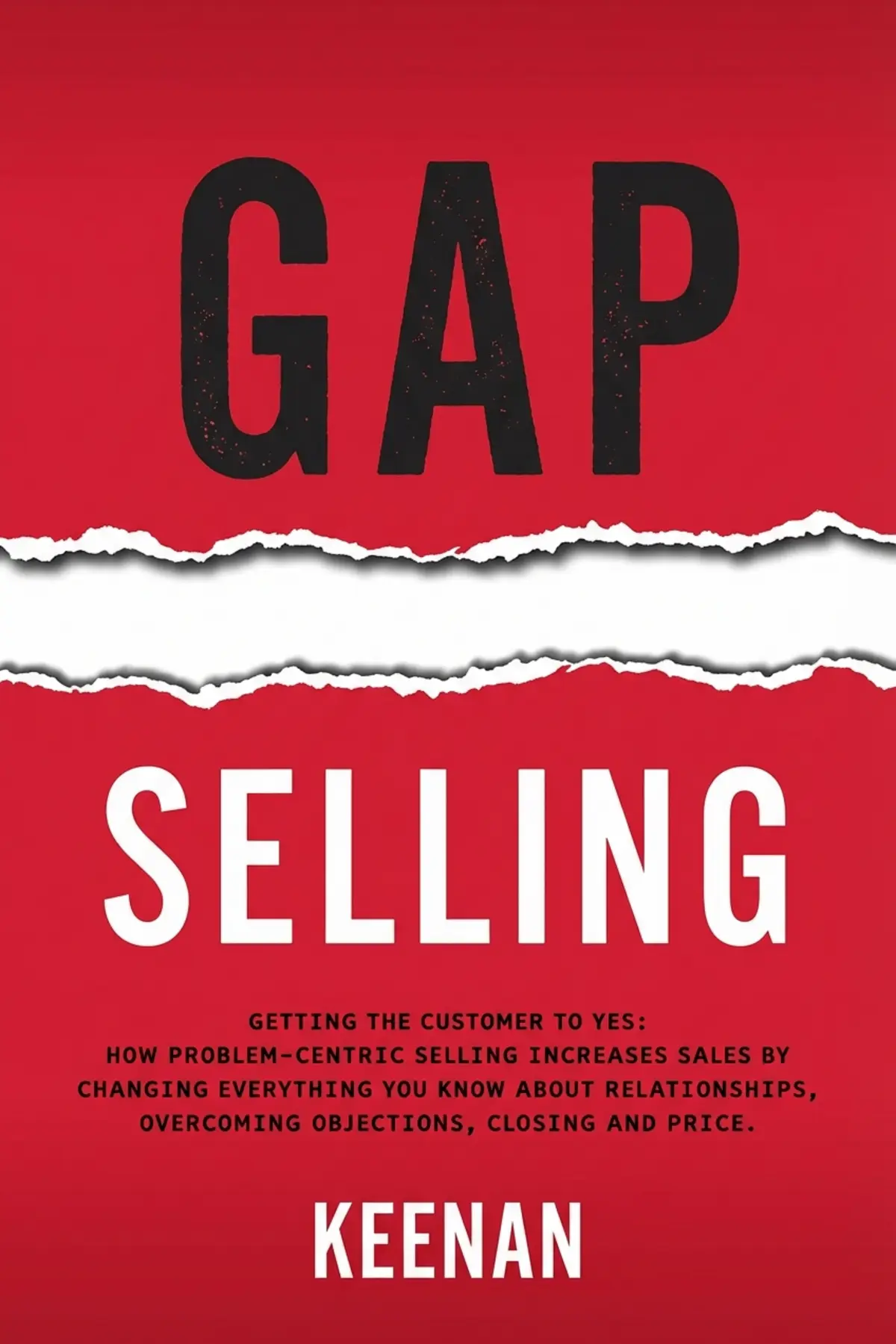
Table of Content
1. Introduction
55 sec
If your pitches are polished and your deals still stall, you may be selling a product to someone who came to you with a problem. In Gap Selling, sales consultant Keenan argues that buyers no longer need a salesperson to recite features, since they can find specs on their own and spot a sales technique from a distance. What they cannot easily find is someone who understands exactly where they are stuck.
Keenan’s method rests on one picture: a gap between the buyer’s current state and the future state they want. Once you have mapped that gap more clearly than the buyer has, and shown how your offer closes it, the sale follows almost on its own. Through a single plumbing deal told twice, a four-step discovery sequence and a research routine for before the call, the book offers a way to turn sales calls into diagnosis, and buyers into partners.
2. Stop losing deals to a flawless pitch
1 min 46 sec
A seller qualifies the budget, explains every feature, hands over detailed specs and asks for the order. By the old rules he makes no mistakes, and he still loses the deal. Keenan explains what was missing.
3. Find the real problem behind the order
1 min 52 sec
The contractor asked for a thousand feet of pipe. That request turned out to be the least interesting thing he said. What sits underneath a buyer’s order, and why does it decide who wins the sale?
4. Ask your way from facts to root cause
2 min 02 sec
Most sellers stop asking questions as soon as they hear something they can sell to. Keenan lays out a sequence that keeps going several layers deeper, until the buyer has practically designed the solution for you.
5. Arrive already knowing their business
1 min 53 sec
The best discovery questions are written before the meeting starts. Keenan points to a handful of areas worth studying in advance, and to the double return that preparation brings once the buyer starts talking.
6. Describe their headache better than they can
1 min 40 sec
A buyer says the system is slow and the seller nods and moves on. That polite moment is where many deals are quietly lost. Keenan offers a finish line that tells you when discovery is truly done.
7. Conclusion
1 min 05 sec
Gap Selling asks sellers to move their effort from the middle of the call to the start of it. The plumbing seller had the right product both times. What changed was that the second time, he knew about the 50-year-old galvanized pipes, the rusty water, the tenants and the liability, and so his comparison charts finally meant something. Keenan’s claim is that this is the whole difference: buyers do not buy features, they buy a way across the distance between where they are and where they want to be.
That suggests a different way to prepare, and a different way to judge your own work. Study the prospect’s projects, results, industry and tools before you call. In the conversation, hold back the pitch until you have moved from facts to problems, to their cost, to the root cause, and refuse to settle for vague answers along the way. Afterward, measure the call by one question: could you describe this buyer’s problem as fully as they could?
When the answer is yes, the pitch almost writes itself, because the buyer has already told you what to say.
About this book
What is this book about?
Many salespeople lose deals they did everything right on. They qualify the budget, present the features, hand over the specs and press for the close, and the buyer still drifts away. In Gap Selling, sales consultant Keenan argues that this old playbook fails because buyers can find product information on their own and recognize sales tactics instantly. What they value is a seller who truly understands their problem. Keenan calls his answer problem-centric selling. Every buyer has a current state, a desired future state and a gap between them. The seller's job is to uncover that gap through careful discovery: gathering facts, pinning down specific problems, measuring what they cost and finding the root cause. Only then does the product enter the conversation, positioned as the way across. Using one plumbing supplier's deal told two ways, the book shows how the same product can lose or win depending on what the seller learned first. Readers get a four-step discovery sequence, a set of areas to research before any call, and a clear test for knowing when discovery is complete.
Book Information
Who it's for
Salespeople with stalling deals
Salespeople whose demos impress but whose deals keep stalling before the close.
Founders leading with features
Founders who sell their own product and tend to lead with features.
Managers wanting shared discovery
Sales managers who want a shared discovery routine their team can practice and check.
About the Author
Keenan
Keenan is the chief executive and president of A Sales Guy Inc., a sales consultancy, and the author of the bestselling book Not Taught. Forbes ranked him among the 30 leading social sellers in the world, and Top Sales World Magazine has named him one of 50 influential sales and marketing figures every year since 2012. His work has been cited by publications including the Harvard Business Journal, Huffington Post, Entrepreneur Magazine and Inc.
Ratings & Reviews
Ratings at a glance
What people think
Listeners view this sales guide as an essential read that provides genuine results, with one describing it as a total game-changer for those in the profession. The text delivers practical wisdom and is simple to digest, with one listener pointing out how it is supported with examples and data. They appreciate its overall impact, with one noting how it drives meaningful conversations, and find the experience absorbing, with one listener mentioning how Keenan's energy is contagious.
Top reviews
Pairot
Finally, a sales book that doesn't feel like it was written in 1985. Keenan has managed to distill the essence of modern business transactions into a clear, actionable framework. Frankly, most sales training focuses way too much on the 'close,' but this book flips the script by obsessing over the discovery phase. By identifying the 'Current State' and the 'Future State,' you stop being a pesky solicitor and start acting like a high-value consultant. It's a demanding read that requires you to actually do the work, which might scare off the lazy reps. However, if you're willing to challenge buyer assumptions and dig into the messy details of their problems, the results are undeniable. My discovery calls have already transformed into meaningful business conversations rather than just awkward interrogations.
Show moreSue
The shift from being a product-pusher to an expert consultant is probably the most valuable takeaway here. Keenan explains that the product doesn't drive the sale; the problem does. This mindset change is massive. In my experience, sales teams usually fail because they jump into their pitch way too early before they even understand the prospect's world. This book provides a blueprint to avoid that trap by using deep discovery to uncover the actual costs of doing nothing. It’s supported by great examples and real-world data that make the concepts easy to visualize and even easier to implement. If you want to stop being treated like a vendor and start being treated like a partner, this is your manual. It’s hard work, but it pays off.
Show moreLucia
Wow, I’m actually seeing my sales cycle shorten after implementing just a few of the discovery techniques Keenan outlines. It turns out that when you get a buyer to envision their life without their biggest headaches, they move a lot faster. This book is all about the 'Gap'—the space between where they are and where they want to be—and that’s where the value lives. Not gonna lie, I was skeptical about the 'no-nonsense' approach at first, but it works because it builds genuine trust. You aren't just selling a tool; you're selling a transformation. The book is incredibly engaging and the author's passion for the profession of sales is contagious. Every chapter feels like a high-energy coaching session that pushes you to be better.
Show moreSom
Stop asking for 'a few minutes' to talk and start asking for a chance to provide value through expert insight. This book is a loud wake-up call for anyone who thinks they can just coast through demos without doing any real discovery. Frankly, I loved how Keenan uses logic trees and storytelling to show why deals stall. If a customer doesn't see a gap, there is no sale. It’s that simple. The advice here on how to avoid 'losing on price' is particularly brilliant because it shifts the focus to the cost of the problem rather than the cost of the solution. It’s a fast-paced, high-impact read that provides the executable skills needed to win in a crowded market. Highly recommended for anyone in SaaS.
Show moreYam
Ever wonder why your deals just go dark right at the finish line? Keenan argues it's because you haven't identified a big enough gap to justify the change. This book is a masterclass in uncovering those hidden motivations that actually drive a purchase. I found the sections on 'current state' versus 'future state' to be incredibly practical, especially the emphasis on getting buyers to own their problems. Sometimes customers think they know what they need, but they’re wrong, and this book gives you the permission to challenge them. It’s definitely not for the lazy, as it requires deep research and an expert-level understanding of your industry. If you’re willing to put in the effort, this book will change how you view your entire career.
Show morePongpan
Keenan’s energy is absolutely contagious throughout these pages, making what could be a dry subject feel like a high-stakes adventure. He provides a roadmap for shortening sales cycles by ensuring you’re only solving problems that actually matter to the 6.8 stakeholders involved in the deal. I’ve read a lot of sales books, and many are just fluff, but this one is packed with real results and data-backed strategies. To be fair, you might need to read it twice to really absorb how to construct your 'logic trees' effectively. It’s a brilliant, simple concept that is surprisingly difficult to apply in the heat of a live presentation. Once you master it, however, you’ll never go back to the old way of selling again. It’s simply brilliant.
Show moreYok
After hearing about Keenan on LinkedIn for months, I decided to see if the hype was real. I've been a fan of 'The Challenger Sale,' so I wasn't sure if I needed another methodology in my head. Truth is, this book feels like the missing piece of the puzzle because it focuses on the emotional and financial gap that drives a purchase. The writing style is fast-paced and punchy, mirroring the author’s 'take no prisoners' personality. I particularly appreciated the emphasis on validation questions like 'I am confused... you said X but now Y?' which forces the buyer to own their problems. My only minor gripe is that the layout can feel a bit repetitive in the middle chapters. Still, it’s a modern classic for anyone who hates losing on price.
Show moreTalia
Look, if your discovery calls are basically just you reading a feature list, you need to buy this right now. Gap Selling isn't just about 'asking questions'—it's about asking the right questions to help the prospect realize their current situation is untenable. I love how it encourages you to not care about being liked and instead focus on being respected for your expertise. The distinction between 'technical' problems and the 'business impact' of those problems is a game-changer for anyone selling complex software. While the tone is quite aggressive, the logic is sound and the method is repeatable. I’ve already bought copies for my entire SDR team because we need to get away from the 'me too' sales process of the 20th century.
Show moreAroha
To be fair, the core concept of this book—identifying a gap—isn't exactly revolutionary for seasoned enterprise account executives. Personally, I found the first half a bit slow as it hammered home points that felt like common sense for anyone who has done consultative selling. It essentially argues that you need to be an industry expert to sell well, which is true, but that's a tall order for a junior rep. That said, the specific questioning techniques and the focus on the 'impact' of a solution are very well-explained. It’s a solid resource for someone transitioning into B2B sales from a more transactional background, but maybe a bit overhyped for veterans. It's definitely better than most 'how-to' guides out there, though I wanted more advanced closing strategies.
Show moreWittaya
Not what I expected, primarily because the tone is a bit too aggressive for my personal taste. I get that sales is a 'battle' for some people, but the 'take no prisoners' attitude feels a bit dated and masculine in a way that doesn't always land well with modern buyers. Furthermore, I found the author's dismissal of being 'liked' by customers to be a bit extreme. Relationships still matter in high-stakes deals! While the logic of finding the gap between current and future states is sound, I didn't find the execution advice to be particularly nuanced. It feels like a lot of 'just work harder and ask more questions.' It might work for some, but I prefer a more empathetic, collaborative approach to the sales conversation.
Show moreQuestions about this book
What is gap selling?
Gap selling is Keenan’s problem-centric approach to sales. Every buyer has a current state, a desired future state and a gap between them. Instead of opening with product features, the seller uncovers that gap through research and questioning, then positions the product as the way to close it. Keenan argues that once the gap is clear to both sides, the sale follows naturally.
What are the four steps of discovery in Gap Selling?
Keenan describes four steps. First, gather facts about the buyer’s situation while listening and reflecting back what you hear. Second, identify the specific problems. Third, measure their impact in time and money, including indirect costs like reputation. Fourth, find the root cause, such as a weak process, outdated tools or too few resources. Only after these steps should the product come up.
What should you research before a sales call, according to Keenan?
Keenan recommends studying the prospect’s strategic initiatives and the people who will shape the decision, the company’s recent financial performance and past successes or failures, the trends and disruptions in its industry and how competitors respond, and the technology it uses. This research sharpens your discovery questions and gives you immediate credibility with the buyer.
How do you know when sales discovery is complete?
Keenan’s test is simple: discovery has worked when you can describe the buyer’s problems as completely as the buyer can. That means understanding both technical problems, such as tools that fall short, and the business problems behind them, along with their measurable effects and root causes. If a buyer gives a vague answer, keep asking follow-up questions until the picture is clear.
Who should read Gap Selling?
It suits salespeople who give strong pitches but still lose deals, founders who sell their own products, and managers who want a repeatable discovery process for their teams. The book is most useful for anyone who tends to talk about features before understanding the buyer’s situation, as the plumbing supplier example shows.
Readers also enjoyed

AUDIO SUMMARY AVAILABLE
Listen to Gap Selling in 15 minutes
Get the key ideas from Gap Selling by Keenan, plus 5,000+ more nonfiction titles.
- 5,000+ titles
- Listen as much as you want
- 7-day free trial
- Cancel anytime









