

13 min 39 sec
Available in: English
Frenemies: The Epic Disruption of the Advertising Industry (and Everything Else)
By Ken Auletta
Explains how big data and smartphones turned advertising from a creative art into a science of targeting individuals, and what that shift means for agencies, for clients, for your privacy and for politics.
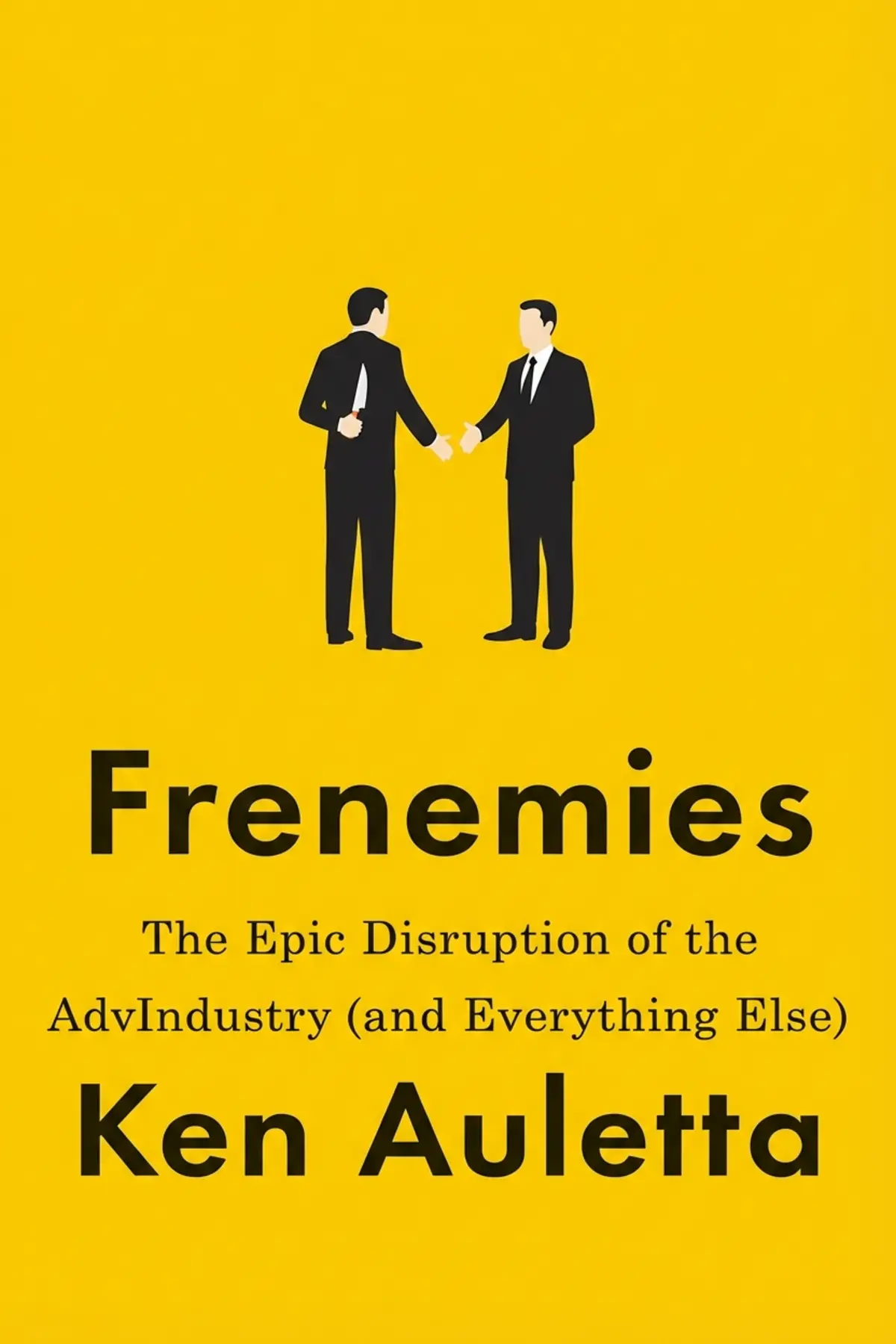
Table of Content
1. Introduction
1 min 03 sec
If you run marketing, buy ads or simply scroll past them, the rules you learned are probably out of date: advertising has stopped being an art of persuasion and become something closer to a science. In Frenemies, New Yorker media writer Ken Auletta traces how technology and big data rewrote how agencies earn money, how clients judge a campaign and how people respond to ads.
His argument is that the winners now are those who hold personal data and use it to speak to small, carefully chosen groups. The cleverest slogan and the biggest budget count for less than they used to. That shift explains why old agencies are nervous, why Facebook, Google and Amazon know so much about you, and why a candidate who spent half as much on ads as his rival won the American presidency in 2016.
By the end, you will be able to explain where ad money flows today, what is being gathered about you, and why precise targeting now matters more than size.
2. Find where marketing now reaches your customers
2 min 00 sec
Marketing once meant a newspaper page or a television spot. Today one device in every pocket lets companies watch and answer people as they act, and a single Chinese platform shows how far that can go.
3. See how the old agency money machine collapsed
1 min 57 sec
The real ad men behind Don Draper were paid twice for every ad they placed, and nobody had much reason to complain. Then clients started reading the bill, and an entire business model began to wobble.
4. See why data outranks the big idea
1 min 57 sec
For decades, agencies sold one brilliant concept that everyone could believe in. A tiny file stored on your phone changed what clients are willing to pay for, and a cosmetics campaign shows who benefited.
5. Tell the three kinds of customer data apart
1 min 46 sec
Some customer information is worth a fortune and some is sold off in bulk. Knowing which is which explains who holds the real power in advertising, and why even rich agencies keep running into walls.
6. Know what your favorite apps collect about you
1 min 55 sec
A photo tag, a favorite film, a question asked out loud in the kitchen: each one ends up somewhere useful to an advertiser. The details explain the strange word Auletta chose for his title.
7. Learn how sharp targeting beat bigger ad budgets
1 min 47 sec
In 2016 one candidate was outspent by his rivals and still won. His campaign’s method rewrote a rule marketers had treated as settled, and it carries a warning for anyone who sells with mass advertising.
8. Conclusion
1 min 14 sec
Frenemies follows one thread from a Roman wall painting to a phone in every pocket: whoever knows the customer best now controls the message. For most of the last century, that was the agency with the best creative minds and a guaranteed commission. Today it is the media agency with data scientists, the platform holding first-party records, and the campaign that gathered 4,000 data points per voter. Clients, squeezed since 2008, want campaigns that are tailored, affordable and provably effective, and personal data is what makes that possible.
The price of that precision is paid in privacy. The same Alexa that answers a question also learns when you get up and what you eat, which is why Auletta treats these companies as friend and enemy at once.
Two things are worth carrying into work this week. If you spend money on marketing, ask how your agency or platform is paid and what it can prove, click by click. And if you are shaping a message, start from a small group you understand well instead of one big idea for everyone.
Then look at your own phone with fresh eyes. It is an ad space with enormous potential for advertisers, and you are the one being tracked.
About this book
What is this book about?
For most of the twentieth century, advertising agencies lived well. They were paid by the media that ran their ads and by the clients who ordered them, and their value rested on one big creative idea. Ken Auletta shows how that world came apart. Tighter budgets after the 2008 financial crisis made clients question every cost. At the same time, cookies and smartphones let marketers track what people do and measure whether an ad worked. Media agencies with data scientists began taking work from creative agencies, and Facebook, Google and Amazon gathered personal details on a scale that raises hard questions about privacy. Auletta calls these companies frenemies: they help us and they watch us. The book ends with the 2016 American election, where a candidate who spent far less on advertising won by targeting likely supporters on social media. Readers come away with a clear picture of where advertising money and power sit today, what kinds of data drive it, and why precise targeting now beats the biggest budget.
Book Information
Who it's for
Marketing and agency teams
Marketers and agency staff who want to understand why their industry's money and power have moved.
Founders weighing ad spend
Founders deciding where to spend a limited advertising budget.
Uneasy about online privacy
Curious readers uneasy about how much Facebook, Google and Amazon know about them.
About the Author
Ken Auletta
Ken Auletta writes the Annals of Communications column for The New Yorker, and his earlier books include Three Blind Mice and Googled. His earlier books include Three Blind Mice, on how the television networks lost their way, World War 3.0, on Microsoft and its rivals, and the New York Times best seller Googled. He has served as a Pulitzer Prize juror and as a national judge of the Livingston Awards for young journalists.
Ratings & Reviews
Ratings at a glance
What people think
Listeners find this account thoroughly documented and absorbing, featuring substantive analysis of its core topics. They value its accessible writing style, and one listener highlights that it offers an excellent exploration of today's media industry landscape.
Top reviews
Rung
Finally, someone explains why my digital life is a constant barrage of targeted ads and why traditional agencies are panicking. This book is a wild ride through the boardrooms of the most powerful media companies on the planet. I didn't expect a book about advertising to be this gripping, but Auletta makes the power struggles feel almost Shakespearean. To be honest, I didn't know much about Michael Kassan before this, but his role as the industry’s 'connective tissue' is fascinating to see unfold. The book captures that anxious energy of an industry realizing its old tricks don't work in the age of ad-blockers and Netflix. Some parts are a little repetitive, especially when discussing the agency holding companies, but the overall picture is clear. It’s an essential look at how data is the new oil in the attention economy.
Show moreManop
Auletta has clearly spent decades building the rolodex necessary to write a book of this magnitude. This is an incredibly well-researched exploration into the tectonic shifts currently rattling the advertising world. I appreciated how he broke down the 'frenemy' relationship between legacy agencies and the tech giants like Facebook and Google. It’s not just a business book; it’s a character study of titans like Martin Sorrell and Maurice Levy. While it gets a bit bogged down in the minutiae of MediaLink’s consulting deals, the broader insights are prescient. Personally, I found the second half much more engaging once the narrative momentum picked up. It is a dense read that requires focus, but the payoff is a much deeper understanding of the media landscape we inhabit. Truly a must-read for anyone trying to make sense of why traditional ads are failing.
Show moreNitaya
Think of this as the 'Mad Men' finale for the 21st century, where the martinis are replaced by data points and algorithms. Auletta does a masterful job of showing how the 'creative' side of advertising is being crushed by the 'analytical' side. The tension between the old-school agency heads and the new-school tech platforms is palpable throughout every chapter. I particularly enjoyed the sections on how consumers are revolting against intrusive marketing through subscriptions and ad-blockers. It’s a very readable, engaging look at a world that most of us interact with every day but rarely understand. My only gripe is that it can feel a bit repetitive when it comes to the biographical details of the CEOs. Still, it provides a fantastic overview of why the media world is in such a state of upheaval right now.
Show moreTantipat
After hearing about this in my communications seminar, I expected a dry textbook, but I was pleasantly surprised by the storytelling. Auletta turns the complicated world of media arbitrage and brand management into something that feels like a high-stakes drama. I loved the deep dives into the lives of industry giants like Carolyn Everson and Martin Sorrell. It’s fascinating to see how much of the global economy relies on these 'frenemy' agreements. To be fair, some of the industry jargon can be a bit overwhelming if you aren't familiar with the space. But the author does a good job of simplifying things without being condescending. It’s an eye-opening look at how much power Facebook and Google really wield over what we see and buy. Highly recommended for anyone curious about the machinery of modern influence.
Show moreKru
Truth is, the media world moves at such a breakneck speed that half the 'revelations' here already feel like ancient history. Writing about digital disruption is a losing game because by the time the book hits the shelves, the landscape has changed again. Auletta is a great writer, but this book relies too heavily on anecdotes from a few years ago. The chapters on the big holding companies like Omnicom and Publicis are interesting, but they don't offer much that you couldn't find in a weekend’s worth of trade articles. Personally, I found the focus on individual personalities to be a distraction from the larger systemic issues he was trying to address. It’s well-researched, sure, but it lacks the 'wow' factor I was expecting from such a big name. It’s a fine book for a long flight, but not a definitive text.
Show moreArthit
Ever wonder why you're paying for Netflix just to avoid the noise? Frenemies takes you behind the curtain to show the people desperately trying to get back into your living room. The book is incredibly insightful when it discusses the rise of 'interruption' marketing and the consumer's subsequent rebellion against it. Auletta manages to make the dry world of media buying feel urgent and consequential. I especially liked the analysis of how IBM and other consulting firms are becoming the new players in a space once dominated by creatives. While it does lean a bit too heavily on the celebrity status of certain CEOs, the core message about the death of the old agency model is spot on. It’s an engaging, well-paced read that gives you a new perspective on every ad you see. Definitely worth picking up for the industry insights alone.
Show moreNook
While the insights into the 'frenemies' dynamic are undeniably sharp, the structure of the narrative leaves a lot to be desired. The book feels more like a series of loosely connected essays than a focused investigation. One chapter we are deep into the history of WPP, and the next we are meandering through a profile that feels slightly out of date. Look, Auletta’s prose is top-tier, and he clearly knows these players personally, which allows for some great 'fly-on-the-wall' moments. But I wanted more data and fewer descriptions of expensive lunches in Cannes. To be fair, he does a great job illustrating how consulting firms are eating the agencies' lunch. It’s a solid 3-star read that offers some value but lacks a strong, unifying conclusion. It’s worth a look if you’re interested in the business side of things, but don’t expect a roadmap for the future.
Show moreYothaka
Look, Ken Auletta is a titan of journalism, but this often feels less like an objective analysis and more like a love letter to Michael Kassan. MediaLink is mentioned so frequently that I began to wonder if they sponsored the research for the book. That said, if you can look past the heavy focus on Kassan, there is some genuinely good reporting here on the decline of the traditional agency model. The way he describes the 'frenemy' relationship between WPP and the tech giants is quite clever. However, the book struggles to stay relevant as the industry shifts toward AI and programmatic buying, which are only briefly touched upon. It’s a decent primer on the personalities involved, but it doesn't quite get to the heart of the 'everything else' promised in the title. A bit of a mixed bag, to be perfectly frank.
Show moreYanin
Is this book actually for industry pros, or just the casual observer? Frankly, for those of us living in the trenches of media buying, a lot of the 'insider' info feels like yesterday’s news. Auletta provides a decent high-level view of how companies like WPP and Publicis are being squeezed, but he spends far too much time on the social lives of the executives. To be fair, the writing is crisp and the access he has to people like Michael Kassan is unparalleled. However, it often reads more like a collection of New Yorker profiles rather than a cohesive thesis on the future of marketing. If you're new to the space, the anecdotes about Google and Facebook disrupting the old guard will be fascinating. If you’re a veteran, you might find yourself skimming through the gossip to find the actual meat.
Show moreMarco
What a massive slog. I went into this hoping for a deep dive into the technology behind modern marketing, but instead, I got 300 pages of industry gossip. Not gonna lie, I was bored by the third chapter because so much of the content revolves around who knows whom in the New York media circle. It feels very 'insider' in a way that excludes the reader rather than inviting them in. Plus, the mentions of people like Les Moonves make the whole thing feel incredibly dated. The truth is, the book spends way too much time worshipping Michael Kassan and MediaLink without questioning their actual impact on the consumer experience. It’s mostly just high-level executives complaining about Google while doing nothing to innovate. Skip this one and find a book that actually talks about the tech.
Show moreQuestions about this book
What is Frenemies by Ken Auletta about?
It describes how technology and big data transformed advertising from a creative art into something close to a science. Auletta covers the collapse of the old commission system, the rise of media agencies that analyze data, the three kinds of customer data, the privacy cost of Facebook, Google and Amazon, and how targeted social media ads helped Donald Trump win in 2016.
Why are Facebook, Google and Amazon called frenemies?
Auletta uses the word because these companies help us and watch us at the same time. Facebook sorts its two billion users into more than 1,300 categories, Google’s About Me page shows advertisers details like phone numbers and workplaces, and Amazon’s Alexa learns when its owners wake up and what they eat, watch and ask for.
How did advertising agencies make money before big data?
They were paid from both sides. Media outlets gave agencies a 15 percent commission for placing an ad, clients paid a further 17 percent for creating new ads and also covered production costs. Auletta notes this gave agencies little reason to bargain on price. After the 2008 financial crisis, tighter marketing budgets brought the system down.
What does Frenemies say about Trump's 2016 campaign?
Trump was heavily outspent on advertising, by Clinton two to one and by Jeb Bush five to one, yet he won. His team hired Cambridge Analytica, which built about 4,000 data points on each potential supporter, then aimed social media messages at those people directly. Auletta reads this as proof that targeting now beats big-budget mass advertising.
How can I apply the ideas in Frenemies?
If you buy marketing, ask how your agency is paid and demand measurable results, since commissions tied to spending once rewarded higher prices. Value the data your own customers give you directly above anything you can buy. Build messages for small, well-understood groups instead of one idea for everyone, and think about what each app or device learns about you.
Readers also enjoyed








AUDIO SUMMARY AVAILABLE
Listen to Frenemies in 15 minutes
Get the key ideas from Frenemies by Ken Auletta, plus 5,000+ more nonfiction titles.
- 5,000+ titles
- Listen as much as you want
- 7-day free trial
- Cancel anytime









