


A Promised Land
Barack Obama
 English
Shows how one thought experiment, choosing society's rules without knowing your own place in it, leads to a concrete agenda for personal freedom, real democracy, equal opportunity and shared wealth that you can use to judge any policy.
1 min 05 sec
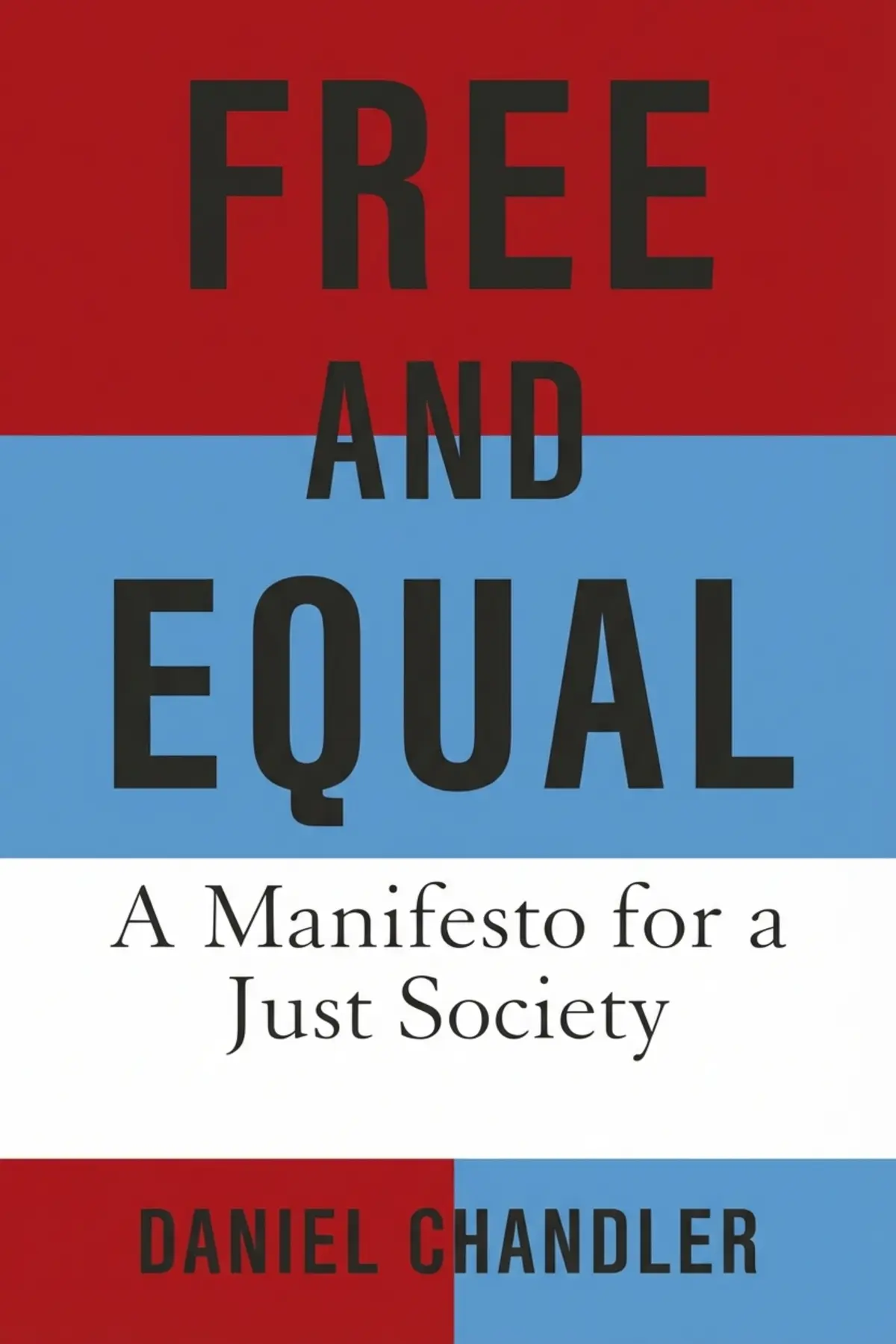
Most of us can list what feels unfair about the society we live in, yet few can say what a fair one would look like, or how to judge a proposal we hear on the news. In Free and Equal, Daniel Chandler, an economist and philosopher at the London School of Economics, offers a single test for that: picture designing a society without knowing which place in it will be yours. The idea comes from the philosopher John Rawls, and Chandler builds his whole manifesto on it.
The argument is simple to state. People choosing rules from behind that kind of blindness would protect everyone’s freedoms and allow inequality only when it lifts those at the bottom. Chandler then shows that this standard points to specific changes in how we handle rights, elections, schools and taxes.
Follow it through and you gain a way to judge any policy from every seat in society, plus an agenda you can defend in an argument with friends who disagree.
1 min 54 sec
Almost everyone argues about fairness from the seat they already occupy, which is why those arguments rarely end. A philosopher’s thought experiment removes your seat entirely, and what people choose without it is surprising.
1 min 48 sec
Culture war arguments usually end with both sides more certain and nobody persuaded. Someone with conservative Christian convictions and a progressive atheist might never settle the question of whether gay relationships are moral, but they could still share common ground on one point.
1 min 47 sec
A religious baker and a gay couple both claim that their freedom is at stake. There is no perfect answer, Chandler admits, but there is a principled way to decide which claim gives way.
2 min 07 sec
Many people suspect their vote changes little, and Chandler thinks the evidence backs them up. His repair plan reaches past elections into newsrooms and public budgets, and one city has already tried part of it.
2 min 12 sec
Even when two infants arrive on one date within one nation, they seldom end up with equal opportunities, and the difference shows years ahead of any school exams. Chandler’s remedies go further than most politicians dare.
2 min 09 sec
A fairer economy sounds like it must mean handing half your salary to the state. Chandler’s numbers are high, but his answer to who should actually carry that bill is not the one most people expect.
1 min 11 sec
Chandler’s manifesto rests on a single act of imagination. Set aside your own bank balance, your faith and your neighborhood, and ask what rules you could live with from any position. That one move produces both his defense of personal freedom and his case for sharing wealth, two causes usually sold as rival camps. Here they grow from the same root.
He admits the agenda is ambitious, yet he points out that many of its parts already exist somewhere: citizens setting budgets in a Brazilian city, high-tax economies in parts of Europe. The real shortage, as he sees it, is political will.
You can start using the idea without waiting for a government. Run the blind test on the next policy you read about, and ask whether you would accept it from the bottom rung. When a disagreement over values heats up, move the question from whose morality is right to who gets to decide. And when you look at a winner, at work or at school, remember how much of the race was already shaped by age five.
A fair society, in Rawls’s sense, is one you would agree to join before you knew which life you would get.
Plenty of books describe what is going wrong in our societies: rising inequality, angry politics, a threatened environment. Far fewer describe what a fair society would actually look like, or offer a plan for getting there. Daniel Chandler sets out to do both. His starting point is the philosopher John Rawls and his famous test: design a society without knowing which position in it will be yours. Chandler argues that this test leads to two principles. Everyone's basic liberties must be protected, and economic inequality is acceptable only when it helps those with the least. He then applies those principles across economics, politics and philosophy, from defusing culture war fights over religion and sexuality to capping campaign donations, funding preschools, rethinking private schools and taxing great fortunes. Readers get a clear standard for judging any policy they hear about, and a bold but practical agenda covering elections, media, education, wages and wealth, many parts of which already exist somewhere in the world.
Professionals and students frustrated by political debates who want a clear standard for judging what is fair.
Readers worried about inequality, money in politics or culture war fights who want concrete proposals instead of complaints.
Anyone who hires, teaches or mentors and wants to think harder about head starts and equal opportunity.
Daniel Chandler is based at the London School of Economics, where he directs research for the Programme on Cohesive Capitalism. He holds degrees in economics, philosophy and history from Cambridge and the LSE, and as a Henry Fellow at Harvard he studied with Amartya Sen. Before turning to research, he advised the British Government in the Prime Minister's Strategy Unit and the Deputy Prime Minister's Office, and he has worked at think tanks including the Resolution Foundation and the Institute for Fiscal Studies.
Listeners find that while perspectives on the book’s tempo differ—with some feeling the philosophical sections are a "slog"—the majority value how Chandler translates John Rawls’ intricate theories for a broader public. Furthermore, they appreciate the shift from high-level concepts toward an "inspiring blueprint" for the future, highlighting the latter portion’s practical ideas like workplace democracy and universal basic income. They also remark on the book’s power to ignite significant conversation, as one listener observes that its "thought-provoking analysis" is an essential tool for grasping contemporary equality. Finally, they highlight that the author’s cross-disciplinary method successfully supports bold arguments through transparent logic and evidence.
This book is a masterclass in making high-level philosophy feel relevant to the average person. Chandler takes the dense, often impenetrable theories of John Rawls and turns them into a roadmap for institutional renewal. I was particularly struck by the 'original position' thought experiment. It really forces you to check your biases at the door. While some might find the theoretical first half a bit of a climb, the payoff in the second half is immense. The concrete proposals for universal basic income and workplace democracy aren't just pipe dreams; they are backed by rigorous data and a clear moral compass. It's an inspiring blueprint. We need more thinkers who are willing to be this bold.
Show morePicked this up for a discussion group and was blown away by how Chandler bridges the gap between abstract justice and real-world economics. Most philosophy books stay in the clouds, but this one hits the ground running with an inspiring blueprint for how we actually fix our broken systems. I loved the deep dive into 'workplace democracy' and the idea of a citizen’s wealth fund. It’s rare to find a writer who can explain the 'veil of ignorance' so clearly while also providing a data-driven argument for universal basic income. Is it ambitious? Extremely. But in a world full of cynicism, this kind of bold thinking is exactly what we need right now. A total tour de force.
Show moreWow, Chandler has managed to do the impossible: he made John Rawls' dense 'A Theory of Justice' actually readable for the rest of us. This is more than just a summary; it's a call to action. I found the sections on media ownership and journalism funding to be incredibly timely. We often talk about 'fairness' in vague terms, but this book pins it down with specific, actionable goals. It’s a thick read, and you have to be in the mood for some serious thinking, but the reward is a completely new perspective on what democracy can be. It’s easily one of the most stimulating books on politics I've picked up in years.
Show moreFinally, a political manifesto that doesn't just complain about the status quo but actually offers a coherent way forward. Chandler’s writing is accessible, though I'll be honest, the philosophical exposition in the beginning can feel like a bit of a slog if you aren't in the right headspace. However, once he moves into the policy suggestions, the book really finds its rhythm. His arguments for 'democracy vouchers' and reforming media ownership are fascinating and feel genuinely fresh. Even if you don't agree with every single solution—like his controversial take on private schools—it’s hard not to appreciate the intellectual rigor he brings to the table. It’s a highly valuable resource for anyone tired of the current political polarization.
Show moreEver wonder what a society built on pure fairness would actually look like? Chandler tries to answer that by synthesizing philosophy, law, and economics into one ambitious volume. The transition from abstract justice to real-world applications like UBI and sovereign wealth funds is handled brilliantly. I did find the pacing a bit uneven, as some chapters dive deep into data while others stay a bit too surface-level. But the core message is vital. It challenges us to look beyond our own self-interest. It’s a thought-provoking analysis that stays with you long after you finish the last page. Definitely worth the time if you can get past the slower opening.
Show moreThe truth is, we are living through a period of deep political polarization, and this book feels like a necessary balm. Chandler doesn't just vent about how society is falling apart; he provides a structural way to think about fairness. I particularly appreciated the focus on dignity and self-respect rather than just wealth redistribution. It’s not just about the money. It’s about power. My only real gripe is that the book can be a bit repetitive in its middle section, and the price tag for his proposed reforms is absolutely eye-watering. Still, the logic is sound. If you want to understand the future of liberalism, start here.
Show moreAfter hearing so much buzz about this, I was surprised by how much data the author packed into the second half. It’s not just theory; it’s a toolkit. I appreciated how Chandler justified radical claims—like the citizen's wealth fund—with clear reasoning and international examples. There were moments where the writing felt a bit like a slog, especially during the more technical philosophical sections, but the overall message is too important to ignore. It stimulates meaningful discourse on what we owe one another. It might not be a perfect book, but it is certainly a necessary one for our current moment.
Show moreI'll admit I struggled through the first hundred pages because the writing can be quite dry and academic. It reminded me of a university lecture I wasn't quite prepared for. To be fair, the explanation of Rawls' principles is very thorough, but it lacks a certain spark. Things definitely pick up in the second half when we get into the nitty-gritty of policy. I found the section on the citizen’s wealth fund to be the most compelling part of the whole book. Still, I disagreed with several of his solutions, especially his stance on education. It felt a bit one-sided. It’s a useful read for the data alone, but I wasn't as inspired as I hoped I would be.
Show moreNot everyone will agree with the radical suggestions here, particularly the bit about abolishing private schools, which I found totally unconvincing. Frankly, the book is a bit of a mixed bag. On one hand, the intellectual history of Rawls is handled with great care and makes complex ideas accessible. On the other hand, the policy wishlist feels like it was written in a vacuum without much regard for political reality. I kept thinking of that Gramsci quote: 'the old is dying and the new cannot yet be born.' Chandler is trying to birth the new, but I'm not sure his version is the one that will survive. Useful, but flawed.
Show moreAs much as I wanted to love this, it felt like a massive academic slog that never quite found its rhythm. The first half is essentially a dry retelling of John Rawls, and if you aren't already a fan of political theory, your eyes will glaze over instantly. To be fair, Chandler has a lot of heart, but the perspective feels incredibly narrow and American-centric at times, despite his background. I found myself checking how many pages were left every ten minutes. It’s useful if you need a summary for a book club or a class, but as a casual read? Forget about it. The ideas are there, but the execution is just too torrt—as they say, dry and boring.
Show moreChandler builds on John Rawls’s thought experiment of designing a society without knowing your own place in it. He argues that people in that position would protect everyone’s basic liberties and accept inequality only when it helps the least well-off. He then turns those two principles into a practical agenda covering personal freedom, democracy, education and the economy.
It is a thought experiment in which you choose the rules of a society without knowing whether you will be rich or poor, a man or a woman, in the majority or a minority. Because you could land anywhere, Rawls argued, you would choose rules that are fair to every position, including the most disadvantaged one.
He suggests proportional representation, automatic voter registration, longer voting hours and possibly compulsory voting. Most of all he wants caps on campaign donations, with public democracy vouchers citizens could give to campaigns. He also proposes limits on media ownership, public funding for trustworthy journalism, citizen panels whose proposals go to a public vote, and participatory budgeting like that used in one Brazilian city.
No. He puts taxes at about 45 to 50 percent of national income, which some European countries have already reached, yet he argues that the bulk of this load ought to land on companies, income from capital and big accumulations of wealth. The average office worker would not hand over half their paycheck, and he argues the right design can keep the economy dynamic.
Use Rawls’s test on any policy: would you accept it if you did not know which side of it you would end up on? In arguments about values, shift from whether a belief is right to whether anyone should impose it on others. And when judging success at work or school, consider how much reflects a head start rather than talent.
Barack Obama

Masaji Ishikawa

John Rawls



Miles Taylor



William B. Irvine

AUDIO SUMMARY AVAILABLE
Get the key ideas from Free and Equal by Daniel Chandler, plus 5,000+ more nonfiction titles.









