
A History of Iran: Empire of the Mind
Michael Axworthy
 English
 ไทย
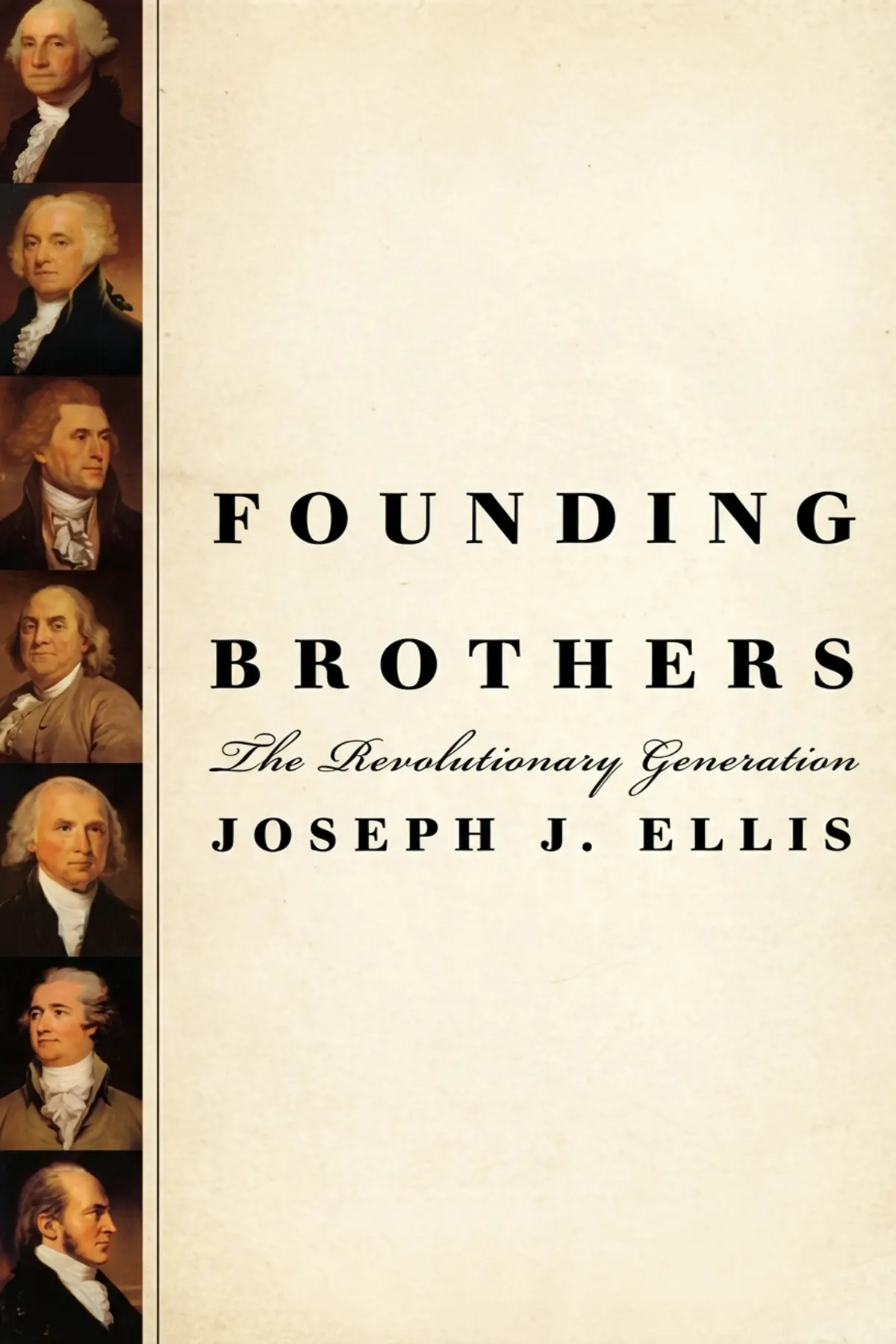
Shows how America's founders were quarreling rivals running a risky experiment, and how their clashes and compromises over war debt, the capital and slavery shaped the young nation, for better and for worse.
1 min 02 sec
Most of us picture the American founding as a done deal, a few wise fathers handing down a finished nation. In Founding Brothers, historian Joseph J. Ellis offers a truer picture: the founders were rival brothers running a risky experiment whose outcome was never certain. They gambled, misjudged, bargained and refused to yield, and they held one another to brutal standards because they believed one mistake could sink the republic. That fear, Ellis argues, explains both their fiercest quarrels and their most important deals.
The story runs from the logic of their wager to a debt crisis that nearly split the states, a dinner that decided where the capital would stand, and a dying Benjamin Franklin forcing the country to face slavery. What emerges is a clear view of how big decisions really get made: by flawed people under pressure, trading one goal for another, sometimes at a price only later generations pay.
2 min 02 sec
Thirteen colonies took on the strongest military power on earth, yet the founders feared something worse than defeat in battle. Their sense of the odds changes how every later quarrel among them should be read.
1 min 50 sec
A tyrant can rule perfectly well over selfish, corrupt subjects. A republic cannot, and the founders thought they knew exactly what had killed Rome. Their conclusion made them unusually hard on one another.
2 min 01 sec
An illegitimate boy from a small Caribbean island became the fiercest champion of a strong national government. A rival’s insult about his birth hides the real clue to what he wanted America to become.
1 min 58 sec
By 1789 the new nation owed $80 million and some states were nearly broke. One founder’s rescue plan looked to another like the very tyranny they had just fought a war to escape.
2 min 03 sec
Two brilliant men had reached a standoff that threatened the whole experiment. An older colleague, a dinner invitation and a muddled piece of geography about a Virginia river opened a way out.
2 min 03 sec
At 84 and near death, America’s most famous man made one final demand of Congress. It forced the country to talk about the issue its founders had worked hardest to avoid.
2 min 14 sec
The founders kept the union together in 1790 with a bargain built on silence and a confident economic forecast. The forecast proved wrong, and the bill for that bargain kept growing for decades.
1 min 21 sec
Founding Brothers trades the marble statues for something more useful. The men who built the United States were short and tall, sickly and combative, proud and wounded, and they fought as hard as they did because each believed the experiment could fail at any moment. Their success, Ellis concludes, came from stubborn and very human determination, settling one fight after another through hard bargains, with no guarantee any of it would hold.
That same fear explains their failures. The anxiety that produced the dinner deal of 1790 also produced the silence on slavery, and that second bargain handed its cost to a later generation that paid in a civil war.
The book supports a few habits. When an outcome in the past looks inevitable, look for the forks where it could have gone another way. When a debate freezes, ask what each side fears, and whether a trade on another issue could free it. And when a compromise buys peace by postponing a hard problem, ask honestly whether that problem will shrink while you wait or grow, as slavery did.
Hindsight draws a straight line from 1776 to today. The people living through it saw only a gamble, and they kept placing it.
The founders of the United States are usually remembered as wise fathers who knew exactly what they were building. Historian Joseph J. Ellis argues that this picture flattens them. In his account, Hamilton, Madison, Jefferson and Franklin were brothers in a struggle whose result was never certain. They were gifted but fallible men who gambled, compromised and sometimes refused to yield. Ellis starts with the idea they all shared: republicanism, government by citizens instead of subjects, and the belief that such a state survives only if leaders and people stay virtuous. That conviction made every disagreement feel like a threat to the republic's life. He then follows three moments from 1790. The first is Hamilton's plan to have the federal government take on the states' war debts. The second is the dinner at Jefferson's home that traded that plan for a capital on the Potomac. The third is Franklin's final petition against slavery, which Madison worked to quiet. Readers get a vivid, human account of the early republic and a sober lesson in how compromise works, including what it costs when a hard problem is put off.
History readers who want the American founders as real, quarreling people instead of statues.
Students looking for a clear account of the debt fight, the Compromise of 1790 and the early silence on slavery.
Managers and negotiators curious how deadlocks between strong personalities actually get broken.
Joseph J. Ellis is a historian, born in 1943 in Alexandria, Virginia, whose books examine the era and the people behind the founding of the United States. His American Sphinx: The Character of Thomas Jefferson won the National Book Award in 1997, and Founding Brothers received the Pulitzer Prize for History in 2001. Both became bestsellers. He has also written The Passionate Sage, a study of John Adams.
Listeners find this work to be an intriguing and approachable experience that provides significant insight into America's past. The narrative flows smoothly and is organized into distinct historical episodes, leading one listener to remark that it feels like reading a novel. Listeners value the educational benefits of the material, especially for those studying history, and view it as a worthwhile investment. Although many listeners consider the language straightforward, some feel the writing style is overly verbose.
Picked this up for a college course, but I ended up devouring it like a thriller. Ellis manages to take dry historical facts and weave them into a narrative that feels remarkably immediate and alive. The opening chapter on the Hamilton-Burr duel sets a high bar, stripping away the mythology to show two men driven by ego and archaic codes of honor. Truth is, I never realized how fragile the early republic actually was until reading about these bitter rivalries. While some find the prose a bit elevated, I found it sophisticated and fitting for the era. It’s an essential read for anyone wanting to understand the human flaws behind the Great Men of history.
Show moreWhy do we call them brothers instead of fathers? That’s the core question Ellis explores, and his answer is a beautifully written look at the 1790s. He shows that these men weren't distant statues but colleagues who worked, fought, and eventually reconciled in a way that shaped our entire government. I was particularly struck by the chapter on the 'Collaborators,' showing how Madison and Jefferson operated as a tag-team against Adams. The book reads with a certain kinetic energy that makes you feel the stakes of every letter and every secret cabinet meeting. If you want a dry list of dates, go elsewhere; if you want the 'why' behind the American experiment, read this.
Show moreEver wonder how the United States survived its first decade without falling apart into a dozen tiny, warring countries? This book answers that by focusing on the intense, personal relationships between the men at the center of it all. Ellis is a gifted storyteller who understands that history is made by people with biases, tempers, and contradictory dreams. The final chapter on the correspondence between Adams and Jefferson is one of the most moving things I’ve read in a history book. It shows two old enemies finding common ground at the end of their lives, which feels like a lesson we could all use today. Highly recommended for any history buff or casual reader alike.
Show moreThe chapter on 'The Silence' was a punch to the gut and easily the most important part of the whole book. We often hear about the brilliance of the founders, but Ellis forces us to look at their calculated decision to ignore the slavery question for the sake of union. It’s a sobering reminder that the 'checks and balances' were sometimes just tools for procrastination on moral crises. Personally, I appreciated how the book focused on the 1790s as a series of specific episodes rather than a sprawling, messy timeline. To be fair, there are moments where the language gets a bit academic, but the insights into Washington’s Farewell Address made the effort worthwhile.
Show moreFinally got around to this Pulitzer winner and I’ve got to say it lived up to most of the hype. Ellis treats these historical icons like a dysfunctional family, which makes their political bickering feel much more relatable to our modern era. The way he compares the 'odd couple' of the American Revolution—Adams and Jefferson—is masterful and quite touching toward the end. You see the tall, elusive Virginian contrasted against the short, combative New Englander in a way that feels human rather than legendary. My only gripe is that it can be a bit repetitive in its themes of collaboration and strife. Still, it’s a fluid read that doesn't feel like a dusty textbook.
Show moreWow, this was surprisingly easy to digest despite the heavy subject matter of constitutional formation and fiscal reform. I’ve been trying to learn more about Alexander Hamilton lately, and the sections here on his financial plans and his rivalry with Jefferson provided great context. Ellis has a way of explaining complex political shifts, like the 'Dinner Table Bargain,' without making it feel like a boring lecture. I did find a few sentences that were absolute monsters to unpack, which is why I'm not giving it a full five stars. Overall, it’s a solid piece of nonfiction that provides a lot of educational value for the price.
Show moreAfter hearing about this book in my American History course, I expected it to be a real drag, but I was pleasantly surprised. The narrative is divided into six distinct stories, which makes it much easier to pick up and put down during a busy semester. I felt like I got to know John Adams for the first time, especially his relationship with Abigail and how she acted as his 'cabinet of one.' Some of the language is definitely 'historese,' but the drama keeps you moving forward. It’s a great example of how personality drives politics, proving that the founders were just as petty and brilliant as anyone today.
Show moreAs someone who usually loves history, I found myself torn on whether to recommend this one to friends. On one hand, the vignettes about the early republic are fascinating and offer deep dives into personalities I only knew from surface-level biographies. On the other hand, the writing style is so thick with multi-syllabic words that it occasionally breaks the immersion. To be fair, the research is top-notch, and the connections Ellis makes between the personalities of the brothers and the policies they created are brilliant. However, I often felt like I was wading through a swamp of academic prose just to get to the next interesting anecdote. It's educational, sure, but it definitely isn't the light, novel-like experience some reviewers claim.
Show moreFrankly, Ellis seems a bit too enamored with his own vocabulary at times, which almost ruined the experience for me. There are sections where the sentences are so long and convoluted that I had to read them three times just to find the subject. That being said, the actual content is quite good, especially the analysis of Washington’s struggle to maintain neutrality amidst the French Revolution. The book does a fine job of illustrating the 'contaminating radioactive cloud' of slavery that hung over every single discussion the founders had. It's a bit of a mixed bag: great historical insights trapped inside some very dense, sometimes pretentious writing.
Show moreLook, I really wanted to like this given the National Book Award win, but it felt like a chore from page one. The author seems to have swallowed a dictionary and spent most of his time trying to impress the reader with academic jargon rather than telling a clear story. It’s incredibly wordy, making even the most exciting moments—like the tension between Jefferson and Adams—feel bogged down in academic fluff. I frustra-cried a bit because I knew the material was important, but the delivery was just so unnecessarily dense and pretentious. If you enjoy reading a thesaurus in a dark room, this is the book for you. Otherwise, find a more accessible historian who doesn't use ten words when two would do.
Show moreEllis argues that America’s founders were not all-seeing patriarchs but brothers engaged in a fight where nobody could be sure how things would end. Committed to republicanism, they believed a free state survives only if its leaders and citizens stay virtuous, so they held each other to severe standards and clashed often. The book follows those clashes, over federal debt, the location of the capital and slavery, to show a nation built through hard compromise and human determination.
Alexander Hamilton wanted the federal government to take over the states’ war debts, and James Madison opposed it, partly because Virginia had already paid its own. In the summer of 1790, Thomas Jefferson invited both men to dinner at his home. Madison agreed to the debt plan, and in return the national capital would be built on the Potomac, the site of today’s Washington.
Ellis traces their silence to self-interest, since many founders owned enslaved people, to self-regard, and to politics. In 1787 the North was moving toward abolition while the South was expanding slavery, so the Constitution avoided the word entirely. When Franklin petitioned for abolition in 1790, Madison helped persuade Congress to stay out of the question until at least 1808, wrongly expecting slavery to fade because it was unprofitable.
It suits readers who want to understand the early United States through its people: Hamilton, Madison, Jefferson and Franklin, with their tempers, ambitions and blind spots. Students will find a clear account of republicanism, the debt crisis and the Compromise of 1790. Anyone who negotiates or leads will also find a vivid case study in how deadlocks get broken and what postponing a hard problem can cost.
The book suggests remembering that outcomes which look inevitable in hindsight were once uncertain choices. The 1790 dinner shows how a stalled dispute can be freed by trading across issues, since Madison accepted the debt plan in exchange for the capital. The slavery debate shows the other side: postponing a divisive problem kept the peace, but Madison’s forecast failed and the cost kept growing.
Michael Axworthy
Tom Standage

Ishmael Beah




William J. Bernstein

Ben Macintyre


AUDIO SUMMARY AVAILABLE
Get the key ideas from Founding Brothers by Joseph J. Ellis, plus 5,000+ more nonfiction titles.









