

59 Seconds: Change Your Life in Under a Minute
Richard Wiseman
 English
Shows that a meaningful life is one with enough value in it. It also explains why perfectionism, death, determinism and suffering fail to make ordinary lives pointless, and how to find more meaning on purpose.
1 min 06 sec
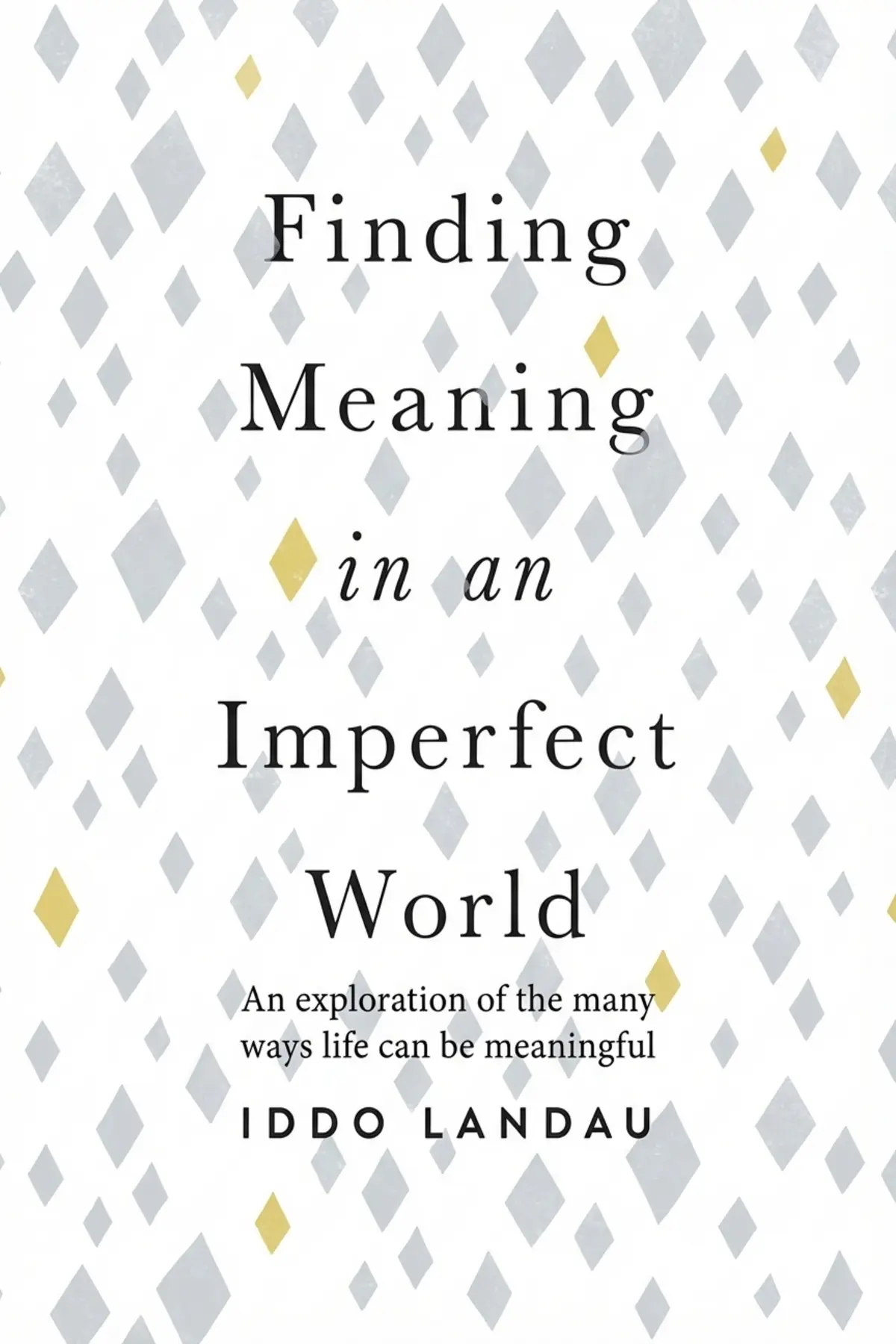
If your life sometimes feels empty because you are not doing anything remarkable, the standard you are using is probably broken. In Finding Meaning in an Imperfect World, Iddo Landau, who teaches philosophy at Haifa University, argues that asking whether life has meaning is simply asking whether it holds enough things of value. That one move turns a mystical puzzle into an ordinary question you can reason about.
From there Landau takes apart the usual reasons for despair: that only extraordinary lives count, that death cancels everything, that we lack free will, that life needs a goal beyond itself, that success leaves us hollow, and that the world holds too much suffering. Each one fails on inspection. What remains is a practical task, noticing the value already in your days and adding more on purpose. Along the way, a mopped kitchen floor, Shakespeare’s imaginary twin and a child’s questions about candy each do serious philosophical work.
1 min 34 sec
One of the most celebrated novelists who ever lived had fame, a country estate and a loving family, and still decided his life was pointless. What he lost reveals what we are really asking about when we ask about meaning.
1 min 35 sec
Most of us are neither Einstein nor Mother Teresa, which seems to settle the matter for a lot of philosophers. Landau thinks their reasoning would collapse if they applied it to dinner or a school exam.
1 min 38 sec
Albert Camus said we are all like the man condemned to push a boulder uphill forever. Landau answers him with a household chore almost everyone does and almost no one thinks about.
1 min 39 sec
If every choice you make has causes you never chose, it can seem that nothing you do deserves credit. A thought experiment about Shakespeare’s imaginary brother suggests we have been looking for value in the wrong place.
1 min 41 sec
Many people feel their lives lack meaning because they cannot name a grand mission. A tiresome game that small children love to play turns out to show why a mission may not be required at all.
1 min 37 sec
You work for months toward something, finally get it, and feel strangely flat. Landau gives this experience a name and explains why it does not have to keep happening, especially to people who never stop working.
1 min 44 sec
A famous German philosopher argued that even a glass of water on a hot day proves life is mostly suffering. Landau takes the argument seriously, then tests it against the darkest places in modern history.
1 min 28 sec
Winning the argument that life can be meaningful does not make your own life feel any fuller. Landau offers a few deliberate exercises, one of which asks you to imagine your final months decades early.
1 min 11 sec
Landau ends up defending ordinary life against some of its most brilliant critics. Tolstoy, Camus and Schopenhauer each found a reason to call human existence empty, and Landau answers them with things anyone can check: a mopped floor, a shady apple tree, a child running out of whys. Meaning, on his account, was never a prize reserved for the extraordinary. It is the value a life holds, and that value can be partial, temporary, unchosen and mixed with pain without disappearing.
That makes a frightening question workable. This week, write down what already matters to you, along with one thing to add and one to let go. When a goal is reached, pause long enough to feel it. And when the old thought returns that nothing counts unless it is perfect or permanent, test it the way Landau does, against how you judge a dinner, an exam or a clean kitchen.
Tolstoy’s crisis left him asking so what. Landau’s reply is that a floor stays clean for only a few days, and people keep mopping because those days are worth having.
Many people quietly suspect their lives do not add up to much. They are not curing diseases or writing classics, everything they build will end, and the world is full of pain. Questions about the meaning of life seem too lofty to answer, so the suspicion stays. Philosopher Iddo Landau takes those questions down to earth. He argues that asking about meaning is really asking about value: whether a life contains enough things the person finds worthwhile. With that reframing, he tests the most common arguments for despair one by one, using everyday examples like a mopped kitchen floor, an apple tree, an imaginary twin of Shakespeare and a child who keeps asking why. Each argument turns out weaker than it sounds. Readers come away with clear reasons to reject the all-or-nothing standard many of us apply to our lives, and with practical exercises for spotting the value already present and adding more.
Professionals who feel their ordinary careers and routines do not add up to anything that matters.
People going through grief, illness or a hard stretch who wonder whether pain cancels meaning.
Curious readers who want clear, everyday answers to life's big philosophical questions.
Iddo Landau teaches philosophy at Haifa University in Israel. He has published extensively on the question of what makes a life meaningful, the subject at the heart of his academic work. In Finding Meaning in an Imperfect World he turns that research toward a practical concern: how ordinary people can find fulfillment in a world that is flawed.
Listeners find the work both articulate and readable, with one listener noting its practical approach throughout. They value the philosophical themes, including one individual who highlights the enlightening insights regarding perfectionism. However, listeners have mixed reactions to the sections concerning meaning.
After hearing Oliver Burkeman recommend this work in a recent interview, I knew I had to dive in. Landau offers an incredibly insightful look at how we define worth in a world that often feels chaotic or indifferent. The final third of the book is where it truly shines, providing practical suggestions for creating meaning rather than just theorizing about it. Truth is, his critique of the perfectionist mindset—the idea that life must be flawless to be meaningful—felt like a weight lifting off my shoulders. It is a thorough and readable treatment of a dense subject. While the middle sections can get a bit bogged down in academic rebuttals, the overall message is transformative. I found the arguments well-articulated and surprisingly easy to follow for a philosophy text. If you have ever felt like your life is 'not enough,' this book will likely change your perspective entirely.
Show moreThe chapter on perfectionism was an absolute game-changer for my perspective. Landau manages to dismantle the idea that meaning requires some sort of cosmic significance or flawless execution. Instead, he focuses on how we can find value in the mundane and the imperfect. Not gonna lie, I was worried this would be another dry academic text, but it’s actually quite illuminative. The author presents and criticizes arguments against finding meaning in a way that is easy to understand for a layperson. Life is valuable, and even if we struggle to find its purpose, that doesn't mean it isn't there. This book acts as a guide to help you navigate through those internal storms. I highly recommend it to anyone who feels like they are constantly falling short of some invisible standard. It’s a classic of philosophical work in the best possible sense.
Show moreWow, I didn't realize how much I needed this framework until I started reading. Landau's take on how perfectionism poisons our search for meaning is absolutely brilliant. He identifies the core issue: we think meaning has to be 'big' or 'perfect' to count, when the reality is that it's found in the small, imperfect moments of every day. The work was insightful and showcased some truly novel ways of understanding our place in the world. I loved the balance between rigorous philosophical argument and practical, real-world application. In my experience, most books on this topic either go too far into the clouds or stay too close to shallow self-help, but this hits the sweet spot. It’s a thorough and practical guide that actually leaves you with something to use. Definitely a must-read for the modern skeptic who still wants to believe in something.
Show moreEver wonder why it's so difficult to feel satisfied with your daily routine? Landau addresses this head-on by critiquing our tendency toward existential perfectionism. This book helped me form a coherent thought process for my own 'quarantine shower thoughts' and general overthinking about my career path. To be fair, some of the points he makes feel like common sense once you see them on the page. However, having them organized into such a logical framework is immensely helpful for navigating the storms of adulthood. The author identifies and defines how we can find value even in an imperfect world, which is a message we desperately need. I appreciated the breath of ideas touched upon here, even if some of the chapters felt a bit wordy. It’s a solid read for anyone in their 20s or 30s struggling with the 'is this it?' feeling.
Show morePicked this up during a particularly existential weekend and found it quite grounding. Landau identifies and defines the topic of meaning with the precision of a scholar but the heart of a therapist. He argues that losing meaning doesn't make life meaningless, a key message that I think everyone needs to hear at least once. I particularly liked the discussion on how perfectionism ruins our ability to appreciate the 'good enough.' Got to say, the structure of the book is very helpful; it moves from high-level philosophy into actual practical advice. Some of the sections are a bit dense and felt like a philosophical digression, but the core message remains strong. It’s an excellent book for anyone looking for a thorough but readable treatment of existentialism. It helped me realize that life is valuable in and of itself, regardless of whether we achieve some grand purpose.
Show moreLook, most philosophy books can often feel like they are written for a different species, but this one is remarkably human. Landau focuses on how to avoid common pitfalls in our thinking about what makes a life 'count.' I really appreciated the critique of some of the main existentialist philosophies that tend to be overly bleak. Personally, I found the practical suggestions in the final third of the book to be the most impactful part of the whole experience. It isn't just theory; it’s a way of reorienting your daily life. My only real gripe is that the middle sections are a bit repetitive. He spends a lot of time responding to hypothetical skeptics that I just didn't find that interesting. Still, the overall approach is practical and the writing is consistently well-written and clear. It’s a 4-star read that offers a lot of comfort.
Show moreFinally got around to finishing this after seeing it referenced on several 'must-read' lists. It's a very well-written book that handles a heavy topic with a surprisingly light touch. The author’s view on how to avoid pitfalls in our thinking is especially relevant in today’s high-pressure society. To be fair, I am not a skeptic or a cynic, but I still appreciated the depth of ideas Landau touches upon throughout the chapters. The book helps to set a course through life's inevitable disappointments. While the presentation of arguments can be a bit repetitive at times, the clarity of the prose makes it a very easy read overall. It serves as a great reminder that losing meaning in one area doesn't make your entire life meaningless. A very solid 4-star effort that provides plenty of food for thought.
Show moreThis book is a bit of a mixed bag for me. While I acknowledge the author's reasoning that life has inherent meaning, his arguments sometimes feel like they only work within a strict binary system. If we look at things from the perspective that everything exists on a spectrum, then the meaning he describes often lies very close to meaninglessness. I don't draw much more comfort from the idea that my life is 'almost' meaningless than I would if it were entirely so. Frankly, the counterarguments to other philosophers are often vague appeals to the author's sense of what is typical. He says 'many people find that's not true if they think about it,' which isn't very convincing as a logical proof. The first chapter and the last few paragraphs were the most valuable parts for me. It’s okay, but maybe a bit too repetitive for my taste.
Show moreFrankly, I found the middle section where he argues against other philosophers to be quite tedious and a bit wordy. The author seems to get caught up in responding to every possible cynical objection, which makes the pacing feel sluggish. To be fair, the first two-thirds of the book do a good job of setting the stage, but I found myself skimming to get to the practical advice. Some arguments for the meaning of life are interesting, yet I assume I won’t remember many of them for long. The idea that meaning exists on a spectrum is a nice thought, but as other reviewers mentioned, it feels a bit thin when you really dig into it. It’s a decent book for someone new to philosophy, but for those who have read a lot in this area, it might feel a bit like common sense.
Show moreNot what I expected from a book about finding purpose. The author spends way too much time on repetitive arguments against skeptics and cynics, many of which felt like straw-man scenarios. I found his 'spectrum' logic to be particularly problematic in its real-world application. For instance, if we start attributing moral importance to things on the extreme margins of a spectrum, it leads to weird conclusions—like the idea that hurting an NPC in a video game is morally wrong. That kind of thinking just doesn't sit right with me. To be fair, the writing style is clear and accessible, but the content felt very thin for a full-length book. I stopped caring about the 'novel ways of understanding' about halfway through because the points were just being hammered over and over. It's a readable book, but the insights weren't as illuminative as the Amazon summary led me to believe.
Show moreIddo Landau argues that asking about the meaning of life is really asking about value: whether a life contains enough things the person finds worthwhile. With that definition, he examines the common arguments for meaninglessness, including perfectionism, death, lack of free will, the need for an outside goal and suffering, and shows that each one fails. Ordinary, imperfect lives can be fully meaningful.
No. Landau reduces the argument to the claim that only lasting things can have value, and he rejects it. People mop kitchen floors that will be dirty again in days and still enjoy them clean. An apple tree that will one day die still gives shade, beauty and fruit. If temporary things can be valuable, a finite human life can be too.
Perfectionists believe only extraordinary achievements, like Einstein’s science or Mother Teresa’s care for the poor, give life meaning. Landau points out that they rarely apply this standard elsewhere: they do not call a good meal pointless because it is not the finest French cuisine. He also argues the standard is unrealistic, like calling a friend a failure for doing less in a day than Superman.
It is the empty feeling that can follow reaching a goal, such as finally buying the car you saved for. Without a goal life seems to lack meaning, yet achieving it removes the meaning the goal provided. Landau notes that many achievements, like raising a child, stay meaningful, that some goals never end, and that habits such as workaholism make the paradox more likely but can be changed.
Landau suggests structured reflection: list what already feels meaningful, then decide what to add and what to remove, looking at admired friends for ideas. He recommends imagining you have only months to live, decades from now, to see what truly matters. He also advises noticing your own blindness to value, finding its causes, such as perfectionism, and building small habits of seeing everyday things freshly.
Richard Wiseman






William B. Irvine


Andrew D. Thompson

AUDIO SUMMARY AVAILABLE
Get the key ideas from Finding Meaning in an Imperfect World by Iddo Landau, plus 5,000+ more nonfiction titles.









