

13 min 12 sec
Available in: English
 ไทย
EnglishไทยFierce Conversations: Achieving Success at Work and in Life One Conversation at a Time
By Susan Scott
A practical guide to the honest conversations most people avoid, with tools for surfacing every view in a meeting, hearing the intent behind words and delivering hard feedback in under a minute.
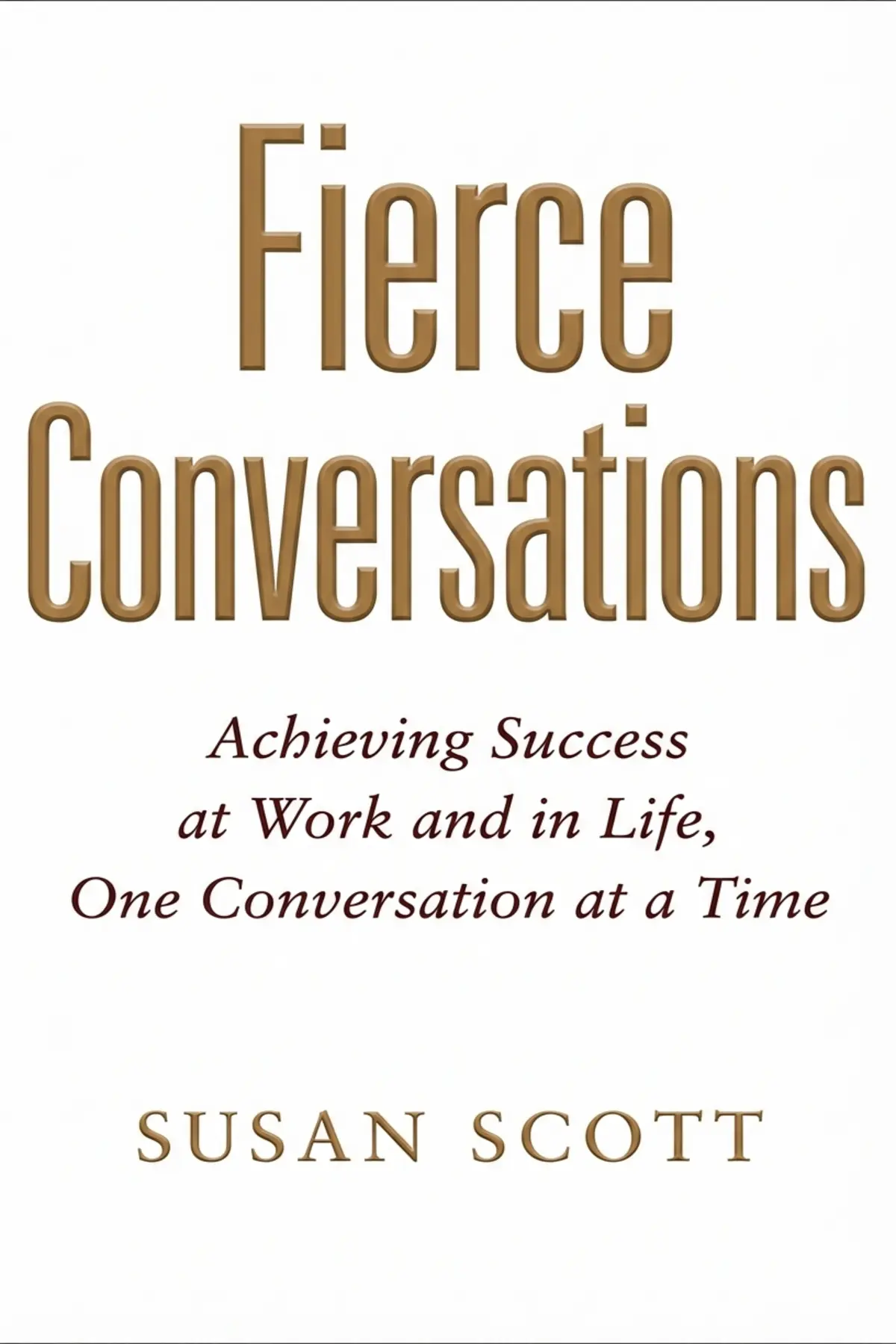
Table of Content
1. Introduction
1 min 05 sec
Most of us know exactly which conversation we have been avoiding, and when a business wobbles or a relationship goes flat, we tend to blame the problem itself. In Fierce Conversations, Susan Scott, who led CEO think tanks for more than a decade, argues that the real cause is usually the talk that never took place. She compares life to a board game in which conversations are the dice: each one moves you ahead or leaves you stuck at the start.
Fierce, in her sense, means authentic above all. It is the conversation the real you would have if manners and fear stepped aside. Scott’s case is that relationships and results change one honest conversation at a time, provided you speak truthfully, listen fully and watch the feeling you leave behind. What follows is a working kit: a one-minute script for hard feedback, a meeting design that surfaces every view, and a way to say the thought you usually swallow.
2. Speak up as the person behind your fear
1 min 55 sec
Staying silent in a tense meeting feels like the safe choice. Scott pictures two versions of you standing in line, and argues that the one in front is costing you and your team more than you think.
3. Bring every point of view into one room
1 min 50 sec
A sudden flood of orders reached a crab fishery for a reason nobody there could have predicted. How the business handled it shows why one person’s view of a problem is never enough.
4. Hear the intent hiding behind someone's words
1 min 50 sec
Three groups listened to the same man describe the same problem and reached three very different conclusions. The bluntest group said he wasn’t ready to change, and his trip back for extra brownies at the break did not go unnoticed.
5. Say the thought you keep in the left column
1 min 52 sec
While you nod and say the encouraging thing, a second conversation runs silently in your head. Scott argues that this hidden track often holds the most useful words in the room.
6. Give hard feedback in under a minute
1 min 49 sec
Most managers put off the awkward performance talk until resentment has spread across the team. Scott’s answer is a short opening built from seven parts, and one of them is an apology.
7. Leave a feeling people are glad to remember
1 min 45 sec
Long after a conversation ends, something of it stays with the other person. Scott gives that lingering effect a name and shows how heat, and even silence, can sweeten or spoil it.
8. Conclusion
1 min 06 sec
Scott’s argument runs against a familiar habit. We tend to treat hard conversations as a risk to the relationship, when in her view the risk lies in the ones we skip. The silent employee keeps Neel’s weak hiring process alive. The kind friend keeps Jin from the practice that might win her the promotion. The father who stops feeling keeps his own healing on hold. Each fierce conversation, by contrast, moves the game forward a square.
The book supports a modest start. Choose one conversation you have been avoiding, write its opening in seven short lines, and say it within the week. In your next meeting, listen for intent as well as words, and call by name the person who has not yet spoken. Keep a private left column for a day and notice which of its thoughts would help someone if said with care. After a tense exchange, check your wake.
None of this asks you to become someone else. It asks the person already standing behind your caution to step forward and speak.
About this book
What is this book about?
Many problems at work and at home grow out of talks that never happen: the employee who stays silent about a failed project, the manager who delays a hard review, the friend who keeps a useful doubt to herself. Susan Scott argues that conversations work like the dice in a board game. Each one moves you forward or leaves you stuck. Her answer is the fierce conversation, which she describes as powerful, passionate and above all authentic: the talk your real self would have if manners and fear stepped aside. Drawing on her workshops and coaching, she sets out principles for having it, from inviting every point of view into a meeting to noticing the thoughts you keep private while someone else speaks. Readers get concrete tools: a seven-part opening statement for difficult feedback, a meeting format that draws out quiet voices, a two-column exercise for honest thinking, and a way to use silence without turning it into a weapon.
Book Information
Who it's for
Managers delaying performance talks
Managers who keep postponing a performance talk and want a script that works.
Team members staying silent
Team members who stay silent in meetings when they know what went wrong.
Partners, parents and friends
Partners, parents and friends who swallow hard truths to keep the peace.
About the Author
Susan Scott
Susan Scott led CEO think tanks for more than a decade before founding Fierce, Inc., a global training firm that helps large organizations improve the conversations their results depend on. Its clients have included Yahoo, Starbucks, Cisco, Nestle and Coca-Cola. Besides Fierce Conversations, she has written Fierce Leadership and Fierce Love, and she has given keynote talks and TEDx Talks.
Ratings & Reviews
Ratings at a glance

What people think
Listeners find this work a pleasure to experience, highlighting its realistic guidance and candid communication style. The material offers significant lessons suitable for both private and career-focused connections, and listeners value the way it encourages more genuine interactions. They characterize the content as accessible and life-changing, mentioning its positive influence on every facet of their daily existence.
Top reviews
Bo
Finally got around to reading this after seeing it on so many 'must-read' lists for leaders. Scott’s central premise—that the conversation is the relationship—hit me like a ton of bricks. We often think of communication as a tool to manage our connections, but she argues it is the very foundation of them. If the conversation stops, or becomes dishonest, the relationship itself effectively ends. I loved the practical frameworks provided for having those 'fierce' yet compassionate interactions. It isn't about being aggressive; it is about being incredibly clear and authentic. While some of the corporate examples felt a bit dated, the core wisdom is timeless and applicable to both my marriage and my team at work. This is a foundational text for anyone who wants to live more truthfully.
Show moreKru
After hearing my boss rave about this for months, I finally dove in. It is easily one of the most transformative leadership books I’ve encountered in a decade. The idea that we need to 'interrogate reality' is something every management team should adopt immediately. We spend so much time pretending not to know what we actually know, and this book gives you the permission to stop that cycle. The writing is elegant and the exercises are genuinely challenging. It isn't just about workplace efficiency; it is about becoming a more present and authentic human being. I’ve already started using the 'fierce' techniques with my kids, and the difference in our connection is palpable. Absolutely essential for anyone looking to deepen their interpersonal impact.
Show moreLook
As someone who has struggled with conflict avoidance my entire life, this book was a revelation. It completely reframed how I view difficult interactions. Instead of seeing them as something to fear, I now see them as a gift to the relationship. Scott’s voice is encouraging and guiding, helping you through the process of shedding your 'mask.' The concept of the 'emotional wake' stayed with me long after I finished the last page. I’ve realized that being 'nice' is often just a way to avoid being honest, and that honesty is actually the kinder path. This is a book I will keep on my desk and revisit whenever I feel myself shrinking back from a necessary truth. It is rare to find a professional book that hits this hard on a personal level.
Show moreMaja
The chapter on 'emotional wake' was a massive eye-opener for me. It forced me to consider the lingering impact I leave on people after a meeting or a simple talk. Am I leaving them feeling empowered or crushed? Frankly, I realized I’ve been leaving a pretty messy wake lately. The book provides excellent tools for 'interrogating reality' and getting past the polite surface-level chatter that stalls most companies. My only gripe is that some of the scenarios feel a bit tailored to high-level executives who have time for 4 AM tea ceremonies. It is a bit 'touchy-feely' in spots, but the actionable advice on asking better questions makes it well worth the time. Look, if you want to stop skating over the surface of your life, read this.
Show moreSiriphen
Ever wonder why your team meetings feel so stagnant and unproductive? This book suggests it is because we are all too afraid to have the 'fierce' conversations required to move the needle. Scott does an amazing job of explaining how to approach sensitive topics without being a jerk. I particularly liked the distinction between being fierce and being aggressive. It is about clarity and courage, not dominance. The book is filled with specific outlines for how to structure a difficult talk, which I found incredibly useful for my recent performance reviews. My only criticism is the heavy reliance on movie quotes to prove points, which felt a little bit superficial at times. Still, the impact on my communication style was immediate and positive.
Show moreTantipat
This book should be mandatory reading for anyone in a leadership role, but it is just as relevant for parents and partners. The framework for 'interrogating reality' is brilliant because it exposes how often we operate on assumptions rather than facts. I found the section on 'one conversation at a time' particularly grounding in our world of constant distractions. Truth is, we often skip the hard parts of communication because they take effort. Scott makes a compelling case for why that effort is non-negotiable for success. I did find some of the personal anecdotes a little bit pretentious—like the martial arts sensei stories—but the core message is so powerful that I can look past the author’s occasional ego trips. It changed how I talk to my spouse.
Show moreTeng
I picked this up thinking it would be another dry leadership manual filled with corporate buzzwords and graphs. Instead, I found a deeply personal and practical guide on how to actually talk to people. The emphasis on authenticity is refreshing in a world that feels increasingly performative and fake. I loved the practical questions she suggests, like 'What is the thing you are pretending not to know?' That one question alone has changed the way I approach my weekly 1-on-1s with my staff. It is a joy to read because Scott is clearly passionate about the subject. While I don't agree with every single anecdote she uses, the overarching philosophy of 'fierce' communication is something I’ve already started implementing with great success. It works.
Show moreRay
Look, I’m usually skeptical of the 'self-help' label, but this book offers genuine, actionable value for the average working Joe. It isn't just theory; it is a toolkit for real-life engagement. The focus on the 'emotional wake' is particularly poignant for anyone who manages people. It is easy to forget how much power our words carry. Scott’s writing is definitely more flowery than your average business author, which might annoy some readers who want pure data. However, I found it made the concepts more memorable. My team has started using her strategies to address elephants in the room that have been there for years. We aren't all the way there yet, but the culture is shifting toward much-needed transparency. Definitely worth the read.
Show moreUraiwan
Not what I expected from a business book, for better or worse. Scott’s writing style is definitely unique—she waxes lyrical about the sea and emerald currents in a way that feels more like a novel than a manual. While I appreciated the change of pace from dry textbooks, it did make the actual 'how-to' sections feel a bit sparse. The advice is basically 'don't be afraid of the truth,' which is great, but maybe not worth three hundred pages. I did find the sections on active listening helpful, though. It’s a decent read if you enjoy storytelling and a more maternal tone. However, if you are looking for a quick bulleted list of tactics, you might find yourself getting frustrated with the slow flow and personal detours.
Show moreAndrei
To be fair, I really wanted to like this given the high ratings, but it was a slog for me. Susan Scott seems to have a hard time getting to the point without meandering through endless, self-indulgent anecdotes. I found the constant references to Winnie the Pooh and her own high school memories quite distracting. At times, the writing felt like a failed attempt at a literary memoir rather than a practical business guide. Why are we spending pages on descriptions of orca whales in a book about leadership communication? Some of the core advice—like being honest and asking deep questions—is solid, but it’s common sense. It is buried under too much fluff and pretension for my taste. I would have preferred a twenty-page pamphlet over this long-winded volume.
Show moreQuestions about this book
What is the main idea of Fierce Conversations?
Susan Scott argues that relationships and results change one conversation at a time. She compares conversations to the dice in a board game: each one moves you forward or leaves you stuck. A fierce conversation is an authentic one, the talk your real self would have if fear and politeness stepped aside, combined with full attention to the other person and to the feeling you leave behind.
What is the seven-part opening statement in Fierce Conversations?
It is a short script for difficult feedback, delivered in under a minute. You name the issue, give a specific example, say what you feel, describe what is at stake, own your part in the problem, state that you want to resolve it and invite the other person to respond. Then you discuss, bring deflections back to the issue gently and finish with a clear agreement on next steps.
What is the left-hand column exercise?
Scott asks you to imagine two columns: on the right, what is said aloud; on the left, what you privately think. The left column often holds the most useful truth, such as a doubt about a friend’s chances or an observation about someone’s emotional state. Her advice is to say those thoughts with care when they would help, finding a path between staying silent and blurting them out.
How can I use Fierce Conversations in meetings?
Scott suggests stating the issue in a sentence or two, sending context in advance and inviting people affected further down the line as well as those directly involved. In the room, favor eye contact over note-taking, call quiet people by name and answer disagreement with curiosity. Close by having everyone write a solution and read it aloud, then thank them and report back on results.
Who should read Fierce Conversations?
It suits managers who delay hard feedback, employees who stay quiet about problems they can see, and anyone whose personal relationships suffer from things left unsaid. Scott’s tools cover both work and home: a meeting format, a feedback script, listening exercises and a reminder to use silence as a tool rather than a weapon.
Readers also enjoyed









AUDIO SUMMARY AVAILABLE
Listen to Fierce Conversations in 15 minutes
Get the key ideas from Fierce Conversations by Susan Scott, plus 5,000+ more nonfiction titles.
- 5,000+ titles
- Listen as much as you want
- 7-day free trial
- Cancel anytime









