

59 Seconds: Change Your Life in Under a Minute
Richard Wiseman
 English
Shows how to find your real strengths by gathering stories from people who know you at your best, and how to reshape your job and daily routines so you use those strengths every day.
1 min 00 sec
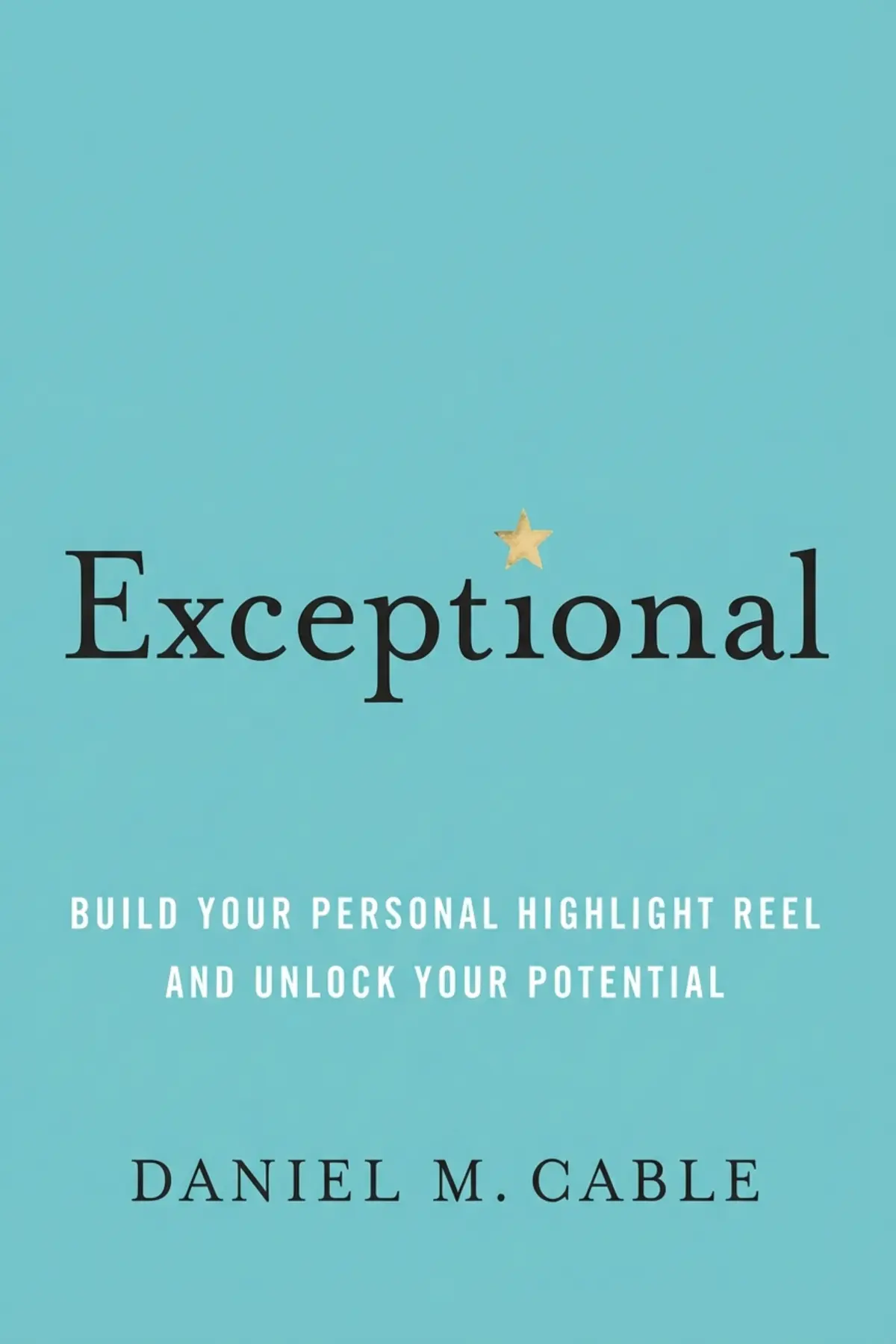
Most people try to get better by studying their mistakes. In Exceptional, London Business School professor Daniel M. Cable argues that the quicker route runs through what you already do well, and he cites a study in which teenagers who watched edited videos of their best work became 15 percent more productive than those who saw every slip.
The catch is that nobody hands you that kind of evidence. Social habits keep the people around us silent about our best qualities, often until a funeral. Cable’s remedy is a personal highlight reel: true stories, written by people who know you, about moments when you were most yourself. Gather those stories, read them for patterns, then rebuild your work and your days around the strengths they reveal. That is the whole argument, and each step comes with an exercise. Expect to finish with a plan for collecting the letters, a fresh way to describe your own job, and a small ritual for walking into any room as your best self.
1 min 41 sec
Two groups of teenagers learned the same tasks and watched videos of themselves afterward. Only one detail differed between the videos, and it changed how hard each group worked for the rest of the month.
1 min 49 sec
A comedian read his own farewell messages after waking from a coma and burst into tears. What he learned about himself exposes two social habits that keep almost everyone in the dark.
1 min 38 sec
As many as 83 percent of those who endure trauma report that it changed them for the better. Cable argues a pleasant shock can do the same work, and that you can create one for someone else this week.
1 min 39 sec
The letters will be tempting to open the moment they land. Cable’s advice on when and how to read them matters, because the most useful discovery is often a trait you thought was a flaw.
1 min 44 sec
A telesales manager, an introvert who dreads networking and a hospital scheduler each found more satisfaction in the same role they already had. None of them waited for a promotion or a new contract.
1 min 39 sec
A full schedule feels like the perfect excuse to change nothing. Cable answers with a list of ten, a reminder he uses in dull meetings and a small gesture at every door you walk through.
1 min 37 sec
Three groups of students prepared for the same exam, and two of them spent time imagining success. One of those groups did worse than students who imagined nothing at all.
1 min 13 sec
Dave Maher learned what his friends valued in him only because they thought he was gone. Cable’s book is, in a sense, a way to get that news without the coma. The stories other people carry about you are evidence, and evidence of your best moments does what the edited videos did for the teenagers in Auckland: it makes you want to repeat them. Once you know those moments, the job, the weekend and the walk into a meeting can be shaped to bring them back.
Write one letter to someone you value, built around a single concrete memory of them at their best, and send it before the week is over. When replies to your own request arrive, let them pile up before reading.
Cable closes with one more piece of writing. Take a long stretch of time to write yourself a letter from the best possible future you, someone who has achieved what they wanted at home, at work and with friends. Describe that person’s ordinary day and state of mind, then keep the letter close for the days you need it.
Most people hear their eulogy too late to use it. A highlight reel lets you hear yours now, while there is still a life to build on it.
Most people try to improve by working on what they do badly, and many replay their mistakes far more often than their successes. Daniel M. Cable, a professor at London Business School, argues that this habit holds them back. People make their biggest impact, he says, when they lean into what they naturally do well, and positive evidence about their abilities makes them try harder. The trouble is that we rarely hear that evidence. Cable describes how social norms save praise for funerals, and how our avoidance of thinking about death makes us postpone using our gifts. His remedy is the personal highlight reel: letters from friends, family and colleagues describing specific moments when you were at your best, read first for comfort and then for patterns. From there the book turns practical. Readers learn how to give gratitude letters before asking for their own, how to reshape a job without changing its official title, why picturing the steps beats picturing the prize, and how small rituals, such as pausing at a doorway, keep strengths in use every day.
Professionals who are hard on themselves and spend most of their energy fixing weaknesses.
Employees who feel they cannot be their best at work and want to reshape the job they already have.
Managers and team leads looking for a simple, concrete way to tell people what they do well.
Daniel M. Cable, known as Dan, teaches and researches at London Business School. His work centers on leadership mindset, organizational culture, how leaders drive change and what keeps employees engaged. Born in Pittsburgh, he studied psychology at Pennsylvania State University and went on to Cornell University for his master's and doctoral degrees. He is a founding partner of Essentic, a firm that helps people identify their strengths, and the author of Change to Strange and Alive at Work. He has published more than 50 academic articles, has twice won a Best Article award from the Academy of Management, and has advised groups as different as the World Economic Forum and high-tech start-ups.

Listeners find the book’s perspective to be positive, with one listener highlighting how it makes complicated topics accessible. They also value its clear writing, describing it as wonderful.
Daniel Cable’s perspective on personal development is remarkably refreshing because he rejects the standard obsession with "fixing" flaws. Instead of focusing on what’s broken, Exceptional pushes you to curate a personal highlight reel of your best moments. I found the concept of "eulogy delay"—the idea that we only hear our best qualities after we are dead—to be incredibly poignant and true. The book makes complex neurochemistry approachable without losing its scientific grounding. While some might find the examples plentiful, I appreciated the depth of the research provided. It’s a wonderful read for anyone tired of the hustle culture that prioritizes fixing weaknesses over magnifying natural talents. Cable writes like a genuinely caring teacher who wants you to thrive.
Show moreAs someone who works in leadership development, I found the framework in Exceptional to be a powerful tool for building authentic confidence. Cable bridges the gap between high-level neuroscience and practical daily habits beautifully. The focus on "authoring yourself" through life experiences provides a sense of agency that many other self-help books lack. I’ve already started recommending the highlight reel exercise to my coaching clients. It’s rare to find a book that is both backed by rigorous social science and written with such a genuinely warm, conversational voice. It makes complicated issues surrounding self-worth and professional identity feel totally manageable. Highly recommended for those wanting to design a life that activates their true strengths.
Show moreWow, this book really shifted my perspective on how to approach my career. I’ve spent years trying to fix my "growth areas," but Cable argues that we should be amplifying our unique gifts instead. The chapter on positive feedback over self-criticism was a revelation for me. Writing that letter to my future self actually made me emotional, which I didn't expect from a business-adjacent book! The layout is clean, the tone is conversational, and the research is top-notch. It’s an empowering guide for anyone who feels stuck in a cycle of remediation and wants to finally play to their strengths. It makes you feel like becoming the best version of yourself is actually possible.
Show morePicked this up after seeing a summary online, and I must say the full text provides a much deeper emotional resonance. The core exercise of asking friends and family for letters about your strengths was intimidating at first, but the results were transformative. Cable writes with a conversational ease that makes it feel like you’re sitting in one of his lectures at London Business School. Truth be told, he could have made his point in fewer pages, and it does get a bit repetitive by the middle chapters. However, the actionable advice regarding the "letter from your future self" is absolutely worth the price of admission. It’s a solid 4-star guide for career pivots or anyone feeling stagnant.
Show moreEver wonder why we spend so much energy on remediation instead of excellence? That’s the central question Cable tackles, and his insights into "playing not to lose" versus "playing to win" really hit home for me. The writing style is energetic and clear, making the psychological concepts easy to digest even after a long day at work. I specifically loved the exercise of writing a letter from the perspective of your future, best possible self; it helped me visualize a version of myself that wasn’t just surviving but actually thriving. My only minor gripe is that some of the workplace applications feel a bit idealistic for corporate environments that aren't already progressive. Still, a very motivating and readable book.
Show moreFinally got around to finishing this, and the timing couldn’t have been better. Cable’s discussion on how we often live as if life is just a safe, efficient trip to the grave was the wake-up call I needed. The prose is readable and warm, avoiding the dry academic tone you might expect from a professor. I particularly enjoyed the section on how to present your strengths to the world using body language and posture, drawing on social science. It’s a very positive, uplifting book that encourages you to stop being a mush of mediocrity. It lost a star because the middle section felt like it was spinning its wheels, but the ending brings it all together nicely.
Show moreGood ideas are definitely present here, but the execution felt a bit bloated for my tastes. The concept of the personal highlight reel is a game-changer, but I felt like the author spent too much time trying to prove the concept with endless anecdotes. After the third or fourth case study, I found myself skimming to get to the actual exercises. Frankly, this could have been a very impactful long-form essay or a series of blog posts rather than a full-length book. If you’re a fan of positive psychology, you’ll enjoy the tone, but if you’re looking for a quick, punchy read, this might feel a bit like a slog through familiar territory. It's useful, but redundant.
Show moreThe core message of this book is vital: we make our biggest impact when we do what we’re best at. However, I struggled with the pacing. One moment you're getting brilliant insights into how our mental state affects our performance, and the next you're buried under five similar stories of people finding their "best self." In my experience, the book tries a little too hard to convince you of its premise rather than just letting the exercises speak for themselves. The author seems like a wonderful person and his passion is infectious, but the text needs a tighter edit. I’d recommend it to someone new to the genre, but seasoned readers might find it a bit elementary.
Show moreAfter hearing Dan Cable speak at a conference, I was totally sold on his energy and wit. The book captures some of that magic, but it doesn’t quite translate perfectly to the written page. The personal highlight reel is a fantastic concept, yet implementing it requires a level of social vulnerability that the book doesn't quite prepare you for. Asking friends to tell you why you’re great feels awkward! I think the advice is sound, but the execution is harder than it looks. It's a decent read with some gems buried in it, but I’m not sure it changed my daily habits as much as I hoped it would. Good, but not essential.
Show moreNot what I expected based on the glowing summaries I’d seen. Look, the central premise—focus on your strengths—is something we’ve heard in various forms for decades. While Cable is a gifted writer, I found the book to be overly repetitive and filled with filler content to reach a certain page count. I read about half of it and realized I had already grasped the primary tools: ask for feedback and write a letter to yourself. The "eulogy delay" term is clever, but it doesn't justify a 270-page commitment. It’s a nice sentiment, but if you’ve read any other positive psychology books, you likely won't find much new ground here. I'd suggest just reading a summary.
Show moreCable argues that people do their best work when they build on what they naturally do well, and that positive evidence about their abilities spurs them on. In a University of Auckland study, teens who watched edited videos of their best performances became 15 percent more productive. Because social norms keep praise unspoken, Cable proposes a personal highlight reel of letters from people who know you, then shows how to shape work and leisure around the strengths it reveals.
It is a collection of letters from friends, family and colleagues, each describing a concrete moment when you were at your true best. Cable suggests reading them twice: once just to feel appreciated, then again to note traits people mention repeatedly and compare them with a eulogy you wrote for yourself. The letters often reveal strengths you overlooked, like the young man who thought he was stubborn while his friends admired his strong point of view.
Cable recommends giving first. For two weeks, write a gratitude letter each day to a different person, naming what is unique about them and one specific moment when they used that quality to help someone. Then ask people to write back honestly about at least one concrete moment when you were most yourself. Wait until a good number of replies have arrived before reading any of them.
Cable calls this work crafting. Spend 20 minutes listing tasks you enjoy, tasks that use your strengths and tasks you dread, then 20 more on ways to bring your strengths into the role. His friend Charles, a telesales manager, started visiting one client a week. His colleague Marcus treats small talk as interviewing. A hospital scheduler named Tim calls himself The Connector. Cable suggests tracking the changes in a diary.
It suits people who criticize themselves in the hope of improving and pour their energy into fixing weaknesses. It also helps employees who feel they cannot be their best at work, a group Cable puts at 80 percent of workers worldwide, and anyone who wants simple writing exercises, such as drafting a eulogy or a letter from their future self, to clarify what they do well.
Richard Wiseman





William B. Irvine


Andrew D. Thompson


Deepak Chopra
AUDIO SUMMARY AVAILABLE
Get the key ideas from Exceptional by Daniel M. Cable, plus 5,000+ more nonfiction titles.









