


12 min 52 sec
Available in: English
Exactly What to Say
By Phil M Jones
Phil M. Jones gives you short, tested phrases for the moments when conversations turn: booking a meeting, answering a skeptic, offering a choice and handling I need to think about it, so people move toward yes.
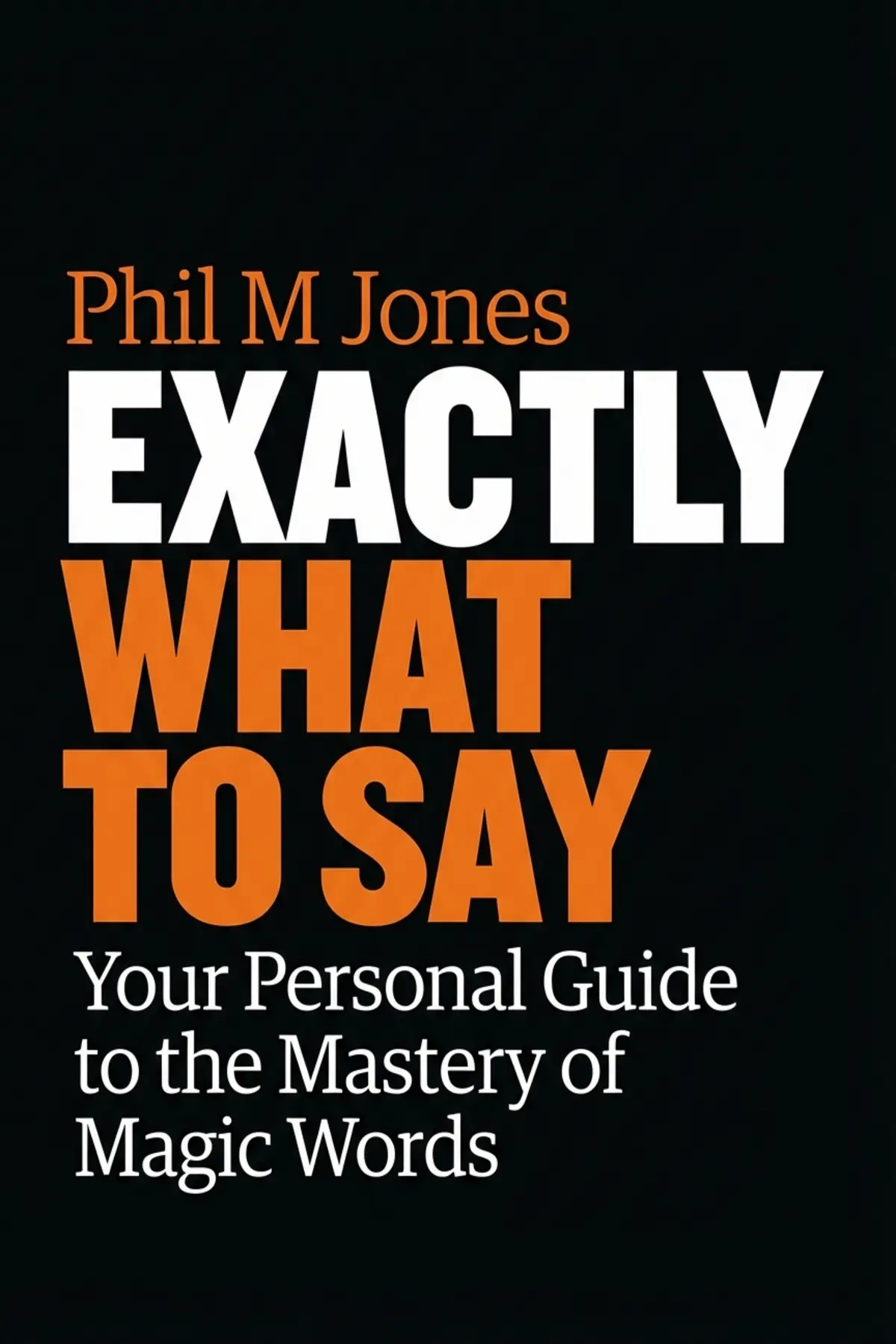
Table of Content
1. Introduction
58 sec
If you have ever lost a sale, a meeting or an agreement in the space of one clumsy sentence, the fix may be smaller than you expect. In Exactly What to Say, award-winning sales trainer Phil M. Jones argues that a handful of carefully built phrases can change how another person hears a request before they have consciously weighed it. Take the line I’m not sure this is for you, but. The first half removes any pressure, the doubt makes people curious, and the word but cancels the doubt, leaving a simple urge to take a look.
Jones’s case is that the words you choose at key moments shape the other person’s instinctive response. A few tested phrases, used at the right point, let you steer a conversation toward yes without pushing. What follows are the openers, questions and closing lines he relies on, each matched to the moment it is built for, from booking a first meeting to answering I need to think about it.
2. Open any conversation without raising defenses
1 min 46 sec
Almost everyone answers one simple question the same way, and Jones builds an opener around that near-certain answer. Paired with a smarter way to ask for meetings, it changes how first requests land.
3. Correct a know-it-all without starting a fight
1 min 52 sec
Arguing with someone who is sure they are right rarely works. Jones uses one polite question instead, along with small rewordings that stop people feeling foolish at the end of a pitch.
4. Offer three options and guide the final choice
1 min 45 sec
People need to feel they are making the final decision, and narrowing the choices down makes that easier. Jones offers a structure that leaves the final pick to them while making one path look clearly the best.
5. Let identity and consequence make your case
1 min 39 sec
A childhood warning from your parents still shapes how you hear promises today. Jones pairs that pattern with a simple move about identity that makes later objections much harder to raise.
6. Make the next step feel safe to take
1 min 49 sec
A group of children hesitating on a rock above the sea explains why people stall at the moment of commitment, and which few words help them finally take the step.
7. Turn "I need to think" into an honest answer
1 min 45 sec
I need time to think rarely means what it says. Jones offers a gentle question, followed by an uncomfortable silence, that brings the real reason into the open so you can deal with it.
8. Conclusion
1 min 18 sec
What Jones offers, in the end, is a different way to prepare for the conversations that matter. Most people rehearse their arguments. Jones rehearses the few sentences at the turning points: the opening, the objection, the moment of decision. His bet is that a well-built phrase reaches the instinctive mind before careful reasoning begins, and that this first reaction often decides whether the rest of your case gets heard.
He is also honest about the limits. He says these words land well with most people on most occasions, but never with everyone in every situation. A phrase that falls flat is a reason to keep practicing, because only repetition makes them sound like your own voice.
A sensible start is to pick the one situation that costs you most. If meetings never get booked, ask when would be a good time. If deals stall at I need to think about it, add just out of curiosity and then hold your silence. If agreement fades into nothing, say what happens next is and lay out the steps. Use one until it feels natural, then add another.
The right sentence still needs a good offer behind it. What it decides is whether the other person stays long enough to hear that offer.
About this book
What is this book about?
Many sales, proposals and requests fail because of a single badly built sentence. One question sounds like pressure. Another invites an easy no. A weak close lets a warm conversation fade into nothing. Phil M. Jones, a sales trainer who started working at 14 and later built a career in sales, argues that these moments can be planned for. His approach is to change a few words at each turning point of a conversation. A request framed around being open-minded is hard to refuse. Asking when would be a good time assumes there is one. Offering three options lets people choose for themselves while you shape the menu. Phrases such as the good news is, what happens next is and just out of curiosity lead people past doubt and delay. Readers get a practical toolkit of openers, questions and closing lines, each tied to a specific situation, from following up on a pitch to answering a stalled prospect. Jones is frank about the limits: the phrases succeed with the majority of people in the majority of situations, and they only feel natural after practice.
Book Information
Who it's for
Founders and sales reps
Salespeople and founders who lose deals at the first objection or the final close.
Early-career professionals
Young professionals who struggle to book meetings or get a clear yes from busy people.
Stuck after a maybe
Anyone who hears I need to think about it and never knows what to say next.
About the Author
Phil M Jones
Phil M. Jones began working at 14, washing cars with a bucket and sponge, and by 15 had friends working for him. He built a career in sales and founded his own training and consulting business in 2008. In 2013 he was named Sales Trainer of the Year at a British sales and marketing awards event, the youngest person to win it. Exactly What to Say is his best-known work, and he describes his mission as helping great people get better.
Ratings & Reviews
Ratings at a glance
What people think
Listeners find this book to be an efficient and accessible read that provides actionable guidance for daily life. Further, its direct and concise nature makes the advice simple to apply right away, and listeners enjoy the specific wording and useful demonstrations included. They also appreciate the short length and its effectiveness in sharpening communication, highlighting how it can improve social exchanges and shift one’s inner monologue.
Top reviews
Fatima
Wow. I didn't realize how much I was over-explaining until I read this. Jones provides a toolkit of verbal shortcuts that actually work. I started using "how open-minded would you be" in my client meetings this week and the shift in energy was immediate. It’s a tiny book, more of a pamphlet really, but the density of value is incredible. You can finish it in a single sitting, yet you'll find yourself flipping back to it before every major call. If you’re looking for deep theory, go elsewhere, but for practical, "do this now" advice, it’s a goldmine. It completely changed my internal dialogue about how to approach difficult prospects.
Show moreLogan
As someone who works in the nonprofit sector, I’ve always been wary of sales tactics that feel slimy or pushy. However, the phrases in this guide are less about tricking people and more about removing the friction in communication. "Just imagine" is a phrase I’ve started using during donor meetings to help them visualize the impact of their gift, and it makes the conversation feel collaborative rather than confrontational. The book is incredibly thin—I'm talking 20 minutes to read—but it focuses on the subconscious triggers that stop people from saying yes. It’s become a mandatory read for my team because it helps us stay focused on the other person's needs during high-stress fundraising rounds.
Show moreBig
Picked this up after seeing it on a "must-read" list for entrepreneurs. Let's be real: this is a collection of scripts, not a deep dive into human psychology. That being said, the scripts are brilliant. I love the "I’m not sure if it’s for you, but..." opening because it takes the pressure off both parties immediately. My only gripe is the price for such a short read; you’re basically paying for a series of bullet points in a very small format. Still, if even one of these phrases helps you close a deal, the ROI is massive. It’s a tactical manual for anyone who needs to influence others without sounding like a robot.
Show moreNattapong
Ever wonder why some people just seem to get their way without any effort? This book explains those "magic words" that bypass the brain's rejection response. Personally, I found the section on "the good news" to be a total game-changer for handling negative clients. It helps pivot the conversation without sounding dismissive or rude. The layout is very clean with big fonts, which makes it a quick reference guide rather than a dense textbook. It’s definitely "salesy," so if you’re sensitive to that tone, you might find some of it a bit manipulative. But for business? It is undeniably essential for improving your social acumen.
Show morePita
After hearing the audiobook was a massive hit, I decided to grab the physical copy for my desk. It's essentially a list of 23 psychological triggers packaged into short, punchy phrases. Truth is, many of us use these naturally, but seeing them codified helps you use them intentionally rather than by accident. "When would be a good time to..." is a much better approach than "Are you free?" because it assumes a positive outcome. I’ve started using these scripts in my emails and noticed a higher response rate already. It’s a bit repetitive in parts, but the clarity is what makes it useful for everyday scenarios.
Show moreMuk
To be fair, this is less of a "book" and more of a pocket guide. If you’re expecting 300 pages of research and case studies, you’ll be disappointed. Phil Jones cuts straight to the chase with actionable scripts that target the subconscious mind. I particularly liked the advice on using "what's the best number to contact you at" instead of asking for permission to call. It sounds small, but these shifts in language change the power dynamic of a conversation instantly. It’s practical, punchy, and easy to implement the same day you read it. Just don’t expect a literary masterpiece; it's a tool, not a story.
Show moreMilk
The chapter on "what most people would do" really rubbed me the wrong way. While I understand the power of social proof, using it to nudge someone into a decision feels a bit too much like manipulation for my comfort level. I read this to better understand the tactics manipulative people use on me, and in that regard, it was very eye-opening. There are some gems here, like "before you make your mind up," which encourages looking at more facts. However, the tone is very aggressive in its pursuit of "winning" the conversation. It’s useful as a defensive arsenal, but use it with a conscience because it can feel like you're attacking the person you're talking to.
Show moreTum
Look, I appreciate the simplicity of this book, but the price for something I can read in 15 minutes is a tough pill to swallow. The font is huge and there’s a lot of white space. Jones clearly knows his stuff, and the "If I can... then will you..." formula is a classic for a reason. But I didn't find anything here that I hadn't already heard in basic sales training or on a few YouTube videos. It’s a nice refresher if you’re in a slump and need a quick confidence boost, but if you’ve been in the game for a while, you probably know most of these "secrets" already. It's more of a booklet than a book.
Show moreMan
Not what I expected at all. I was hoping for more mindset training and psychological depth, but this is strictly about the mechanics of a sales pitch. It’s very focused on steering people toward a specific outcome that favors you. Some of it feels quite dated and potentially annoying to a savvy customer who knows they are being handled. For instance, the "silence" trick is so well-known now that it can come across as awkward or even passive-aggressive if not handled perfectly. I’ll give it three stars because the "just imagine" section was actually quite inspiring for my creative work, but the rest felt a bit too transactional for me.
Show moreMatteo
Finally got around to reading this and I feel a bit cheated. It’s a booklet at best with fewer than 6,000 words. The author claims these are magic words, but they're mostly just ways to corner people into saying yes by exploiting their desire to be polite. I tried the "what makes you say that?" response to an objection and it just made the client defensive and annoyed. It lacks the nuance needed for complex human interactions and feels like a collection of scripts for a call center. If you work in high-pressure telemarketing, this might be your bible. But for building long-term, honest relationships? This approach feels a bit too slimy.
Show moreQuestions about this book
What is the main idea of Exactly What to Say by Phil M. Jones?
Jones argues that a few carefully chosen phrases, used at the turning points of a conversation, shape how the other person instinctively responds. Asking when would be a good time assumes a meeting will happen, and offering three options lets people choose while you shape the menu. Small wording changes like these reduce resistance and steer conversations toward yes without pushing.
How do you respond when someone says they need to think about it?
Jones suggests asking what they need to think about, but softened by starting with just out of curiosity, since the bare question sounds rude and a little aggressive. Then stay silent and wait. Either the person gives an honest reason you can work on together, or they realize nothing is really stopping them from going ahead.
What are some examples of magic words from Exactly What to Say?
Jones’s phrases include how open-minded are you, when would be a good time, what do you know about, what questions do you have for me, you have three options as I see it, most people, the good news is, what happens next is, before you make your mind up and just out of curiosity. Each is matched to a specific moment, from opening a conversation to handling an objection.
Do the phrases in Exactly What to Say always work?
No. Jones says plainly that the phrases succeed with the majority of people in the majority of situations, not with everyone every time. He advises against getting discouraged when one fails and recommends steady practice, so the phrases become second nature and sound like your own words rather than a script.
Who should read Exactly What to Say?
It suits salespeople, founders and anyone whose work depends on persuading others: booking meetings, presenting proposals, following up with prospects and handling objections. Because the techniques are short phrases tied to specific situations, readers can try one in their next conversation without studying a full sales system first.
Readers also enjoyed








AUDIO SUMMARY AVAILABLE
Listen to Exactly What to Say in 15 minutes
Get the key ideas from Exactly What to Say by Phil M Jones, plus 5,000+ more nonfiction titles.
- 5,000+ titles
- Listen as much as you want
- 7-day free trial
- Cancel anytime









