
15 min 01 sec
Available in: English
Drunk: How We Sipped, Danced, and Stumbled Our Way to Civilization
Explains why humans have kept drinking for thousands of years. Slingerland argues that loosening the calculating brain helped us trust strangers, think creatively and build civilization, and that the way a culture drinks shapes how much harm follows.
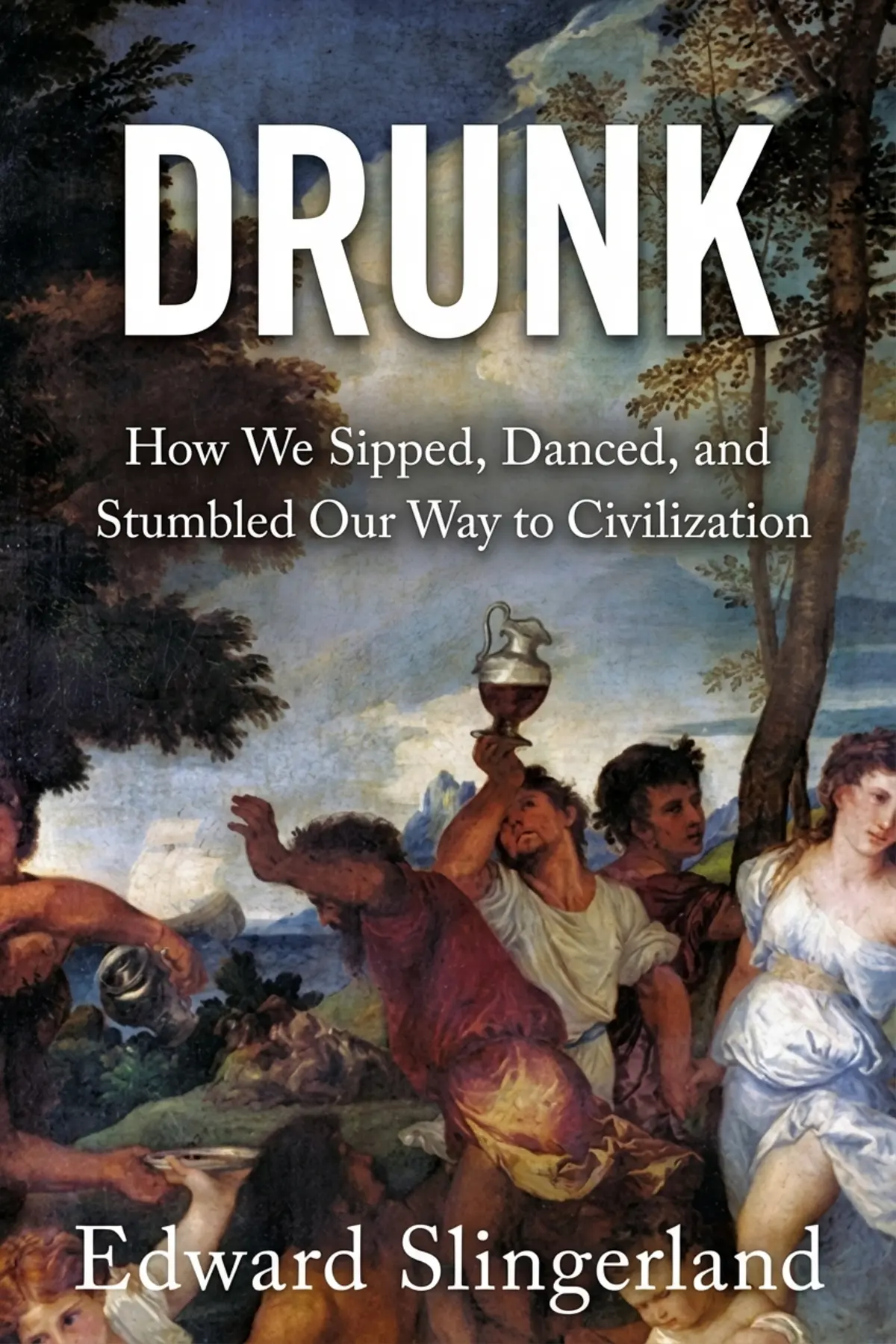
Table of Content
1. Introduction
1 min 06 sec
Most scientists treat our taste for alcohol as a mistake that evolution never got around to fixing. In Drunk, philosopher Edward Slingerland of the University of British Columbia argues the opposite: humans kept drinking for thousands of years because it paid off. Alcohol briefly switches off the prefrontal cortex, the calculating and self-interested part of the brain. That short loss of control helped a wary species trust strangers, think like children and build societies far larger than a family band.
Slingerland takes the damage seriously, from car crashes to liver disease to violence at home. His reasoning is that costs this large imply benefits larger still. Follow it and the glass at dinner starts to look like an ancient social technology, with dangers that depend heavily on how a culture uses it. Along the way comes a fresh way to think about trust, creativity and the stress of change, and a clear picture of why some countries drink every day yet see less alcoholism.
2. See why drinking is no evolutionary accident
2 min 17 sec
Two neat theories explain away our love of alcohol as a glitch in human evolution. Both have a hole in them, and the hole points toward something drinking may have been doing for us all along.
3. Know the three C's that keep humans alive
2 min 04 sec
Cooking made our ancestors smarter and, at the same time, more helpless. That trade reveals the odd survival strategy of our species, and the inner conflict that comes with it.
4. Quiet the calculating brain to build trust
2 min 13 sec
A purely rational mind loses a famous game about two prisoners every single time. Slingerland uses two Greek gods and a Fijian village council to show what it takes to win.
5. Borrow a child's mind when you need ideas
2 min 03 sec
A crow can bend a stick into a hook, yet it will never invent anything new. The difference between that bird and a curious five-year-old explains why a little disorder in an adult mind is useful.
6. See how parties may have built the first farms
1 min 55 sec
The standard story says people learned to farm and then discovered beer. A very old site in Jordan suggests the order might have been the other way around, with surprising consequences.
7. Learn from cultures where drinking does less harm
1 min 59 sec
Some countries put wine on the table every day and still see less alcoholism than places where people drink far less often. The reason has more to do with habits and settings than with quantity.
8. Conclusion
1 min 24 sec
Slingerland’s book ends up as a defense of both gods. Apollo gave us planning, abstract thought and the self-control to wait for a reward. Dionysus gave us the loyalty that wins the prisoner’s game, the openness of a child and the shared feasts that may have drawn hunter-gatherers into villages. A species that lives by culture needs both, and for thousands of years alcohol has been its most convenient way of handing the evening to Dionysus. The same drink that helped strangers trust each other still crashes cars and destroys livers, and Slingerland never hides that.
What follows from his case is a more deliberate way to drink. Keep alcohol tied to meals and company, the way Southern drinking cultures do, and be wary when it becomes a solitary or binge activity. When you plan a gathering, consider whether the loosening you want could come another way, such as a breakfast with one mimosa in place of an open bar. And when the subject comes up, argue from evidence that weighs benefits and dangers together, leaving moralism and outdated science aside.
We are a strange and successful kind of ape. Part of that success came from knowing when to let go of control, and part of it depends on knowing how to take it back.
About this book
What is this book about?
Alcohol wrecks cars, livers and families, so most scientists treat our taste for it as a mistake evolution never fixed. Edward Slingerland, a philosopher who also works in psychology and cognitive science, disagrees. He argues that a habit this costly would not have lasted tens of thousands of years unless it brought large benefits. His case starts with what makes humans unusual. We survive through culture, which means living among crowds of strangers we do not fully trust but badly need. Alcohol temporarily switches off the prefrontal cortex, the rational and self-interested part of the brain. That lets people lower their guard together, tell the truth more easily and think with the openness of a child. Slingerland follows the idea from the prisoner's dilemma and kava ceremonies in Fiji to a 14,000-year-old brewing site in Jordan, which suggests beer may have come before farming. He also takes the damage seriously. Readers learn why countries that drink with meals see less alcoholism than countries that binge, and what a more deliberate approach to drinking could look like.
Book Information
Who it's for
Curious drinkers
Curious drinkers who want to understand why alcohol has followed humans across every era and culture.
Hosts and team leads
Team leads and hosts deciding what role drinks should play at work events and gatherings.
Into evolution and history
Readers of human evolution and history who want a fresh angle on trust, creativity and the birth of farming.
About the Author
Edward Slingerland
Edward Slingerland is a professor of philosophy at the University of British Columbia, with further appointments in Psychology and Asian Studies. He trained at Princeton, Stanford and the University of California, Berkeley. His research covers early Chinese thought, comparative religion, the cognitive science of religion and cognitive linguistics, and he has translated the Analects of Confucius. For general readers he has written Trying Not to Try, published in 2014, and Drunk, published in 2021.
Ratings & Reviews
Ratings at a glance

What people think
Listeners find the work highly informative and well-researched, with one listener noting that it delivers a thought-provoking reexamination of societal development. The book also garners praise for being easy to digest, as listeners characterize it as a blast to read, and one listener commends its balanced approach to alcohol's place in society. Furthermore, listeners value the content, with one mentioning how it balances personal and societal costs of drinking. Conversely, reactions to the humor are split, as some find it funny while others disagree.
Top reviews
Gung
Finally, a scholar who treats our love for intoxicants as a vital feature of civilization rather than just a bug in our biology. This book is an absolute blast to read, blending humor with serious research into how alcohol facilitates the 'three Cs': creativity, cultural learning, and cooperation. Slingerland argues that by temporarily shutting down our overly-analytical prefrontal cortex, we become the hyper-social primates we need to be to survive in large groups. His writing style is chatty and accessible, making complex neurobiological concepts easy to grasp for a general audience. Even when he’s citing obscure historians or psychologists, the prose never feels dry or academic. It provides excellent value for money by totally reframing how you view every happy hour or toast. This is easily one of the most informative and enjoyable non-fiction books I’ve picked up this year.
Show moreDimitri
Wow, what a refreshing and bold perspective on a topic that is usually shrouded in moralizing or medical jargon. Slingerland’s 'Drunk' is a wide-ranging exploration of why humans everywhere have always sought out intoxication. He successfully argues that alcohol is not just a 'hijacking' of our reward systems, but a tool for creating social solidarity and enhancing group creativity. The book is packed with humor and fascinating historical deep-dives, from ancient brewing to modern office culture. I appreciated how he balanced the evolutionary benefits against the 'poisonous neurotoxin' reality, though he clearly falls on the side of it being a net positive for the species. If you enjoy evolutionary psychology or just want to understand human nature better, this is a must-read. It’s rare to find a book this informative that is also such a page-turner.
Show moreMoo
Just when I thought I’d read everything on the social costs of alcohol, this book comes along to show the other side of the ledger. Slingerland uses his expertise in the history of religion and early Chinese thought to show that intoxication is a human universal for a reason. He argues that the very thing that makes alcohol dangerous—the impairment of our judgment—is exactly what makes it useful for building trust among strangers. The writing is upbeat and energetic, making the dense psychological stats feel light and interesting. It really changed how I think about the role of 'the pub' or 'the lounge' in professional and creative circles. It’s a bold defense of a much-maligned pastime that acknowledges the dark side without letting it drown out the benefits. Absolutely worth the cover price for the education alone.
Show moreWanida
Ever wonder why business deals happen over drinks or why every culture has a 'Cheers'? This book gives you the answers in a way that is both intellectually satisfying and genuinely funny. Slingerland’s argument about the downregulation of the prefrontal cortex being a 'feature, not a bug' is brilliant. It explains so much about human creativity and why we need to occasionally 'shut off' our adult brains to connect with others. The book is a perfect blend of anthropology and science, providing a coherent evolutionary explanation for a behavior that usually baffles biologists. Some might find it a bit repetitive toward the end, but the anecdotes about Viking kings and ancient rituals kept me entertained throughout. It’s a brave piece of scholarship that isn't afraid to challenge the modern 'temperance' movement with actual data.
Show moreEthan
Picked this up because I wanted something deeper than a lifestyle blog about drinking, and Slingerland delivers a fascinating dive into evolutionary history. The core premise—that our love for booze isn't just an evolutionary mistake—is handled with a surprising amount of scientific rigor. He explains how down-regulating the prefrontal cortex allows for the kind of lateral thinking and social bonding that actually built our civilizations. I found the sections on Göbekli Tepe and the historical 'rituals of trust' particularly enlightening for understanding societal development. To be fair, the middle section gets quite repetitive as he hammers the same point home through different lenses. However, the writing remains witty and engaging throughout the 300-odd pages. It’s a thought-provoking reexamination of a substance we often view through a purely negative lens.
Show moreTakeshi
Frankly, I wasn't sure if a book about being drunk could be truly academic, yet the blend of anthropology and neuroscience here is genuinely impressive. Slingerland makes a compelling case for alcohol as a 'social lubricant' that helped our ancestors move from small bands to massive cities. I loved the specific details about Beowulf and how different cultures used mandatory intoxication to ensure honesty in negotiations. My only real gripe is that the book is very repetitive, often recycling the same 'PFC down-regulation' explanation for every single human achievement. That said, the stats he provides are fascinating and provided plenty of conversation starters for my own social circles. It’s a balanced approach to alcohol’s place in society that doesn't just preach abstinence or ignore the heavy personal costs involved.
Show moreMaya
Slingerland provides a fascinating reexamination of why we value 'lateral thinking' and how alcohol facilitates that by shutting down our internal censors. The book is well-researched and bridges the gap between the humanities and the hard sciences effectively. I especially liked the discussion on how the invention of beer might have actually preceded the invention of agriculture. It’s a provocative thought that our desire to get buzzed is what actually settled us into farming communities. While I do agree with other reviewers that the book is quite repetitive in its phrasing, the quality of the insights kept me engaged. He makes some pretty good points about how our current 'at-home' drinking culture is a dangerous departure from the social rituals of the past. Definitely worth a read for the perspective shift alone.
Show moreArnav
After hearing the author on a podcast, I was intrigued by the idea that intoxicants might be essential to human cooperation. Slingerland is a likable narrator, and his background in early Chinese thought adds a unique flavor to the anthropology. He spends a significant amount of time trying to discredit the 2018 Lancet study about 'no safe level' of alcohol, which felt a bit like a stretch to me. While his arguments for 'loosening the ego' are compelling, the book downplays the catastrophic social costs of addiction until the very end. The final chapters on the 'dark side' felt like a necessary hedge against criticism rather than a fully integrated part of his thesis. It’s a well-written book with fascinating stats, but it feels a bit irresponsible in how it glosses over the abject misery alcohol causes for millions.
Show moreViolet
To be fair, the author has some genuinely witty lines that made me chuckle out loud during the first few chapters. But honestly, the entire book could have been a long-form magazine article rather than a full-length volume. Slingerland has exactly one point: alcohol makes us more creative and helps us bond. He then proceeds to make this exact argument over and over (and over) again for the rest of the book. It felt like reading a graduate thesis that was padded to meet a page count. While the historical anecdotes about Vikings and Japanese salarymen were interesting at first, they eventually felt like they were just piled higher and deeper to fill space. If you’ve read the introduction, you’ve basically read the book. I really wanted to like this more, but the repetition was just exhausting.
Show morePing
The core argument of this book is hammered in so relentlessly that I felt like I was trapped in a 300-page lecture I didn't sign up for. Unless you want to read what feels like an overstuffed graduate thesis for fun, give this a miss. Slingerland's bloviating on the social benefits of drinking felt incredibly tone-deaf to me. As someone who has seen the health consequences of alcohol up close, his dismissal of modern medical consensus felt arrogant and outdated. He spends hundreds of pages essentially saying 'it's fun and helps us make friends,' which isn't exactly a revolutionary insight. The book is incredibly light on actual argument and heavy on 'up-cycled' anecdotes that don't justify the length. It was a total waste of my time.
Show moreQuestions about this book
What is the main argument of Drunk by Edward Slingerland?
Slingerland argues that our habit of getting drunk is no evolutionary accident. Because drinking is so costly, he reasons it must have brought large benefits. Alcohol briefly switches off the prefrontal cortex, the rational and self-interested part of the brain, which helped humans trust strangers, think creatively and cooperate in large groups. He links this to the three C’s our cultural niche demands: being creative, communal and cultural.
Why does Slingerland reject the hijack and hangover theories of drinking?
A hijack like masturbation survives because it costs almost nothing, but alcohol causes deaths, disease and violence, so natural selection should have removed it. Evolution is not too slow either: herders adapted to digesting milk in a handful of generations. The drunken monkey hangover theory, which holds that the smell of ethanol led our ancestors to calorie-rich overripe fruit, falls short because humans prefer fruit without alcohol and wild primates appear to steer clear of overripe fruit.
Did beer come before bread according to Drunk?
Slingerland presents the beer-before-bread view seriously. Evidence of large alcohol-fueled feasts from the tenth to eighth millennia BCE, and a 14,000-year-old site in Jordan where bread or beer was made, predate farming by thousands of years. Supporters argue the desire to drink helped push people into agriculture, and that alcohol then eased the stress of settled life and bonded new communities.
Why do Italy and Spain have lower alcoholism rates?
In Southern drinking cultures like Italy and Spain, wine or beer is a normal part of meals, children are exposed to alcohol early so there is no taboo, and binge drinking and drinking alone are frowned on. In Northern cultures such as Finland and Russia, drinking happens less frequently but in binges, spirits are common and rates of alcoholism run high. Slingerland also links high US rates to individualism and isolated home drinking.
How can I apply the ideas in Drunk?
Follow the Southern pattern: keep alcohol tied to food and company, and watch for drinking alone or in binges. For work events, consider lighter formats, such as Slingerland’s suggestion of a breakfast party with a one-mimosa limit. Protect time when your planning mind can rest, since creativity draws on a childlike openness. And base opinions about alcohol on evidence about both its benefits and its dangers.
Featured in
Readers also enjoyed

1491: New Revelations of the Americas Before Columbus
Charles C. Mann
Age of Anger: A History of the Present
Pankaj Mishra

A Life Decoded: My Genome: My Life
J. Craig Venter

1929: Inside the Greatest Crash in Wall Street History--and How It
Andrew Ross Sorkin
Agent Sonya: The Spy Next Door
Ben Macintyre

A Planet of Viruses
Carl Zimmer

A Biography of Loneliness: The History of an Emotion
Fay Bound Alberti
Alexander Hamilton
Ron Chernow

A Short History of Nearly Everything
Bill Bryson
AUDIO SUMMARY AVAILABLE
Listen to Drunk in 15 minutes
Get the key ideas from Drunk by Edward Slingerland, plus 5,000+ more nonfiction titles.
- 5,000+ titles
- Listen as much as you want
- 7-day free trial
- Cancel anytime









