
13 min 04 sec
Available in: English
Distancing: How Great Leaders Reframe to Make Better Decisions
Shows why stress and self-image narrow your judgment when the stakes are high, and teaches simple ways to step outside yourself, through personas, a balcony view and your future self, to decide more clearly.
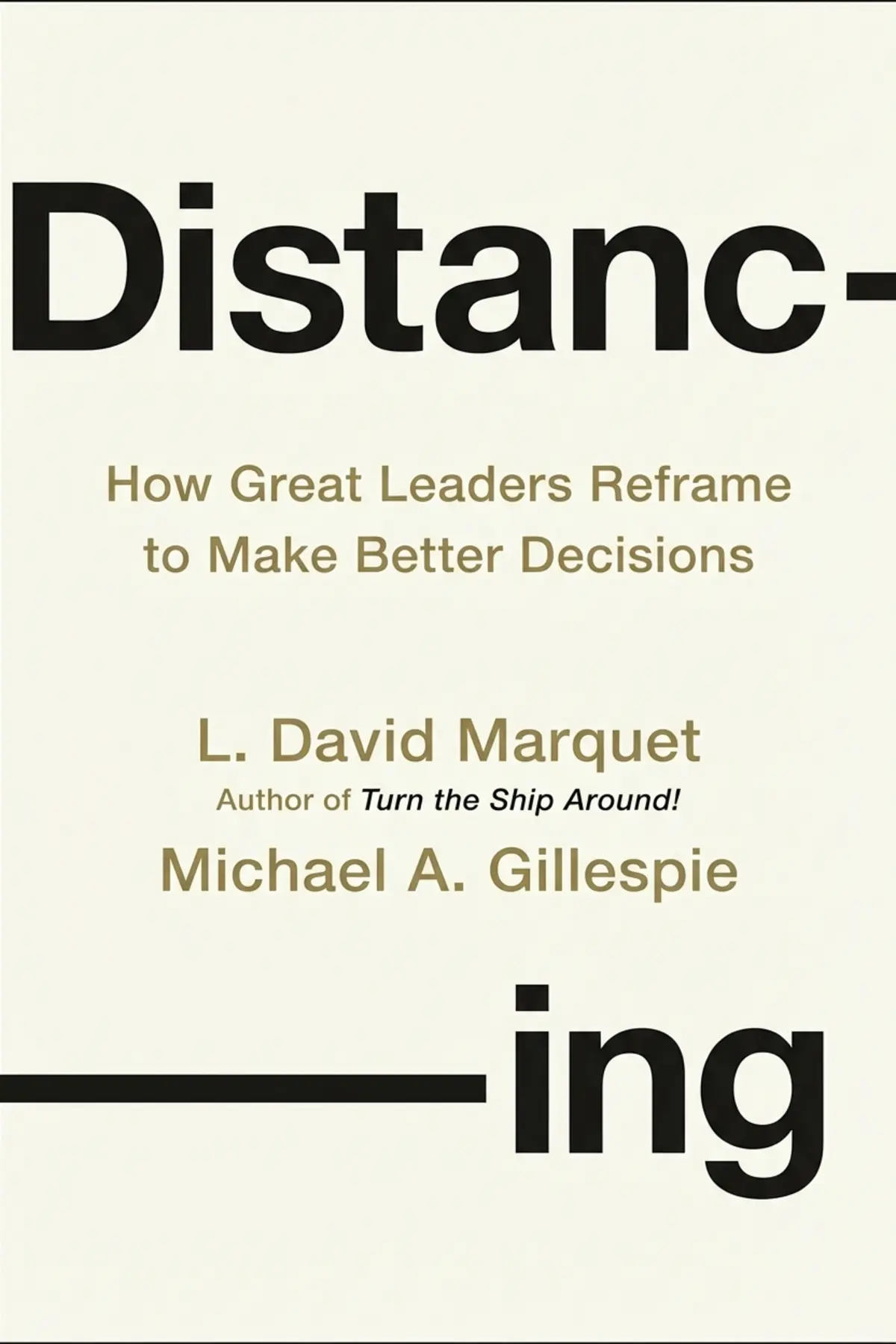
Table of Content
1. Introduction
1 min 00 sec
Under pressure, most of us fight the wrong battle: part of the mind stops working on the problem and starts guarding our reputation. In Distancing, former submarine captain L. David Marquet and organizational psychologist Michael A. Gillespie argue that the fix is a deliberate step outside yourself. You imagine being someone else, somewhere else or at some other time.
The authors call the default state the immersed self, where every event is judged by what it means for me. The alternative, the distanced self, sees what an outsider would see, and often that answer was obvious to outsiders all along.
That is the claim the book builds: clear decisions come from stepping away from your own ego, and the step can be learned. The evidence runs from a doomed landing in San Francisco and a turning point at Intel to a room of four-year-olds pretending to be Batman and a founder imagining himself at eighty. Each one leads to a technique ready for your next hard call.
2. Spot the moment your ego grabs the controls
1 min 59 sec
An experienced pilot saw the warning lights and still kept descending toward the runway. The reason had little to do with flying skill, and the same trap waits in every meeting where your reputation feels at stake.
3. See your problem the way an outsider already does
1 min 58 sec
Two founders sat on a decision that strangers could have made in a minute. What finally freed them was a single imagined scene, and it works on almost any choice you have been putting off.
4. Borrow a fresh identity when the task gets hard
1 min 36 sec
Preschoolers given a tough task did far better after one small change in how they thought about themselves. Adults can use the same move at work, especially on the first morning back from a break.
5. Build an inner Coach who sees through your excuses
1 min 47 sec
Everyone needs an advisor who is firmly on their side yet refuses to believe their excuses. The authors show how to create one in your own head, and the step most people forget once the advice arrives.
6. Calm a heated moment from the balcony
1 min 45 sec
A negotiator who has worked on nuclear talks uses an imaginary place to keep his head when tempers rise. The same mental spot can also loosen the grip of a memory you keep replaying.
7. Let your eighty-year-old self make the big call
1 min 55 sec
Your brain treats the person you will be in ten years almost like a stranger, which explains many poor long-term choices. A famous founder found a way to listen to that stranger before a risky leap.
8. Conclusion
1 min 04 sec
What the authors offer is a way to keep your judgment working at the very moment your ego wants it back. Every hard decision has two people in it: the one immersed in it, worried about how things will look, and the one who could see it from outside. Captain Lee needed the second one above the runway in San Francisco. Grove found him by imagining his own replacement. The hopeful part of the book is that this clearer view belongs to you already. It is a perspective you have and rarely use.
Start small. The next time a choice feels personal, picture whoever would take your job tomorrow and ask what they would do. Before a tense meeting, climb onto Ury’s balcony and watch yourself below. When an old hurt keeps replaying, watch it as the distant you and ask what everyone in it was feeling. For the decisions that shape years, write yourself a letter from five or ten years ahead.
Pressure shrinks the world to the size of your ego. Distance gives it back its real size.
About this book
What is this book about?
When a decision feels personal, part of the mind stops working on the problem and starts protecting a reputation. L. David Marquet, a former submarine captain, and Michael A. Gillespie, an organizational psychologist, call this default state the immersed self. They argue it explains failures as grave as a fatal plane crash and as costly as a company clinging to a fading product. Their answer is the distanced self: a learnable way of seeing your situation as an outsider would. The authors map three routes to it. You can imagine being someone else, view the scene from somewhere else, or judge it from sometime else. Stories from Intel's founders, the negotiator William Ury picturing himself on a balcony, a group of four-year-olds pretending to be Batman and Jeff Bezos imagining himself at eighty show each route in action. Readers get concrete exercises they can use the same week. These include asking what their replacement would do, building an inner Coach, climbing onto a mental balcony during a tense moment, replaying painful memories from a distance and writing a letter from their future self.
Book Information
Who it's for
Managers who freeze up
Managers and team leads who freeze or get defensive when a decision feels personal.
Founders weighing letting go
Founders weighing whether to drop a product or plan they are emotionally tied to.
Replaying painful work moments
Anyone stuck replaying a painful work moment, or facing a big career leap they fear they will regret.
About the Author
L. David Marquet
A 1981 graduate of the US Naval Academy, L. David Marquet spent 28 years in submarines. He took command of the nuclear submarine USS Santa Fe when it was ranked last for retention and performance, handed control to the crew, and led it to the top standings in the Navy. He now teaches an approach he calls Intent-Based Leadership and has taught at Columbia University. Michael A. Gillespie is an associate professor of organizational psychology at the University of South Florida, where he directs a lab on human cognition and decision-making and researches leadership and culture.
Ratings & Reviews
Ratings at a glance
What people think
Listeners describe the book as an outstanding manual for enhancing decision-making, while one review mentions it offers a functional blueprint for individual and corporate evolution. Furthermore, the text provides beneficial perspectives, with one listener drawing attention to the scientifically supported method of moving past ego and bias. Listeners also value how accessible the writing is, with one noting its ideal application for both personal growth and professional advancement.
Top reviews
Kiattisak
Finally, a self-help book that respects the reader's time by getting straight to the point without hundreds of pages of filler. "Distancing" is a clear, actionable guide for anyone looking to improve their judgment by putting ego and bias aside. I loved the striking real-life examples that ranged from nuclear submarines to chip manufacturing and even sports. These anecdotes make the cognitive science feel much more grounded and easy to grasp. The method is immediately actionable—you don't need a workshop to start using these techniques today. Not gonna lie, I was skeptical about how much "being somewhere else" could help. It works. It’s a high-value, low-time-investment read that I highly recommend for personal and professional development. Thank you to the authors for this brilliant guide.
Show moreWipada
As someone who appreciates evidence-based strategies, I found the collaboration between Marquet and Gillespie to be a masterclass in synthesis. They turn complex neuroscience into actionable tools that anyone can use to navigate career crossroads or team dynamics. I’ve read many books on decision-making, but the way they frame distancing as a specific, learnable skill is unique. The book is packed with striking real-life examples that illustrate how these techniques work across different cultures and industries. I particularly liked the focus on becoming less reactive and more intentional. The book is short enough to read in a single weekend but dense enough with insights that you’ll want to keep it on your desk for reference. If you liked "Turn the Ship Around," you will find this to be a thoughtful and practical follow-up.
Show moreWanida
Decision fatigue is a real problem in my line of work, so this framework arrived at the perfect time. I’ve enjoyed L. David Marquet’s other writing, and "Distancing" is another worthwhile addition to his bibliography. The authors advocate for a counterintuitive approach: stepping outside of yourself to gain objectivity. I particularly connected with the "Be Sometime Else" practice, which forces you to imagine your future self looking back on a current choice. It’s a powerful way to reduce daily anxiety and shift into a wiser perspective. Frankly, the writing style is exceptionally clear and straight to the point, likely the result of very careful editing. It’s a short, sweet, and efficient read that offers grounded strategies for intentional thinking. I plan on gifting this to my management team.
Show moreCooper
Frankly, I didn't expect a book written by a former Navy Captain to feel so much like a modern manual on Stoicism. By separating yourself from the raw emotions of the moment, you can make a more rational choice rather than reacting impulsively. This book artfully blends neuroscience with practical leadership insight to show us how to become our own coaches. The three core strategies—self-distancing, spatial distancing, and temporal distancing—provide a solid framework for creating that mental gap in different contexts. It is a rather short book, which I appreciate, as it doesn't bury the lead in fluff. All the points are backed with academic research, making it feel more like a serious tool than just another self-help piece. It’s a great guide for becoming more self-aware and less reactive in high-stakes environments.
Show moreYongyut
Ever wonder why you give great advice to others but struggle to make your own choices? This book tackles that exact problem through psychological distancing. Marquet and Gillespie have created a transformative guide that helps you view your life through a broader, wiser lens. The "Be Someone Else" technique, which involves adopting the role of a coach, was a game-changer for my morning planning sessions. I found the writing clear and the research references neatly arranged, which is always a plus for a non-fiction book. My only minor gripe is that some of the reflection exercises felt a bit repetitive by the end of the book. Still, the message is timely and empowering. It’s a fantastic resource for anyone aiming to reduce daily anxiety and move toward more intentional living.
Show moreMay
Picked this up on a whim after seeing a summary of the "Be Sometime Else" technique online, and I’m glad I did. It’s an excellent book for anyone who wants to learn how to make better decisions as a person, not just as a manager. The writing is incredibly clear and straight to the point, which makes it an entertaining read despite the heavy scientific underpinnings. I found the exercises scattered throughout the text to be surprisingly effective at shifting my perspective on a few nagging work issues. In my experience, most leadership books are far too long, but this one is short, sweet, and efficient. It’s a grounded, empowering strategy for clear and courageous thinking. While it might feel a bit like a Stoic primer at times, the modern psychological context makes it feel fresh and applicable to current life.
Show moreAndrei
After being a huge fan of "Turn the Ship Around," I went into this with very high expectations that weren't entirely met. Look, the book explains how one can make better decisions by distancing ourselves from the immediate heat of a situation, which is a valuable lesson for any leader. Marquet and Gillespie break this down into three types of distancing: self, spatial, and temporal. While the framework is solid, there wasn't anything truly revolutionary in here for me. It served more as a well-written reminder of why I already use certain perspective-shifting techniques to avoid reactive choices. The psychology is sound, and the academic research is definitely there, but the actionable steps felt a bit thin in certain chapters. It's a good, concise book for someone new to cognitive behavioral concepts, but seasoned leaders might find it a bit basic.
Show morePatcharaporn
The blending of cognitive science and leadership theory here is solid, but something felt missing for me during the read. Michael Gillespie brings a lot of psychological depth to Marquet’s practical leadership experience, which makes the evidence-based approach feel very credible. The "Be Someone Else" strategy is particularly helpful for those of us who struggle with ego-driven reactions in the workplace. However, the book focuses heavily on the how and not enough on the when. Truth is, not every situation requires a deep psychological distance; sometimes you just need to act. Without more specific criteria for when to deploy these mental exercises, the advice can feel a bit one-size-fits-all. It is definitely a thoughtful and empowering book, but I would have liked more discussion on the potential downsides of over-analyzing every decision.
Show moreSamart
Look, I think the core message of this book could have probably been an insightful long-form essay rather than a full hardcover. While I appreciate the science-backed skill of putting ego aside, the three practices of being someone, somewhere, or sometime else felt a bit stretched out. That being said, the "Be Sometime Else" chapter alone is worth the price of admission for chronic procrastinators or impulsive deciders. Marquet's voice is distinct. The inclusion of Gillespie’s psychological expertise ensures the advice isn't just anecdotal. It’s a good reminder to see things from a different perspective, even if it isn't exactly revolutionary for people who have studied leadership before. I'd give it a solid three stars for its readability and the occasional "aha" moment.
Show moreBunyarit
Is one vocabulary word really worth an entire book? While Marquet is a legend in leadership circles for his previous work, I found "Distancing" to be a bit of a stretch. The concept of illeism—speaking about oneself in the third person—is fascinating, but it doesn't quite carry the weight of an entire volume. To be fair, the writing is punchy and the Navy submarine anecdotes are always a highlight, but I felt the core message was repeated too often. It’s a decent reminder to step back, yet it lacks nuanced guidance on exactly when these techniques are necessary versus when they might actually hinder quick decision-making. If you’ve already practiced mindfulness or basic Stoicism, most of this will feel like common sense dressed up in new terminology. It is a quick read, but not quite the revelation I was hoping for.
Show moreQuestions about this book
What is the main idea of Distancing by Marquet and Gillespie?
The authors argue that we have two modes. The immersed self judges everything by what it means for us and defends our image under stress, which narrows our vision. The distanced self views the situation as an outsider would. By imagining being someone else, somewhere else or at another time, anyone can switch to the distanced mode and make clearer decisions, often reaching answers outsiders saw long before.
What is the inner Coach technique in Distancing?
The Coach is a lasting persona that supports you but sees through your excuses. You design it deliberately, with its own personality, style and values, perhaps modeled on someone like Nelson Mandela or a fictional character. Before a big decision you physically move, think as the Coach about what they notice and advise, then return to yourself on purpose and write down the actions that fit their view.
How does the balcony technique help in stressful situations?
Negotiator William Ury pictures stepping onto a balcony and watching a heated meeting, including himself, from above. This spatial distancing shifts attention from the ego to the wider context, and many people feel calmer and more focused. The same view helps with painful memories: watching the event from a distance lets you reconstrue it and understand everyone involved, where reliving it only repeats the old emotions.
How can I use my future self to make better decisions?
Brain imaging suggests we treat our future selves almost like strangers, so long-term choices suffer. The authors cite Jeff Bezos, who pictured his eighty-year-old self and wondered which untried path he would regret skipping, a question he considered before launching Amazon. Their exercise is a letter from the future: describe your current decision, become yourself five, ten or twenty years on, and write back as a wise friend. Practice it monthly on smaller choices.
Featured in
Readers also enjoyed



A Bigger Prize: How We Can Do Better Than the Competition
Margaret Heffernan





A Guide to the Good Life: The Ancient Art of Stoic Joy
William B. Irvine


AUDIO SUMMARY AVAILABLE
Listen to Distancing in 15 minutes
Get the key ideas from Distancing by L. David Marquet, plus 5,000+ more nonfiction titles.
- 5,000+ titles
- Listen as much as you want
- 7-day free trial
- Cancel anytime









