

12 min 26 sec
Available in: English
Disrupt You!: Master Personal Transformation, Seize Opportunity, and Thrive in the Era of Endless Innovation
By Jay Samit
Shows how founders find business ideas by watching for overlooked problems, selling solutions instead of products, letting data kill weak concepts fast, taking small bold risks and setting deadlines instead of waiting for luck.
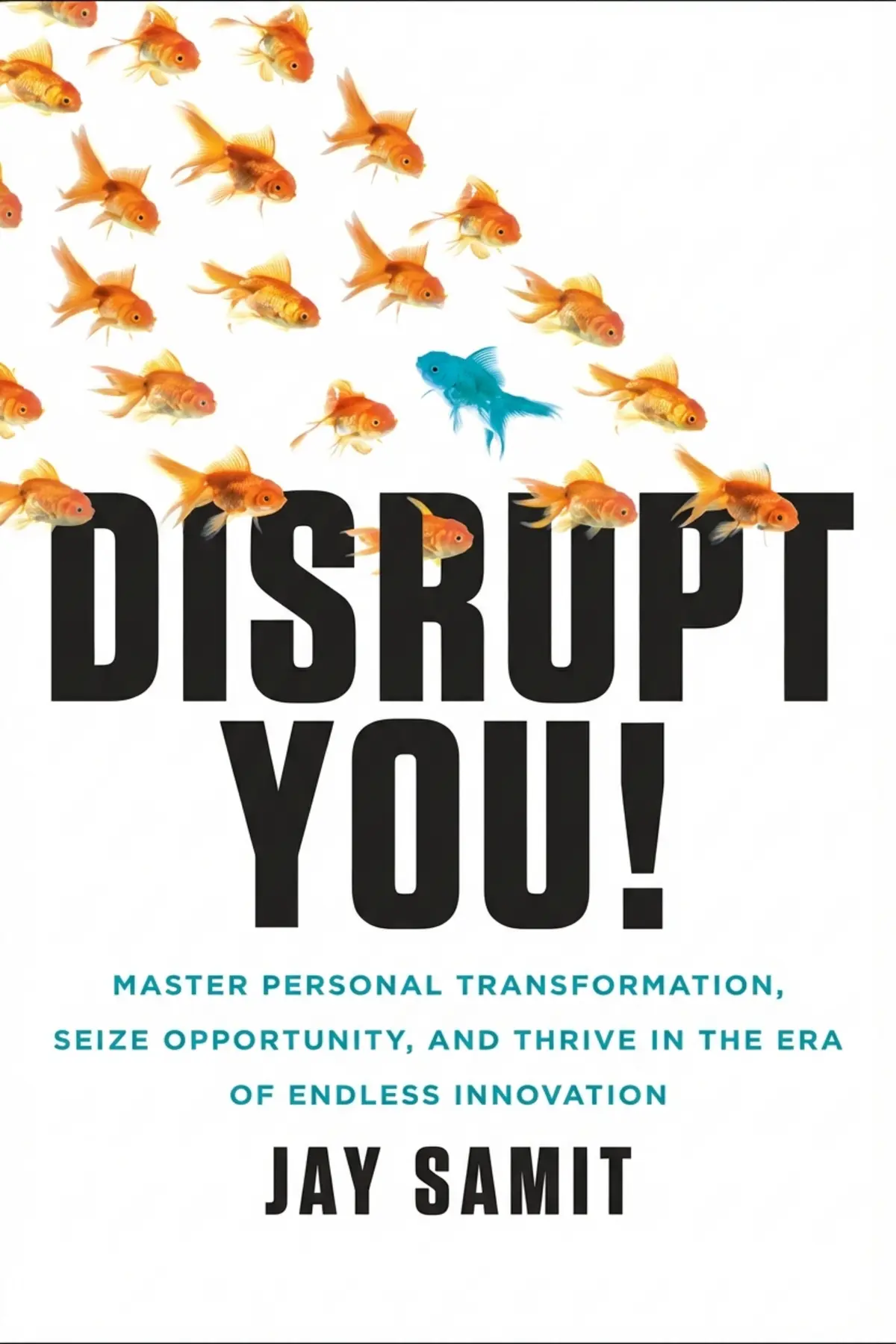
Table of Content
1. Introduction
1 min 02 sec
If you have ever watched someone else’s business take off and put it down to luck, Jay Samit has a correction. In Disrupt You!, the technology entrepreneur and former chief executive of SeaChange International argues that people who build new businesses are logical rather than lucky, and that logic, unlike luck, can be learned. His own proof is a machine that failed: a kiosk he designed to sell lottery tickets, which flopped and then found its real home in airports around the world.
That story carries the book’s whole case. Successful founders keep watching for real problems that others overlook. They sell the answer instead of the gadget, let data tell them when to drop an idea, take small risks that get them noticed, and start today instead of tomorrow. Each of these habits can be practiced. By the end, you will have a daily exercise for spotting ideas, a test for whether an idea deserves to live, and a reason to take the bold first step you keep postponing.
2. Treat every rejection as a redirection
1 min 40 sec
A machine built to sell lottery tickets turned out to be a complete flop. What its inventor asked next decided whether the flop ended his career or started it, and the same question works on any failure you face.
3. Find the need everyone else walks past
1 min 50 sec
In the early computer boom, the first $100 million sale went to someone who could not use a computer. His edge was a habit of attention that anyone can train in a few minutes a day.
4. Sell what your product does for people
1 min 47 sec
A cell phone, a tube of toothpaste and a navigation app all hide the same truth about why people pay. Miss it, and you may end up trying to sell sand in a desert.
5. Let the numbers end a bad idea early
1 min 36 sec
Two founding teams dropped their first ideas once the data pointed somewhere else. What they then spotted in their own usage numbers turned those flops into two of the best-known apps in the world.
6. One small bold move can get you hired
1 min 43 sec
A young copywriter nobody had heard of wanted jobs with famous creative directors. His trick played on a habit he figured almost everyone shares, and it got most of his targets to pick up the phone.
7. Put a date on your goal and start now
1 min 36 sec
An unknown actor made out a check to himself for ten million dollars and post-dated it by several years. A Harvard dorm room shows the other side of the lesson: what happens to people who simply show up.
8. Conclusion
1 min 12 sec
Disrupt You! adds up to a reassuring claim for anyone who feels they lack the instincts of a natural founder. In Samit’s account, the people who build new things are mostly careful observers who move fast. They notice a computer owner with nothing to cover the screen, they hear the data say nobody wants video dating, and they act before the moment passes. None of that depends on fortune, which is why Samit believes it can be learned.
The practices he supports are small enough to begin tomorrow morning. Spend a few minutes writing down three things around you that could work better, and keep going when the list gets hard. Describe whatever you offer by the problem it removes. Decide which signal would make you abandon your current idea, and respect it when it comes. Samit also suggests five minutes each morning picturing your goals already achieved, to prepare your mind for the future you mean to build.
His own story is the image worth keeping. A lottery machine nobody wanted could have ended up in a storeroom. Instead it prints boarding passes for travelers around the world, because its inventor asked one more question after it failed.
About this book
What is this book about?
Many people assume successful founders were simply lucky, with the right idea arriving at the right moment. Jay Samit, a technology entrepreneur whose first big success began as a lottery kiosk that failed, argues the opposite. In Disrupt You!, he presents entrepreneurship as a set of logical habits that anyone can learn, starting with how you react when an idea falls flat. Samit builds his case on stories of people who read reality more carefully than their competitors. Billy Myers made a fortune on computer dust covers without knowing how to use a computer. The founders of a failed video dating site noticed what their users actually liked and built YouTube. A young copywriter used search ads to catch the eye of his heroes, and Jim Carrey, then struggling, made out a $10 million check to himself and put a deadline on it. Readers get practical tools: a daily exercise for spotting problems worth solving, a way to describe any offer by the problem it removes, a rule for dropping ideas the data rejects, and a push to set dated goals and start on them now.
Book Information
Who it's for
Future founders with ideas
Would-be founders with a notebook full of ideas who need a way to test them and act.
Workers stuck after setbacks
Professionals stuck after a failed project, pitch or job search who want to turn it into a new direction.
Junior staff wanting visibility
Early-career people trying to get noticed by leaders who have never heard of them.
About the Author
Jay Samit
Jay Samit is a technology innovator and entrepreneur whose career runs to more than three decades. He served as chief executive of the video service provider SeaChange International and earlier held senior roles at EMI, Sony and Universal Studios. He went on to become independent vice chairman at Deloitte and a senior advisor to LinkedIn, and he has taught as an adjunct professor at the Viterbi School of Engineering, part of the University of Southern California.
Ratings & Reviews
Ratings at a glance
What people think
Listeners describe this work as motivational and full of deep insights, with one listener mentioning how it provides a clear framework and mindset. Furthermore, the content is captivating, actionable, and loaded with powerful success stories, making it essential for both entrepreneurs and global citizens. Listeners also value its savvy business perspective, with one review emphasizing the book’s focus on leveraging business to transform the world. The writing style is praised, and listeners find the inclusion of humor beneficial for developing new ventures.
Top reviews
Noi
Ever wonder why some people just seem to 'see' opportunities while others stay stuck in the daily grind? Samit answers this by detailing how to train your brain to spot inefficiency through constant reflection. The daily exercise of writing down three problems you notice in the world has been a total game-changer for my morning routine. I love how he emphasizes that you don't need to be a coding genius to succeed—look at Billy Myers and those plastic computer dust covers! It’s about solving real-world problems, not just chasing tech for tech's sake. The writing is incredibly savvy, blending humor with hard-earned wisdom from his decades in the trenches. Truth is, this book makes you feel like you have a superpower once you start looking at the world as a series of solvable puzzles. It's inspirational without being cheesy, and practical without being a dry textbook. Highly recommended for any aspiring entrepreneur.
Show moreGioia
After hearing Jay Samit speak in a podcast, I knew I had to grab "Disrupt You!" and it did not disappoint. The core message is powerful: you can either be the one disrupting or the one getting disrupted. The book is packed with actionable advice, specifically the five-minute visualization techniques and the 'fail forward' mentality. Samit’s perspective on using business as a tool to change the world is incredibly refreshing in an era of pure profit-seeking. He uses great examples, like how Waze isn't just a map app—it’s a time-saving solution for real people. This distinction between selling a product and selling a solution is a vital shift in thinking for my own startup. The writing style is very engaging, and the personal stories from his time at EMI add a layer of authenticity. If you are looking to sharpen your focus and actually build something that matters, this is the guide you need.
Show moreRose
Wow, the 'zombie idea' concept is something every business owner needs to hear before they waste another dime. We all get so attached to our original visions that we ignore the data telling us it’s time to move on to something better. Seeing how YouTube and Instagram pivoted from their initial flops was the exact motivation I needed to rethink my current strategy. Samit’s writing is sharp and frequently funny, which makes the hard truths about industry disruption much easier to swallow. This isn't just about business; it’s about a personal evolution. I’ve started doing the daily visualization, and it really does help with maintaining focus throughout the day. The book offers a comprehensive landscape of modern disruptors, providing a perfect mix of inspiration and tactical strategy. It’s one of the few books I plan on re-reading every year to keep my mindset sharp. Truly a must-read for anyone.
Show moreBrooklyn
Finally got around to reading this and I’m kicking myself for waiting so long to dive into Samit's world. The practical mindset shifts he suggests are incredible. I especially liked the "effectuation process" he describes for defining your market and value before you even launch. It takes the guesswork out of starting a new venture. The book is an absolute gold mine of insights for anyone who feels stuck in the status quo. His point about how 35% of business owners have dyslexia and how that unique way of thinking provides an advantage was particularly moving. It really reinforces the idea that your differences can be your greatest strengths if you learn to disrupt yourself first. The focus on solving shared problems rather than just chasing a paycheck is what makes this book stand out. It’s optimistic, practical, and filled with the kind of business savvy you need.
Show morePor
This book isn't your typical corporate manual; it’s a blueprint for anyone feeling stagnant in their current career. Jay Samit manages to bridge the gap between high-level theory and gritty, boots-on-the-ground entrepreneurship. I particularly enjoyed the focus on internal disruption—the idea that you can't change your industry until you’ve overhauled your own mindset first. While some of the success stories like YouTube and Instagram are common tropes in business literature, Samit’s specific breakdown of the value chain offers a fresh perspective. He doesn’t just tell you to be innovative; he provides a tangible framework to identify where an industry is vulnerable. The prose is punchy and moves fast, keeping you engaged even through the more analytical sections. It’s a solid read because it offers more than just motivation; it gives you a lens to view the world differently. I wish there was more depth on technical hurdles, but as a primer on the disruptor's spirit, it is excellent.
Show moreAnna
The chapter on value chains was a massive eye-opener for me as I’m currently trying to pivot my small business. Samit breaks down complex industry structures into manageable segments, showing exactly where a newcomer can wedge themselves in to create change. I appreciated the logical flow of his arguments; it’s not just about dreaming big, but rather about analyzing deeply. The concept of "failing forward" and scrapping "zombie ideas" resonated deeply, especially since I’ve been clinging to a failing project for months now. My only minor gripe is that the paperback format is a bit cramped—I’d suggest getting the hardback for better highlighting. Overall, the book is incredibly business-savvy and filled with compelling success stories that actually illustrate the points rather than just filling space. It’s a great roadmap for anyone who feels like a replaceable cog and wants to reclaim their professional agency.
Show morePakinee
Picked this up on a whim during a long flight and ended up highlighting almost every other page before we landed. Samit has a way of making complex market shifts feel intuitive and manageable for the average person. He argues that logic, not luck, is the driver of success, and he backs it up with some really left-field examples. The story of Billy Myers and the mouse pads was fascinating—it proves that the simplest solution is often the most lucrative. I did find some of the popular motivational maxims a bit clichéd, but the way Samit weaves them into his own career anecdotes makes them feel more authentic. The book is very engaging and doesn't take itself too seriously, which I appreciated. It's a great tool for anyone looking to understand the 'why' behind today's most successful startups. A solid 4-star experience that I'll be recommending to my colleagues.
Show moreSuphan
As someone who has spent years in the tech sector, I found Samit's take on the "organizational imperative" to disrupt to be spot on. He doesn't sugarcoat how difficult it is to stay relevant in the twenty-first century. The book is a healthy mix of part-inspiration and part-tactical guide. I appreciated his deep dive into the value chain—it's a critical tool for anyone trying to identify where a market is ripe for change. While I found a few of the personal anecdotes a bit self-indulgent, the overall framework he presents is undeniable. The book encourages you to treat your career as a series of cycles rather than a single monolithic path, which is a very liberating perspective for the modern worker. It’s a very savvy read that provides a clear landscape of the latest disruptors to inspire action. Definitely worth a spot on your bookshelf if you're serious.
Show moreRatree
To be fair, I felt like a lot of this was ground I’d covered in other business books like 'The Lean Startup.' Samit is clearly brilliant and his credentials are top-tier, but the first half of the book felt a bit repetitive at times. He spends a lot of time on popular motivational maxims that we've all heard before. That being said, the section on analyzing the value chain—R&D, production, marketing, and distribution—was incredibly insightful and worth the price of admission alone. It helped me realize that disruption doesn't have to happen at the product level; it can happen anywhere in the process. The anecdotes are interesting, but sometimes they feel a bit like a highlight reel of success cases rather than deep dives. It’s a decent read if you’re new to the genre, but seasoned entrepreneurs might find themselves skipping the more 'rah-rah' sections. It is a mixed bag for me.
Show moreMats
Look, I wanted to love this given the glowing reviews, but it felt like a copy-paste of every other entrepreneurship book on my shelf. I was hoping for more specific "how-to" and fewer anecdotes about Facebook and Tesla that I've already read a hundred times in other places. The advice to "visualize your goals" for five minutes a day is pretty basic self-help stuff, isn't it? While Samit’s career is undeniably impressive, the book lacks a truly unique framework that sets it apart from the crowd. Frankly, I almost DNF’d it around the midpoint because it felt like a long newspaper summary of people who already made it. There are a few insightful nuggets regarding the 3D printing and automation trends, but they are buried under layers of motivational fluff. If you've never read a business book before, you'll probably love it. Otherwise, you might find this derivative and superficial.
Show moreQuestions about this book
What is the main idea of Disrupt You! by Jay Samit?
Jay Samit argues that successful entrepreneurs are logical, not lucky. They watch closely for real problems that others overlook, sell the solution instead of the product, let data tell them when to drop an idea, take small bold risks and act right away. His own airport check-in kiosk, which began as a failed lottery ticket machine, is his main example of turning a failure into a new direction.
What is the daily exercise in Disrupt You!?
Every morning, write down three things around you that could be improved: an inefficient process, a product that underperforms or a task you dread. Samit says the exercise starts easy and gets harder over time, which forces you to observe more closely. He believes one observation can be enough to start a business, as Billy Myers showed with simple plastic dust covers for computers.
Why does Jay Samit say businesses should sell solutions, not products?
Because people pay for what a product does for them. A phone gives connection, toothpaste gives fresh breath and healthy teeth, and Waze gives drivers back their time. Samit advises leading with that outcome whether you are pitching investors or writing for customers. He also warns against solving problems that do not exist, since a business like that ends with no customers and no profit.
Who should read Disrupt You!?
It suits aspiring founders, people recovering from a failed project and early-career professionals who want to stand out. The stories are short and concrete, from YouTube’s start as a video dating site to a copywriter who used search ads to reach famous creative directors. Each one leads to a habit you can try, such as setting a dated deadline for a goal and planning backward from it.
Readers also enjoyed


Alibaba: The House That Jack Ma Built
Duncan Clark


60 Seconds & You’re Hired!
Robin Ryan





7 Powers: The Foundations of Business Strategy
Hamilton Helmer
AUDIO SUMMARY AVAILABLE
Listen to Disrupt You! in 15 minutes
Get the key ideas from Disrupt You! by Jay Samit, plus 5,000+ more nonfiction titles.
- 5,000+ titles
- Listen as much as you want
- 7-day free trial
- Cancel anytime









