

13 min 10 sec
Available in: English
De-Positioning: The Secret Brand Strategy for Creating Competitive Advantage
By Todd Irwin
Shows how to stop competing on surface difference and win by solving your customers' most painful problem better than rivals, then saying it with one idea and running the whole company around it.
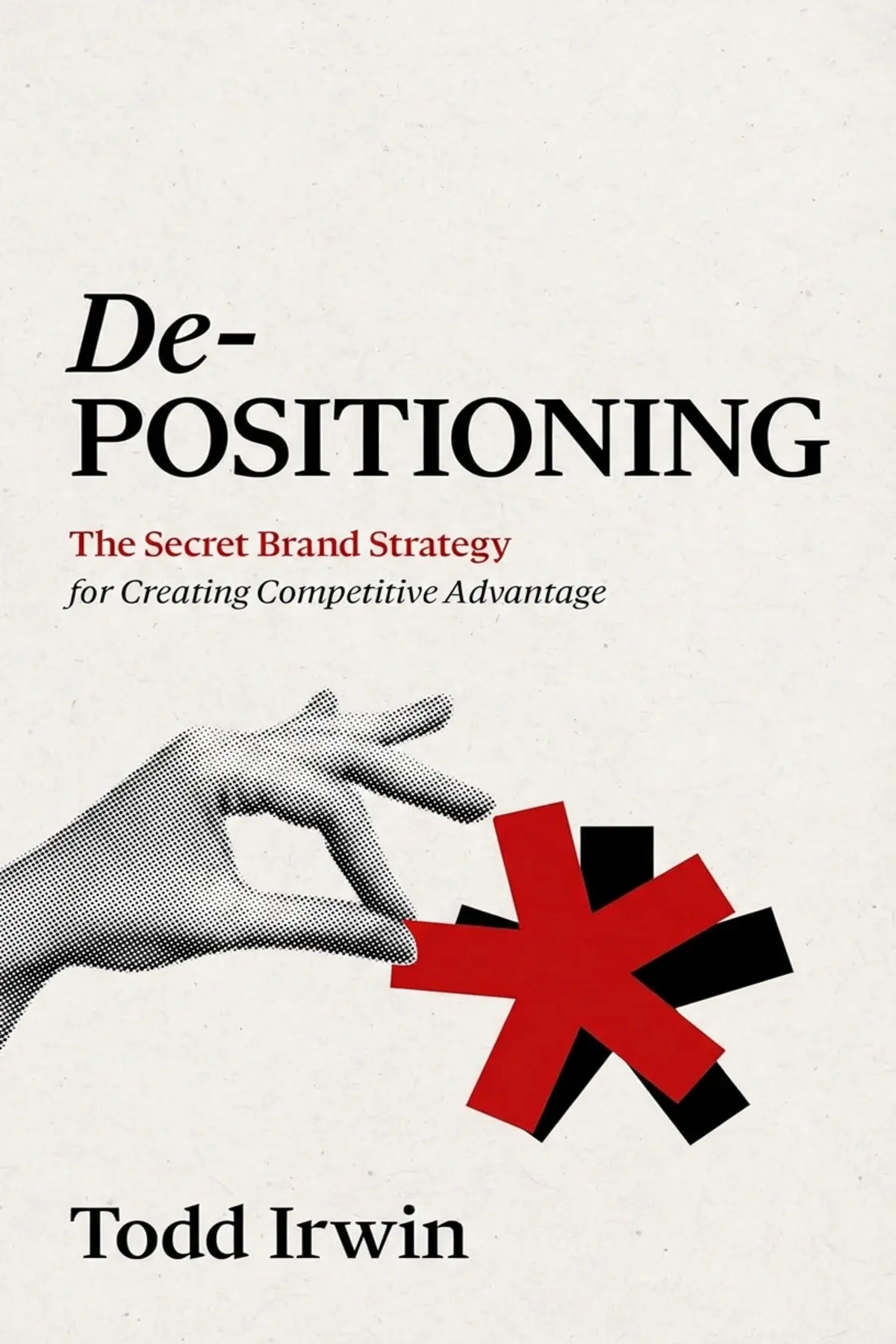
Table of Content
1. Introduction
1 min 08 sec
If your brand keeps announcing that it is different and customers keep shrugging, Todd Irwin has a blunt diagnosis: being different was never the point. In De-Positioning, the brand strategist who founded the firm Fazer argues that empty market space has all but disappeared, so the brands that win stop chasing novelty and go after the customer’s pain instead. Find the frustration your rivals ignore or make worse, become its cure, and they start to look outdated next to you.
Every idea that follows supports one claim: a brand that solves its customers’ worst problem better than anyone, says so with a single idea and runs the whole company around it leaves its rivals looking irrelevant. Irwin builds the case on Apple’s habit of arriving second, a model of how purchases begin, Volvo’s one word and Disney’s recovery through Pixar. By the end you will know how to name your customer’s hero pain point, how to spot the weakness a rival cannot fix, and why saying no to good ideas protects a brand.
2. Stop hunting for empty market space
2 min 10 sec
Strategists still search for the untouched corner of a market, and clever slogans are the usual fallback when they fail. Irwin thinks both habits miss where real advantage hides, and Apple’s history makes his case.
3. Find the one pain your customer feels most
2 min 10 sec
Customers rarely go looking for a brand with personality. Something has gone wrong in their day, and the brand that shows up at that exact moment with the right answer earns a kind of trust advertising cannot buy.
4. Turn a rival's strength into its weak spot
2 min 12 sec
The things competitors are proudest of can be the very things that let their customers down. Irwin borrows a lesson from a martial art, and draws a firm line between exposing a rival and attacking one.
5. Own one word in the customer's mind
1 min 56 sec
A team agrees on a sharp, simple brand idea, and then the meeting continues. Irwin describes how good intentions inside a company can wear a strong position down until nothing distinctive is left.
6. Make every department keep the brand's promise
2 min 19 sec
A brilliant product and a clever idea can still add up to nothing. Irwin explains why, and how Disney pulled itself back together after a decade of drifting into businesses that had little to do with what it stood for.
7. Conclusion
1 min 15 sec
De-Positioning adds up to a change in what a brand is for. Irwin’s winners are rarely the loudest voices in the room. They are the ones that pick the customer’s worst problem, solve it better than anyone, say so in a single idea and organize the whole company around that answer. Competitors are not beaten in a head-on contest; they are left holding the old frustration while customers walk toward the cure. Apple never needed to invent the computer. It only needed to make the existing one look gray and tiresome.
The method also asks for restraint, which is harder than creativity. Turning down a good feature for the headline, refusing the easy mudslinging campaign and putting in deep, disciplined research before saying anything all cost effort that never shows up in an ad.
If you want to start this week, find the moment when your customer first feels that something is wrong, and name the one pain behind it. Then look at your strongest rival for the weakness built into how it works. Choose the one word that answers both, and ask whether your call center would back it up. A brand that passes that last test no longer has to shout about being different.
About this book
What is this book about?
Most brands fight for attention by claiming to be different, and most of those claims vanish into the noise. Todd Irwin argues that the empty market space strategists hunt for has largely gone, and that differentiation for its own sake can even backfire when it solves nothing real for the customer. His alternative, de-positioning, starts from the customer's frustration. Find the single most painful obstacle they face, the hero pain point, and the weaknesses built into how competitors operate, then position your brand as the cure. Irwin draws on Apple's second-mover approach to computers, phones and tablets, a consumer psychology model of how purchases begin, Volvo's ownership of one word, and Disney's recovery after it scattered itself in the 1990s. Readers get a sequence they can apply: name the customer's worst problem, study where rivals fall short without attacking them, compress the brand into one big idea, resist the internal pressure to add more, and make sure every department, down to the call center, keeps the promise the advertising makes.
Book Information
Who it's for
Founders with overlooked products
Founders whose product is good but keeps getting lost among louder competitors.
Tired of hollow campaigns
Marketing and brand leads tired of campaigns that sound clever and change nothing.
Executives sensing a gap
Executives who suspect their company's promise and its daily operations have drifted apart.
About the Author
Todd Irwin
Todd Irwin founded the brand strategy firm Fazer, where he serves as Chief Strategy Officer. He has worked in brand strategy for more than three decades, advising Fortune 500 companies such as Coca-Cola and Verizon as well as startups backed by Sequoia, Andreessen Horowitz and Google Ventures. He created the De-Positioning methodology, a customer-first approach built on solving pain points better than competitors, and his work has been covered by The New York Times, Forbes and MIT Technology Review.
Ratings & Reviews
Ratings at a glance
What people think
Listeners appreciate the straightforward, pragmatic take on current branding, characterizing the guide as an actionable "playbook for competitive dominance" that bypasses usual industry clichés. They specifically value the central theme of de-positioning, which involves tackling consumer problems by capitalizing on a rival's shortcomings. While some listeners suggest the approach leans too much on well-known Apple case studies, they still observe that the takeaways are incisive, short, and manageable. Additionally, the methodology is praised as truly impactful for founders, with one listener noting that it successfully bridges the gap between high-level theory and actionable brand-building steps.
Top reviews
Chee
This book cuts straight through the fluff of modern branding and delivers something actually useful for a change. Todd Irwin challenges the obsession with 'differentiation' and instead focuses on how to systematically dismantle your competition by solving what they won't. I found the 'Hero Pain Point' concept particularly transformative for our internal strategy sessions. It’s a sharp, no-nonsense guide that feels more like a tactical playbook than a theoretical lecture. While the heavy reliance on Apple examples is definitely noticeable, the logic behind the six principles is undeniable. If you’re tired of soft marketing strategies that don't move the needle, this is a breath of fresh air. It’s practical, slightly aggressive in its tone, and exactly what I needed to rethink our market position. Highly recommended for any leader looking to gain a real edge.
Show moreWatcharin
Finally, a strategy book that doesn't just feel like a long-winded LinkedIn post expanded into 200 pages. Todd Irwin provides a masterclass in how to identify where your competitors are failing and how to plant your flag right in that gap. I love the aggressive stance on moving past 'purpose-driven' fluff to focus on actual customer utility. The six principles are laid out clearly, and the book's structure makes it very easy to go back and reference specific tactics when you're planning a campaign. Personally, the Apple case study served as a perfect illustration of his points, even if it's a common example in these types of books. This is an essential toolkit for anyone serious about building a brand that doesn't just exist, but actually leads the market.
Show moreFort
Picked this up during a total rebrand of my startup, and the timing could not have been better. Irwin's 'De-Positioning' framework helped us stop trying to match our competitors feature-for-feature and instead focus on where they were leaving our customers frustrated. It’s an unflinchingly practical guide that cuts through the noise of modern marketing trends. The book is short, sharp, and punchy, which I appreciate as a busy entrepreneur. I found myself scribbling notes in the margins and questioning every campaign we’ve run in the last year. It’s not just about being better; it’s about being the only solution that matters for a specific, painful problem. This is easily one of the most actionable business books I've read in years.
Show moreRoo
De-Positioning is the first marketing read in years that actually made me change my campaign strategy mid-stream. Irwin’s take on the 'Hero Pain Point' is a game changer for how we talk to our customers. He reminds us that branding isn't about being pretty or having a cool origin story—it’s about solving problems better than anyone else. The book is concise, powerful, and remarkably easy to digest. I loved the way he evaluated Sinek’s 'Start with Why' in the context of today’s cutthroat business climate. It’s a refreshing, honest look at what it actually takes to build a brand that lasts. If you are in leadership or marketing, stop reading the trend reports and just read this instead.
Show moreSomsri
Ever wonder why some brands just seem to dominate the conversation without shouting the loudest? Irwin argues that it's because they've mastered the art of de-positioning, turning a rival's supposed strength into a glaring liability. I appreciated the nod to Trout and Reis; it gives the book a sense of professional lineage while updating the concepts for a digital-first world. The breakdown of Volvo’s safety focus and Starbucks’ dominance was enlightening, though I did find myself wishing for a few more niche or B2B case studies. The writing style is very punchy, making it a quick read for a flight or a Sunday afternoon. Truth is, some of the points feel repetitive by the halfway mark, but the core message is too valuable to ignore. It’s a solid addition to any marketer's library.
Show moreBo
Todd Irwin’s background with Trout and Reis really shows in how he structures his arguments, and that’s a good thing for those of us who value logic over buzzwords. He successfully bridges the gap between high-level theory and the kind of actionable steps that a small business owner can actually implement tomorrow. I particularly enjoyed the sections on brand behavior and culture, which emphasize that strategy isn't just what you say, but how the whole company acts. Not gonna lie, the text can feel a bit repetitive at times, as if he’s trying to hammer the same three points home in every chapter. However, those points are vital. Moving the focus from 'us' to 'the customer's problem' is a shift many brands still haven't made. It’s grounded, honest, and very useful.
Show moreVilaiporn
After hearing Irwin talk on a podcast, I wanted to see if the book lived up to the 'de-positioning' hook, and it mostly does. The idea of turning a competitor’s strength into a weakness is a fascinating strategic move that most companies are too afraid to try. Irwin makes it feel attainable by breaking it down into a clear process. The writing is accessible and avoids the usual industry jargon, which is a massive relief. I did feel that the book leaned a little too heavily on the same few examples, but the underlying logic is incredibly strong. It’s a playbook for dominance, not just survival. For any founder tired of 'soft' strategies, this book will feel like a wake-up call to start playing to win.
Show moreTar
As someone who has worked in brand strategy for over a decade, I found the core premise of 'De-Positioning' to be a bit of a rebrand of existing competitor analysis techniques. Irwin is a fantastic writer, and his tone is engagingly direct, but the 'secret strategy' felt a lot like standard market research dressed up in new terminology. To be fair, the focus on solving customer pain points over just being 'different' is a necessary reminder for the industry. I just didn't feel like I was learning a revolutionary new system. The book is probably best suited for business students or founders who are new to the marketing world and need a clear, structured framework to follow. It’s a decent read, just don't expect it to completely reinvent the wheel if you’re already a pro.
Show moreSai
The core framework of the six principles is solid, but the execution feels a bit thin in the middle chapters. I appreciated Irwin's no-nonsense tone and his critique of 'purpose' marketing, which often feels disconnected from reality. However, I struggled with the lack of diverse case studies outside of the usual global giants like Volvo and Starbucks. For a book about competitive advantage, it would have been great to see how this works in more crowded, less 'sexy' industries. It’s a good primer for someone just starting their journey in brand strategy, but seasoned veterans might find themselves nodding along without actually discovering anything new. Worth a read if you need a refresher on the basics of positioning, but maybe skip if you're looking for deep, technical insights.
Show moreRotjanee
Not what I expected based on the glowing reviews I'd seen on social media. While the concept of de-positioning is sound, the book spends way too much time on Apple. I get it—Apple is the gold standard—but I wanted more variety in the examples, especially for those of us not working with billion-dollar budgets. Most of this felt like common sense marketing that’s been polished up with a fancy new title. Frankly, I could have gotten the same value from a long-form article or a 20-minute podcast. It isn't a bad book per se, but it didn't offer the 'revelation' I was promised. It’s a very fast read, which is a plus, but I found myself skimming through large sections that felt like filler.
Show moreQuestions about this book
What is the main idea of De-Positioning by Todd Irwin?
Irwin argues that empty market space has mostly disappeared, so brands should stop chasing surface differentiation. Instead they should find the customer’s most painful problem, solve it better than rivals who ignore it or make it worse, and position the brand as the cure. Done well, this makes competitors look outdated and irrelevant, which Irwin calls de-positioning them.
What is a hero pain point?
It is Irwin’s term for the single most painful obstacle standing between customers and what they want. He relies on the Engel-Blackwell-Miniard model, which holds that each purchase starts when someone notices the distance between their present situation and the one they desire. A brand that offers a credible answer at that moment earns trust, so Irwin urges building the whole business around removing that one pain.
How did Apple use de-positioning?
Irwin describes Apple as a deliberate second mover. The smartphone, the MP3 player and the PC were not its inventions. It let companies like IBM and Microsoft go first, studied the frustrations they created, such as clunky interfaces and poor integration, and answered them. Apple then recast the PC as the gray, complicated machine for the man in the suit, and later did the same with tablets through the iPad.
What is featuritis and how do you avoid it?
Featuritis is Irwin’s name for the slow erosion of a brand’s one big idea inside the company. A team agrees on a single word, such as safety, then colleagues add fuel economy, affordability and technical specs until the message becomes a list. His remedy is discipline: own one idea, as Volvo owns safety and Uber owns convenience, and say no to good ideas that do not serve it.
Who should read De-Positioning?
It suits founders, marketers and executives competing in crowded markets where claims of being different no longer get noticed. Irwin wrote it for business leaders who want to pull ahead of rivals. Readers whose advertising and operations feel out of step will find the chapters on integration especially useful, including the Disney example and the argument that strategy must be driven from the top.
Featured in
Readers also enjoyed






AUDIO SUMMARY AVAILABLE
Listen to De-Positioning in 15 minutes
Get the key ideas from De-Positioning by Todd Irwin, plus 5,000+ more nonfiction titles.
- 5,000+ titles
- Listen as much as you want
- 7-day free trial
- Cancel anytime









