
16 min 16 sec
Available in: English
Dark Towers: Deutsche Bank, Donald Trump, and an Epic Trail of Destruction
By David Enrich
The story of how one bank's appetite for risky clients and its fixation on a single profit figure produced fortunes, crimes and a president in debt. It also shows how to read the same warning signs in any organization.
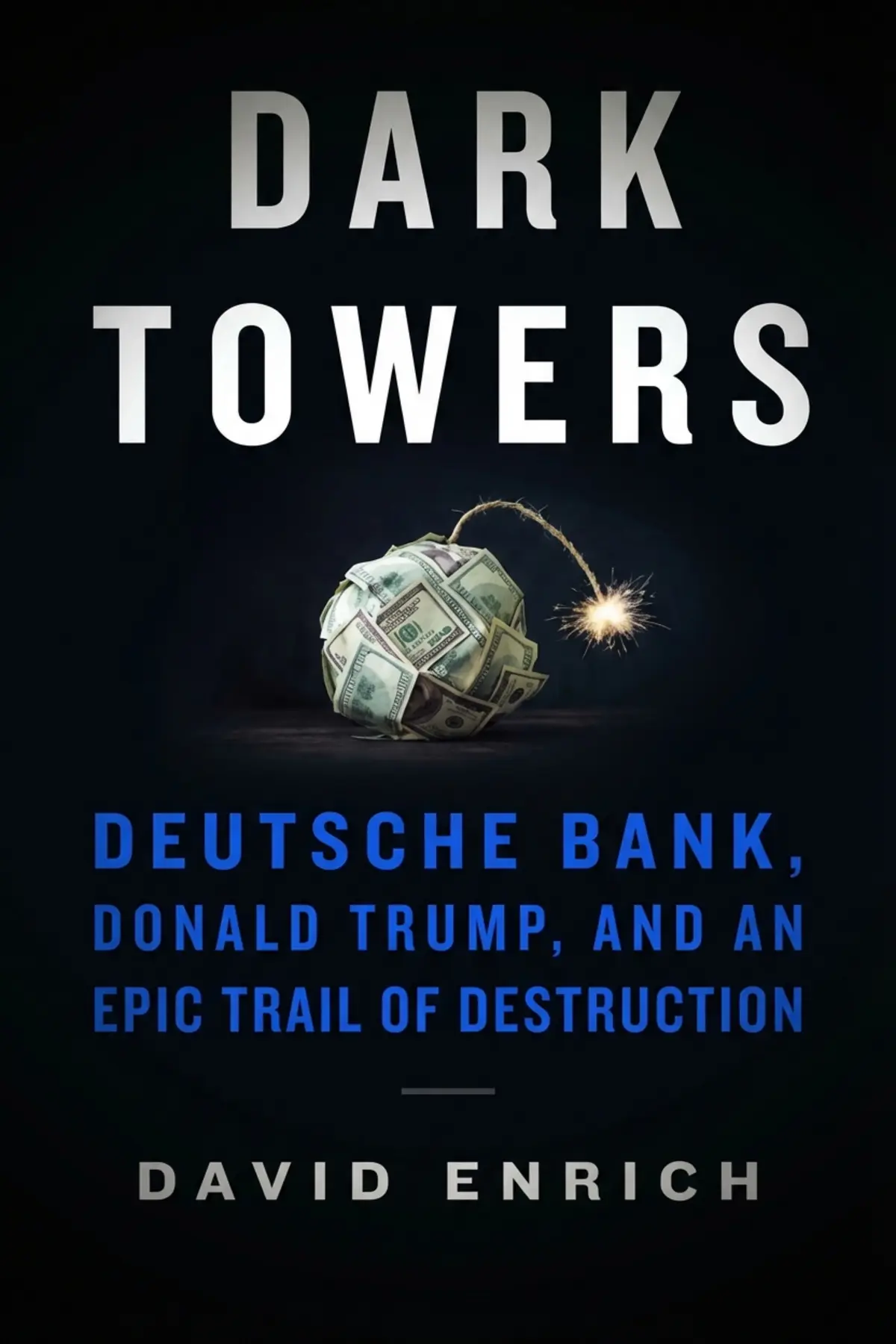
Table of Content
1. Introduction
1 min 06 sec
If you have ever worked somewhere that rewards the number and ignores how it was reached, this story will feel familiar. In Dark Towers, New York Times editor David Enrich shows how Deutsche Bank, founded in 1870, grew by taking on clients and risks that rival banks refused, from the Nazi regime to Donald Trump. That appetite grew sharper under a trading culture that measured everything in profit. It made the bank’s leaders rich, and then it pushed the bank toward ruin.
Enrich’s argument is blunt: an institution willing to do anything for growth eventually pays for all of it, and so do the people inside. The story runs from a Montana railroad in 1883 to a $640 million Chicago loan and a family laptop that became evidence. It also gives you a way to read the warning signs in any organization: one sacred metric, systems nobody understands, a client everyone else avoids, and a conscience that keeps being overruled.
2. See how a founding habit outlives its founders
2 min 07 sec
A railroad baron lost a German bank its money within weeks of a grand ceremony, and the bank’s response set a pattern. It would shape the bank’s choices through world war and well beyond.
3. What happens when traders take over a bank
2 min 26 sec
A cautious German institution hired a team of American traders to compete with Wall Street. Within a year of the Bankers Trust deal, the balance of power inside the bank had flipped toward its investment arm.
4. One profit number can corrupt a whole company
2 min 00 sec
A new chief executive asked every part of the bank to chase one measure of performance. It sounded disciplined, but it pushed decisions about sanctions, Russia and the bank’s own computer systems in a dangerous direction.
5. Learn how a bank kept saying yes to Trump
2 min 27 sec
He defaulted elsewhere, mocked his lenders and finally sued them for billions. The same bank still came back with more money, and by election night it was owed a sum its own executives struggled to explain.
6. Tell lucky profits apart from real skill
2 min 27 sec
In the worst financial crisis in decades, one bank appeared to keep making money. The explanation mixed a nervous decision at a conference in Barcelona with something less flattering, and eventually regulators came looking.
7. Notice the colleague carrying your company's conscience
2 min 23 sec
One executive helped build the trading machine and later spent years trying to restrain it. After he died, a stepson with a list of passwords uncovered what the bank had hoped would stay private.
8. Conclusion
1 min 20 sec
Dark Towers reads like a ledger in which every entry eventually comes due. In the 1880s the bank forgave Henry Villard. Later it served the Nazis, and it welcomed Donald Trump back after he had sued it. Bad luck had little to do with what followed. The bank kept choosing growth over judgment, and once a trading culture made one profit figure the only measure, nobody inside could stop it. The cost came as billions in fines, a planned cut of a fifth of the workforce, a US president in the bank’s debt and a family grieving a man who had tried to object.
You can carry Enrich’s story into any workplace. Notice which number your organization treats as sacred, and ask what it leaves out. When a deal or client has been refused by everyone else, ask why your team believes it is different. Treat systems that nobody fully understands as a danger to fix, even when fixing them is expensive. And listen to the colleague who keeps saying no, because that person is often the one who pays for everyone.
Deutsche’s twin towers in Frankfurt were nicknamed Debit and Credit. For decades, the bank kept its eyes on only one of them.
About this book
What is this book about?
Deutsche Bank was founded in 1870. For well over a century it got ahead by doing business that other banks refused: a railroad baron who defaulted, the Nazi regime, sanctioned dictatorships and Donald Trump after the rest of Wall Street had cut him off. David Enrich, a journalist, follows that habit from a Montana railroad ceremony to the Frankfurt boardroom. His account turns on a change of culture. In the 1990s the bank hired American derivatives traders, and they made personal profit the goal. Under Joe Ackermann, a single measure of return ruled every decision. That brought $30 million bonus checks for some traders, hidden losses, more than 7,000 legal actions and a $7 billion fine. It also left the bank holding hundreds of millions in loans to a man who became president of the United States. Running through the story is Bill Broeksmit, an executive who helped build the trading business, tried to rein it in and was overruled. After his death, his stepson's search for answers exposed the bank's internal record. Readers come away with a gripping case study and a practical eye for the metrics, clients and silenced colleagues that signal trouble at work.
Book Information
Who it's for
Uneasy with results-only rewards
Professionals who sense that their company rewards results without asking how they were made.
Setting team incentives
Founders and managers who set incentives, targets and bonuses for their teams.
Curious about Trump's money
Readers curious about the money behind Donald Trump's rise and the 2008 financial crisis.
About the Author
David Enrich
David Enrich is an American journalist and author, born in 1979, who works as an editor at The New York Times after earlier years at The Wall Street Journal. He won a Gerald Loeb Award for feature writing in 2016, among several journalism honors. His book The Spider Network was a finalist for the Financial Times and McKinsey Business Book of the Year Award. He grew up in Lexington, Massachusetts, and lives in New York.
Ratings & Reviews
Ratings at a glance

What people think
Listeners find the work an engrossing experience that is thoroughly documented and informative, with one listener noting it feels like a spy thriller. Furthermore, the prose is skillfully crafted, and listeners characterize it as a revealing account of Trump’s dealings. On the other hand, the narrative's tempo draws varied responses, including one listener who thought it was overly muddled. In addition, the depiction of characters and the level of sensitivity shown also garner divided opinions.
Top reviews
Nan
This book reads more like a high-octane spy thriller than a dry financial history. David Enrich has done an incredible job untangling the web of Deutsche Bank’s rise and fall, focusing on the human cost of institutional greed. The narrative surrounding Bill Broeksmit is particularly haunting, offering a tragic lens through which we see the bank’s internal collapse. While the Trump connection is certainly the hook, the real story here is the toxic culture of a bank that lost its moral compass. It is a meticulously researched and educational piece of investigative journalism. I found myself glued to the pages, even during the denser explanations of derivative trading and Russian mirror trades. It’s an eye-opening account that every citizen should read to understand how global finance really operates.
Show moreJong
Wow, the depth of research on display here is truly impressive. This isn't just a political hit piece; it’s a thorough autopsy of a dying financial giant. Enrich manages to connect the dots between the 2008 financial crisis, Russian money laundering, and the Trump presidency with terrifying clarity. The sections on how the bank ignored its own compliance officers were particularly eye-opening for me. It’s a compelling read that manages to feel urgent despite covering decades of history. I appreciated that the author didn't shy away from the darker parts of the bank's past, including its Nazi era. This is a vital piece of work for anyone trying to understand the intersection of big money and global politics. Highly recommended for fans of investigative non-fiction.
Show moreSomporn
The sheer audacity of Deutsche Bank’s leadership throughout the early 2000s makes for a gripping, if infuriating, read. David Enrich has written a masterpiece of financial journalism that manages to be both educational and entertaining. I was particularly fascinated by the division between the traditional German banking culture and the aggressive, American-style investment wing. This culture clash eventually led to the bank's downfall, and Enrich captures the tension perfectly. While some critics didn't like the focus on Val Broeksmit, I thought he provided a necessary, if messy, human entry point into a world of spreadsheets and secrets. The book is eye-opening, expertly written, and deeply troubling. It exposes a system where the rules simply don't apply to the people at the top. A must-read for anyone interested in power.
Show moreSupatra
As someone who enjoyed The Spider Network, I found this follow-up to be equally informative, though perhaps a bit less focused. Enrich excels at making complex financial maneuvers accessible to the layperson. The way he details the bank's willingness to lend to a radioactive Donald Trump when no one else would is truly startling. To be fair, the second half drags slightly as it follows Val Broeksmit’s personal struggles and drug use. Those sections felt a bit too detailed for a book primarily about a financial institution. However, the overarching story of corporate rot and regulatory failure is compelling enough to keep you going. It’s a sobering reminder that some institutions are simply too big to care about the law.
Show moreLogan
Finally finished this beast, and the truth is that it’s one of the most sobering accounts of corporate malfeasance I’ve ever encountered. The author paints a vivid picture of a bank that was essentially a criminal enterprise with a respectable logo. I was particularly struck by the description of the 'profit at all costs' mindset that permeated every level of management. While the pacing can be uneven, especially during the deep dives into Val Broeksmit’s personal life, the educational value is immense. It really highlights how easily regulators can be outmaneuvered by those with enough resources. Some might find the character development of the executives a bit thin, but the systemic issues are documented with surgical precision. It’s a dense read but one that feels absolutely necessary in our current era.
Show moreAudrey
Gotta say, the human element in this book—specifically the tragic story of Bill Broeksmit—is what really stuck with me. We often think of these banking scandals in terms of numbers and percentages, but Enrich reminds us of the lives ruined in the process. The way the bank treated its own employees as disposable tools for growth is infuriating. The research is clearly meticulous, and the connections to Russian capital are explained in a way that finally makes sense. My only real gripe is that the middle section felt a bit repetitive regarding the internal politics of the Frankfurt office. Still, the writing is well-executed and the subject matter is incredibly relevant. It’s an eye-opening account that reveals just how fragile and corrupt our global financial systems can be.
Show moreKenji
After hearing the author on several podcasts, I was eager to see the primary sources for the Deutsche Bank saga. The book does not disappoint in terms of technical detail. Enrich explains the 'mirror trades' and the manipulation of LIBOR with a level of clarity that is hard to find elsewhere. It’s a compelling read that exposes the sheer lawlessness of the banking elite. Look, it’s not always an easy read—there are a lot of names to keep track of—but the effort is worth it for the big picture. The fact that Justin Kennedy, the son of a Supreme Court Justice, was Trump's main point of contact at the bank is a detail that deserves more attention. It's a meticulously researched book that serves as a grim warning about the power of unchecked capital.
Show moreJackson
Ever wonder how a bank with such a staid reputation could end up financing everything from the Holocaust to modern-day Russian oligarchs? Enrich provides the answers, but the delivery is a bit of a mixed bag. The first half is a gripping history of Deutsche Bank’s desperate attempt to compete with Wall Street giants. Then, the focus shifts heavily toward Val Broeksmit and his cache of emails. While Val is an interesting character, the narrative becomes quite muddled in the final third. I often found myself confused by the sheer volume of names and sub-plots that didn’t always seem to lead anywhere. It’s an important book, but it lacks the tight editing needed to make it a truly great one. Still, the insights into the Trump organization’s finances are worth the slog.
Show moreMia
Not what I expected given the hype surrounding the Trump connection. While there are certainly some revealing moments about his relationship with Rosemary Vrablic, much of the information feels like a retread of news headlines. The book is heavily compared to Bad Blood, but I didn't find the prose quite as sharp or the pacing as relentless. Enrich spends an enormous amount of time on Val Broeksmit’s eccentricities, which often felt like a distraction from the actual banking scandal. Frankly, I grew tired of the constant teasing about what Bill Broeksmit knew without ever getting a definitive answer. It’s a decent overview of Deutsche Bank’s history, but it feels like it’s trying to be two different books at once. One is a financial expose, the other a family tragedy.
Show moreJoe
Picked this up hoping for a definitive 'smoking gun' regarding the 2016 election, but the narrative felt quite muddled. There is a lot of buildup with very little payoff in terms of new revelations about the Trump-Russia connection. Instead, we get hundreds of pages about a risk manager’s son who seems like an unreliable narrator at best. The author's focus on Val's drug use and family drama was excessive and, quite frankly, boring. To be fair, there is some good historical context about Deutsche Bank’s culture, but it gets lost in the weeds. The book is 360 pages but could have easily been 200 if the fluff was cut. If you want a punchy thriller, look elsewhere. This felt more like a collection of journal entries than a cohesive investigative report.
Show moreQuestions about this book
What is Dark Towers by David Enrich about?
It tells the story of Deutsche Bank from its founding in 1870 to its modern crisis. Enrich argues that the bank grew by doing business others refused, from a defaulting railroad baron to the Nazi regime and Donald Trump. After American derivatives traders reshaped its culture in the 1990s, a profit-only mindset led to hidden losses, sanctions violations, record fines and hundreds of millions in loans to a future president.
How did Deutsche Bank help Donald Trump?
Deutsche kept lending to Trump after other banks had cut him off. Enrich describes loans of $125 million and $300 million in the 1990s and $640 million for a Chicago tower in 2005. After Trump sued the bank in 2008, a settlement and a $50 million loan from its private bank followed. More credit came later, including during his campaign. Trump also pointed to the relationship to show he was not shunned by the financial world.
Who was Bill Broeksmit in Dark Towers?
Broeksmit was an American derivatives expert and the best friend of Edson Mitchell, who led Deutsche’s push into global trading. Broeksmit later tried to curb the bank’s riskiest practices but was mocked and overruled. Investigators began focusing on him, and in January 2014 he took his own life. His stepson Valentin later found hundreds of forwarded work emails, which revealed much of what Enrich reports.
What lessons does Dark Towers offer for managers and businesses?
The story shows what happens when one metric, here return on equity, rules every decision and bonuses reward only profit. It warns against clients that everyone else has refused, against internal systems so broken that nobody knows what the firm is doing, and against strong results that may hide luck or concealed losses. Above all, it shows the cost of ignoring the colleague who keeps raising concerns.
Why did Deutsche Bank's culture change?
In Enrich’s account, the change began when Deutsche tried to compete with Wall Street. It bought Morgan Grenfell in 1989 and Bankers Trust in 1998, and it hired American traders led by Edson Mitchell. Their swaggering, individual profit-seeking replaced a cautious German culture of decisions by agreement. Within a year of the Bankers Trust deal, investment banking went from 29 percent of profits to 85 percent.
Readers also enjoyed


A River in Darkness: One Man’s Escape from North Korea
Masaji Ishikawa

A Splendid Exchange: How Trade Shaped the World
William J. Bernstein

A Theory of Justice
John Rawls






A Warning
Miles Taylor
AUDIO SUMMARY AVAILABLE
Listen to Dark Towers in 15 minutes
Get the key ideas from Dark Towers by David Enrich, plus 5,000+ more nonfiction titles.
- 5,000+ titles
- Listen as much as you want
- 7-day free trial
- Cancel anytime









