
Zone To Win: Organizing to Compete in an Age of Disruption
Geoffrey A. Moore
 English
 ไทย
Shows why promising tech products stall between eager early buyers and cautious mainstream ones, and how to cross by winning one niche with a complete product, a clear position and a sales channel buyers trust.
1 min 02 sec
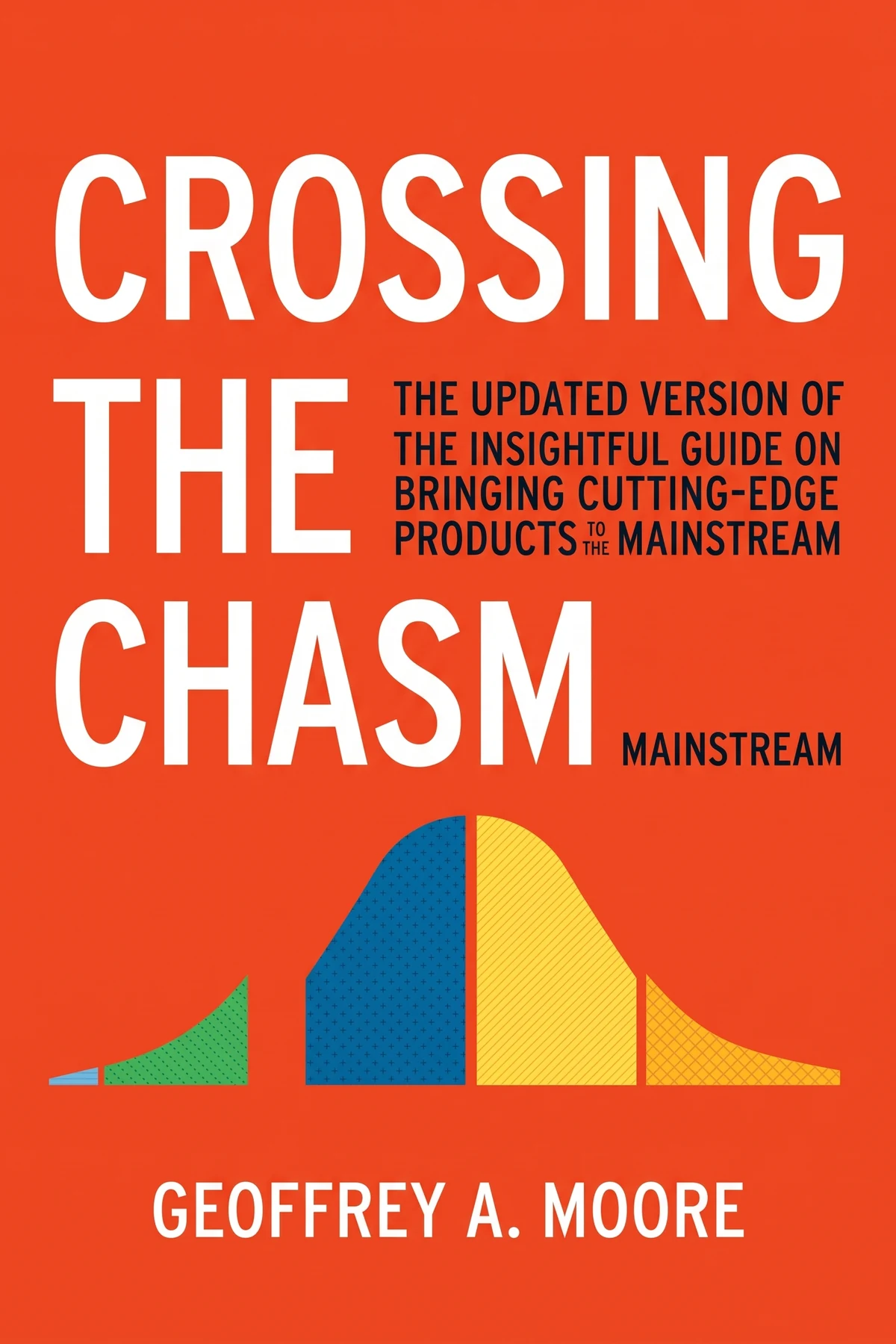
If your product has a few excited customers but sales have stopped growing, the cause may be those very customers. In Crossing the Chasm, marketing consultant Geoffrey A. Moore argues that the people who buy a new technology first make poor references for the people who must buy it next. Early buyers want a breakthrough. Mainstream buyers want safety, and they trust only buyers like themselves. Between the two sits a gap where promising products stall and companies fail.
Moore’s way across is narrow on purpose. Pick one small group of practical customers, give them everything they need, present yourself as their obvious leader and sell through people they already trust. Win that niche outright, and its references carry you into the next one. Along the way you get a method for choosing a first market, a two-sentence positioning claim you can draft tonight, and a warning about what changes inside the company once the crossing is done.
1 min 45 sec
The customers who love a new product first are rarely the ones who decide whether it survives. Knowing the order in which people adopt technology tells you who to court, and when, and why the biggest prize waits in the middle.
1 min 45 sec
Glowing praise from your most enthusiastic customers should open doors. With one crucial group of buyers it does the opposite, and the resulting trap has stalled products that worked perfectly well.
1 min 41 sec
A brilliant core product can still lose to a weaker one. Moore explains what mainstream customers are really buying, and why some of the pieces that decide the sale may have to come from other companies.
1 min 38 sec
Turning down paying customers sounds like the last thing a struggling company should do. Moore argues it is exactly what separates the companies that cross from the ones that exhaust themselves trying.
1 min 43 sec
You will have to pick your first market before you have the data to be sure. Moore offers a way to decide anyway, and a test that shows why some customers will keep saying maybe forever.
1 min 52 sec
Cautious buyers judge a product by where it stands among its rivals, and a newcomer seems to have none. Moore shows how to pick your own competitors, using a film-editing launch and a personal finance program.
1 min 35 sec
The right product with the right message can still fail if the wrong people sell it or the price sends the wrong signal. Moore explains who should sell during the crossing, and who the price is really for.
1 min 46 sec
The people who got a company through its early days can become its biggest obstacle on the other side. Moore describes the clash that follows a successful crossing, and two temporary jobs that keep customers from slipping away.
1 min 10 sec
Moore’s book is finally an argument about trust. A promising product can stall even when it works well, because the people who love it first cannot vouch for it to the people who must buy it next. Pragmatists believe leaders and peers, so a newcomer has to become a leader somewhere and gather references there, by shrinking the battlefield until both are possible. Every tool in the book serves that aim: the whole product, the hand-picked competitors, the familiar channel, the leader’s price.
For your own work, the steps are concrete. Write scenarios for several customer groups and pick the one whose problem is most urgent. List everything that group needs beyond your product, and find partners for the gaps within three months. Draft the two-sentence claim that names their old method and the nearest new rival. Then turn down business outside that niche until you hold most of it.
Tarzan keeps moving only while the next vine is within reach. Moore’s method is about making sure it is, one small, well-chosen niche at a time.
Many new technology products win a burst of excited early customers and then stop growing. Geoffrey A. Moore explains why. Buyers adopt in stages, from technology enthusiasts and visionaries to the pragmatists and conservatives who make up the mainstream. Visionaries want dramatic change. Pragmatists want safe, steady gains, and they buy only from established leaders that other pragmatists already use. That divide between the two groups is called the chasm, and a product that falls into it may never recover. Moore's way across borrows from military planning. Choose one narrow niche of pragmatist customers with an urgent problem, then give them a whole product, with partners filling every gap. Position yourself against two competitors you pick yourself, in a claim of two sentences. Sell through a channel those buyers already trust, and price like the leader you mean to become. His examples run from Silicon Graphics and digital film editing to Intuit's Quicken. Readers get a step-by-step method for picking a first market and taking it, plus a clear view of what changes inside a company once the crossing is done, when pioneers give way to settlers.
Founders and product leads whose new technology has eager early customers but stalled growth.
Marketers and sales heads choosing a first target market, a positioning claim or a launch channel.
Managers at growing tech firms facing the clash between early pioneers and process-minded hires.
Geoffrey A. Moore studied American literature at Stanford and earned a PhD in English literature at the University of Washington, then spent four years teaching English at Olivet College. He moved into high tech as a training specialist and went on to work in sales and marketing. He started consulting at Regis McKenna Inc. and later helped found The Chasm Group, Chasm Institute and TCG Advisors, where he is now chairman emeritus. His other books include Zone To Win, on how large companies handle disruptive innovation, and The Infinite Staircase.
Geoffrey A. Moore
Listeners find this title to be a vital resource for business professionals, offering deep perspectives and useful wisdom. They also value how relevant it remains as a modern update to a classic, and one listener notes how it provides in-depth knowledge of marketing and analytics practices. The writing is high-quality and easy to grasp, with one listener highlighting its clear description of different phases. However, the pacing gets mixed reviews, as some find the material engaging while others feel it can be quite dense.
Wow, I really wish I had picked this up during my first startup attempt years ago. This book completely reframed how I view my role in product marketing by emphasizing the power of referenceability. Look, if you don't understand that mainstream customers need other mainstream customers to vouch for you, you're going to fail. Moore’s instructions on building a 'whole product' strategy are incredibly insightful and offer a deep dive into analytics practices that I hadn't considered before. The book is well-written and easy to understand, even for those of us who aren't marketing veterans. To be fair, some of the concepts take a minute to sink in, but the D-Day strategy for attacking a niche is just masterfully explained. It’s a classic for a reason and a must-read for business professionals.
Show moreThis book changed my life and the way I approach every single client project I take on now. I bought it years ago and skimmed it, but it wasn't until I truly dug into the 'secrets' of the chasm that I understood marketing. If marketing touches any part of your professional life, you must buy, read, and then re-read this until the D-Day strategy is second nature. The author gives examples of real-world products and how the model applies to them with such clarity that it’s almost startling. Frankly, until you understand why a pragmatist won't buy from you without a reference, you are basically clueless about high-tech growth. It’s a well-written, thoughtful explanation of why some companies scale while others vanish as passing fads. Truly a masterpiece of the genre.
Show moreTo be fair, I went into this expecting a dry, academic textbook but came away with a tactical field manual. The instructions and concrete steps to take to make use of the chasm model are surprisingly practical for a book first written decades ago. I loved the breakdown of what technology enthusiasts want versus what the pragmatist majority actually requires. It’s a classic for a reason—it’s fascinating, competent, and gives a fresh set of tools to help navigate complex product lifecycles. One customer highlight I agree with is that it provides a very clear description of different phases. It was exactly what I wanted in a book I’m reading for work. The bowling pin analogy alone has completely shifted how our team views our Q3 roadmap. Highly recommended for anyone in the tech space.
Show moreAfter hearing colleagues rave about this for years, I finally dove into the updated edition. The way Moore breaks down the transition from early adopters to the pragmatic mainstream using the D-Day analogy is nothing short of brilliant for anyone in high-tech sales. Frankly, it can get a bit dense during the middle chapters, and some of the newer company examples feel a little tacked on compared to the core theory. However, the underlying logic regarding the technology adoption life cycle remains an essential framework. It provides a clear description of different phases that most startups ignore at their own peril. If you are struggling to move past the 'enthusiast' phase, the strategies here regarding market niches are worth the price of admission alone. It’s a competent, usable guide that actually delivers on its reputation.
Show moreEver wonder why great tech products fail while mediocre ones dominate the market? This book answers that question by focusing on the 'chasm'—that terrifying gap where startups die because they can't appeal to pragmatists. Personally, I found the bowling pin analogy for niche market expansion to be the most usable part of the whole text. It’s to the point and concise, providing a tactical field manual for attacking a point of entry. Not gonna lie, the pacing is a bit uneven, and I found myself skimming some of the repetitive sections in the latter half. But the first 20% of the book is absolutely vital for anyone interested in building high-tech products. It gives a fresh and powerful set of tools to help navigate the stages of product life effectively.
Show moreMoore’s framework has aged surprisingly well, especially with the more recent case studies added to the newer editions. I particularly enjoyed the chapter on target customer characterization and the scoring scenarios for niche selection. Gotta say, the pharmaceutical company example regarding document management really helped clarify how to solve specific niche issues before expanding. The book provides in-depth knowledge of marketing that transcends just selling features; it’s about understanding human psychology in the face of innovation. Some of the instructions on making money from day one felt a bit aggressive for today's VC-heavy world, but the logic holds up. It’s a rather short book, yet it carries a lot of weight for those interested in making technology sustainable. Definitely a solid addition to any professional’s bookshelf, despite some dense sections.
Show morePicking a target customer isn't just about who likes your tech; it's about who actually needs it to survive. I found the checklist for the target market selection process on page 126 to be worth the price of the book alone. It’s a very good guide about transitioning between selling to early adopters and winning over the mainstream customers. The truth is that this transition doesn’t happen smoothly, and Moore covers the hard decisions that must be made with brutal honesty. While I enjoyed the scene-setting chapters, I did feel that some of the later sections on pricing and distribution were a bit less engaging. Still, it’s a-must-get-familiar-with for anyone in the industry. The clear implications of adopting this model were presented and well-organized for immediate use in my current project.
Show moreAs someone who works in a crowded SaaS space, the concept of the 'small pond' was a total game-changer for me. Moore explains that fighting your way into the mainstream requires a focused point of attack rather than a broad, unfocused launch. I appreciated the specific details on targeting a small market to gain that vital foothold before attempting to cross the chasm. In my experience, the book is a bit repetitive in its middle sections, but the core strategy is absolutely solid. The updated version includes some great recent company examples that help bridge the gap between 90s hardware and modern software services. It’s a fascinating business book about running startups that actually provides usable, concise advice for the real world. Despite the pacing issues, it remains a vital read for anyone in product development or marketing roles.
Show moreFinally got around to finishing this, though I’ll be the first to admit it was a bit of a slog in the middle. The concept presented is very interesting and vital, particularly the sections on targeting a 'small pond' to build a big reputation. In my experience, the parts worth the greatest attention are the first 20% and a small chunk in the middle; the rest is a bit boring. It took me nearly four months to get through because the writing can be quite dry and repetitive at times. That said, the model describing high-tech marketing is well-articulated and the 2010s updates keep it from feeling completely outdated. It’s an okay business book, but maybe more of a 'must-get-familiar-with' than a 'must-read' from cover to cover. I'd recommend it with some reservations about the pacing.
Show moreThe advice here feels incredibly anecdotal and lacks the scientific rigor I expect from a modern business text. Truth is, many of the stories Moore uses to back up his points feel cherry-picked to fit his specific model after the fact. I’m not saying his directions are necessarily wrong, but I wasn't convinced they were based on anything more than gut feeling and a few high-profile successes. Researching the author's track record only made my skepticism increase because it feels more like a collection of opinions than a proven methodology. For a book that is so famous in the tech world, I expected more evidence-based research rather than just clever analogies like the bowling pin model. It’s a dangerous error to implement these steps without questioning the lack of data behind them. It just wasn't for me.
Show moreGeoffrey A. Moore argues that disruptive tech products face a gap between visionary early buyers and pragmatic mainstream ones. Pragmatists want references from people like themselves and buy only from established vendors, so praise from visionaries does not persuade them. To cross, a company should dominate one narrow niche of pragmatists with a whole product, a clear position, a trusted sales channel and a leader’s price, then expand from there.
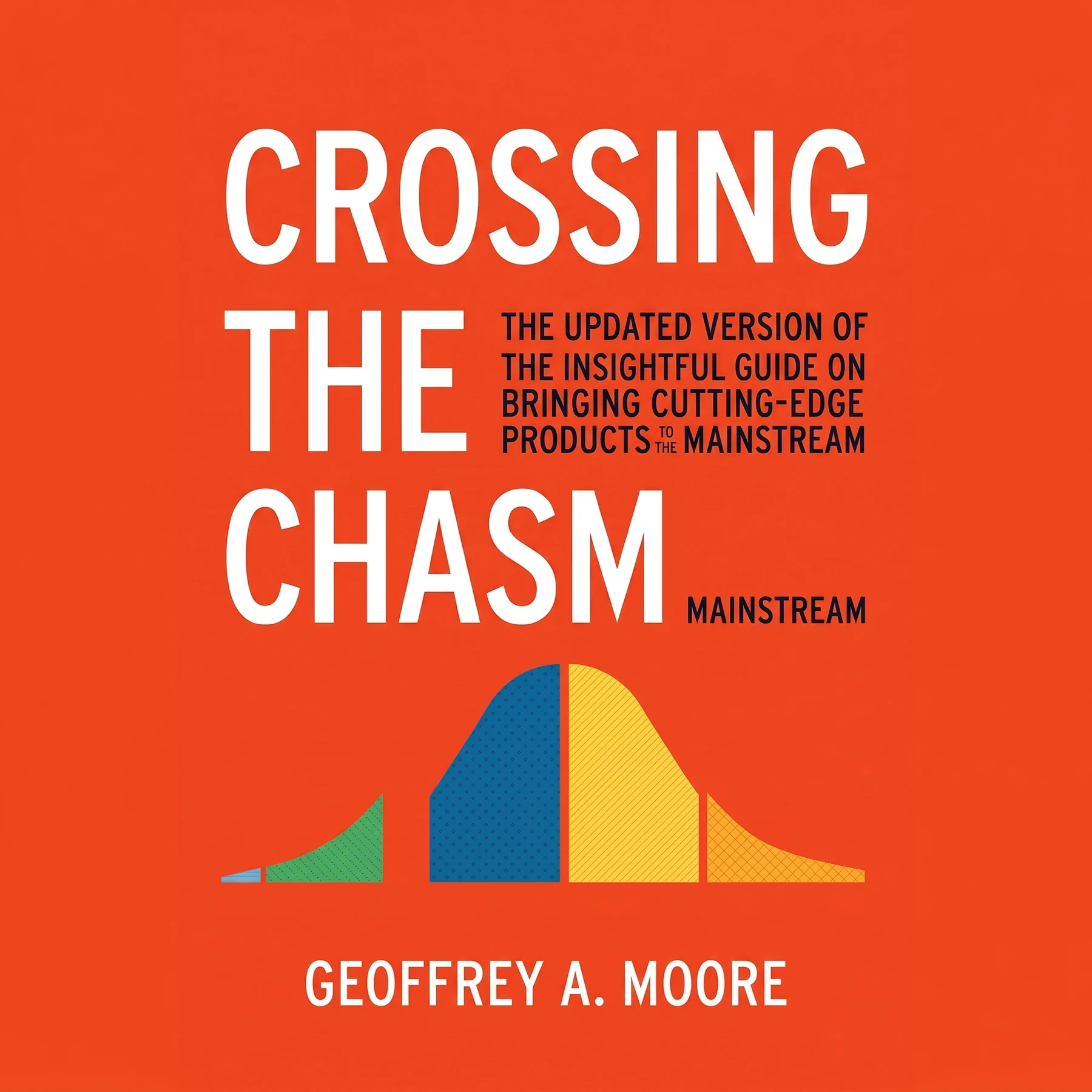
Moore describes technology enthusiasts, who want the newest thing first; visionaries, who want a competitive breakthrough; pragmatists, about a third of the market, who want proven, well-supported products from a clear leader; conservatives, equally numerous, who want simple, cheap, trouble-free products; and skeptics, a small group that resists technology but can reveal where a product falls short. The first two form the early market, the next two the mainstream.
A whole product is everything a customer needs to fully reach their goal, beyond the generic product that ships in the box. That includes installation, support and any extra software or hardware. Moore argues that mainstream buyers will not hunt for the missing components themselves, so firms often need partners, as with a pharmaceutical data company that must work with individual scientists, agencies in charge of health, and organizations that provide managed care.
Pick two reference points. The market alternative is what your customers have used for years; the product alternative is another company using a new technology similar to yours. Then write a claim of no more than two sentences that places you between them. Silicon Graphics, in Moore’s example, could set its digital film editor against traditional cutting and splicing and against SUN workstations not built for editing.



Hamilton Helmer





Duncan Clark


AUDIO SUMMARY AVAILABLE
Get the key ideas from Crossing the Chasm by Geoffrey A. Moore, plus 5,000+ more nonfiction titles.









