

A Theory of Justice
John Rawls
 English
A tour of methods for clear thinking from Socrates to modern educators, showing how to question claims, define terms, argue against your own views, spot bias and judge any argument against explicit standards.
1 min 11 sec
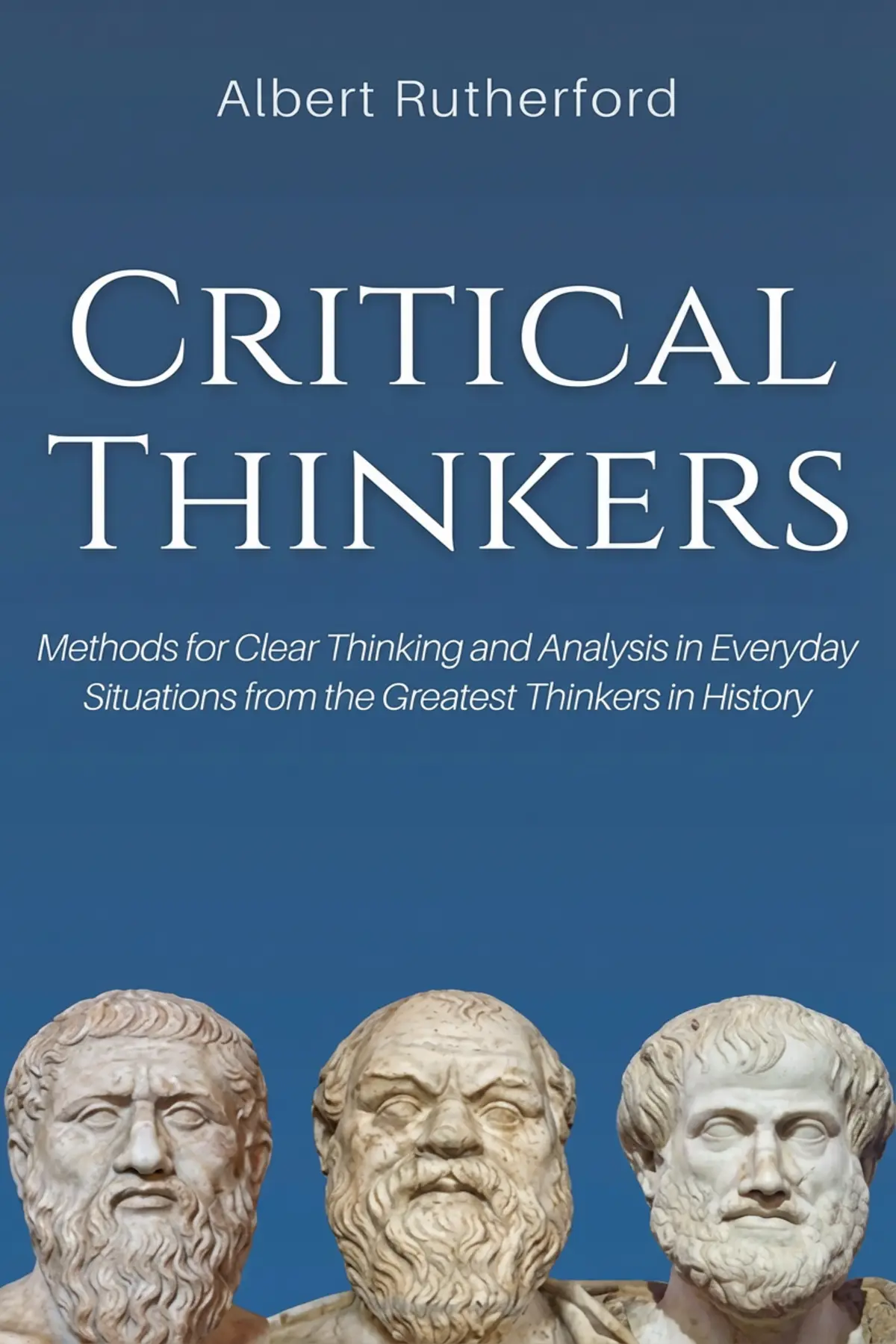
Most arguments go wrong long before anyone wins or loses, because nobody stops to ask what a claim assumes or what its key words mean. In Critical Thinkers, former corporate executive Albert Rutherford traces how a line of thinkers, from Socrates in ancient Greece to the modern educators Richard Paul and Linda Elder, built tools for exactly that problem. His case is that clear thinking can be learned, because it is a set of methods, each invented by someone who noticed a specific way the mind goes wrong.
Socrates used probing questions to expose contradictions. Aristotle insisted on exact definitions. Thomas Aquinas argued against himself, Francis Bacon named the biases that bend perception, and René Descartes doubted until only certainty was left. Later figures turned these habits into a discipline for ordinary life.
Follow the line and you gain a working kit: questions to ask in a tense meeting, a way to test a favorite theory, and eight standards for judging any claim, your own included.
1 min 29 sec
Pushing your own view harder rarely wins a heated debate. An ancient Greek philosopher found a gentler move that makes weak positions reveal themselves, and it depends on the kind of question you choose to ask.
1 min 33 sec
Two smart people can argue for an hour and never actually disagree. Aristotle saw why, and his fix takes two steps that anyone can apply to a fuzzy word in a meeting.
1 min 40 sec
The arguments you trust most are the ones you made. A medieval friar refused to trust his, and the way he tested them works as well on a business case as on theology.
1 min 32 sec
Some of your firmest opinions may not be yours at all. Three thinkers, centuries apart, each found a different source of borrowed beliefs, and together they give you a quick way to trace any conviction back home.
1 min 37 sec
Knowing what to distrust is only half the work. Two thinkers of the Renaissance era, one an empiricist and one a rationalist, offered contrasting routes to conclusions you can stand behind.
1 min 34 sec
Most people would rather be told what to think, an eighteenth-century philosopher complained. He also showed how little any of us can truly know, and offered one test for actions that fits in a single sentence.
1 min 49 sec
A boy kept apart from other children, quizzed on long walks about his reading, grew into one of the sharpest reformers of his century. His training, and a teacher’s protest against conformity, show how thinking gets built.
1 min 52 sec
Centuries of philosophy are hard to recall when a deadline is close. A philosopher and a psychologist packed the lessons into a model you can run against any draft, and two of its parts take minutes.
1 min 07 sec
The striking thing about Rutherford’s line of thinkers is how usable their oldest ideas remain. A friar born in 1225 debating himself and a philosopher who opened his center in 1980 were fighting the same habit of mind: the comfortable belief that never gets inspected. Each of them treated clear thinking as work done the same careful way every time, which is exactly why it can be learned.
The book supports a few small habits. In your next disagreement, ask one assumption question before offering a counterpoint. When a single word is carrying the argument, define it in two steps, broad category first and distinguishing features second. Before committing to a view you care about, write the best case against it and answer it honestly. And when an opinion feels obvious, check whether you reasoned your way there or absorbed it from your schooling, your group or your wishes.
Kant described enlightenment as using your own reason without a guide. Every method here is a way to need that guide a little less.
Heated debates and hard decisions often go wrong for the same reason. Nobody stops to ask what a claim assumes, what its key words mean, or whether the person making it has tested it at all. Albert Rutherford argues that the tools for fixing this already exist, and that they were built over centuries by some of history's best-known thinkers. He follows a line running from Socrates and Aristotle in ancient Greece through Thomas Aquinas, Francis Bacon, René Descartes, Immanuel Kant, John Stuart Mill and William Graham Sumner, ending with the modern model of Richard Paul and Linda Elder. Each figure contributes a method: probing questions, two-step definitions, self-debate, a catalogue of mental biases, inductive testing, systematic doubt, a moral test for actions, and an education designed to delay judgment. Readers get a practical kit for everyday situations: questions to ask in a disagreement, a way to examine their own favorite theories, and eight intellectual standards for checking any piece of reasoning, including their own.
Professionals who lose arguments in meetings and want sharper questions and clearer definitions.
Managers, teachers and parents who want to train others to reason instead of conform.
Curious readers who want the great thinkers' methods without reading the original works.
Albert Rutherford spent his career as a corporate executive before retiring, and he studied both the sciences and the humanities. He writes about systems thinking, game theory and critical thinking, and is known for making complex subjects accessible. His other books include The Systems Thinker, Statistics for the Rest of Us and How to Think Critically. He holds to Benjamin Franklin's view that an investment in knowledge pays the best interest.

Listeners find the material highly informative and a superb condensation of critical thinking theories across the ages. They also value the accessible prose, mentioning the book is entertaining, while one listener reports being captivated the entire time. Furthermore, the content is seen as highly applicable, with one review emphasizing its utility in daily life. Conversely, the standard of writing earns inconsistent remarks, as several listeners depict the prose as being of low quality.
Albert Rutherford has a knack for distilling incredibly complex philosophical traditions into bite-sized, actionable insights. This book serves as a brilliant roadmap through history, starting with the foundational Socratic method and moving toward modern logic. Personally, I found the breakdown of Descartes' Cartesian doubt to be the most practical section for everyday decision-making. Truth is, we often take our first impressions for granted, but this text forces you to pause and evaluate your internal biases. It’s a short read, yet it carries the weight of a much larger volume because of how it challenges your worldview. If you want to sharpen your reasoning skills without wading through dry, thousand-page academic tomes, this is your best bet. It’s essentially a highlight reel of the greatest minds to ever live.
Show moreThe chapter on Socratic questioning alone is worth the price of admission here. It outlines how clarification, perspective, and evidence are the pillars of any meaningful dialogue. Not gonna lie, I used to be someone who took first impressions for granted, but this book taught me the value of the 'questions about questions' approach. By exploring the works of Thomas Aquinas and Francis Bacon, Rutherford shows how the evolution of society is intrinsically linked to the evolution of thought. The tone is encouraging throughout, reminding us that even if our reasoning doesn't work out at first, we must keep working until we are satisfied. It’s a empowering look at human potential. I highly recommend this to anyone looking to enhance their analytical mindset and approach problems with more confidence.
Show moreWow, this was a refreshing sprint through the history of human thought! I’ve become a huge fan of Albert Rutherford’s ability to take the 'scary' out of philosophy and make it feel like something anyone can master. The book is an excellent introductory resource that references a multitude of beliefs you can explore in depth later. My favorite takeaway was the idea that teaching others is actually one of the best ways to improve your own critical thinking. It makes so much sense! The breakdown of the Aristotelian and Kantian philosophies was fascinating and surprisingly easy to digest. If you want to approach problems with a more analytical mindset without feeling overwhelmed, you should definitely pick this up. It’s a quick read that stays with you long after you finish.
Show moreEver wonder how the giants of history actually processed information? This book provides a clear window into that world by examining the evolution of thought from Plato to Kant. To be fair, the writing style is quite functional and lacks some artistic flair, but the utility of the content makes up for it. I particularly enjoyed the sections on John Stuart Mill and his distinction between higher and lower pleasures. It reminded me that our intellectual pursuits are not just for ourselves, but for the betterment of the society we inhabit. The author makes a compelling case that training the brain is exactly like training for a sport. You have to put in the reps if you want to see results in your daily reasoning.
Show morePicked this up after a friend recommended it as a 'brain gym' session, and that description is spot on. The book is remarkably easy to read and keeps you engaged by jumping between different historical eras and thinkers. In my experience, many books on logic are far too dense, but Rutherford keeps things accessible for the average reader. I loved the emphasis on intellectual humility and the idea that we should never take pride in our skills but always seek improvement. There is something very grounding about admitting, 'I’m willing to change my mind.' While it’s a super short read, the lessons on Cartesian doubt and logical fallacies are things I can apply to my job immediately. It’s a practical guide masquerading as a history book.
Show moreAs a student of life, I’m always looking for ways to keep my thinking sharp, and this book delivered exactly that. It offers a wonderful blend of history and practical application, focusing on how we can use old wisdom to solve modern problems. The concept of pursuing 'higher pleasures' to contribute more to the good of society really resonated with me. I've been trying to apply the Cartesian doubt method to the news I consume lately, and it's been eye-opening. While I noticed some of the minor editing issues others have mentioned, they didn't detract from the overall value of the information. It’s a concise, light cardio session for your brain that encourages you to investigate difficult questions with real courage. Definitely a useful tool for personal growth.
Show moreFinally got around to reading this, and I was pleasantly surprised by how much I enjoyed the historical context. It’s not just a list of rules for logic; it’s a narrative about how great minds like William Graham Sumner and the Elders contributed to our collective understanding of truth. In my experience, the most important quality of a thinker is being open to change, and this book hammers that point home beautifully. The author uses accessible language to explain how we can overcome personal biases and perceived facts. Though some might find the presentation a bit too basic, I thought the brevity was a strength. It keeps the conversation moving, much like a good Socratic questioner should. It’s a great tool for anyone seeking to become a more effective and informed thinker in their daily life.
Show moreTo be fair, this is a very basic and simple presentation of complex philosophical models. If you are already well-versed in philosophy, you might find the summaries of Socrates and Aristotle a bit too elementary for your taste. Frankly, the writing quality is a mixed bag, with some sections feeling a little repetitive or unpolished. However, it still functions as a solid introductory resource for someone just starting their journey into critical thinking. The six types of Socratic questioning were a highlight for me, as they offer a tangible framework for keeping conversations productive. It’s a worthwhile read if you need a quick refresher, but don't expect a deep academic dive. It serves its purpose as a brief overview of how great minds have shaped our world.
Show moreNot exactly what I expected, but it was an okay summary of different philosophical concepts. The book covers a lot of ground—from ancient Greece to more contemporary thinkers—but it stays very much on the surface level. Truth is, the prose feels a bit clunky in certain chapters, which made it harder to stay focused during the transition from Mill to Kant. I did appreciate the practical tips on how to become more reasonable by admitting our own flaws. It’s a good starting point for further exploration, but it feels more like a collection of notes than a fully fleshed-out narrative. If you want a quick primer on how different philosophers contributed to society, this will do the trick. Just be prepared for a very simplistic writing style.
Show moreLook, the information here is solid, but the execution left me wanting much more in terms of polish. It’s hard to ignore the clunky phrasing and repetitive sentence structures that pop up throughout the chapters. That being said, if you can push past the writing quality, the summaries of thinkers like Kant and Bacon are actually quite useful for a beginner. It feels more like a collection of detailed blog posts rather than a cohesive, professionally edited book. I appreciated the core message about intellectual humility, yet the delivery felt rushed. It’s a decent primer for someone who has never touched a philosophy book, but seasoned readers might find the prose distracting. Not a bad resource, just needs a heavy edit and more depth.
Show moreRutherford argues that critical thinking is a learnable skill built over centuries by a line of thinkers. Socrates contributed probing questions, Aristotle precise definitions, Aquinas self-debate, Bacon a catalogue of biases and inductive testing, Descartes systematic doubt, Kant independent reason and a moral test, Mill and Sumner an education that resists conformity, and Paul and Elder a modern model with explicit standards for judging any argument.
Rutherford advises keeping questions respectful, intellectual, specific and critical. Clarification questions ask how a point connects to the argument, while assumption questions ask why we believe something or what other option we could assume. If you lead the discussion, summarize the argument from time to time and make sure every participant gets a chance to speak.
Richard Paul and Linda Elder list eight standards, which are fairness, logic, breadth, depth, relevance, precision, accuracy and clarity. Each becomes a question to ask of your own reasoning. For clarity, check whether others could understand your idea easily and fully. For fairness, check whether you are being objective or steering toward the conclusion that suits you.
Ask an assumption question before arguing back. Define key words in two steps, a broad category and then distinguishing features, as Aristotle did with the car. Write down the strongest objections to your own view and answer them, as Aquinas did. Trace strong opinions back to their source, since Bacon and Descartes warned that education, desire and social pressure shape beliefs.
John Rawls

Richard Wiseman






William B. Irvine

AUDIO SUMMARY AVAILABLE
Get the key ideas from Critical Thinkers by Albert Rutherford, plus 5,000+ more nonfiction titles.









