
14 min 04 sec
Available in: English
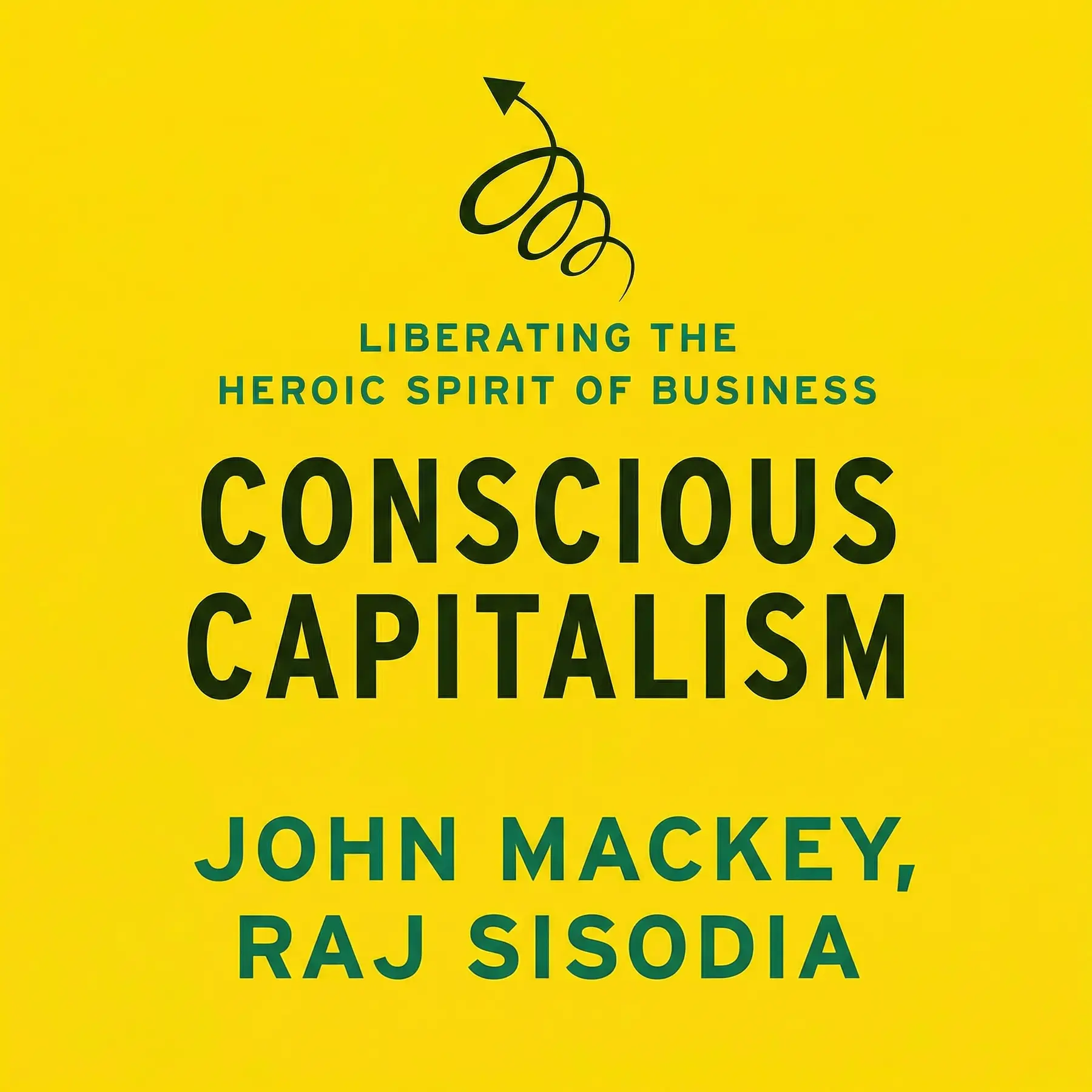
Conscious Capitalism: Liberating the Heroic Spirit of Business
Shows how companies earn trust and real commitment by serving a purpose beyond profit and every group they depend on, from customers and staff to suppliers, communities and the environment.
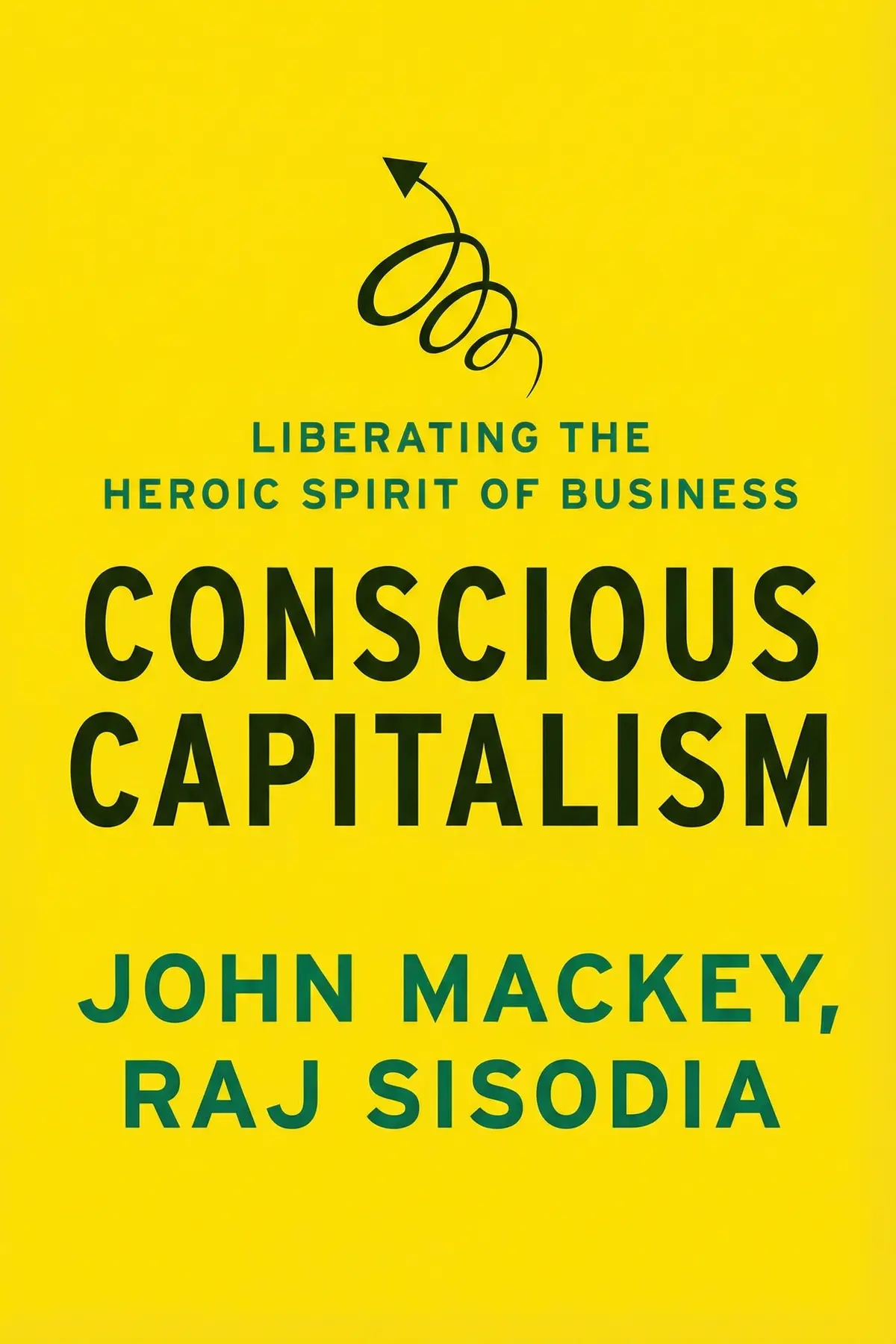
Table of Content
1. Introduction
1 min 01 sec
If you lead a team or run a company, you have probably felt torn between hitting the numbers and doing work people can believe in. In Conscious Capitalism, Whole Foods Market cofounder John Mackey and business professor Raj Sisodia argue that this conflict is mostly false. A business needs profit to live, the way a body needs red blood cells, but profit is not what the business is for.
Their case is that business becomes a heroic force when it pursues a purpose larger than money and serves everyone who trades with it: customers, team members, suppliers, investors, communities and the environment. The book rests on four pillars, higher purpose, stakeholders, leadership and culture, and on Mackey’s own brush with ruin, when a flood sank his only store. Follow the argument and you will be able to explain why trust in business fell so far. You will also have a short set of questions to put to your own company this week.
2. Make the case for business without apology
2 min 23 sec
A young activist who considered corporations evil opened a tiny store, lost half his money and was still called an exploiter. What he learned from that unfair charge changed how he saw every trade.
3. Give your company a purpose beyond profit
1 min 45 sec
Most workers are not fully engaged on the job; the Gallup figures the book cites put only 28 percent as engaged. A comparison with the professions and another borrowed from biology point to what does.
4. Learn why every stakeholder keeps a business alive
2 min 16 sec
An uninsured store sat under eight feet of water and its owners were bankrupt. What happened over the next four weeks reshaped Mackey’s view of who a company really belongs to.
5. Learn from competitors, critics and unions
1 min 48 sec
Rivals, activists and regulators usually get treated as threats to contain. A clothing brand that told people not to buy its jacket suggests a very different stance toward the edges of a company’s world.
6. Lead by serving the purpose and the people
1 min 52 sec
Many managers were trained to set targets and watch closely. The authors describe a kind of leader who needs to control far less, and explain what makes that possible.
7. A culture people are proud to join
1 min 45 sec
Love and camaraderie sound out of place in a business book. The authors use them anyway, and a grocer that grew to hundreds of stores is their argument that the words mean something practical.
8. Conclusion
1 min 14 sec
Mackey started out believing business was the villain. A losing first year, a flood and a crowd of neighbors with mops changed his mind, and Conscious Capitalism is his and Sisodia’s attempt to pass that change on. Their boldest claim, as the 2014 paperback preface puts it, is that business is heroic, able to do more good than any other system people have built. They present it as a way of managing a company, distinct from an economic system or a socialist alternative, and they insist that owners stay in charge.
The book gives you a few things to try. Write down what the world would lose if your company or team disappeared, and see whether the answer goes beyond money. Before a hard decision, walk through each stakeholder in turn, customers first, and look for the option that gives the most to the most people. Treat the next rival or critic as a source of information. And notice how your team feels when the working day begins.
Free markets, the authors say, rank among the most powerful ideas humans have had, but people can aim higher. The flood in Austin shows what higher looks like: a business so worth keeping that the people around it came to save it.
About this book
What is this book about?
Free enterprise has lifted billions of people into better lives, yet trust in business keeps falling and most employees feel little connection to their work. Whole Foods Market cofounder John Mackey and professor Raj Sisodia argue that the trouble lies with companies that look no further than profit. Their alternative rests on four pillars. A business needs a higher purpose, with profit treated as the fuel that keeps it alive. It should serve all its stakeholders, customers first, and look for choices that benefit many of them at once. And it needs servant leaders and a culture of care in which people largely manage themselves. The case draws on Mackey's own story, from a tiny natural foods store where the founders washed in the dishwasher to the 1981 flood that bankrupted Whole Foods until customers, staff, suppliers and investors came to its rescue. Patagonia appears as a second example. Readers get a clear way to think about what a company is for, along with practical questions to bring to their own team or business.
Book Information
Who it's for
Founders wanting irreplaceable companies
Founders who want to build a company people would rescue in a crisis.
Managers with disengaged teams
Managers facing disengaged teams who want a reason to work that goes beyond the numbers.
Uneasy about business's reputation
Professionals uneasy about business's reputation who want a confident case for what companies can do.
About the Author
John Mackey
John Mackey cofounded Whole Foods Market in 1980 and ran it as CEO until he retired in 2022, growing it from one store in Austin, Texas, into a chain with hundreds of locations. He was named Ernst and Young Entrepreneur of the Year in 2003 and cofounded the Conscious Capitalism Movement. Raj Sisodia, who holds a Ph.D. in business from Columbia University, is a professor of conscious enterprise at Tecnologico de Monterrey in Mexico. He has published sixteen books, including Firms of Endearment, and has advised companies such as Tata and IBM.
Ratings & Reviews
Ratings at a glance
What people think
Listeners consider this work an essential read, particularly for those in business school, and laud its high-quality writing and accessibility. They also value the uplifting themes, noting its emphasis on core principles and a higher purpose, as well as its passionate justification of free market systems. Furthermore, the book is commended for its utility, providing strong real-world examples and excellent worth, with one listener highlighting that it provides proven business models.
Top reviews
Titiluck
Finally got around to finishing this, and I find it to be a refreshing defense of the free market system in an era of corporate greed. Mackey and Sisodia argue that business isn’t just about the bottom line; it’s about a higher purpose that serves everyone from the janitor to the customer. While some might find the spiritual aspects a bit 'woo-woo,' I found the focus on core values incredibly inspirational for any aspiring entrepreneur. The book flows well and offers a blueprint for what a more humane version of capitalism could actually look like in the real world. It's not just theory, as they provide plenty of examples where these models have actually outperformed traditional, cutthroat competitors.
Show moreKiattisak
Wow, what a spirited defense of capitalism that doesn't ignore the ethical responsibilities that come with running a massive corporation. The authors do a fantastic job of distinguishing between 'crony capitalism' and the heroic spirit of true entrepreneurship. I was moved by the idea that a company can prioritize its culture and community impact without sacrificing its profitability or stock price. It’s an essential read for anyone who feels disillusioned with the current state of Wall Street but still believes in the power of commerce. The examples provided, like Southwest Airlines and The Container Store, prove that this isn't just some pipe-dream philosophy.
Show morePrim
Ever wonder if it’s possible to be a successful CEO without losing your soul in the process? Mackey and Sisodia argue that it’s not only possible but actually necessary for the survival of our global economic system. This book is a revolutionary look at how we can brand capitalism as a force for liberation rather than exploitation. I found the sections on 'conscious culture' to be particularly moving, emphasizing trust and transparency over the usual corporate secrecy. It’s an inspirational guide that makes you want to go out and build something that truly matters to the world. A must-read for any leader who wants to leave a lasting, positive legacy.
Show moreSirichai
Truth is, I wasn't sure if a book co-authored by the Whole Foods founder would be anything more than a vanity project, but I was wrong. This is a deeply thoughtful and well-written exploration of how ethics and commerce can coexist in a way that benefits everyone. The readability is fantastic, and the authors do a great job of making the reader feel empowered to make changes in their own professional lives. It provides a much-needed positive spin-off for capitalism, showing that it can have a redemption arc if we choose to lead with empathy. This is easily one of the most important business books I've read in the last decade.
Show moreSomporn
As someone currently grinding through a business degree, this was a necessary break from the dry, profit-obsessed textbooks I'm usually assigned. The writing quality is top-notch, making complex economic theories feel accessible and even exciting to read. I particularly enjoyed the sections on 'conscious leadership,' though I do think Mackey spends a bit too much time talking about his own company, Whole Foods. It can feel like a bit of a promotional piece at times, but the underlying message about stakeholder integration is solid. If you want to believe that business can be a force for good, this is probably the most practical guide you'll find on the shelf.
Show moreWanida
Picked this up on a recommendation and found the emphasis on 'Systems Intelligence' to be one of the more fascinating takeaways. The book argues convincingly that we must balance the needs of all stakeholders—employees, suppliers, and the environment—to achieve long-term success. Frankly, it gets a bit repetitive in the middle sections, especially when they dive deep into shareholder minutiae, but the overall framework is incredibly valuable. I appreciated the practical business models that are laid out, even if the tone occasionally veers into 'preachy' territory. It’s a great value for the money if you can look past the author's clear bias toward his own brand.
Show moreNook
After hearing so much buzz about this title, I was surprised by how much practical advice was actually tucked between the spiritual bits. The authors provide a clear roadmap for how a company can transition from a narrow focus on profits to a broader focus on value creation. While the 'must-do' tone can be a bit patronizing at times, the actual business models they highlight are proven and effective. It’s an excellent read for anyone looking to build a company with a strong internal culture and a positive external impact. Even if you don't agree with every point, the challenge to rethink the purpose of business is well worth your time.
Show moreThawee
The chapter on conscious leadership had some interesting points, but the rest of the book felt incredibly uneven to me. On one hand, you have these beautiful ideals about purpose and meaning, but then you're hit with long strings of flowery adjectives that don't really mean much. I wanted to see more diverse case studies instead of hearing about Whole Foods every ten pages. It’s an 'okay' read if you’re new to the concept of sustainable business, but more experienced finance professionals will probably roll their eyes at the lack of hard data. It functions better as a manifesto for the 'do-gooder' crowd than a serious economic critique.
Show moreOrawan
This book felt like one long, wordy advertisement for Whole Foods disguised as a manifesto on corporate ethics. Mackey seems unable to separate his own ego from the narrative, constantly referencing his grocery store as the pinnacle of human achievement. To be fair, some of the ideas about treating employees better are great on paper, but the execution in the text is full of hokey buzzwords and spiritual prescriptions. I didn't need a lecture on why I should give up caffeine or start meditating in the middle of a business strategy book. It’s a very pretty-looking distraction from the systemic issues of wealth hoarding and crony capitalism that actually plague our society.
Show moreRay
Not what I expected at all; it’s mostly just John Mackey trying to convince us that he’s some kind of enlightened guru. The man was in a cult and it shows in his writing, which is packed with condescending advice about how workers should be grateful for 'trickle-down' crumbs. He labels Walmart and Amazon as 'conscious' businesses, which is honestly laughable if you've ever looked at their actual labor practices. This isn't a book about reforming capitalism; it's a manual for billionaires to feel better about their wealth while masking it with empty employee discounts. I found the whole thing to be a miserable, ego-driven slog that failed to address any real economic problems.
Show moreQuestions about this book
What is the main idea of Conscious Capitalism?
In their view, Mackey and Sisodia see business as a heroic force for good, provided it pursues a higher purpose and serves every stakeholder: customers, employees, suppliers, investors, communities and the environment. Profit is still essential, but they compare it to red blood cells, which the body needs to live without being the meaning of life. The book rests on four pillars: higher purpose, stakeholders, conscious leadership and conscious culture.
What are the four pillars of conscious capitalism?
The first is higher purpose, a reason for existing beyond making money. The second is stakeholder integration, seeing customers, staff, suppliers, investors and communities as interdependent. The third is conscious leadership, meaning servant leaders who serve the purpose and the stakeholders instead of themselves. The fourth is conscious culture, a workplace built on care in which people flourish and largely manage themselves.
Does conscious capitalism mean shareholders come last?
No. Mackey says stakeholders matter but are not equally important. Customers come first because the business exists to create value for them, owners come second, and employees rise in priority as the company grows. He rejects the charge that the idea is a Trojan horse for taking control from owners, and he presents it as a philosophy of management that improves on traditional capitalism.
What happened in the Whole Foods flood story?
On Memorial Day 1981, Austin’s worst flood in seventy years left the uninsured Whole Foods store under eight feet of water, with losses of about $400,000. Customers and neighbors came to clean up, staff worked without pay, suppliers restocked on credit, investors added money and the bank lent more. The store reopened 28 days later, and Mackey saw how much a business depends on all its stakeholders.
How can I apply Conscious Capitalism at work?
Start by naming what people would lose if your company or team vanished; if the answer is only money, sharpen the purpose. Before big decisions, consider each stakeholder group and look for options that benefit several at once. Treat competitors and critics as sources of learning. As a leader, spend more time mentoring and less time directing, and pay attention to how your team feels at work.
Readers also enjoyed



A Year with Peter Drucker: 52 Weeks of Coaching for Leadership Effectiveness
Joseph A. Maciariello





Acting with Power: Why We Are More Powerful Than We Believe
Deborah Gruenfeld

All In: How Great Leaders Build Unstoppable Teams
Mike Michalowicz

AUDIO SUMMARY AVAILABLE
Listen to Conscious Capitalism in 15 minutes
Get the key ideas from Conscious Capitalism by John Mackey, plus 5,000+ more nonfiction titles.
- 5,000+ titles
- Listen as much as you want
- 7-day free trial
- Cancel anytime









