

14 min 10 sec
Available in: English
Conflict Resilience: Negotiating Disagreement Without Giving Up Or Giving in
Shows how to stay in hard disagreements at home, at work and across political lines without caving or attacking, by calming your brain's alarm, hearing your own feelings, listening deeply and preparing a fallback plan.
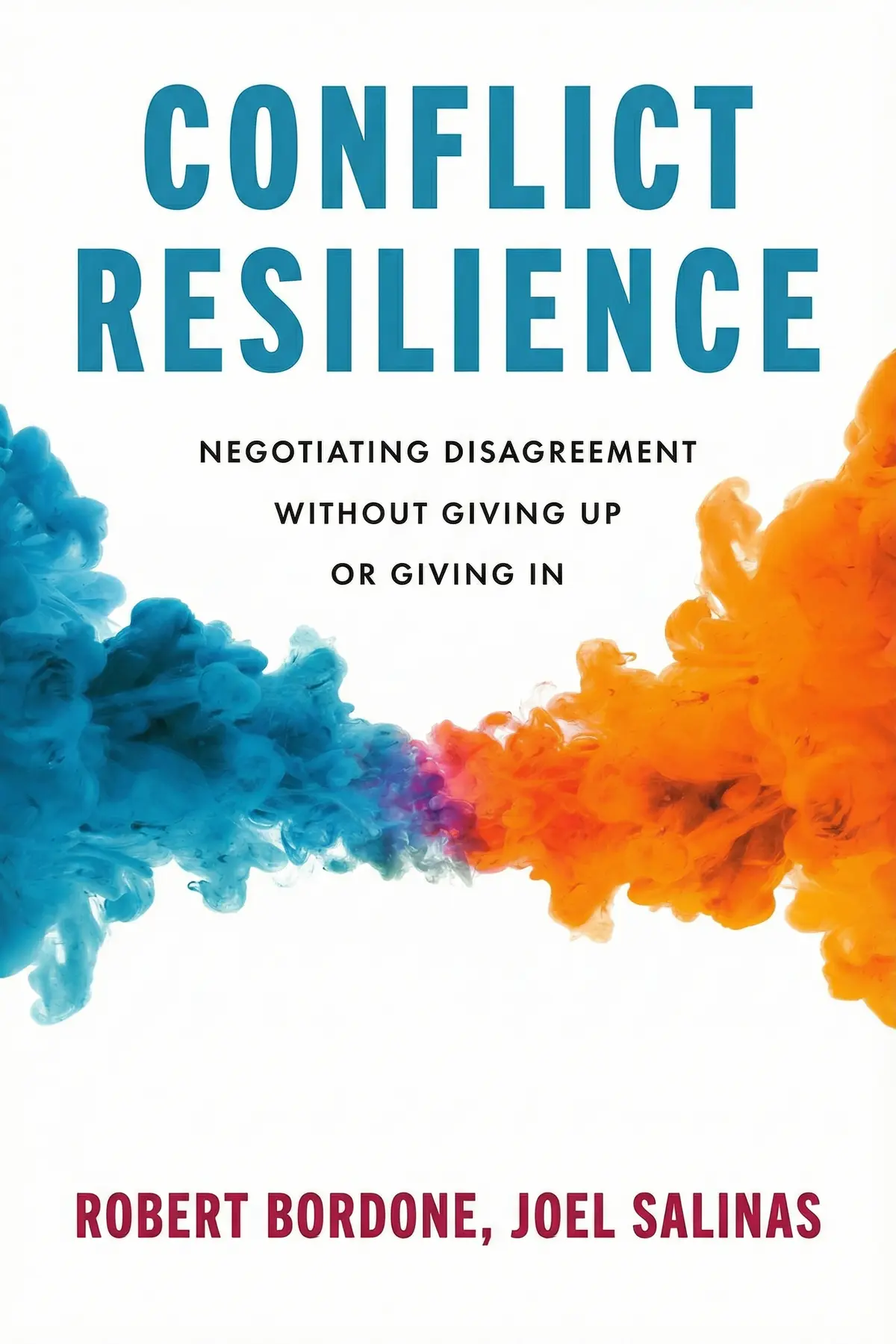
Table of Content
1. Introduction
1 min 11 sec
Most people who avoid conflict believe they are keeping the peace, yet the bill arrives anyway: estranged relatives, resentment at work, opportunities never pursued. In Conflict Resilience, negotiation teacher Robert Bordone and neurologist Joel Salinas argue that the way out is neither surrender nor digging in, but a skill anyone can build. Conflict resilience, as they describe it, means staying with hard feelings during a disagreement and still choosing how you respond.
The skill grows from the inside out. First you learn how your own brain reacts to a clash. Then you give your feelings a voice, and only after that do you turn toward the other person with real listening, careful preparation and a clear fallback plan.
The tools are small and practical: three chairs in a room, one sentence that names what you feel, a few open questions, a coffee meeting in the afternoon. With them, you can keep your values and still make room for people who see the world differently, at home, at work and across political lines.
2. Hold firm values without treating them as facts
1 min 39 sec
We like to believe our opinions rest on evidence we weighed carefully. The authors point to an uncomfortable pattern in how beliefs actually form, and it changes what every argument you have is really about.
3. Read your own conflict alarm before it rings
1 min 38 sec
Your body reacts to a sharp remark from your manager much as it would to danger in the wild. Knowing two things about your own wiring decides where your practice should begin.
4. Give each mixed feeling its own chair
1 min 45 sec
A fight about dishes can carry anger, guilt and something much older at the same time. An exercise that feels a little strange at first lets each of those voices finally be heard.
5. Name the feeling to stop the automatic reaction
1 min 38 sec
Some people attack, some flee, some smile and agree, and some stew for weeks. Whichever reflex is yours, the authors describe a surprisingly modest act that can switch it off mid-conversation.
6. Ask the questions that show what a fight is about
1 min 41 sec
Some arguments play like a recording, the same lines in the same order every time. The way to stop the loop has less to do with what you say than with what you finally ask.
7. Set the table before the hard conversation
1 min 52 sec
Professionals in high-pressure talks do something before they ever start bargaining, and most of us skip it entirely. Borrowing their order can change how a difficult talk with your boss or partner unfolds.
8. Ask for more with a clear plan B
1 min 29 sec
Walking into a salary talk with one number in your head feels focused and confident. The authors show why it can leave you stuck at the first refusal, and what to settle before the meeting starts.
9. Conclusion
1 min 17 sec
Bordone and Salinas treat conflict as something you can get better at, the way a runner builds distance. Avoidance, they argue, is what breaks families, stalls careers and widens political, cultural and religious divides. Resilience grows from the inside out: an honest look at how quickly you sense a clash and how much stress you can hold, the habit of watching your own feelings, and only then the outward work of listening, asserting yourself clearly and designing the conversation. A known fallback keeps the whole structure steady.
The starting point can be modest. Pick one stuck conflict and give its feelings a voice, with real chairs if you can bear the awkwardness. The next time your face goes hot, name what you feel before you speak. Before your next hard request, decide what you will do if the answer is no, and prepare a few options the other side could accept. Count each small step as a win, because the authors insist that even experienced negotiators built this skill slowly.
None of this asks you to give up your values or to give in. It asks you to stay in the room long enough for both views to be heard.
About this book
What is this book about?
Many people will do almost anything to dodge a disagreement. They swallow their views at family dinners, steer around difficult colleagues and never ask for the raise. Robert Bordone and Joel Salinas argue that this avoidance has a price: estranged relatives, resentment at work, missed opportunities and communities split apart. Their answer is conflict resilience, the ability to stay with strong emotions during a clash and still choose how to respond. A negotiation teacher and a neurologist, the authors start inside the head. They explain why beliefs often come before facts, how a vast network of danger-sensing neurons treats a tense meeting like a threat, and how the Five F's of fight, flight, freeze, fawn and fester take over. Then they give readers practical tools: a self-inventory of how you detect and tolerate conflict, chair work for hearing your mixed feelings, a simple naming habit that calms the body, open questions for deep listening, principles for setting up a hard conversation, and a clear fallback plan before any important ask.
Book Information
Who it's for
Professionals avoiding hard talks
Professionals who avoid hard talks with bosses, colleagues or clients and want a calmer way in.
Stuck in repeat arguments
Partners and parents stuck in the same household arguments again and again.
Dreading political family dinners
Anyone dreading family dinners with relatives whose political views are far from their own.
About the Author
Robert Bordone
Robert Bordone spent more than 20 years on the full-time faculty of Harvard Law School, where he held the Thaddeus R. Beal Clinical Professor of Law post and founded the Harvard Negotiation and Mediation Clinical Program. He founded The Cambridge Negotiation Institute, advising executives, officials and university leaders on difficult conflicts. Joel Salinas is a neurologist trained at Massachusetts General Hospital and Brigham and Women's Hospital, with a fellowship in behavioral neurology and neuropsychiatry. He has held neurology faculty posts at Harvard Medical School and NYU Grossman School of Medicine and wrote the memoir Mirror Touch.
Ratings & Reviews
Ratings at a glance
What people think
Listeners describe the book as highly engaging and elegantly crafted, with one listener highlighting its role as an ideal resource for managing disagreements in challenging eras. They value its foundation in neurological research for resolving disputes and its deeply empathetic perspective.
Top reviews
Gabriel
Conflict is exhausting, and I’ve spent most of my life trying to outrun it. This book changed my perspective by reframing conflict not as a disaster to be avoided, but as an opportunity for growth and deeper connection. I found the sections on 'Emotional Approach Coping' to be incredibly practical for my day-to-day interactions with my spouse and coworkers. The authors write with a level of compassion that is rare in business-adjacent books. They acknowledge that sitting with others in their pain or anger is hard work. It's about 'conflict resilience' rather than just resolution, which feels much more honest and sustainable in our current social climate. I feel more equipped to handle the physiological spikes of adrenaline that used to shut me down. This is a beautiful, essential read for anyone living in these divided times.
Show moreAraya
Finally, a guide that doesn't just tell you to 'stay calm' but explains why your body is screaming at you during a fight. As someone who leans toward 'flight' or 'freeze' in tense moments, understanding the biology of my reactions was a total game-changer. The authors move beyond simple negotiation tactics and dive into the neuroscience that governs our survival instincts. I loved the focus on the difference between actual trauma and the mere discomfort of disagreement. We live in such a conflict-averse society now, and this book serves as a much-needed wake-up call for those who hide from hard talks. It’s beautifully written and feels very relevant to the polarization we see in the news every single day. I’ve already recommended it to several friends who struggle with setting boundaries. It’s a toolkit that I’ll be reaching for whenever I feel that familiar knot in my stomach.
Show moreNan
The chapter on 'chair work' was a revelation for me. It’s a simple exercise, but it helped me untangle a lot of the conflicting emotions I bring into my marriage when we argue about chores. I’ve always been someone who avoids conflict because I don't want to deal with the fallout, but this book taught me that avoiding it just makes things worse. The authors show how to sit with the discomfort and use it as a doorway to intimacy rather than a wall. It’s a very compassionate book, and you can tell the authors really care about helping people navigate these troubled times. I loved the 'metacognition' tools that help you observe your own thoughts without being hijacked by them. It feels like a therapy session and a negotiation workshop rolled into one. I’m definitely going to be trying these techniques out at my next family dinner!
Show moreBoy
Look, we’ve all been there—avoiding a difficult talk because it’s just easier to stay quiet and let the resentment build up. This book is the kick in the pants I needed to stop running away. The distinction between conflict resolution and conflict resilience is a vital one that I hadn't considered before. It’s not about winning or even finding a middle ground every time; it’s about having the strength to stay engaged. The brain science was fascinating and explained why I get so defensive even when I know I'm wrong. It’s a beautifully written book with a tone that feels both expert and deeply human. I’ve already started using the 'deep listening' techniques with my kids, and it’s actually making a difference. This is a must-read for anyone who wants to improve their relationships and stay grounded in a chaotic world.
Show moreJai
Picked this up during a particularly tense period at my workplace, and the timing could not have been better. Bordone and Salinas have created what feels like a comprehensive toolkit for anyone who feels paralyzed by disagreement. I specifically appreciated how they integrated the neurology of conflict, explaining that our brain's threat detection system isn't always our friend in a boardroom. The 'Ladder of Inference' was a highlight for me, though some of the personal anecdotes felt a bit long-winded at times. It’s a dense read, and you have to be willing to sit with the discomfort they describe. While the writing occasionally leans toward the academic side, the compassionate tone kept me engaged throughout. This isn’t a quick fix, but a deep dive into building actual resilience. If you're tired of the usual 'win-win' fluff, this is a solid, science-backed alternative for navigating our troubled times.
Show moreChan
As a mediator, I'm always looking for new frameworks, and the idea of 'negotiating disagreement without giving up or giving in' really resonated with me. The book provides a sophisticated look at how we can prepare ourselves mentally before even entering a room. I especially liked the section on BATNA (Best Alternative to a Negotiated Agreement), as it empowers people to stand their ground with clarity. The 'chair work' technique is also a fantastic addition to any practitioner’s repertoire for navigating internal emotional conflicts. My only minor gripe is that the book feels very centered on neurotypical experiences, occasionally missing the mark for different communication styles. Still, the emphasis on deep listening and curiosity is vital for anyone trying to bridge divides. It’s an intelligent, science-informed approach that moves beyond the superficial tips found in most leadership books. Definitely worth a spot on your professional shelf.
Show moreSophia
Ever wonder why a simple disagreement feels like a life-or-death situation? This book explains that your brain literally can't tell the difference between a mean email and a predator in the wild. I found the neurological perspective on conflict to be the most enlightening part of the entire work. It helped me realize that my 'fawn' response is just a biological glitch, not a character flaw. The writing is generally very accessible, though it does get a bit dense when discussing the specific neuron counts and chemical reactions. I appreciated the practical tips for 'staying in the moment' during high-stakes conversations. To be honest, I think every manager should read the chapter on 'The Neurology of Conflict' to better understand their team's reactions. It’s a compassionate look at human fragility in an increasingly angry world. A few parts felt repetitive, but the core message is incredibly strong.
Show moreJackson
In a world that feels increasingly polarized, Bordone and Salinas offer a much-needed bridge for those of us tired of the constant shouting. They tackle the difficult reality that facts rarely change minds when emotions are at the wheel. I was particularly struck by the discussion on 'trigger warnings' and how they might actually hinder our ability to develop resilience. It’s a bold take, but it’s backed by a deep understanding of psychology and growth. The book is eminently readable, though it does demand a certain level of focus to get through the more academic sections. I appreciated the specific examples of how to phrase responses that make the other person feel heard and seen. Some of the content about 'allistic' perspectives could have been more inclusive, but the general framework is very solid. It’s a powerful toolkit for navigating both personal and political disagreements with grace.
Show moreWichai
There’s a massive amount of potential here, but the execution felt a bit uneven to me. The concept of 'conflict resilience' is brilliant—the idea that we need to build the capacity to stay in the room rather than just fixing the problem. However, the book felt like it needed a much tighter edit to truly sing. At times, the two authors' voices felt distinct and disconnected, like two separate essays stapled together. I loved the science-heavy portions about the brain, yet I found myself skimming through some of the more repetitive personal examples. To be fair, the hidden gems are worth the effort, especially the 'chair work' exercise. It just felt like I had to do a lot of heavy lifting as a reader to get to the core message. It is a good book that could have been great with 30% less filler.
Show moreGoy
I really wanted to love this one because the premise of combining neurology with conflict management is exactly what I was looking for. Frankly, it was a slog. The book lacks a cohesive narrative voice, making it feel like a fragmented collection of different ideas rather than a unified strategy. One chapter is deeply scientific and fascinating, while the next feels like a standard, dry self-help book that drags on for way too many pages. I found myself frequently checking how much was left in the chapter, which is never a good sign. While the 'Ladder of Inference' content was helpful, I don't think it justified the 300+ pages of reading. It’s a shame because the authors clearly know their stuff, but the delivery just didn't land for me. If you have the patience to dig for the insights, go for it, but be prepared for some dry stretches.
Show moreQuestions about this book
What is the main idea of Conflict Resilience?
Robert Bordone and Joel Salinas argue that avoiding conflict damages families, careers and communities, and that the alternative is a learnable skill. Conflict resilience means staying with strong emotions during a disagreement and still choosing how to respond. It starts with self-awareness of how your brain reacts, then moves outward to deep listening, careful preparation and knowing your fallback plan, all without giving up your own values.
What are the Five F's in Conflict Resilience?
The Five F’s are the automatic responses the authors say your nervous system triggers when it senses danger: fight, flight, freeze, fawn and fester. Most people rely on one. Fighters escalate, those who flee leave, fawners rush to please, festerers let tension simmer and freezers lock up. The authors suggest pausing and naming your feelings without judgment, which can help calm the body and interrupt the reflex.
What is chair work and how do you do it?
Chair work is an exercise for hearing your mixed feelings about a conflict. You identify the emotions involved, for example anger, guilt and sadness in a fight over chores, and set out one chair for each. Then you sit in each chair in turn and speak only from that emotion. The authors say the awkward, physical quality helps, and that it builds metacognition, the ability to observe your own thoughts and feelings.
How does Conflict Resilience suggest asking for a raise?
The authors recommend knowing your BATNA, the best alternative to a negotiated agreement, before the meeting. Instead of arriving with one number, prepare other options, such as working from home twice a week or more paid leave. Recognize that your fallback may simply be keeping your current salary. That lets you prepare calmly, and if the answer is no you can update your resume and look for other offers.
Who should read Conflict Resilience?
It suits people who freeze, flee or keep quiet when disagreements arise, whether with a boss, a partner, a coworker or relatives with very different politics. Managers and team members facing tension at work get tools for preparing difficult conversations. Couples and parents get exercises like chair work and open questions for recurring household fights. The book’s methods are small enough to try in the next conversation.
Readers also enjoyed





AUDIO SUMMARY AVAILABLE
Listen to Conflict Resilience in 15 minutes
Get the key ideas from Conflict Resilience by Robert Bordone, plus 5,000+ more nonfiction titles.
- 5,000+ titles
- Listen as much as you want
- 7-day free trial
- Cancel anytime









