How Will You Measure Your Life?
Clayton M. Christensen
 English
Shows why customers choose one product over another: they hire it to make progress in a specific situation. It also shows how to find those jobs and build products, processes and metrics around them.
1 min 00 sec
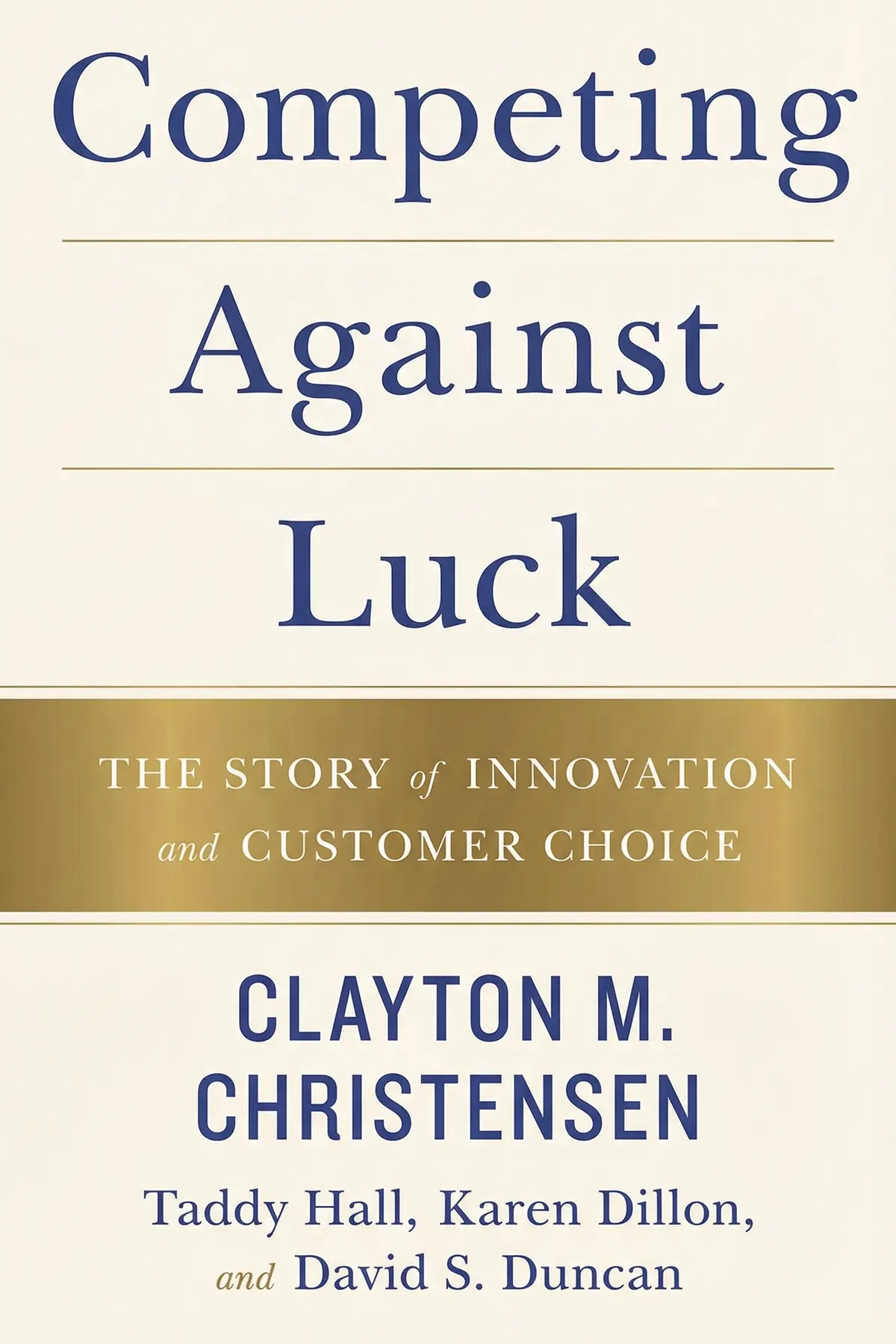
Teams launch products with better features and stronger technology, then watch customers walk past them. In Competing Against Luck, Harvard Business School professor Clayton Christensen and his co-authors Taddy Hall, Karen Dillon and David S. Duncan argue that the missing piece is a better question. Instead of asking who the customer is or which features they want, ask what job they are trying to get done at a particular moment. People, the authors say, hire products to do those jobs, and they drop them when something else does the job better.
That idea carries the whole book: innovation stops being a gamble once you understand the job a customer is hiring for and keep every product, process and number pointed at it. The cases run from a milkshake bought for the drive to work to a doll with a history lesson inside, a clinic that books your specialists for you and a vegetable juice that lost its way. Each one turns into a method you can try on your own customers.
1 min 56 sec
A fast-food chain spent years tuning a milkshake to customer requests and barely moved sales. Then it noticed who was buying and when, and the obvious improvements turned out to be ones nobody had asked for.
1 min 58 sec
The people who buy nothing in your category may be telling you more than your best customers. Christensen and his co-authors explain where unmet jobs hide, and why an ordinary drill is doing three jobs at once.
1 min 58 sec
Early doubters thought Pleasant Rowland’s dolls were just more toys. She had seen something in how parents and children played that surveys would have missed, and her insight came with a warning about switching costs.
1 min 57 sec
One famous clinic gives patients a person whose whole role is to make the visit hang together. The authors use it to show where lasting advantage comes from, and why your dashboard may be measuring the wrong thing.
2 min 02 sec
V8 once owned a clear place in shoppers’ minds, and sales climbed to match. Then success set in. The authors name three data traps that pull growing companies away from the job that made them.
1 min 05 sec
The title is worth taking literally. In the authors’ view, innovation succeeds less through clever technology than through understanding the job customers need done. Ask what features people want and you get a longer list. Ask what job someone is hiring for, in which situation, and the milkshake gets thicker, the doll gets a history, the clinic gets a coordinator and the juice remembers why people bought it in the first place.
The book supports a handful of concrete moves. Spend time watching how and when people use what you make, and look hardest at the workarounds and at the people who buy nothing. Describe each job in its functional, emotional and social layers, and ask what customers must give up before they can switch to you. Then check that your processes and your dashboard track the customer’s progress, and that every new line extension can name the job it does.
None of this needs a new technology. It needs the patience to watch a commuter early in the morning and notice that the shake in their hand is doing a job nobody designed it for.
Companies pour money into better features and smarter technology, then watch customers walk past. Clayton Christensen and his co-authors Taddy Hall, Karen Dillon and David S. Duncan argue that the problem usually lies in the question being asked. The useful question is not which features to improve, but what job the customer is trying to get done. It is what job they are trying to get done in a particular moment, and what they hire to do it. The authors build their jobs to be done theory from cases such as a fast-food milkshake bought for the morning commute, Pleasant Rowland's American Girl dolls, the Mayo Clinic's single-visit diagnosis and V8 vegetable juice's rise and drift. They show how to spot jobs hiding in workarounds and unusual uses, why every job has functional, emotional and social layers, and why a new product has to make customers fire something first. Readers get a practical lens for product and strategy work: watch behavior before trusting feedback, measure the customer's progress instead of internal output, and guard against the data traps that pull growing companies away from the job that made them successful.
Founders and product managers whose feature upgrades are not moving sales.
Marketers and strategists who want a sharper reason why customers choose them or walk away.
Leaders of growing companies who suspect their metrics are pulling the team away from what customers actually need.
Clayton M. Christensen held the Kim B. Clark professorship at Harvard Business School and introduced the idea of disruption in The Innovator's Dilemma. Thinkers50 ranked him the world's top business thinker in 2011 and 2013, and he helped originate the Jobs to Be Done approach. David S. Duncan, a Harvard physics PhD, was a Senior Partner at Innosight. Karen Dillon is a former Harvard Business Review editor. Taddy Hall is a senior partner in Lippincott's innovation practice.
Clayton M. Christensen

Clayton M. Christensen
Clayton M. Christensen

Listeners find the material accessible and thoroughly investigated, specifically highlighting the lucid breakdown of the Jobs to be Done framework. Additionally, the book provides actionable guidance through compelling illustrations, leading listeners to view it as a superb primer on the topic of innovation. They value its stimulating perspective, with one listener mentioning that it successfully bridges the gap between theory and real-world application, making the investment of time and money worthwhile.
Ever wonder why some products explode in popularity while others with better specs just wither away? Christensen argues that we "hire" products to do a specific job, and if they fail, we "fire" them just as quickly. This causal mechanism is the heart of the Jobs to be Done theory, and it’s explained here with remarkable clarity. I found the examples of companies like IKEA and Netflix to be particularly illuminating in how they integrate their entire processes around the job. This isn't just theory for the sake of theory; it’s a blueprint for building something people actually want. My only minor gripe is that the text can feel a bit repetitive toward the end, but the fundamental shift in mindset it offers is worth every page. It’s a must-read for entrepreneurs and product managers alike.
Show moreFinally got around to reading this classic on innovation, and it really shifted how I view my own customer research sessions. The authors do a fantastic job of explaining that customers often can’t tell you what they want because they don’t know themselves until they are in the moment of struggle. By focusing on the "circumstance" rather than the "customer," you unlock a much more predictable way to innovate. I loved the distinction between "Big Hire" and "Little Hire"—it really changed how I think about retention and product experience. The writing is accessible, though the academic tone occasionally peeks through in the later chapters. Overall, this is one of the few business books that actually offers a new lens through which to view the world of commerce. It is definitely worth the investment for any serious executive.
Show moreWow, this is a masterclass in understanding the causal mechanisms behind why people buy what they buy. The concept of "firing" a current solution to "hire" a new one is such a simple but profound way to think about competition. It explains why a luxury watch might be competing against a weekend getaway rather than another watch brand. The authors push you to look at the emotional and social progress a customer seeks, which is often ignored in favor of purely functional specs. This book isn't about luck; it's about the hard work of observation and empathy. It’s rare to find a business book that is both intellectually stimulating and practically useful, but Christensen pulls it off here. I’ve already started applying these questions to my own projects with great results. This is essential reading for anyone in growth.
Show moreTruth is, most business books are fluff, but "Competing Against Luck" provides a lens that you can actually apply to your daily work. The authors argue that innovation is only "luck" if you don't understand the job your customer is trying to do. Once you see the "job," the path forward becomes much clearer. I appreciated the specific examples from diverse industries like healthcare and education, proving that this isn't just for tech companies. It’s a thought-provoking read that challenges the standard way we measure success. Instead of just looking at sales figures, we should be looking at whether the customer successfully made the progress they were looking for. Highly recommended for anyone tired of the usual "fail fast" rhetoric and looking for something more substantial and well-researched. It’s worth every penny.
Show moreThe central premise that innovation is a predictable process rather than a roll of the dice is what makes this book so essential. The authors present a compelling case that by mapping the emotional and social dimensions of a "job," companies can stop guessing and start building with purpose. This book is a deep dive into the "Jobs to be Done" theory, and it’s packed with insights that go way beyond the surface-level marketing advice you see online. I was particularly struck by the idea that a "job" stays relatively constant while products come and go. It’s a vital reminder to focus on the human experience rather than just the technology. The writing is engaging and the structure makes sense, even if it gets a little dense in the middle sections. If you want to understand why customers really choose your product, read this.
Show moreThe milkshake story is probably the most famous part of this book, but there is so much more depth to the framework than just that one anecdote. I appreciated how the authors differentiate between the functional, social, and emotional dimensions of a "job." It’s not just about the product features; it’s about the progress the customer is trying to make in a specific circumstance. While some sections felt a bit long-winded, the core message is incredibly grounding for anyone in marketing. We often get lost in demographic data and forget that a person’s age or zip code doesn't cause them to buy a specific candy bar. This book forces you to look at the "why" instead of the "what." It’s a solid read that I’ll likely revisit when I’m stuck on a new product launch, despite the slightly repetitive middle chapters.
Show moreAs someone who works in product design, the concept of "Jobs to be Done" isn't exactly a secret, yet this book provides a much-needed formal structure to the chaos. Christensen and his co-authors provide a compelling argument against over-reliance on "Big Data," which often shows correlation without ever touching on causation. I particularly liked the section on "nonconsumption" and how finding where people are currently struggling to find any solution can lead to the biggest breakthroughs. The prose is clear and professional, making it easy to digest during a commute. While I agree with other reviewers that it can be a bit repetitive, the central framework is so powerful that it's worth the occasional slog through the more corporate-heavy chapters. It definitely made me rethink our current roadmap and how we measure success internally.
Show moreAfter hearing several colleagues rave about the JTBD theory, I decided to dive into the source material myself. It’s a very well-researched piece of work that manages to be both academic and accessible at the same time. I found the discussion on "passive data" vs. "active data" to be one of the most useful parts of the book. It warns against the trap of only tracking what is easy to measure, like internal efficiencies, while losing sight of the customer’s actual struggle. My only minor complaint is that the authors sometimes sound a bit too enamored with their own theory, treating it as a universal law of the universe. Still, the logic is sound and the case studies—like the one about the condo developers—are genuinely interesting. It’s a great tool for any manager's toolkit who wants to move beyond mere correlation.
Show moreNot what I expected in terms of layout, as the first few chapters deliver the heavy lifting and the rest feels a bit like filler. The Jobs to be Done (JTBD) theory is absolutely brilliant and should be required learning for anyone in business, but this book could have been a long essay. I found myself skimming through some of the later case studies because they just reinforced the same three points over and over again. To be fair, the milkshake example is a classic for a reason, and it’s well-explained here. However, I struggled with the lack of actionable "how-to" steps for smaller startups that don't have the resources of an Amazon or an Intuit. It’s a great conceptual piece for alignment, but don’t expect a step-by-step workbook for your daily operations. It’s a decent introduction, but it feels somewhat overstretched.
Show moreLook, I wanted to love this given Christensen’s reputation, but most of this felt like common sense dressed up in fancy new management jargon. If you have any background in user experience or design thinking, you’ve heard these concepts before, just under different names like "user needs" or "pain points." The book starts with a fascinating premise about data vs. innovation, yet it quickly devolves into a series of cherry-picked anecdotes that feel more like marketing for a consulting firm than a rigorous study. Some of the insights are so true they’re almost useless, providing little in the way of actual actionable advice for someone on the ground. It’s also quite impersonal, treating the company and the customer as cogs in a machine. For a book about "understanding people," it felt surprisingly hollow. I’d recommend sticking to specific UX research books instead.
Show moreClayton Christensen and his co-authors argue that customers hire products and services to get a job done in a specific circumstance. Innovation succeeds when companies understand that job deeply and design for it, instead of chasing features or technology. Their example is McDonald’s, which raised milkshake sales once it saw that commuters bought shakes to make a dull morning drive more interesting and hold off hunger until lunch.
It is the idea that people do not simply buy products; they hire them to make progress in a particular situation. Each job has functional, emotional and social layers. A drill makes holes, but it can also give the owner a sense of accomplishment and earn appreciation at home. Understanding all three layers shows what to build and what to improve.
The authors suggest observing like a detective or documentary filmmaker. Watch behavior, struggles and circumstances, since actions often reveal more than direct feedback. Look closely at nonconsumers, workarounds and products used in unintended ways, because each points to an unmet job. Also ask what customers would have to stop doing or using to switch to you.
The first is letting loud active data from sales and operations override quiet passive data gathered by observing customers. The second is surface growth, adding products and services to please everyone and drifting from the core job. The third is conforming data, reading numbers in ways that confirm existing strategy. The remedy is to keep returning to the customer’s job.
Start by describing one real moment when a customer uses your product and the job they are trying to do. Replace an internal output metric, such as features shipped, with a measure of customer progress. Design processes around the job, as the Mayo Clinic does with a coordinator who arranges all specialist appointments in one diagnostic visit.
AUDIO SUMMARY AVAILABLE
Get the key ideas from Competing Against Luck by Clayton M. Christensen, plus 5,000+ more nonfiction titles.