


13 min 26 sec
Available in: English
Coffee Lunch Coffee: A Practical Field Guide for Master Networking
By Alana Muller
A practical method for networking without the awkwardness: set clear goals, tell a well-shaped work story, stay calm in meetings and follow up, so steady coffee and lunch meetings grow into a supportive professional community.
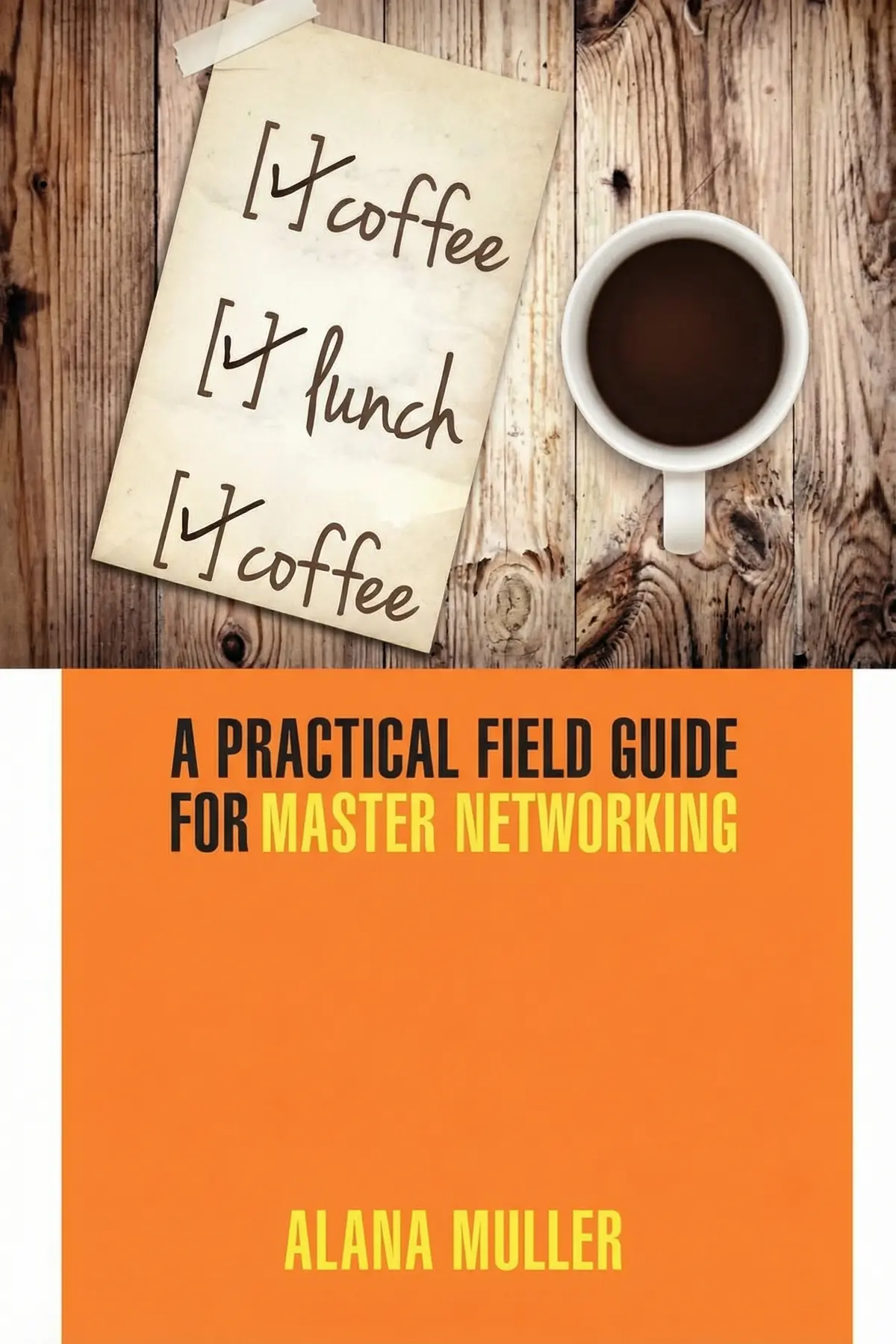
Table of Content
1. Introduction
1 min 01 sec
Most people start networking only after they lose a job, and by then it feels like begging strangers for favors. In Coffee Lunch Coffee, Alana Muller, who has led the entrepreneur training group Kauffman FastTrac, argues for the reverse: build relationships steadily while you are still employed, so the community is already there when work changes. Her own proof is nine months of daily meetings after a ten-year job ended, which led to her next role.
The case running through the book is that networking is a learnable practice of helping people, done on a schedule and prepared for like any other part of your work. Muller breaks it into concrete steps: lists of whom to meet, a work story with a clear shape, calm habits for the meeting itself, a small kit of materials and a follow-up that keeps the thread alive. The reward is the ability to sit across from a stranger with something to offer, and a network that holds when your career shifts.
2. Trade business cards for relationships that last
1 min 34 sec
A famous author ended a talk in a private home with one small gesture that kept every guest in her circle. It shows what most people forget to do before they walk out of the room.
3. A safety net built before you need it
1 min 32 sec
When a ten-year job ended, Muller could have waited at home for replies. She chose a punishing calendar instead, and what it built for her went well beyond a new position.
4. Know what you want before the first coffee
1 min 38 sec
Plenty of friendly meetings end with nothing changed. Muller traces the problem to the evening before, and she asks for four lists, one of which most people never think to write.
5. Tell a work story people remember
1 min 41 sec
Most people describe their careers as a list of job titles, and listeners forget them by dessert. Muller borrows a structure from storytelling that turns one hard week at work into something memorable.
6. Calm habits that keep you present in meetings
1 min 45 sec
Sweaty palms and restless hands can undo hours of preparation in the first minute. Muller offers a few physical checks, and one of them works before you even walk through the door.
7. Materials that introduce you before you speak
1 min 34 sec
A résumé, a card and a short bio sound like paperwork. Muller treats them as one picture of who you are, and a networking expert’s cheeky comparison explains how much to reveal.
8. Say yes to the gathering you might skip
1 min 34 sec
A lonely freelance writer started inviting friends over to talk shop. Years later the idea was worth millions, and the reason it worked runs against most advice about networking for profit.
9. Conclusion
1 min 07 sec
Muller’s book adds up to a change in how networking feels. It stops being an emergency measure for the unemployed and becomes a craft, closer to learning a language than working a room. Fluency comes from hours of use and from asking questions of every size, from where to go on holiday or how to set a camera’s aperture to how you might help someone at a company you admire. Relationships, she adds, grow like a garden, and expecting results overnight makes no sense.
Not every meeting pays off. Muller’s own new role came only after 160 of them.
So pick a number of people to meet each week or each month, and keep in touch with earlier contacts while you add new ones. The next time you are relaxing with friends, notice what puts you both at ease, and bring that warmth into your next professional coffee. Over time, the meetings stop feeling like tasks and start feeling like your community.
The network that catches you when work changes is the one you started building on an ordinary Tuesday, over one cup of coffee.
About this book
What is this book about?
Many people only start networking after losing a job, when every coffee feels like asking for a favor. Alana Muller argues that this timing is backward. Networking, in her view, means building relationships and helping people, and it pays off most when you practice it steadily, even in a job you like. Muller draws on her own experience. After a decade at Sprint Nextel, she spent nine months filling her days with meetings, introduced herself to 200 people and found her next role as president of Kauffman FastTrac. From that period she builds a working method: goals and lists of whom to meet, a meeting request that gets answered, a work story with a clear shape, calm habits in the room, a small portfolio of pitch, cards, résumé and bio, and a follow-up that keeps the relationship alive. Readers get a routine they can start this week and a different way to think about networking. Muller treats it as a skill learned over a lifetime, closer to learning a language than working a room.
Book Information
Who it's for
Professionals in stable jobs
Professionals in a stable job who only think about networking when something goes wrong.
Searching for new work
Career switchers and job seekers who want a daily routine for meeting people instead of sending applications into silence.
Solo freelancers and founders
Freelancers and founders who work alone and need a community around them.
About the Author
Alana Muller
Alana Muller has served as president of Kauffman FastTrac, a not-for-profit educational organization that trains and supports entrepreneurs. She created the blog Coffee Lunch Coffee, which shares its title with this book. Muller earned a graduate degree in business administration from the University of Chicago, regularly leads workshops on business topics and has written for Forbes.com and The Huffington Post.
Ratings & Reviews
Ratings at a glance
What people think
Listeners find this networking guide to be an outstanding asset that can help anyone become a master networker. The material is engaging, clear, and simple to navigate, complemented by quality exercises throughout. They value its pragmatic focus; one listener notes it provides an exacting outline, while another mentions that it includes useful templates.
Top reviews
Boss
Alana Muller is an absolute powerhouse of energy, and that enthusiasm practically jumps off the page in this networking guide. I loved how she frames the 'Coffee Lunch Coffee' cycle as a sustainable lifestyle rather than just a chore for job seekers. The templates for follow-up emails were exactly what I needed to stop overthinking my outreach. It’s a very practical, straightforward resource that helps you move from just collecting business cards to actually cultivating a community. Some might find her tone a bit overly optimistic, but for me, it was the kick in the pants I needed to get out there and start storytelling. If you’re looking to become a master networker, this is the blueprint you want on your desk.
Show moreFrida
Picked this up on a whim after hearing about the author’s work with the Kauffman Foundation. This is honestly the ultimate networking guide if you actually want to see results. I love how Muller encourages you to treat networking like a full-time job; it really changed my perspective on the amount of effort required to build a real community. The storytelling section was a revelation, helping me identify the 'hero' in my own career path. It’s a bubble of energy and connection that makes you want to go out and invite someone to coffee immediately. The practical tips on handling the initial email are worth the price of the book alone. Highly recommended for anyone feeling stuck in their career.
Show moreAna
Finally got around to reading this because I struggle with that 30-second elevator speech everyone talks about. Alana Muller’s advice is clear and incredibly practical, especially when she breaks down how to share anecdotes that actually stick. I appreciated the specific templates for requesting meetings—never realized that sending a résumé too early could be a turn-off! The book is well-written and serves as an exacting outline for building a professional network from the ground up. I did feel like some sections were a bit repetitive, and the 'dry calculation' of networking might put some people off. However, the focus on 'giving back' and being part of a community makes the whole process feel more authentic. Great resource for anyone needing a push.
Show moreTun
The 'why' is definitely present, but I was more impressed by the templates and charts included for organizing contacts. It’s one thing to say you need to network, but it’s another to have a literal schedule for morning coffee, midday lunch, and afternoon coffee. Muller makes the process feel manageable by breaking it down into day-to-day practicalities. Frankly, the advice on how to craft a story with a 'conflict' and a 'peak' was the highlight for me. It turns a boring career history into something engaging. My only gripe is that it feels very focused on a specific type of corporate environment. If you work in a more creative or unconventional field, you might have to adapt some of the tips.
Show moreJoshua
The chapter on 'non-negotiables' changed how I view my career hunt. It’s so easy to just say 'yes' to everything when you’re looking for work, but this book reminds you to keep your goals in sight. Alana Muller provides an exacting outline that is both straightforward and fun to read. While some critics say it lacks a psychological aspect, I actually liked the focus on practical, repeatable steps. It takes the mystery out of how to build a portfolio of relationships. The follow-up email advice is excellent, and the emphasis on quality relations over quantity is a vital reminder. It’s a very practical resource, even if it feels a bit geared toward the Kansas City business scene.
Show moreSai
Kansas City residents might find the local references charming, but the 'American' optimism was a bit overwhelming for my taste at times. The book offers a good overview of the networking landscape, particularly for those who are currently unemployed and need a rigid structure to stay motivated. Muller emphasizes the 'Coffee Lunch Coffee' routine, which is helpful for discipline, but I didn't find the advice on storytelling to be particularly ground-breaking. It’s a practical approach that relies heavily on templates and charts, making it feel a bit like a workbook. If you are starting from zero, the elevator speech tips are solid. However, seasoned professionals might find it a bit repetitive compared to other books in the genre.
Show moreNatchaya
Ever wonder why your LinkedIn requests go ignored? This book tries to solve that by offering a structured way to handle outreach, though it often feels more like a business log than a personal growth book. It’s a straightforward read that cuts through the fluff, providing practical steps like identifying your 'non-negotiables.' While I liked the emphasis on quality over quantity, some of the advice felt like common sense for anyone who has been in the business world for a few years. The writing is fun and fast-paced, which makes it easy to digest. It’s a decent overview, but I wish there were more examples of how to handle awkward interactions. It's a solid guide for beginners.
Show morePenelope
Look, the advice isn't revolutionary, but the 'Coffee Lunch Coffee' schedule is a solid framework for anyone who lacks discipline. The book is very focused on the mechanics of networking—sending the email, tracking the meeting, following up—which can feel a bit robotic. I appreciated the reminders to be an attentive listener, though I think the book could have spent more time on the actual art of conversation. The Kauffman connection provides some interesting context, and the author clearly knows her stuff. It’s a quick read with some decent exercises, but it does fall into the trap of 'same networking stuff' found in most other books. It’s a good refresher, but not a game-changer.
Show moreYanin
To be fair, this felt more like a CRM manual than a guide on human connection. The book treats networking as a dry calculation of leads and follow-ups rather than focusing on the psychological nuances of building real friendships. While the Kansas City context and the author’s background are interesting, the actual 'how-to' advice felt a bit like lead management. I was looking for more depth on how to handle the social anxiety of networking, but instead, I got a registry for scheduling meetings. It’s very 'American' in its upbeat approach, which might work for some, but I found it lacked the human aspect I was hoping for. It’s okay if you just want a schedule, but it won't help you with the actual conversation.
Show moreTawee
I've been networking for years and found most of this to be a repeat of standard industry tropes. There’s a lot of focus on 'why' networking is important, which felt unnecessary since most people buying this book already know they need to do it. The 'American' mindset of being perpetually positive is layered on thick, and at times, the book feels like it’s trying to sell you a lifestyle rather than a skill. I was hoping for more unconventional strategies, but instead, it was 30-second speeches and follow-up emails. To be fair, the charts for organizing your contacts are useful if you aren't already using a CRM. I just didn't find the 'dry calculation' of the meetings very inspiring or human.
Show moreQuestions about this book
What is the main idea of Coffee Lunch Coffee?
Alana Muller argues that networking is about building relationships and helping people, not collecting business cards, and that it works best when practiced steadily, even while you are employed. She treats it like a job, with meetings over coffee and lunch, clear goals, a prepared work story, calm presence, a portfolio and follow-up. Her nine months of meetings after leaving Sprint Nextel built a community and led to her role at Kauffman FastTrac.
How do you write an email asking for a networking meeting?
Muller suggests mentioning who gave you the person’s contact details, if someone did, and how you reached them. Outline your experience in a few lines, then close by stating what you want to work on and asking whether they are free to meet. Leave the résumé out of this first message and send it later, in the email that confirms the meeting.
What should a networking story include according to Alana Muller?
Muller describes six parts. A conflict from your job, such as keeping a client who was about to leave. A hero, which is you, with credit to helpful colleagues. Anticipation, showing why the conflict mattered. A peak, where you explain how you solved it. A transformation, how you changed. And an explanation of how you grew. She recommends writing the story down, practicing it and inviting the listener to share their own.
Who should read Coffee Lunch Coffee?
It suits people who find networking awkward or only do it when job hunting, including career switchers, recent graduates and professionals who are content in their roles. Freelancers and founders working alone will also find value in it, especially in the story of Laurel Touby, whose weekly gatherings with fellow freelancers grew into Mediabistro, a company she later sold for $25 million.
How can I apply Coffee Lunch Coffee in my own career?
Start by writing four lists: people you know, people you want to know, companies you want to learn about and your non-negotiables for a job. Draft a 30-second pitch and one work story in Muller’s six-part shape. Then set a target number of meetings per week or month, send a thank-you email after each one and keep in touch with earlier contacts as you meet new people.
Featured in
Readers also enjoyed








AUDIO SUMMARY AVAILABLE
Listen to Coffee Lunch Coffee in 15 minutes
Get the key ideas from Coffee Lunch Coffee by Alana Muller, plus 5,000+ more nonfiction titles.
- 5,000+ titles
- Listen as much as you want
- 7-day free trial
- Cancel anytime









