

13 min 19 sec
Available in: English
Co-Active Coaching: Changing Business, Transforming Lives
Shows coaches, managers and mentors how to stop fixing people's problems. Instead, they help people find their own answers through trust, three levels of listening, spoken intuition, curious questions and decisions tested against personal values.
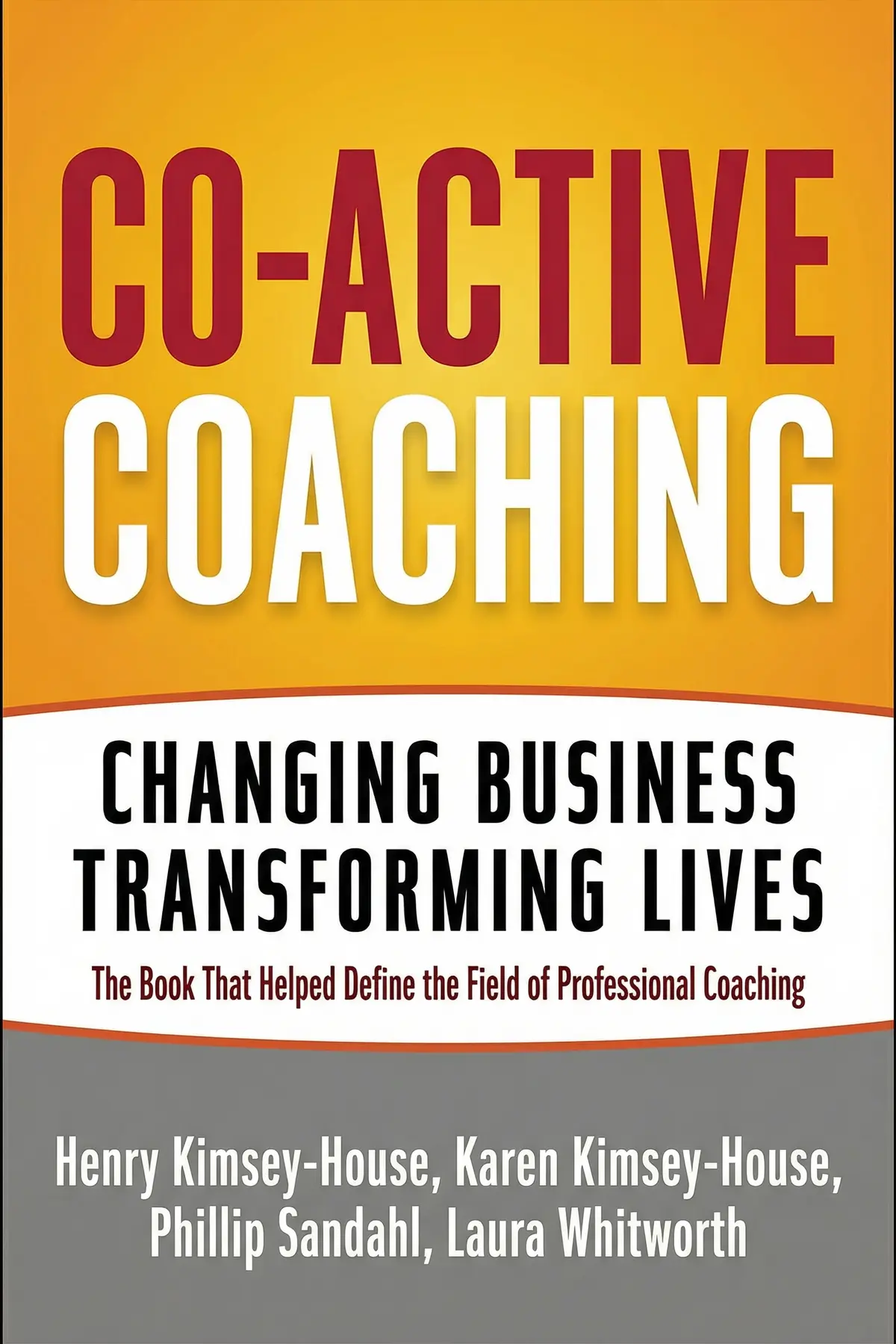
Table of Content
1. Introduction
1 min 12 sec
If you coach, manage or mentor people, your strongest habit is probably fixing their problems for them. The authors of Co-Active Coaching say coaching is not about fixing clients at all. Henry Kimsey-House, Karen Kimsey-House, Phillip Sandahl and Laura Whitworth start from a different assumption: the person in front of you is already creative and resourceful, and able to find their own answers. Three of them founded the Coaches Training Institute together in 1992. Their model treats coaching as joint discovery, with coach and client both active in the conversation.
The argument is simple to state and harder to practice. Build a space that feels safe, listen far below the words, say your hunches out loud and ask curious questions. Clients will then make choices that fit their own values, and such choices tend to feel more fulfilling. Along the way you get a working toolkit: three levels of listening, a way to test a gut feeling in the open, questions that sound almost foolish yet break a rehearsed story, and a method for turning values into a test for hard choices.
2. Treat every client as already capable
1 min 58 sec
The urge to help by offering a solution feels generous, yet the authors say coaching is not mainly about solving problems or fixing anyone. Four starting assumptions change what a helping conversation is actually for.
3. A safe space where clients dare to take risks
1 min 50 sec
Coaches want clients to try bold things, yet bold moves rarely happen on command. The authors name four conditions that make risk possible, and one of them is far less comfortable than being kind.
4. Listen past the words to what drives them
1 min 49 sec
Most of us believe we listen well, yet much of our attention stays on ourselves. The authors describe three distinct levels of listening, and only the deepest reaches what a person cannot quite say.
5. Turn a gut feeling into a useful question
1 min 47 sec
Halfway through a conversation, something feels off, and you cannot prove it. Staying silent seems safest. The authors argue the opposite, and explain why being wrong out loud still helps.
6. Ask the plain question that breaks autopilot
1 min 46 sec
A client who has told the same story many times has an answer ready for every clever question. The authors note that the most powerful questions are sometimes so simple they almost sound foolish to ask.
7. Hard choices get easier when values lead
1 min 39 sec
Fulfillment sounds like a vague reward that arrives on its own. The authors give it a precise definition, and that definition becomes a practical test for any decision a client is stuck on.
8. Conclusion
1 min 18 sec
Co-active coaching asks a helper to give up the role of expert and take on a harder one: partner. Every tool in the book grows from the first cornerstone, the belief that the client is already creative and resourceful. Safety gives people room to risk. Deep listening and spoken hunches show them what they had not seen. Curious, even naive questions shake loose the story they have told too often. Values give them a way to choose. The answers that come out are ones they found for themselves.
None of this needs a paid coaching session. A manager, a mentor or a friend can use it the next time someone asks for help. Catch yourself at level one, about to tell your own story, and move your attention back to the other person. Say the hunch out loud, as a question. When the talk circles, ask what the ideal outcome would look like.
The authors also suggest a way to train curiosity itself. Sit in a coffee shop for half an hour, watch the people around you and imagine their values, hobbies, obstacles and dreams. Then find one person to talk with, ask freely, and notice how they open up. Full attention is rare enough that simply offering it already helps.
About this book
What is this book about?
Most people who coach, manage or mentor have the same reflex. Someone brings a problem and they offer a solution, often drawn from their own life. The authors of Co-Active Coaching argue that this reflex gets in the way. In their model, coach and client both work actively in the conversation, and the aim is awareness, discovery and choice. Solving the problem comes second. The approach rests on a single assumption: every person is naturally creative and resourceful. From there the authors build a practical method. Coaches design a safe environment and agree the terms of the relationship in a discovery session. They listen at three distinct levels, say their hunches out loud and ask curious questions, sometimes so simple they sound foolish. Finally, they help clients name and rank their values so those values can guide hard decisions. Readers come away with tools they can use in their next conversation. They can catch themselves listening only for what matters to them, turn a gut feeling into an open question and break a rehearsed story with a plain one. They can also help someone choose a path that fits who they are.
Book Information
Who it's for
New to coaching
New and aspiring coaches who want a clear model for running sessions.
Managers and team leads
Managers and team leads who keep solving problems their people could solve themselves.
Hoping for deeper one-to-ones
Mentors, HR and learning professionals who want deeper, more honest one-to-one conversations.
About the Author
Henry Kimsey-House
Henry Kimsey-House, Karen Kimsey-House and Laura Whitworth founded the Coaches Training Institute (CTI) in 1992 and developed the Co-Active philosophy behind its coaching and leadership programs. Whitworth, named by Professional Coach Journal one of the 10 most influential coaches, began coaching in 1988 and died in 2007. Karen Kimsey-House leads CTI workshops worldwide, and Henry Kimsey-House, a classically trained actor, designs experiential learning programs. Phillip Sandahl, former senior CTI faculty, co-founded Team Coaching International and pioneered team coaching.
Ratings & Reviews
Ratings at a glance

What people think
Listeners view this coaching guide as an essential asset, offering practical advice and serving as a foundational text for those in the field. They value the accessible prose and straightforward presentation, as well as its capacity for personal transformation; one listener specifically mentions its effectiveness in empowering individuals. Praise is given to the communication techniques and illustrative conversations included, with listeners describing the experience as an engaging read. Feedback on the tempo is varied, as several listeners perceive the content as being very basic.
Top reviews
Clara
As a veteran in the healthcare space with over twenty years of clinical experience, I was skeptical about what a 'coaching' manual could offer that I hadn't already seen. However, this book clarifies the distinction between treating a patient and empowering a client with remarkable precision. The co-active model isn't about fixing people; it starts from the radical assumption that the individual is already creative, resourceful, and whole. The fourth edition remains a definitive resource, offering a structured framework of cornerstones and contexts that move beyond mere advice-giving. While some might find the appendices dense, I viewed them as an essential toolkit for anyone looking to foster deeper, more transformational relationships. Truth is, the 'Level 3 Listening' concept alone is worth the price of admission. It has fundamentally shifted how I interact with my team and my patients. Truly a gold standard for the industry.
Show moreDiego
The section on the three levels of listening completely changed my perspective on how I communicate with my family and colleagues. Most of us spend our time in 'Level 1,' just waiting for our turn to speak, but this book teaches you how to tap into 'Global Listening' to catch those subtle, unspoken cues. It is a transformational experience to move from just solving problems to actually evoking awareness in another person. I loved the emphasis on curiosity over judgment. The book is very readable, and the online toolkit is a goldmine of practical exercises. While it is technically a textbook for professional coaches, I honestly believe the world would be a much better place if these communication skills were taught in middle school. It’s about more than just a job; it’s about a more meaningful way of being in relationship with others.
Show moreWacharapol
Management training often misses the mark by focusing on spreadsheets and KPIs, but this book provides a roadmap for truly empowering employees. The co-active approach creates a level of safety and curiosity that is often missing in corporate culture. I particularly appreciated the distinction between fulfillment, balance, and process. These aren't just buzzwords; they are the pillars of a healthy life and career. The authors' experience shines through in the practical tips and the structure of the coaching relationship 'triangle.' It’s a very engaging read, though you really have to do the exercises to get the full benefit. It’s helped me move from being a 'fixer' to a 'facilitator,' and the results in my team’s engagement have been immediate. If you’re looking to improve your leadership presence, start here.
Show moreGun
While the core content of this model is decades old, this updated edition keeps the material remarkably fresh and relevant for the modern world. The addition of the online Coaches Toolkit is a massive asset, providing ready-to-use forms and exercises that save hours of preparation. The way the authors break down 'Curiosity' as a tool for safety is brilliant—it’s about exploring the dark spaces without making the client feel judged. I’ve read several books on coaching theory, and this one does the best job of capturing the 'vibe' of a great session. It’s practical, heart-centered, and deeply human. Some might find the appendices a bit long, but they are full of gems for those willing to dig. This isn't just a book you read once; it’s a manual you return to whenever you feel your coaching getting stale.
Show moreNannapat
Finally got around to reading this 'bible' of the coaching world, and I can see why it's a staple in CTI training. The pacing of the book is generally good, breaking down complex relational dynamics into five manageable contexts. I particularly appreciated the 'Wheel of Life' exercise; it’s a simple tool, yet it offers a profound way to visualize fulfillment across different life sectors. I do agree with some critics that certain parts feel like common sense, but having that common sense organized into a repeatable system is where the value lies. The collaborative spirit emphasized here is invigorating, though the prose can get a little dry when they're explaining the technical side of the 'power triangle.' It’s a solid, foundational read for anyone starting their certification journey or looking to improve their professional communication.
Show moreYothaka
Ever wonder why some conversations feel like a battle while others feel like a dance? This book explores that 'dance' in detail, emphasizing the shared agency between a coach and their client. I’ve been through a few different leadership seminars, but nothing focused on the 'soft skills' as intensely as this text. The authors argue that the power resides in the relationship itself, not the person in charge. To be fair, the book can feel a little clinical at times, and I found myself wishing for more grit and fewer sanitized examples. However, the core principle of 'dancing in the moment' has made me much more present during my one-on-one meetings at work. It’s an impactful read that challenges you to stop trying to be the expert and start being a partner. Definitely a worthwhile addition to any manager's bookshelf.
Show moreGabriel
Picked this up during my transition into a leadership role, and it was exactly what I needed to stop micromanaging. The 'Co-Active' model is brilliant because it removes the pressure on the leader to have all the answers. Instead, it focuses on the client’s innate ability to find their own way forward. I found the chapter on intuition particularly fascinating, as it gives you permission to trust your gut during a conversation without needing to be 'right.' My only real gripe is that the book plays down how difficult this is to implement in a fast-paced corporate environment where results are demanded yesterday. It takes a lot of self-management to stay in 'coach mode' when things are on fire. Still, the sample conversations are helpful for practice, and the overall framework is incredibly empowering for both parties.
Show moreDaranee
There is a strange disconnect between the clinical, textbook-like tone of this manual and the warm, collaborative coaching style it actually advocates. If you can get past the somewhat dry delivery, the content is actually quite revolutionary. The authors do a fantastic job of explaining how to 'forward' action while simultaneously 'deepening' the client’s learning. It’s not just about hitting goals; it’s about who the person is becoming in the process. I didn't find the model to be 'earth-shattering' in a technical sense, but its application is where the magic happens. The emphasis on the whole person—rather than just the problem at hand—is a much-needed shift in the coaching industry. It’s a reliable reference guide that I’ll likely keep on my desk for years to come, even if I don't agree with every single 'New-Age' sentiment.
Show moreManika
This was recommended to me as a resource for my pastoral mentorship work, but I found it to be a bit of a mixed bag. On one hand, the practical skills regarding curiosity and asking open-ended questions are incredibly useful for guiding others. The sample dialogues provide a clear window into how these theories actually sound in a real conversation. On the other hand, the writing style leans heavily into a New-Agey, humanistic philosophy that didn't always sit right with me. Frankly, the tone can feel a bit repetitive, and the authors tend to strip away the humor and grit that usually accompany real human growth for the sake of clarity. It functions well as a textbook, and the online resources are a nice touch, but I had to do a lot of mental filtering to get past the ideological fluff. Useful, but proceed with a discerning eye.
Show moreAom
Not what I expected given the massive hype surrounding this as the 'definitive guide.' If you have any background in psychology or basic management, most of this will feel like common sense dressed up in fancy terminology. Phrases like 'dancing in the moment' and 'evoking transformation' sound great on paper, but the actual 'tools' provided felt thin and lacked imaginative depth. It’s very much a book for an absolute beginner who has never thought about active listening before. I found the pacing to be quite slow, and the constant self-referencing of their own coaching school felt a bit too much like a long-form brochure at times. There are definitely more robust and scientifically-grounded models out there if you are looking for actual coaching methodology rather than just an 'ethos' of being nice to people.
Show moreQuestions about this book
What is the main idea of Co-Active Coaching?
The authors argue that coaching works best as an active partnership between coach and client. It is mainly about awareness, discovery and choice, and only secondarily about solving problems. Its starting point is the belief that all people are creative and resourceful by nature. The coach builds a safe space, listens deeply, voices hunches and asks curious questions, so clients find their own answers and make choices in line with their values.
What are the three levels of listening in Co-Active Coaching?
At level one, the listener focuses on what the conversation means to them, for example by offering advice from their own life. At level two, attention is fully on the other person, through empathy, clarification and working through options together. At level three, the coach uses intuition to sense unspoken emotions and energy. Co-active coaches move between levels two and three during a session.
How do co-active coaches use intuition?
They notice a hunch, interpret it and then test it openly without getting attached to their reading. If a coach senses a client is holding something back, they simply ask. Whether the guess is right matters less than the deeper conversation it opens. The authors even recommend interrupting to share a hunch, accepting some clumsiness, because it makes the coach seem more human.
What makes a question powerful in Co-Active Coaching?
Powerful questions come from genuine curiosity and push people off autopilot. Instead of asking what a report will cover, a coach asks how much finishing it matters. With a client stuck in a familiar complaint, the coach asks what she gains from the situation. Often the best questions are very simple, such as what the ideal outcome looks like or what to do next.
How do coaches help clients find their values?
The authors advise against checklists. Coaches draw values out of the client’s own experiences in a natural, exploratory conversation. Then the client ranks them by importance. Those values become a test for decisions: when facing a big choice, the client checks how far each option reflects what they value, because the authors see fulfillment as living in tune with one’s values.
Readers also enjoyed




A Year with Peter Drucker: 52 Weeks of Coaching for Leadership Effectiveness
Joseph A. Maciariello





Acting with Power: Why We Are More Powerful Than We Believe
Deborah Gruenfeld
AUDIO SUMMARY AVAILABLE
Listen to Co-Active Coaching in 15 minutes
Get the key ideas from Co-Active Coaching by Henry Kimsey-House, plus 5,000+ more nonfiction titles.
- 5,000+ titles
- Listen as much as you want
- 7-day free trial
- Cancel anytime









