

A Life Decoded: My Genome: My Life
J. Craig Venter
 English
Shows how sunlight sets the body's master clock, why dim offices and glowing evening screens throw it off, and how better timing of light, sleep and daily schedules can help sleep, mood and health.
1 min 05 sec
If you sleep badly, sink in winter or feel foggy at your desk, the cause may be less about you than about the light you live under. In Chasing the Sun, science journalist Linda Geddes argues that sunlight is the main signal setting a master clock in the brain, and that clock times almost everything the body does, from hormones to blood pressure.
Her case runs like this. Modern life keeps us in dim rooms by day and under bright screens by night, so the clock drifts out of step with the world, and sleep, bones and mood pay for it. Put light and timing back in their natural order, and both body and mind can recover.
The evidence ranges from Roman sun baths to a Norwegian town that built mirrors on a mountain, a psychiatric clinic in Milan and high schools that started later. What it gives you is a practical way to use daylight, darkness and timing to sleep better, lift a low mood and shorten jet lag.
1 min 57 sec
A small cluster of cells decides when your blood pressure rises, when you get hungry and when you can sleep. It takes its orders from one source, and the same signal guides flowers that open at very different hours.
2 min 22 sec
Ancient doctors prescribed sunshine, and factory towns paid a price when work moved indoors. Today’s office worker gets a small fraction of the light an outdoor worker does, and the gap is wider than most people would guess.
2 min 03 sec
One month of living by candlelight changed how a science writer slept, though not how long. At the far extreme, a submarine crew on a strange schedule shows what a confused body clock might cost.
1 min 49 sec
A lamp, a set of mountain mirrors and a sauna followed by freezing water all fight the same winter gloom. Each works through the body in its own way, and one sounds far stranger than it is.
2 min 16 sec
A woman who found no help in psychiatric wards now stays awake through a whole night when depression returns. By dawn, something has usually changed, and her doctor’s clinic reports results that many drugs could not match.
1 min 59 sec
A German spa town tried to opt out of changing its clocks, and an American suburb moved its school bell. One effort failed and one succeeded, and both reveal who our daily timetables are really built for.
1 min 13 sec
Geddes turns a familiar object into a piece of medical equipment. The sun is what sets the hands of a clock in your brain, and much of what feels like personal weakness, the restless nights, the gray winters, the fog at a dim desk, can come from that clock running out of step. Romans in their solaria, rickets spreading through factory towns, a submarine crew on an 18-hour day and an artist in Milan waiting for dawn all show the same thing from different sides.
The fixes are mostly about timing. Get outdoors in daylight during the working day, since even a cloudy sky is far brighter than an office. Let evenings grow dim, with fewer screens and softer light, as Geddes did with her month of candles. When a long flight leaves your body on another continent’s hours, she suggests melatonin around sunset for a night or two, standing in for the darkness signal your clock missed. And if you shape schedules for others, think of the students of Edina, who did better once school began a little over an hour later.
Your body still keeps solar time, like a morning glory opening at sunrise. Whether it can depends on how you arrange your day.
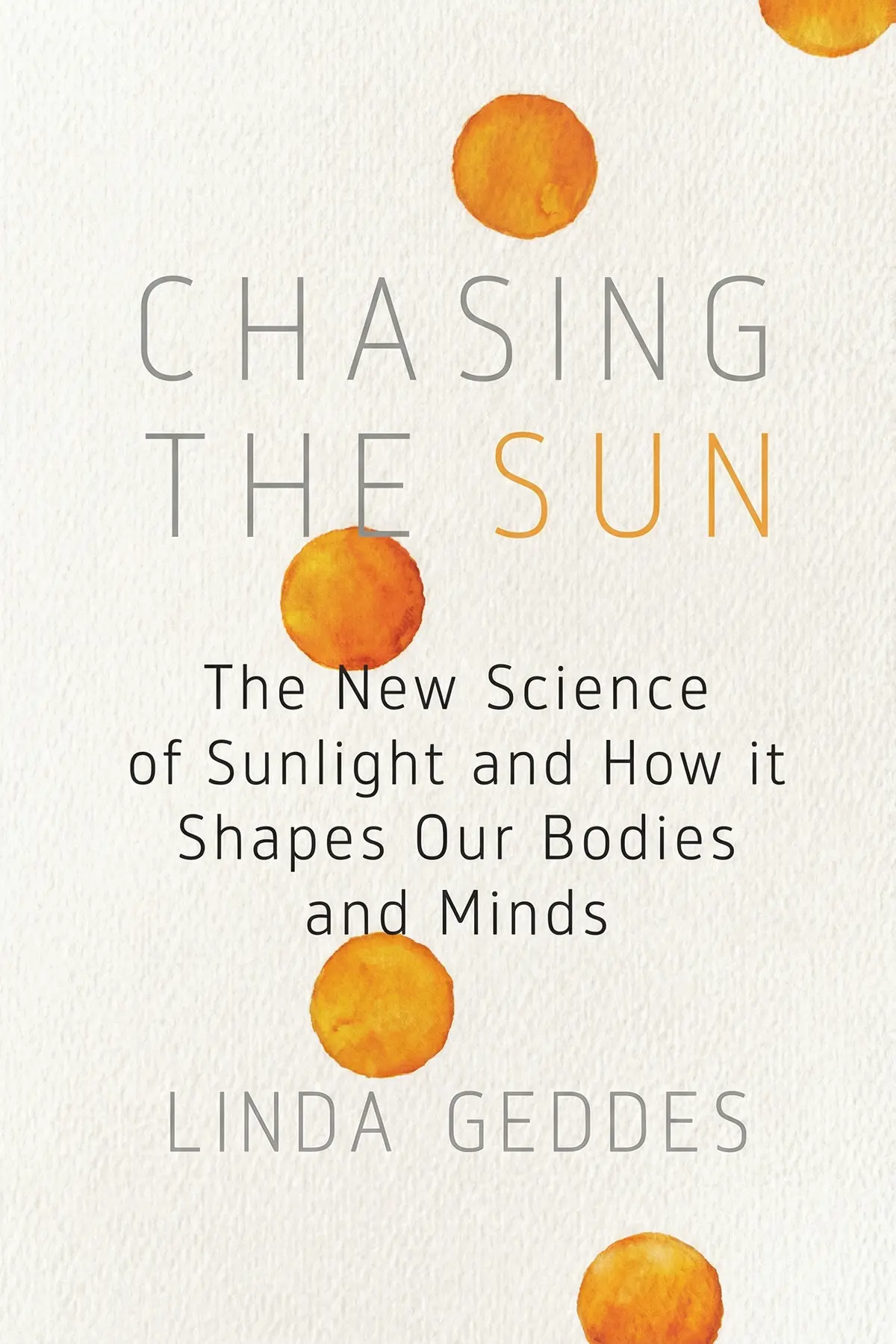
People have worshipped the sun for thousands of years. Science now explains why that instinct made sense. Linda Geddes argues that sunlight is the main signal setting a cluster of cells in the brain that acts as a master clock, timing hormones, blood pressure, body temperature and sleep. Take the sun out of daily life and both body and mind start to suffer. Geddes follows that idea from Roman sun baths and the rickets of English factory towns to today's offices, which can be ten times dimmer than a cloudy winter day. She looks at what screens and indoor lighting do to sleep, at a submarine captain who blames his cancer on years of disrupted rhythms, and at the light boxes, sun mirrors and saunas that northern communities use against the winter blues. The book also covers chronotherapy, a treatment that resets the body clock and has helped patients with severe depression at a clinic in Milan, and the towns and schools rethinking their timetables around human biology. Readers get a clear picture of how light shapes their days, plus practical ways to use daylight, darkness and timing to feel better.
Office workers who sleep poorly and spend daylight hours under artificial light.
People whose mood sinks in the dark months and want options beyond waiting for spring.
Managers, teachers and parents deciding when the working or school day should begin.
Linda Geddes is a journalist who was born in Cambridge. She earned a first-class degree in Cell Biology from Liverpool University, then worked as both a reporter and a news editor at New Scientist magazine. Her journalism has won awards, including the Association of British Science Writers' award for Best Investigative Journalism, and Chasing the Sun brings that training to the biology of light and the body clock.
Listeners find the book thoroughly researched, with one listener specifically noting the research into daily to annual rhythms. The title is praised for its readability. Feedback on the writing style is mixed, though some listeners find it to be well-crafted.
This book is a masterclass in science journalism, weaving together historical anecdotes with cutting-edge biology. From the ingenious mirrors in Rjukan, Norway, that bring light to a dark valley, to the way ancient Romans utilized solariums, Geddes illustrates how our ancestors respected the sun far more than we do today. It’s a wake-up call for the modern office worker. The author’s writing style is incredibly engaging and approachable, even when she’s diving into the complexities of chronobiology or the suprachiasmatic nucleus. I particularly enjoyed the sections on how sunlight exposure can mitigate the effects of seasonal affective disorder and improve general mental health. It’s a well-researched, thought-provoking look at the literal life-giver we often take for granted. After finishing this, I’ve started taking my morning coffee on the porch regardless of the temperature. Truly, everyone living in the modern world needs to understand these rhythms.
Show moreWow. I never realized how much our 'always-on' culture was truly messing with our internal chemistry until I read this. Linda Geddes does a fantastic job of explaining complex biological processes in a way that feels urgent and personal. I loved the chapters on the history of light as medicine, especially the 'solariums' used by the Romans to treat various illnesses. It’s fascinating to see how science is finally catching up to ancient wisdom. The book is exceptionally well-researched, but it never feels like a textbook because the author includes so many personal stories and interviews with experts. Her writing is fluid and the information is presented with a sense of wonder that kept me turning pages late into the night—ironic, I know. It’s an essential read for anyone interested in health, biology, or just living a more balanced life in harmony with nature.
Show moreFinally got around to finishing this, and I’ve already started changing my morning routine to get more direct exposure to the sky. It is a brilliant piece of science writing that manages to be both informative and deeply relatable. I was especially struck by the research on Vitamin D and how our skin has evolved to process light in ways we are only just beginning to understand. Geddes has a knack for making you care about things you never thought of, like the specific frequency of blue light emitted by our smartphones. The book is concise, readable, and packed with 'did you know?' moments that I kept sharing with my family. It’s one of those rare science books that is actually practical. I’ll be keeping this on my shelf to refer back to every time the seasons change or I have to travel across time zones.
Show moreAs someone who spends way too many hours under fluorescent lights, this was a necessary, if slightly convicting, read. Geddes makes a compelling case for how our disconnection from natural light is driving a variety of modern ailments, from rickets to chronic depression. I was fascinated by the practical experiments she conducted, especially her decision to live by candlelight for several weeks to reset her internal clock. The book is chock-full of facts that should be common sense but have been lost in our 24/7 culture. It’s not just about getting a tan; it’s about how light governs our digestion, blood pressure, and even when our hormones are released. My only minor gripe is that some of the science-heavy chapters toward the middle felt a bit dry compared to the vivid opening. Still, it is a highly readable and important contribution to the field of popular science.
Show moreEver wonder why you feel like a total zombie during the winter months? Linda Geddes explores this and so much more in this insightful look at our relationship with the sun. She covers a vast range of topics, from the way the Amish handle light to the potential for 'chronotherapy' in treating mental health disorders. The research into how school start times affect teenage brain development was particularly eye-opening for me as a parent. Frankly, it’s frustrating to see how modern society ignores these biological truths just to fit an arbitrary work schedule. The book is well-written and moves at a brisk pace, though I found the ending a bit abrupt. It provides excellent actionable advice on managing jet lag with melatonin and sunlight, which I’ll definitely be using on my next international trip. A solid four stars for a book that will change how you look at your windows.
Show moreAfter hearing a lot about circadian rhythms recently, I wanted a book that went beyond the surface level, and 'Chasing the Sun' mostly delivered. Geddes is a great guide, traveling across the globe to talk to researchers who are rethinking everything from office lighting to the timing of chemotherapy. The connection between light exposure and drug effectiveness was one of the most surprising things I learned. It makes you realize how little we consider our bodies' natural timing in modern medicine. The book is easy to read and informative, though I did find some of the science history a little tedious in the middle sections. However, the practical takeaways are invaluable. Whether you're a shift worker or just someone who struggles with the winter blues, there is something in here for you. It’s a book that actually makes you want to change your habits immediately.
Show morePersonally, I found the historical perspective of this book to be its strongest suit. Learning about how the ancients viewed the sun as a literal medicine was fascinating, and it makes our modern indoor lifestyle seem even more unnatural. Linda Geddes writes with a clear, journalistic voice that makes the science of circadian rhythms easy to digest for someone without a biology background. I was particularly interested in the discussion surrounding daylight savings time and the arguments for its abolition. While the book does lean heavily into sleep-related topics, the connections she draws between light and overall systemic health are well-supported. There were a few dry spots during the more technical explanations of cellular processes, but they were brief. Overall, it’s a very solid four-star read that offers a lot of food for thought regarding how we design our cities and our daily lives.
Show morePicked this up because I’ve been struggling with insomnia lately and hoped for some novel solutions. To be fair, Geddes provides a very solid overview of why we need sunlight, but I felt like I had heard a lot of this before in other health podcasts. The book felt like a 50/50 split between sleep science and sun science, and I wish there had been more on the latter. I was specifically hoping for more depth on skin conditions like eczema, which were teased in the introduction but barely touched upon later. The writing is clear and the history of heliotherapy was interesting, but the narrative felt a bit disjointed at times. It’s a decent enough primer for a beginner, but if you’ve already read 'Why We Sleep,' you might find a lot of the circadian rhythm information repetitive.
Show moreTruth is, I have mixed feelings about this one. On one hand, the information is vital and the author’s passion for the subject shines through in every chapter. On the other hand, the writing can be quite repetitive, often circling back to the same points about blue light and melatonin several times. I enjoyed the sections on how different cultures across history have worshipped or utilized the sun, but I found the modern-day anecdotes a bit hit-or-miss. Some of the experiments she mentions, like the mirrors in Norway, are incredible, while others felt like filler. I also agree with other reviewers who said it focused a bit too much on sleep patterns at the expense of other sunlight-related health topics. It’s a good book, don’t get me wrong, but it didn't quite reach the 'must-read' status I was hoping for based on the premise.
Show moreThe chapter on ancient Roman solariums started strong, but the rest of the book felt like a collection of data points without a unifying thesis. Look, I appreciate the research that went into this, but the depth just wasn't there for me. It felt more like a series of long-form magazine articles stitched together rather than a cohesive book. Geddes spends a lot of time on sleep, which is fine, but I wanted more on the 'Sun' specifically as promised by the title. The tone is a bit too 'bullet-point' heavy for my taste, and I found myself skimming through the parts about her camping trips and visits with the Druids. It lacks the rigorous scientific method approach I was expecting from a science journalist. If you want a quick summary of why the sun is good for you, a few blog posts would probably suffice. It wasn't for me.
Show moreGeddes argues that sunlight sets the body’s master clock, a cluster of about 20,000 cells in the brain called the SCN. That clock coordinates circadian rhythms, which time hormones, blood pressure, body temperature and sleep. Modern indoor life, with dim days and bright evening screens, pushes those rhythms out of step, which can harm sleep, bones and mood. Restoring natural light and timing helps the body and mind work better.
Geddes explains that the inner clock needs a clear difference between day and night. Blue-white light from computer and phone screens can delay melatonin, the hormone that prepares the body for sleep, and many indoor lights make the clock believe it is always twilight. When she lit her home only with candles for a month, she slept the same hours but felt her sleep was deeper and woke with more energy.
Geddes describes several responses to seasonal affective disorder. Light boxes, popular since the late 1970s, eased symptoms within days in a clinical test at the National Institute of Mental Health, with symptoms possibly gone after ten days. The Norwegian town of Rjukan installed mountain mirrors for two extra hours of sun. In Sweden, a sauna followed by a cold plunge raises serotonin and then releases endorphins.
It is a treatment for depression used by psychiatrist Francesco Benedetti at San Raffaele Hospital in Milan. The treatment pairs light therapy with lithium, a mood stabilizer, and now and then a night without sleep, with the goal of resetting the body clock. His clinic has been treating bipolar depression since 1996, seeing about a thousand patients, and roughly 70 percent got better, including many who had responded poorly to antidepressants.
Geddes suggests taking melatonin around sunset in your new time zone. Your body normally releases melatonin when darkness falls, but after a long trip your rhythms are still set to another part of the world, so the release comes at the wrong time. After a night or two of melatonin before bed, she says, your rhythms should get back on track.
J. Craig Venter


Carl Zimmer

Bill Bryson

Jeff Hawkins




Lisa Kaltenegger

AUDIO SUMMARY AVAILABLE
Get the key ideas from Chasing the Sun by Linda Geddes, plus 5,000+ more nonfiction titles.









