

A Promised Land
Barack Obama
 English
 ไทย
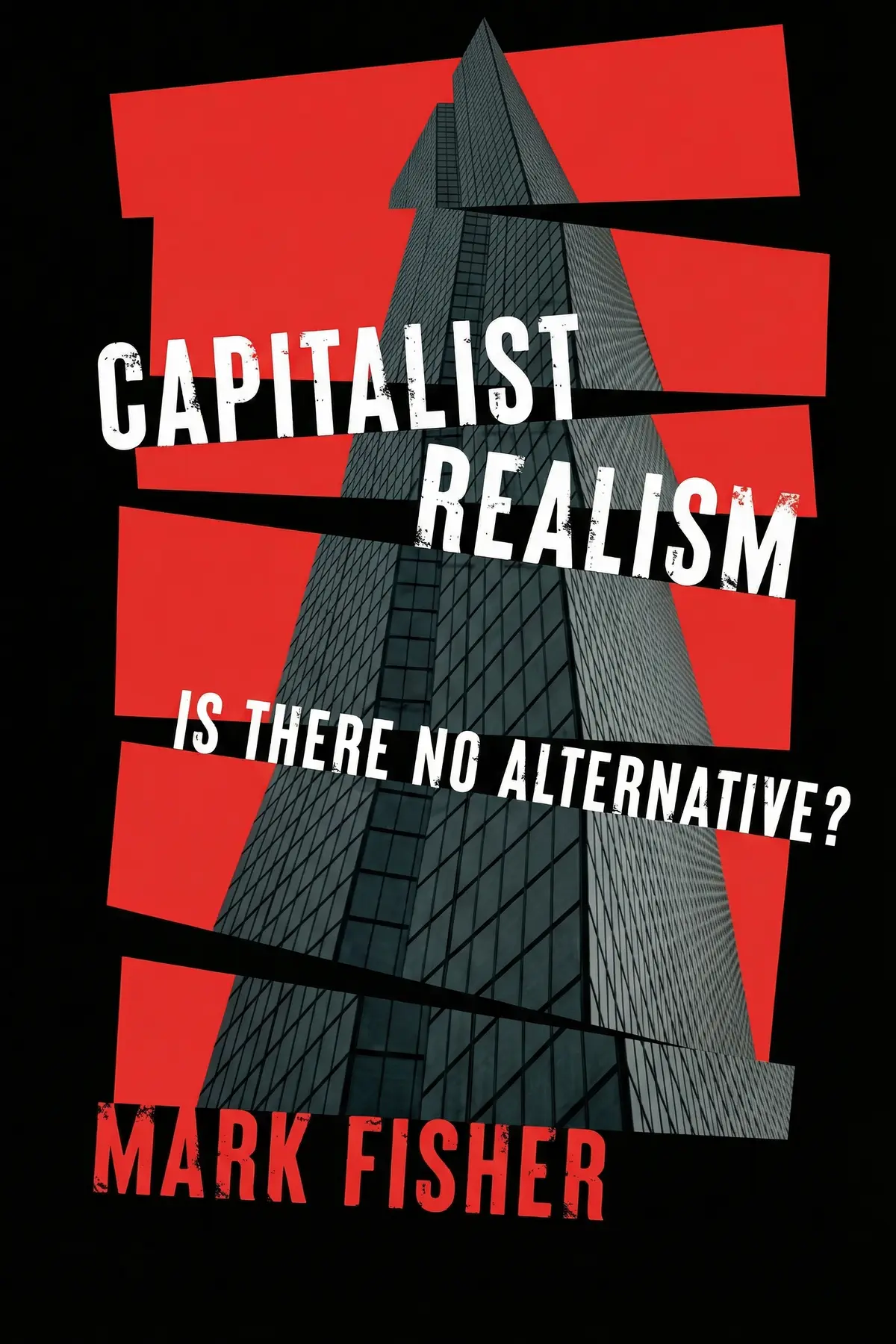
Mark Fisher explains why capitalism has come to feel like the only possible future, and how that belief shows up in culture, youth burnout, workplace bureaucracy and our discomfort with authority.
1 min 02 sec
If the future you picture looks like the present with better phones, Mark Fisher would say the problem is not your imagination. You are living inside capitalist realism. In Capitalist Realism, the English writer and cultural theorist argues that capitalism now feels like the only possible reality, so complete that a story about the world ending seems more believable than a story about the system ending.
That feeling, Fisher contends, reaches far beyond economics. It shapes how young people experience stress, how offices and schools fill up with paperwork, and how much guidance we are willing to accept. The throughline is simple to state: the belief that there is no alternative quietly narrows what we can imagine, and seeing how it works is the first step toward thinking past it.
What follows offers four lenses: one for films and culture, one for burnout, one for office busywork and one for authority at home and in school.
2 min 09 sec
A film about a dying world kept its art collections and its luxuries intact. Fisher saw in that detail a clue about what our imaginations will and will not allow us to consider.
2 min 14 sec
Many young people are told their anxiety and exhaustion are private problems to fix alone. Fisher argues that this framing is part of what keeps them stuck, and points to where the pressure really comes from.
2 min 19 sec
Market reforms promised to cut red tape and reward results. Fisher noticed something very different happening in offices, schools and public services, and he gave the contradiction a deliberately jarring name.
2 min 08 sec
A parenting show on television seems an unlikely place to find social criticism. Fisher saw in it a question most of us prefer to avoid: what happens when nobody is willing to say no?
1 min 11 sec
Fisher’s book works like a pair of glasses. Once you have the term capitalist realism, you start seeing it: in a film where the world is ending but the luxuries survive, in a student chasing the grade and ignoring the idea, in a meeting scheduled to plan the next meeting, in a parent who skips a needed rule to avoid a scene. Each looks small alone. In Fisher’s account they add up to one mood, a shared sense that the present is permanent and that nothing we do will alter it.
A mood can be examined, though, and what can be examined can be questioned. The work starts with noticing. When a story about the future keeps today’s economy unchanged, register it. When distress is framed as yours alone, ask what around you contributes to it. When a task produces only proof of itself, consider dropping it.
Fisher’s closing challenge is to move past criticism toward rethinking authority, responsibility and shared well-being. That begins with hearing the phrase there is no alternative for what it is: a belief, and beliefs can change.
Many people can easily picture the world ending in disaster but struggle to picture an economy that works differently. Mark Fisher calls this condition capitalist realism: the sense that capitalism is the only conceivable reality, now and for the future. Fisher follows that belief into everyday life. He reads the film Children of Men as a portrait of a dying world that never questions its economic order. He describes reflexive impotence, the conviction among many young people that action is futile, and argues that treating their depression as a purely private problem deepens the helplessness. He uses the term Market Stalinism for reforms that promised efficiency and delivered audits, targets and memos, the kind of office life Office Space mocks. And through what he calls the Marxist Supernanny, he questions a culture that promotes pleasure and shies away from setting limits. Readers get a set of lenses for recognizing these patterns in films, classrooms, offices and families, and a challenge to start imagining forms of society that are more than variations on the present.
Students and young workers who feel that nothing big can change and want to understand why.
Teachers, public servants and office staff buried in targets, audits and reports.
Parents and fans of cultural criticism curious about how films and television reflect the economy.
Mark Fisher, born in 1968, died in 2017, was a cultural theorist, music critic and writer from England. He taught, and his academic base was Visual Cultures at Goldsmiths, University of London. His blog k-punk brought him wide attention in the early 2000s. He helped found Zero Books and then Repeater Books, and his other books include The Weird and the Eerie and Ghosts of My Life. He wrote for New Statesman, The Wire and Fact.

Listeners appreciate the book's pacing, calling it a fantastic piece of work. However, the philosophical depth triggers varied responses; while some find the content deeply insightful, others remark that it is not based in meaningful philosophical canon.
Picked this up after seeing it quoted everywhere online. It’s a slim volume, but the punch it packs is heavy. Fisher articulates that nagging feeling that things are broken but unfixable better than anyone else I’ve encountered recently. Using movies like 'Children of Men' and 'WALL-E' to ground high-level theory makes it surprisingly digestible for someone not steeped in Lacanian philosophy. The way he describes 'depressive hedonia'—the inability to do anything except pursue pleasure—hit a bit too close to home. My only gripe is how quickly it ends; I wanted more depth on the solutions rather than just the diagnosis. Still, it’s essential reading if you’ve ever felt like our current system is just an inescapable loop of PR and bureaucracy. It makes sense why this became such a foundational text for the modern Left.
Show moreWow. This is a short but incredibly sharp shock to the system that reframes everything you thought you knew about modern bureaucracy. Fisher explores how neoliberalism, which claims to be anti-bureaucratic, has actually created a more invasive form of 'audit culture' than any socialist state. The way he connects the stress of performance reviews to the wider collapse of social imagination is brilliant. Truth is, it’s rare to find a book that uses pop culture references to 'The Bourne Identity' and 'The Shining' so effectively to explain deep-seated societal problems. It’s not a perfect work—some of the psychoanalytic stuff felt a bit dense for such a short book—but it’s a vital one. If you've ever felt crushed by a call center or a useless performance target, read this immediately.
Show moreLook, if you're trying to understand the deep malaise of the 21st century, this is probably the best place to start. Fisher manages to pack more ideas into 81 pages than most authors manage in 500. His concept of 'Capitalist Realism' explains so much about our current political paralysis and the feeling that we're just recycling the past. I particularly loved the section on 'Market Stalinism' and how companies prioritize the appearance of success over actual productivity. It’s a bit of a downer, but his prose is so engaging and his references are so sharp that you won't want to put it down. It’s not just for philosophy students; it’s for anyone who feels like they’re running on a treadmill that’s slowly being moved toward a cliff. Essential stuff.
Show moreFinally got around to this slim volume and I'm still processing it. The central thesis—that we literally cannot imagine an alternative to our current way of life—is terrifyingly well-defended. Fisher uses everything from 'The Bourne Identity' to the 2008 bank bailouts to show how capitalism has successfully framed itself as the only possible 'reality.' While I found his dismissal of some modern movements a bit harsh, his critique of the 'bureaucracy of the market' is flawless. It’s a book that forces you to confront your own complicity in the system, even in the way you consume 'anti-capitalist' media like WALL-E. It’s a quick read but a long-lasting thinker. Even if you disagree with his Marxist leanings, the cultural analysis here is undeniable. A true modern classic of political theory.
Show moreEver wonder why we’ve stopped being able to imagine a future that doesn't look exactly like the present? This book is a haunting dive into why we are stuck in a cycle of 'capitalist realism' where change seems impossible. Fisher focuses on the mental health crisis, arguing that we should stop treating depression as just a chemical imbalance and start seeing it as a symptom of a dysfunctional social system. His take on 'reflexive impotence'—the idea that we know things are bad but feel we can’t do anything—is incredibly prescient. It’s a grim read, certainly, but one that offers a strange kind of comfort by validating the collective exhaustion so many of us feel. I just wish the final chapters offered a bit more than a vague call to action for the future.
Show moreThe chapter on mental health is easily the standout of this work, and the main reason to pick it up. Fisher makes a compelling case for the 'politicization of mental illness,' shifting the blame from individual biology to the systemic pressures of late-stage capitalism. It’s a refreshing take in a world obsessed with self-help and individualized 'resilience' training. However, I did find the pacing a bit sporadic. He jumps from Kafka to Disney films with a speed that sometimes leaves the actual arguments feeling a bit thin. It's a great 'vibes' book that captures the zeitgeist of the post-financial crisis world, but don't expect a step-by-step guide on how to actually overthrow the system. It’s a diagnosis, not a cure, and it's quite a bleak one at that.
Show moreAfter hearing so much hype about Fisher, I was surprised by how accessible this actually was. He takes massive concepts like 'neoliberalism' and makes them feel personal and visceral by describing his own experiences in the UK education system. The book highlights how we’ve internalized surveillance, becoming our own auditors in a 'flexible' work environment that never actually lets us rest. To be fair, he does lean quite heavily on a specific brand of European pessimism, which might not resonate with everyone. But his analysis of why we continue to participate in a system we claim to hate—even through our 'subversive' art—is incredibly insightful. It’s the kind of book that makes you look at every movie and every workplace meeting differently. Definitely worth the single afternoon it takes to read.
Show moreNot what I expected given the heavy-duty title. I thought I was getting a dry economic text, but instead, I got a brilliant piece of cultural criticism that feels like a conversation with a very smart, very tired friend. Fisher’s observations about 'reflexive impotence' are unfortunately more relevant now than when he wrote them in 2009. My only real criticism is that the book feels very Western-centric; it doesn't really account for the global South or how 'realism' might look different outside of London. Also, the ending is a bit abrupt. It builds up this massive, suffocating atmosphere of doom and then just kind of stops without much of a roadmap. Still, the insights into our collective psychology and the 'call center' reality of modern life are worth it.
Show moreFisher’s use of critical theory in this book feels more like a collection of inspired blog posts than a rigorous academic treatise. While his 'Market Stalinism' observations are witty and relatable for anyone stuck in a corporate job, he often glosses over the actual mechanics of political economy. He relies heavily on the work of Žižek and Jameson without always adding a unique spin to their foundational ideas. For a book that claims to analyze global capitalism, it feels very rooted in a specific Western, post-Cold War anxiety. I appreciated the brevity and the clear prose, but it left me wanting a more systematic materialist analysis. It's an interesting cultural artifact of the 2008 era, but maybe a bit overhyped for what it actually delivers in terms of new philosophy.
Show moreFrankly, I found this more like an edgy blog post than a meaningful contribution to philosophy. Fisher spends a lot of time being curmudgeonly about youth culture and 'pop-lexia' while ignoring the actual material conditions that drive these shifts. His reliance on the 'it’s easier to imagine the end of the world than the end of capitalism' quote is catchy, but the rest of the text feels like it’s just recycling the same three points from Zizek. There is a streak of cultural elitism here that I found off-putting, especially when he dismisses modern identity politics as a mere distraction. The chapter on mental health was the only part that felt genuinely insightful. For the most part, it's just pessimistic speculation that hasn't aged particularly well since the 2008 crash. Not for me.
Show moreCapitalist realism is Fisher’s name for the widespread sense that capitalism is the only conceivable system, now and in the future. In his framing, it has become easier to imagine the world ending than capitalism ending. He illustrates it with the 2006 film Children of Men, where a society collapsing from mass sterility still protects cultural relics and luxuries, and nobody imagines a different way to live.
Reflexive impotence is the conviction, common among young people in Fisher’s account, that action is futile and big change is a fantasy. He argues it is a response to real obstacles, and that it shows up in rising depression and learning difficulties. Treating these as purely individual problems, he says, ignores the social structures behind them and deepens the feeling of helplessness.
Market Stalinism describes free-market systems that combine competition with heavy administrative control and surveillance. Fisher argues that reforms promising efficiency produced more evaluations, audits and performance metrics, the kind of memo-filled office life the film Office Space mocks. In schools and public services, he says, staff end up producing data for the system, which he calls bureaucratic anti-production.
Drawing on the television show Supernanny, Fisher criticizes permissive hedonism, a culture that promotes pleasure and avoids setting limits. He places the problem with parents who dodge conflict, and links it to a wider loss of structure and guidance in capitalist societies. He rejects authoritarianism, arguing instead that people benefit from guidance grounded in their deeper, long-term needs.
Barack Obama

Masaji Ishikawa

John Rawls



Miles Taylor



William B. Irvine

AUDIO SUMMARY AVAILABLE
Get the key ideas from Capitalist Realism by Mark Fisher, plus 5,000+ more nonfiction titles.









