

15 min 55 sec
Available in: English
 ไทย
EnglishไทยCapitalism and Freedom
Milton Friedman argues that economic and political freedom stand or fall together. In his view, a government that only enforces fair rules gives more stability, opportunity and real help to the poor than an interventionist one.
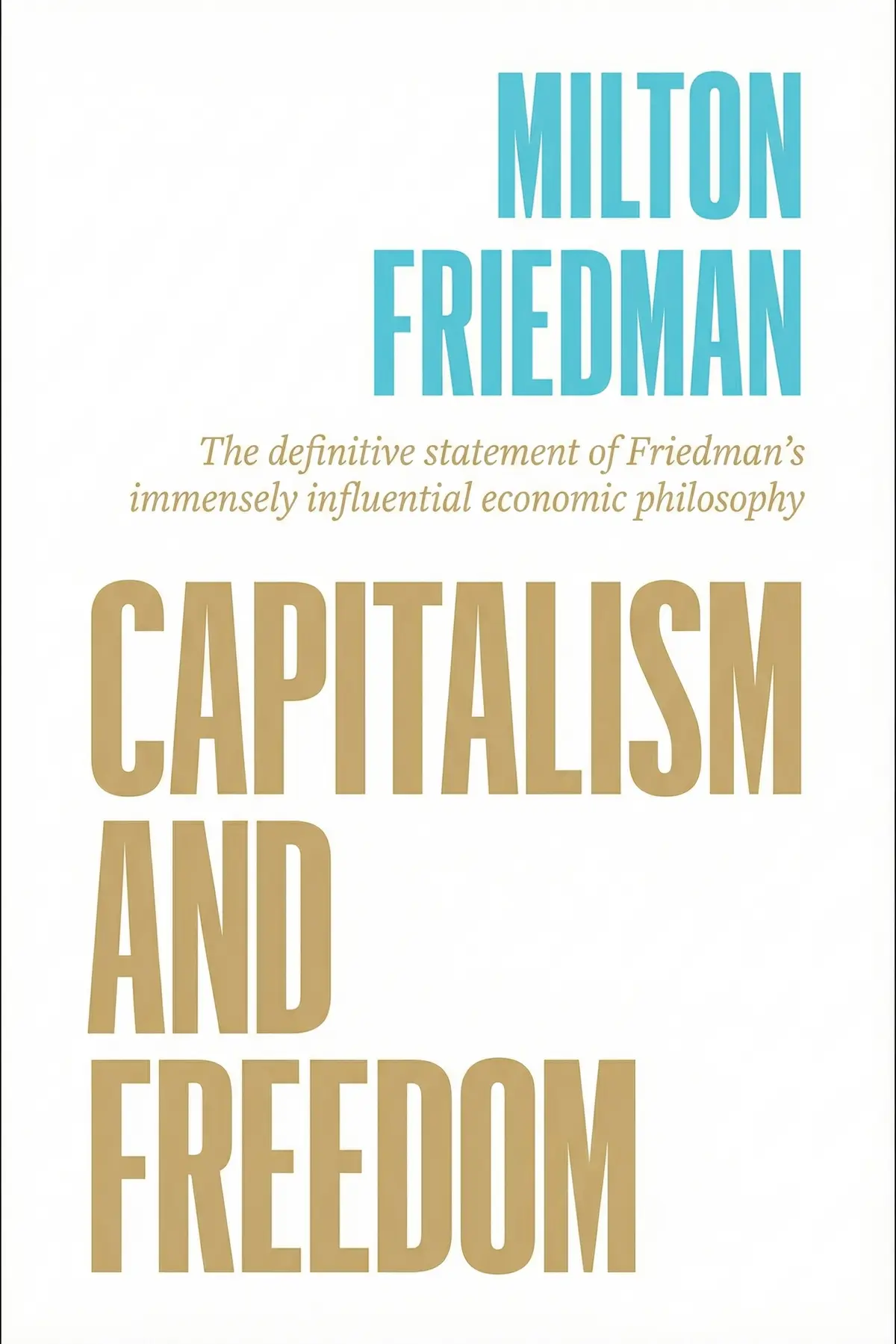
Table of Content
1. Introduction
1 min 08 sec
Most arguments about taxes, schools and welfare run on instinct, and they stall as soon as someone asks what the state is actually for. In Capitalism and Freedom, first published in 1962, Nobel-winning economist Milton Friedman answers in one line: the government should set and enforce the rules of the game, then leave the playing to free people. His boldest claim is that economic and political liberty cannot be pulled apart. A state that controls what you buy and sell ends up controlling where you go and what you think.
From there he argues that well-meant intervention in spending, money, schooling, industry and welfare tends to produce the very harms it promises to cure. That case matters again now, since the 2008 crash brought state-led economics back into fashion. Follow his reasoning and you gain a consistent test for any policy proposal. You also get a set of concrete alternatives, from school vouchers to a cash floor for the poor, to weigh against the ones on offer today.
2. See why your wallet and your vote are linked
1 min 58 sec
A British tourist priced out of a holiday and an American barred from visiting Moscow seem to face different problems. Friedman sees one problem, and it changes how you judge any promise to mix planning with liberty.
3. Spot why stimulus spending arrives too late
1 min 45 sec
The idea that government spending can steady a shaky economy became standard thinking after the Great Depression. Friedman thinks it works well on paper and breaks down in practice, and timing is only part of the reason.
4. A steady money rule beats expert judgment
1 min 54 sec
Most people blame the Great Depression on the stock market or reckless banks. Friedman points to a decision made by a handful of officials, and his fix asks them to give up the very power they used.
5. Spot the policies that quietly create monopolies
1 min 59 sec
Monopolies look like the natural result of markets left alone. Friedman argues that some of the strongest ones grow from help the government gives, and that his idea of competition has little to do with beating rivals.
6. Judge public spending by who really benefits
1 min 58 sec
Friedman supports taxes for basic schooling but not for a doctorate in particle physics. The line he draws, and his plan to let families carry funding to any school, offers a test for far more than education.
7. See how a flat tax protects equal chances
1 min 55 sec
Unequal pay looks like a problem to fix. Friedman reads it as a sign that people are free, and he argues that one common tool for fairness rests on a confusion about what equality means.
8. Replace welfare offices with a simple cash floor
2 min 00 sec
Public housing and pension schemes promise to narrow the gap between rich and poor. Friedman argues they often widen it, and his alternative would close entire departments while still putting money in poor people’s hands.
9. Conclusion
1 min 18 sec
In the end, Friedman’s book is an argument about trust. He trusts people to choose schools, save for old age, pick jobs and spend their own money. He distrusts officials who claim they can fine-tune spending, steer the money supply or shield an industry. As he tells it, society became so fixed on equal outcomes that it gave up freedom. The costly machinery it built for fairness often delivered waste, monopolies, deeper crashes and trapped neighborhoods instead. Narrow the state to a referee, he concludes, and you get stability, liberty and support for the poorest that actually works.
You need not accept every proposal to use his method. When you hear a plan for intervention, ask how long it will take to start and how hard it will be to stop. Ask who gains, the public or a narrow group, and whether the plan widens people’s choices or shrinks them. When fairness comes up, check whether the speaker means equal results or equal chances.
Those questions fit on a single card, and they work whichever side of the debate you start from. Friedman’s own answer never changed: set fair rules, then let free people play.
About this book
What is this book about?
Debates about taxes, schools, welfare and stimulus spending often run on instinct. Milton Friedman offers a single principle to judge them by. He holds that economic liberty and political liberty cannot be separated, and that both depend on a small, decentralized government whose main job is enforcing property rights and the rules of the game. From that starting point, Friedman takes on the most popular forms of intervention in turn. He argues that government spending meant to steady the economy arrives too late and lingers too long. He blames the Federal Reserve's handling of money for deepening the Great Depression. Tariffs, in his account, breed monopolies, progressive taxes confuse equal outcomes with equal chances, and welfare programs often trap the people they mean to help. He doesn't stop at criticism. He proposes concrete alternatives: a fixed yearly growth rule for the money supply, school vouchers, a flat income tax and a negative income tax that replaces welfare bureaucracies with direct cash. Readers get a clear, consistent case for limited government, and questions they can put to any policy proposal, whichever side of the argument they start from.
Book Information
Who it's for
Professionals debating economic policy
Professionals who argue about taxes, welfare and stimulus and want a clear, consistent case for limited government.
Business leaders weighing policy
Founders and managers weighing how regulation, tariffs and public programs shape their markets.
Studying economics or politics
Students of economics or politics who want the classic free-market argument in its own terms.
About the Author
Milton Friedman
Milton Friedman was born in Brooklyn, New York, studied mathematics and economics at Rutgers University and taught at the University of Chicago, where he was a leading figure of the Chicago school of economics. He championed monetarism, developed the permanent income hypothesis and won a Nobel Prize for work on consumption, monetary history and theory, and stabilization policy. He wrote Free to Choose with his wife, Rose D. Friedman, advised Ronald Reagan and Margaret Thatcher, and founded the organization now called EdChoice.
Ratings & Reviews
Ratings at a glance
What people think
Listeners find this book to be a remarkable resource that provides profound perspective on the economy and its underlying mechanics. Furthermore, the work acts as a roadmap for liberty, highlighting the crucial tie between economic systems and personal freedom, and is widely considered a scholarly staple that students should study. That said, the prose style results in varying feedback; while some consider it well-crafted, others suggest it is written in an obtuse manner.
Top reviews
Chee
This foundational text offers a striking blueprint for how we should view the relationship between the state and the individual. Friedman argues with a level of clarity that makes it obvious why he is considered an academic classic. Personally, I found the connection he draws between economic freedom and political liberty to be the most compelling part of the entire work. If you don't have the right to spend your own money, do you really have any rights at all? He tackles big subjects like the Federal Reserve and international trade with a confidence that is refreshing. While the book was written in 1962, the arguments feel incredibly relevant to our current national debt crisis. It is an amazing read that provides deep insight into the economy without being overly bogged down in math. Every student should read this to understand the roots of modern liberalism.
Show moreTeng
Rarely do I encounter a work that so effectively bridges the gap between high-level economic theory and the practicalities of personal liberty. Friedman is a master of logic. He doesn't just preach about the free market; he explains exactly how government intervention in areas like education and occupational licensure actually hurts the very people it's supposed to help. His proposal for school vouchers was decades ahead of its time. To be fair, some of the chapters are quite dense and require a slow pace to fully absorb the weight of his claims. However, the effort is well worth it for the sheer volume of insight provided. This isn't just a book about capitalism; it's a manual for human dignity. I finally understand the 'market-based' solutions everyone is always arguing about on the news. This is essential reading for anyone who values freedom.
Show moreRafael
Wow, I didn't realize how much of our current understanding of the Federal Reserve and international trade was shaped by this single volume. This book serves as an incredible blueprint for freedom by highlighting the inextricable link between our economic choices and our personal liberties. Friedman’s arguments are logically consistent and presented with a level of respect for the opposition that is sorely missing today. Even when discussing radical ideas like the negative income tax, he remains grounded in a desire for efficient, limited government. It’s an academic classic that every student of history or economics should have on their shelf. Truly an amazing read that offers deep insight into the workings of our world. It changed the way I think about 'social responsibility' and the role of the state. Simply brilliant.
Show moreFort
Picked this up after seeing it referenced in almost every political debate I’ve witnessed lately. Frankly, it’s a lot more nuanced than I expected. Friedman provides a clear insight into the economy and how government intervention often does more harm than good. I especially liked his take on the Great Depression and the role of the Federal Reserve. It’s an academic classic for a reason. However, some sections are definitely written in an obtuse manner that makes you reread pages. This isn't a quick beach read. Still, the connection he draws between economics and personal freedom is essential for understanding modern politics. It helped me see the logic behind 'market-based' solutions. Even if you don't agree with every point, the intellectual journey is rewarding. It's a meaty work that challenges your assumptions.
Show moreMarco
Is it possible for a book to be both incredibly influential and somewhat frustrating in its prose? Friedman is a genius, but the truth is that his writing style can be a bit of a slog. He moves from printing money to registering doctors with a speed that can leave you dizzy. Despite the occasionally obtuse phrasing, the core message is a powerful blueprint for freedom. He makes a passionate case for why the government should stay out of our wallets and our lives. I found the chapter on the distribution of income particularly fascinating, especially his early thoughts on a flat tax. It’s an amazing read if you have the patience for it. You can see his fingerprints on almost every major economic policy of the last forty years. This book is a true heavyweight of the 20th century.
Show moreWachira
The chapter on occupational licensure was the real standout for me, even if I’m not entirely sold on his radical proposal to deregulate the medical field. Friedman is at his most provocative here, arguing that even doctors shouldn't need a state license to practice. It’s a bold stance that highlights his absolute commitment to free-market competition over state-mandated barriers. Gotta say, I appreciated how he addressed the 'social responsibility' of business, essentially arguing that a company's only duty is to its shareholders. While some might find that cold, his logic is remarkably consistent throughout the entire book. This is a foundational text for anyone trying to understand why our economy operates the way it does. The insight provided here is invaluable for understanding the push for limited government. It’s a dense read but highly recommended for those interested in policy.
Show moreJan
After hearing so much about neoliberalism, I wanted to go straight to the source to see what all the fuss was about. Milton Friedman is certainly a radical, seeking to overturn much of what we take for granted regarding government activity. He rails against monopolies, but only when they are backed by the state or trade unions. Look, his focus on the individual over the collective is the heartbeat of this book. While I found some of his arguments about the Nuremburg laws and discrimination laws a bit extreme, his devotion to principle is impressive. The writing can be dry, but the logic is usually quite tight. It provides a fascinating blueprint for freedom that values the market above all else. This book helped me realize how much our current system is built on these 1960s ideas. Definitely worth a look.
Show morePrayoon
To be fair, Friedman is a much more respectful debater than the modern pundits who claim to follow in his footsteps. I found his analysis of 'neighborhood effects' and the role of government in education quite thought-provoking, even if I’m not ready to fully embrace the voucher system. Look, the prose is a bit dry and can feel like a slog at times, which makes the more complex theories even harder to digest. He rails against equality in a way that feels somewhat mean-spirited to a modern reader. However, the intellectual rigour he brings to the table is undeniable. It’s a dense, meaty work that forces you to re-evaluate your stance on the Federal Reserve and the necessity of occupational licensure. Not perfect, and certainly written in an obtuse way at times, but definitely educational. It's a classic for a reason.
Show moreClaire
Ever wonder how one man’s ideas could shift the entire global financial landscape over the course of a few decades? This book is that catalyst. While I appreciate the insight into the economy and the call for floating exchange rates, I struggled with Friedman’s utopian vision. It feels a bit like sophistry at times, where the market is treated as a perfect god and the government as a bumbling demon. In my experience, reality is usually somewhere in the middle. The writing is academic and frequently obtuse, which might turn off casual readers looking for a quick summary. That said, it is a blueprint for freedom that everyone should at least be familiar with. You can't understand modern America without understanding Friedman. Just be prepared for a difficult read that ignores the reality of wealth inequality.
Show moreWatcharaporn
Not what I expected from a supposed 'classic' of economic literature. While Friedman is clearly brilliant, the truth is that much of this feels like high-level sophistry designed to protect the interests of the wealthy under the guise of 'freedom.' I struggled with his dismissive tone regarding trade unions and his insistence that the market can solve deep-seated issues like racial discrimination. The writing style is frequently obtuse, making it a difficult slog for anyone not already steeped in 1960s economic jargon. Frankly, I think we've seen the consequences of these theories in our modern era, and the resulting inequality is hard to ignore. It’s an important historical document, but it’s certainly not the perfect roadmap many claim it to be. If you want a one-sided ideological exercise, this is it. Otherwise, look elsewhere for actual economic science.
Show moreQuestions about this book
What is the main idea of Capitalism and Freedom?
Milton Friedman argues that economic freedom and political freedom depend on each other, so restricting one restricts the other. Both, he says, need a small, decentralized government whose main job is enforcing property rights and the rules of the game. When the state goes further, in spending, monetary policy, schooling, industry or welfare, Friedman argues it tends to cause waste, instability and the very inequality it set out to reduce.
What is Milton Friedman's negative income tax?
Friedman proposes abolishing government welfare schemes such as public housing and replacing them with one measure. Anyone who earns less than a set minimum income would receive a cash payment directly from the government. He argues this relieves poverty more efficiently because it removes costly bureaucracies, lowers the burden on taxpayers and lets people decide for themselves how to use the money.
What did Friedman say caused the Great Depression to be so severe?
Friedman blames much of the damage on the Federal Reserve. From July 1929 to March 1933, the supply of money fell by a third while the Fed chose not to act, turning a minor contraction into a crisis in which incomes halved and prices fell more than 30 percent. His remedy is a fixed rule: grow the money supply by 3 to 5 percent every year.
Why does Friedman support school vouchers?
Friedman accepts public funding for kindergarten through high school because basic literacy and arithmetic benefit everyone, which he calls a neighborhood effect. But he wants the money to follow the child. Each family would receive a voucher per child to spend at any school, so schools compete for students, costs fall and curricula improve to suit local communities. He does not extend this public role to university study.
How can I apply the ideas in Capitalism and Freedom?
Use Friedman’s questions to test any policy or program. Ask how quickly it can start and how hard it will be to stop. Ask whether the benefits reach the public or mainly the individuals served, and whether it widens or narrows people’s choices. In debates about fairness, check whether people mean equality of outcome or equality of opportunity, the distinction at the center of his case for a flat tax.
Readers also enjoyed

A River in Darkness: One Man’s Escape from North Korea
Masaji Ishikawa

A Splendid Exchange: How Trade Shaped the World
William J. Bernstein

A Theory of Justice
John Rawls





A Warning
Miles Taylor
AUDIO SUMMARY AVAILABLE
Listen to Capitalism and Freedom in 15 minutes
Get the key ideas from Capitalism and Freedom by Milton Friedman, plus 5,000+ more nonfiction titles.
- 5,000+ titles
- Listen as much as you want
- 7-day free trial
- Cancel anytime









