



13 min 31 sec
Available in: English
Buy Back Your Time: Get Unstuck, Reclaim Your Freedom, and Build Your Empire
By Dan Martell
A guide for founders who still do every job themselves. It shows how to work out what you can afford to delegate, how to hire and train well, and how to spend the hours you win back.
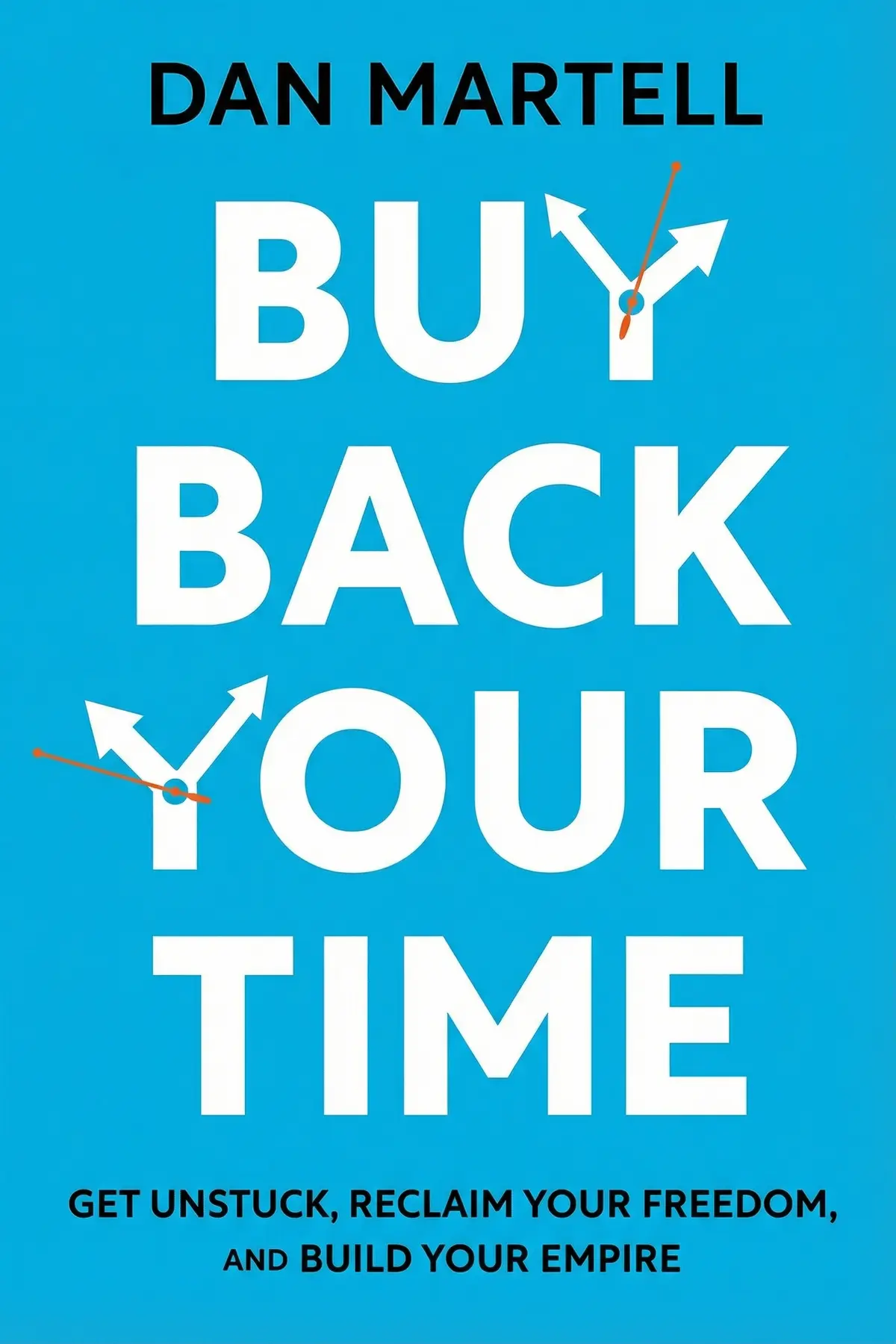
Table of Content
1. Introduction
1 min 02 sec
Plenty of founders hit a ceiling that has nothing to do with their market. They are still doing every job themselves, and they have run out of hours. In Buy Back Your Time, Dan Martell, who built and sold three tech companies in a decade, makes a blunt case: paying someone to take over your work will earn you more money, because it frees you for the work only you can do.
His method rests on one step, hiring the right people, and on a new way of thinking about why you hire. In Martell’s view, a new hire’s real job is to give your time back, and the tasks they cover come second. From that idea he builds a full system. It includes a way to sort your tasks, a formula for what you can afford to spend, and a routine for hiring and training. It adds a way of leading that makes people own their work, and a plan for the hours you win back. Each piece moves you from doing everything to directing what matters, and you can start each one this month.
2. Pay others and earn more yourself
1 min 46 sec
A famous thriller writer stopped writing many of his own novels, and his franchise grew bigger. Martell uses that choice to explain why so many businesses stall at the same size, and what owners do instead.
3. Sort every task into four boxes
2 min 02 sec
Oprah Winfrey starts serious work after lunch and stops two hours later. Martell argues her day follows a pattern anyone can copy, and it begins with deciding which of your tasks you should never touch again.
4. Work out what you can afford to hand off
1 min 55 sec
Hiring help sounds like a luxury for people with big budgets. Martell offers a short calculation that puts a real hourly figure on what you should already be spending, even on a modest income.
5. Hire and train once, not every day
1 min 57 sec
A five-minute video can tell you more about a candidate than a polished resume. Martell’s hiring and training routine is built so that you explain a job one time and never again.
6. Get ownership by handing over outcomes
1 min 46 sec
Two managers ask for the same result and both get it. One spends a fortune and teaches nobody anything, while the other saves money and grows a person. The difference is a single sentence.
7. Turn bought-back hours into your biggest plans
1 min 52 sec
Freed time has a way of filling up with small things again. Martell’s answer involves a villa in the south of France, a bucket of rocks and one two-week trip that covers all your office sites.
8. Conclusion
1 min 11 sec
Martell’s book turns a common habit around. Most founders treat their own hours as free and other people’s as expensive. So they keep the invoices, the inbox and the sales calls, then wonder why growth stops near the Pain Line. He flips that accounting. Your time has a price, and a quarter of your income spent on the right help returns more than it costs, because it sends you back to the work only you can do.
The models are Clancy handing his plots to ghostwriters and Oprah doing two concentrated hours after a long, unhurried morning. Both decided their hours were worth more spent on ideas than on chores.
You can start smaller than either of them. Work out your buyback rate and hire for the job that eats most of your week, beginning with someone who reads your email first. Record the task you explain most often, so training happens once. When you hand over work, hand over the outcome and the measure, then coach. Each step returns hours. Each returned hour belongs in the production quadrant, where the business you imagined finally gets built.
About this book
What is this book about?
Many entrepreneurs reach a point where the business stops growing because the owner has run out of hours. They review code, answer every email and run the sales calls, and the long days wear down their health, family life and creativity. Dan Martell calls this the Pain Line, and he argues that most founders who hit it end up selling, sabotaging or stalling. His alternative is the Buyback Principle: audit where your time goes, hand the low-value work to people who do it better, and fill the freed hours with the work only you can do. Martell gives a simple formula for how much of your income to spend on help. He also explains how to sort tasks into four quadrants, how to hire with videos and paid test projects, and how to train with a playbook. Readers also get a leadership style that makes employees own outcomes, plus a planning method built on a perfect week, a 10X vision and a year arranged around big rocks. The promise is practical: fewer hours spent on chores and more spent building the company you actually want.
Book Information
Who it's for
Founders still doing everything
Founders past their first hires who still answer every email and run every sales call.
Owners near seven figures
Small business owners near a million in revenue who feel stuck, tired or tempted to sell.
Team leads wanting self-starters
Team leads who want staff to own results instead of waiting for instructions.
About the Author
Dan Martell
Dan Martell founded, grew and sold three technology companies in ten years. In 2012 he was named Canada's top angel investor, having backed more than 50 start-ups, among them Intercom, Udemy and Unbounce. In 2016 he launched SaaS Academy, a coaching program for business-to-business software founders that has worked with more than 1,000 companies, including ClickFunnels, Proposify and Carrot. He is also an Ironman athlete and a father of two boys.
Ratings & Reviews
Ratings at a glance

What people think
Listeners consider this business book to be an essential listen, loaded with hands-on, implementable guidance that teaches significant lessons about managing one's time. The content is clear and accessible, assisting listeners in hitting their targets and refining their work-life balance. They view it as life-altering, with one listener stating it enhances both private and professional pursuits, while another listener mentions it is worth every cent.
Top reviews
Jom
Finally, a business book that doesn't just preach theory but actually hands you the shovel to dig yourself out of the weeds. Dan Martell’s philosophy on the ‘Buyback Loop’ is a game-changer for anyone feeling suffocated by their own success. I’ve read countless productivity guides, but the focus here isn't just on doing more; it’s about reclaiming your energy to focus on what he calls your 'Zone of Genius.' The frameworks are incredibly actionable, especially the audit process which exposed how much time I was wasting on $15-an-hour tasks. Frankly, it’s a manual for scaling without burning out. While the pace is intense and very ‘work hard, play hard,’ the ROI on my time has already shifted significantly. If you are serious about building a business that doesn't own you, this is worth every cent.
Show moreJan
The concept of the 'Buyback Loop' is worth the price of admission alone. Most gurus tell you to work harder, but Martell teaches you how to buy your freedom back by systematizing and then offloading the things that drain you. I’ve started implementing the 'Audit, Transfer, Invest' cycle and the results in my personal life are already visible. My head was about to explode with the mental load of my company, but the chapter on building an team around your own liberty was eye-opening. It’s an easy, quick read that manages to be both motivating and practical. For anyone who feels like their business has become a cage, this book provides the key to the lock. Truly life-changing stuff if you actually do the work.
Show moreYanin
Ever wonder why you're working 80 hours a week and still feel like you're falling behind? This book explains exactly why: you’re spending your time on the wrong things. Martell’s approach to time management isn't about squeezing more minutes out of the day, but about shifting your focus to high-value activities that actually generate growth. The advice on creating SOPs and systematizing before you even think about hiring was a total lightbulb moment for me. Truth is, I was hiring people just to 'do stuff' without a plan, which just created more work. This book fixed that. It’s straightforward, easy to understand, and packed with tools that you can use the same day you read them. It has completely elevated my professional endeavors.
Show moreJob
Martell’s approach to the '4 Quadrants of Work' changed my entire hiring strategy this quarter. Instead of looking for people to just fill roles, I’m now looking for people to buy back my time in very specific areas. The book is incredibly well-crafted and offers a fresh take on foundational topics like delegation and automation. I especially liked the emphasis on reinvesting the time you save into your health and family, rather than just filling it with more work. It’s about building an empire without losing your soul in the process. Some of the concepts might be familiar if you read a lot of business books, but the way he structures the 'Buyback Loop' makes it so much easier to implement than anything else I’ve found.
Show moreThida
Wow, this completely flipped the script on how I view my own hourly worth. I used to feel guilty about paying someone to handle my laundry or grocery shopping, but after reading the chapters on the Return on Time, I see it as a necessary investment for my business growth. Martell shows you how to design your life and business around freedom, not just profit. The writing is snappy and punchy—no fluff, just straight to the point. It’s easily one of the most practical guides to leadership I’ve encountered in years. Whether you're a startup founder or just someone looking to improve your work-life balance, there is something in here that will make your head spin in the best way possible. Truly a must-read for the modern age.
Show moreFatou
As a small business owner drowning in endless emails and admin, this book felt like a lifeline thrown into a stormy sea. Martell breaks down the mechanics of delegation in a way that feels achievable rather than overwhelming. I particularly appreciated the '4 Quadrants of Work' section—it helped me realize I was stuck in a zone of competence rather than excellence. To be fair, the book is very clearly written for entrepreneurs and high-level founders, so if you’re an entry-level employee, some of the advice on hiring a house manager might feel a bit out of touch. Not gonna lie, it’s a bit ‘tech-bro’ in its delivery, but the core systems are too good to ignore. It definitely got me thinking about my long-term strategy.
Show moreSomboon
Picked this up on a whim after seeing it on Instagram, and it's surprisingly solid for a modern business book. It focuses heavily on the idea that the key to success isn't working more, but regaining control over your schedule. Martell is very high-energy—his 'work hard, play hard' vibe isn't for everyone, but his logic is hard to argue with. I loved the section on the '4 Quadrants' and how to identify tasks that give you energy versus those that drain you. In my experience, most people stay stuck because they are too proud to delegate the 'small' stuff, and this book calls you out on that ego. It’s a fast read, very direct, and though it’s aimed at the high-scale crowd, the principles apply to anyone trying to be more efficient.
Show moreNook
Truth is, I’ve read a dozen books on time management, but this is the first one I actually started implementing before I even finished the third chapter. Dan Martell has a way of making complex scaling issues feel like a simple math problem. If your time is worth X and you can pay someone Y to do it, you’re losing money by doing it yourself. Simple, right? Yet so many of us fail to do it. The book is definitely written for the entrepreneur mindset, but even an admin assistant could learn a lot about how to be more valuable to their boss here. My only gripe is that it can feel a bit repetitive at times, but maybe that's what's needed for the message to finally sink in. Solid 4 stars.
Show moreFrida
To be fair, there are moments where Martell feels slightly out of touch with the average person’s daily reality. Not everyone can afford to hire a house manager to handle their personal mental load or offload every 'dirty work' task to an assistant immediately. While the core ideas about the Return on Time (ROT) are mathematically sound, the execution assumes a level of capital that many startups simply don't have in the beginning. Also, I noticed a weird lack of diversity in the anecdotes; it’s almost exclusively stories about male tech founders, which made it harder for me to relate as a female executive. Look, the frameworks are definitely solid and the 'Buyback Loop' is a smart way to think about growth, but the tone can be a bit extreme and narrowly focused.
Show moreDing
Look, I really wanted to love this because the premise is great, but the lack of representation is impossible to ignore. Almost every successful example or anecdote in the book features a man, usually in the tech space, which confirms a pretty narrow bias about who can lead high-growth companies. Aside from a quick mention of Oprah, the female perspective is virtually absent unless it’s a reference to an assistant. Beyond that, the advice is very specific to entrepreneurs who already have some level of success. If you're an average person trying to manage a household and a job, being told to hire a house manager feels more like a flex than a helpful tip. There are a couple of great ideas about auditing your time, but the delivery felt very exclusionary and 'bro-centric' to me.
Show moreQuestions about this book
What is the main idea of Buy Back Your Time?
Dan Martell argues that entrepreneurs should hire people to take over low-value work so they can spend their own time on the creative, high-value work that grows the business. He calls this the Buyback Principle: audit your hours, hand off the tasks that drain you to someone who does them better, and fill the freed time with work you enjoy and that brings the biggest returns.
How do you calculate your buyback rate?
Martell’s formula is your yearly income divided by 2,000 hours, then divided by four. Someone earning $200,000 a year gets a rate of $25 an hour, enough for a part-time personal assistant. At $50,000 a year the rate is $6.25 an hour, which can still pay for freelancers from sites like Upwork, interns or people working on commission.
What are the four quadrants in Buy Back Your Time?
Martell sorts tasks into delegation, replacement, investment and production. Delegation covers easy hand-offs like invoices and travel, usually given to an assistant. Replacement covers harder roles like sales and marketing. Investment holds what builds you and others, such as family time, hobbies and conferences. Production is the inspiring, high-value work where Martell wants owners to spend most of their time.
What is the Pain Line according to Dan Martell?
The Pain Line is the point where a founder doing everything starts to break down. Martell says it typically arrives at about twelve direct reports and more than $1 million in revenue. At that stage most owners sell the business, sabotage it by chasing too many directions, or stall out of fear. His Buyback Principle is offered as the fourth path.
How does Martell suggest training new employees?
He recommends a playbook built on four Cs. Camcorder means recording yourself doing the task. Course is a short list of high-level steps. Cadence notes how often the task happens. Checklist names the steps that can never be skipped, such as counting the cash and locking the cash box at a bakery. One good playbook replaces hours of one-on-one training.
Readers also enjoyed


7 Powers: The Foundations of Business Strategy
Hamilton Helmer



Alibaba: The House That Jack Ma Built
Duncan Clark



168 Hours: You Have More Time Than You Think
Laura Vanderkam
AUDIO SUMMARY AVAILABLE
Listen to Buy Back Your Time in 15 minutes
Get the key ideas from Buy Back Your Time by Dan Martell, plus 5,000+ more nonfiction titles.
- 5,000+ titles
- Listen as much as you want
- 7-day free trial
- Cancel anytime









