

59 Seconds: Change Your Life in Under a Minute
Richard Wiseman
 English
Shows how to set goals that are specific, demanding and meaningful, then reach them with Goal Setting Theory and a six-step method covering purpose, people, resources, decisions, grit and excellence.
1 min 16 sec
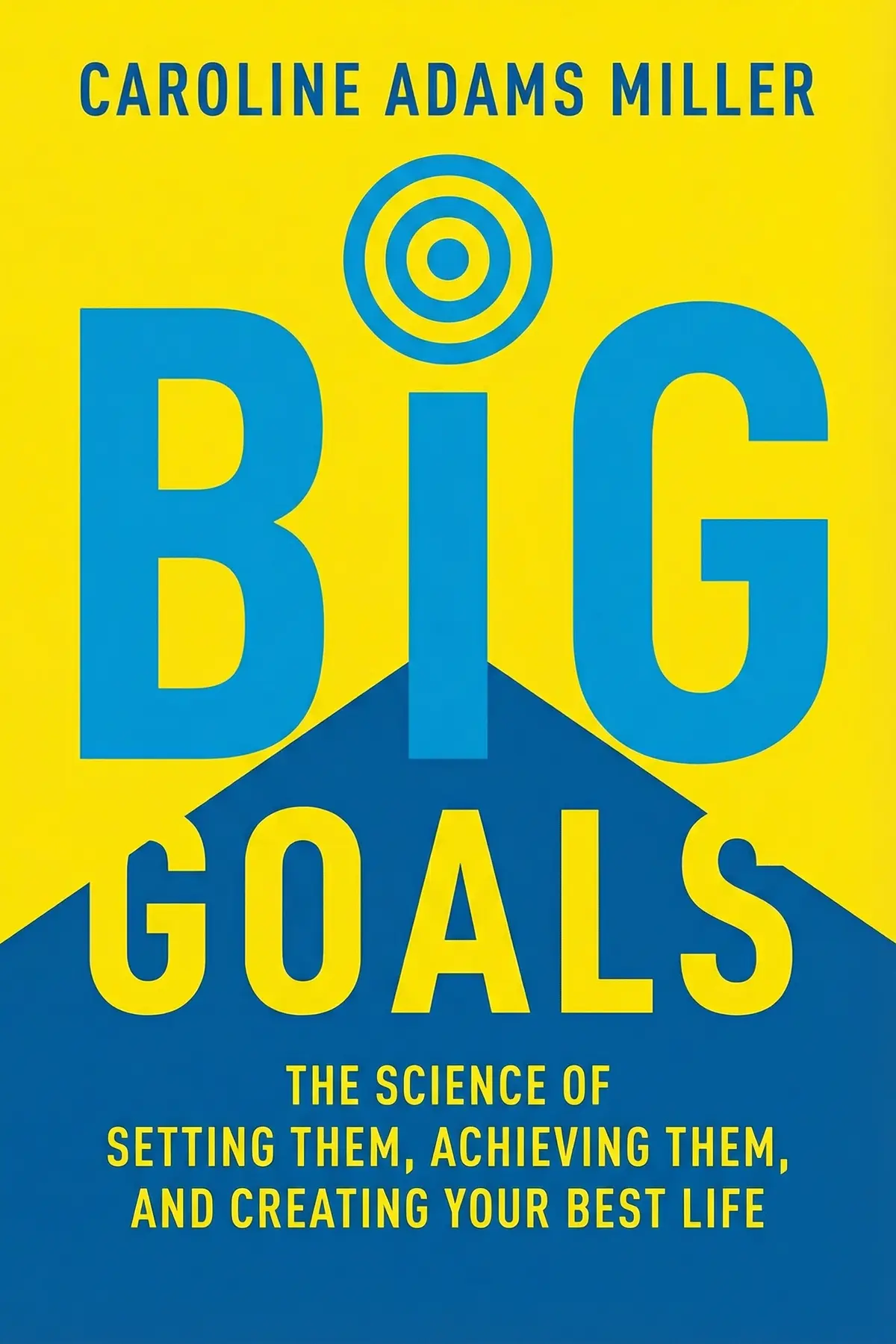
Most people chase their goals with vision boards and to-do lists, and most of that advice has never been seriously tested. In Big Goals, positive psychology coach Caroline Adams Miller argues that a stronger tool has been around for decades: Goal Setting Theory, built by psychologists Edwin Locke and Gary Latham, which shows that clear, challenging goals beat vague or easy ones. Miller came across that research as a student in 2005 and has shaped it into a six-step method she calls BRIDGE, where the letters represent Brainstorming, Relationships, Investments, Decision-making, Grit, and then Excellence.
Her argument fits in one sentence. A big goal is reached when it is specific and stretching, chosen for a real purpose, and supported by the right people, resources, judgment and kind of persistence.
The evidence includes a golfer who recorded every shot, an athlete-entrepreneur who handed off everything except his best work, and a 14-year-old swimmer who named a bolder goal over a casual meal. Each step gives you a way to test your own ambition and find the support it is missing.
2 min 05 sec
Settling for a vague or easy goal can seem like the sensible, gentle choice. Decades of research suggest it quietly holds people back, and the fix asks for something most of us avoid when we set targets.
1 min 50 sec
A dream feels too big to plan, and a plan feels too small to excite anyone. A short writing exercise and an amateur dancer’s first week show how to hold on to both at once.
1 min 42 sec
Some people leave you buzzing after you share a plan, and others leave you doubting it. Miller gives these two groups names and offers a simple drawing that shows where your hours should go.
1 min 55 sec
A golfer without the size of his rivals climbed into the world’s top ten, and a busy founder finishes Ironman races. Neither did it by working longer. The difference lies in where they put their resources.
1 min 47 sec
Judges, doctors and loan officers can reach different answers to the same question on different days. Your own choices about a goal drift the same way, and a week of notes can reveal when.
1 min 54 sec
Persistence is praised in almost every success story, yet the same drive sits behind some of business’s worst collapses. Miller draws a line between two kinds of grit, and only one of them is worth copying.
1 min 40 sec
A teenage swimmer gave her coach a cautious answer about the season ahead, and he asked for more. What happened next shows how the right person can stretch a goal without stealing it.
1 min 08 sec
Miller’s case is that a big goal is less a burst of willpower than a structure built from two ends. On one end stands the science Locke and Latham established: a clear, demanding target held with commitment and checked with feedback. On the other stand the human supports that keep a person climbing: purpose, good company, careful spending, steady judgment and grit that still listens. When goals are poorly planned, things can collapse, which is how bold but unsustainable promises ended in the wreckage of companies like Enron.
The first moves are small. Take one goal and write it so you could prove on a given date whether you met it, then name what could derail it and who has done something similar before. Draw the people it depends on and notice who leaves you with more energy. For one week, log your decisions and look for the days when tiredness made them for you.
Then find your own Suguiyama. A teenager’s goal changed at a dinner table because one trusted person would not settle for the safe answer.
Most goal advice relies on vision boards, lists and pep talks, and Caroline Adams Miller argues that much of it rests on ideas no serious research supports. Her alternative starts from Goal Setting Theory, the work of psychologists Edwin Locke and Gary Latham. They found that clear, challenging goals, held with commitment and checked with feedback, beat vague or easy ones. Miller turns that research into a six-step method called BRIDGE, whose letters stand for Brainstorming, then Relationships, then Investments, followed by Decision-making, and finally Grit along with Excellence. Each step covers part of the work the theory alone leaves open. It starts with finding a purpose and imagining your best possible future self. It continues through mapping the people who energize or drain you, spending time and money with care and auditing your own decisions for noise. It ends with telling healthy persistence apart from the reckless ambition behind collapses such as Enron and Theranos. Along the way she pays attention to people that traditional advice overlooks, including women facing double standards at work. Readers get questions, exercises and stories. Golfer Matt Fitzpatrick tracks his game shot by shot, and swimmer Katie Ledecky changes her goal over a casual meal with her coach. The result is a framework for goals that are both ambitious and reachable.
Professionals whose goals stay vague and who want a research-based way to make them sharp and demanding.
Career switchers and founders who need the right people, resources and judgment behind a big ambition.
Women and others who find standard goal advice ignores the barriers they face at work.
Caroline Adams Miller was among the first people to earn a Masters in Applied Positive Psychology from the University of Pennsylvania, in 2006, and graduated magna cum laude from Harvard. Her books include Creating Your Best Life, which joins the science of happiness with the science of reaching goals, and Getting Grit. She has also written memoirs, among them My Name is Caroline, about her recovery from bulimia. She works with clients around the world, gives keynotes and workshops, and has taught executive education at the Wharton School.
Listeners describe the book as absorbing and simple to navigate, commending the thorough method for establishing goals and the usable techniques provided. Additionally, they value the hands-on activities and inventive material, as one listener points out that the evidence-based framework turns transformative concepts into reachable goals. On the other hand, opinions on the complexity vary, with one listener characterizing the work as profoundly challenging.
After hearing Caroline Adams Miller speak on a podcast, I knew I needed to dive into the full BRIDGE framework. This isn't your standard, fluffy self-help manual that relies on empty platitudes. Instead, Miller anchors every suggestion in Goal-Setting Theory, providing a rigorous roadmap for anyone tired of the outdated SMART goals system. I particularly resonated with the 'Brainstorming' phase, which uses the concept of 'ikigai' to ensure your ambitions actually align with your soul. The writing is crisp and authoritative, yet accessible enough to finish over a weekend. Frankly, the distinction between 'good grit' and 'stupid grit' is a game-changer for high achievers who are on the verge of burnout. It’s a comprehensive, science-backed guide that turns vague aspirations into a structured reality. If you are serious about your 'best possible future self,' this is the text you need on your nightstand.
Show moreFinally got around to reading a book that doesn't just tell you to 'dream big' but actually shows you how to build the scaffolding for those dreams. As a midlife woman looking for a career pivot, I found the BRIDGE framework—Brainstorming, Relationships, Investments, Decision-making, Grit, and Excellence—to be the exact structure I was missing. Miller’s writing style is engaging and energetic, making even the complex psychological theories feel like a conversation with a mentor. The focus on 'authentic pride' over superficial accomplishments really hit home for me. I’ve already started my relationship mind map to identify who is actually fueling my growth. This book is a treasure trove for anyone who feels stuck. It’s rare to find a guide that is this actionable and this deeply rooted in evidence-based research. Highly recommended for those ready to do the work.
Show moreWow, Miller really knocked it out of the park with this science-based roadmap. I’ve always been a dreamer, but I’ve struggled with the execution phase of my 'big goals.' The BRIDGE methodology gave me the structure I didn't know I was missing, specifically the 'Decision-making' and 'Excellence' pillars. Reading about the partnership between Katie Ledecky and her coach was incredibly moving and illustrated the power of the right mentorship. This book isn't just about winning; it's about the growth and integrity you develop along the way. In my experience, most books in this category are all fluff and no substance, but 'Big Goals' is the exact opposite. It is packed with actionable steps and relatable stories that make even the toughest psychological concepts easy to grasp. It’s an essential read for any millennial looking to build a life of purpose and impact.
Show moreEver wonder why your New Year’s resolutions are dead by February? Miller explains exactly why, pointing to the lack of a structured bridge between dreaming and doing. I’ve read dozens of books on productivity, but the way she integrates the 'heliotropic effect' into goal achievement was entirely new to me. It highlights how much we need supportive networks to thrive. The journaling exercises for clarifying intrinsic motivation were tough but worth the effort. My only minor gripe is that the section on corporate failures like Theranos felt a bit long-winded, even if the lesson on ethics was clear. Still, the practical strategies for overcoming cognitive biases are worth the price of admission alone. It’s an insightful, illuminating read that challenges you to aim higher while staying grounded in reality.
Show moreThe chapter on 'Stupid Grit' alone is worth the investment of your time. Miller makes a brilliant distinction between the perseverance that leads to excellence and the stubbornness that leads to a cliff. I’ve always been a 'hustle culture' devotee, but this book helped me realize where I was ignoring feedback to my own detriment. The BRIDGE framework is a solid, evidence-based alternative to the typical advice you see on social media. I especially liked the section on 'Decision-making' and how it addresses the 'noise' that messes with our consistency. While some of the 'Brainstorming' section felt a bit familiar if you’ve studied positive psychology before, the execution and the 'best possible future self' prompts were top-tier. It's a very useful manual for anyone who wants to stop spinning their wheels and start making real progress.
Show moreThis book provides a much-needed upgrade to the antiquated SMART goal system we’ve been using for decades. Miller’s approach is far more holistic, acknowledging that we don't pursue goals in a vacuum—we need relationships and a clear sense of purpose to sustain the effort. I found the 'noise audit' section particularly relevant for my professional life, as it helped me identify why my decision-making was so inconsistent. The prose is punchy and the anecdotes about WeWork serve as a great cautionary tale for those who ignore ethics in pursuit of 'big' targets. My only complaint is that the 'Investments' section could have used more examples for non-corporate settings. Overall, it’s an inspiring and practical guide that balances high-level science with boots-on-the-ground application. It will definitely change how I approach my targets next quarter.
Show morePicked this up because I was stuck in a rut with my career transitions and needed a fresh perspective. I wasn't disappointed. The focus on 'nourishers' versus 'toxins' in the Relationships pillar was exactly what I needed to hear. It’s easy to underestimate how much the people around us dictate our success. Miller’s writing is persuasive, and she backs up every claim with solid data, which I appreciate. The BRIDGE framework is a great mental model, though I’ll admit the 'Grit' section felt a little like a repeat of things I've heard elsewhere. Still, the emphasis on humility and collaboration over 'lone wolf' success was a refreshing change from typical self-help. It’s a substantial, thoughtful book that requires you to actually stop and think. Don’t expect a quick fix; expect a deep dive into your own habits.
Show moreLook, I appreciate the depth of research here, but some of the exercises felt a bit too demanding for a reader with a frantic schedule. The BRIDGE methodology is logically sound, and I found the 'Relationships' section quite eye-opening regarding 'nourishers' versus 'toxins.' However, the 'Investments' chapter felt a little geared toward elite athletes like Matt Fitzpatrick, making it hard to translate some examples to my own middle-management life. It’s a substantial read, definitely more 'weighty' than your average airport bookstore find, which is both a pro and a con. To be fair, the science is rock solid and the 'noise audit' is a brilliant tool for better decision-making. I just wish the tone was a bit less academic at times. It’s a solid 3.5 stars for me, rounded down because it felt like a chore to get through the denser chapters.
Show moreAs someone who has read a lot of positive psychology, I found much of this content familiar, though it is exceptionally well-organized here. Miller does a great job of synthesizing Locke and Latham’s Goal-Setting Theory into something digestible. The BRIDGE methodology provides a nice checklist for ensuring you haven’t missed a crucial step, like building a supportive network or checking your cognitive biases. However, I didn’t feel like I was discovering groundbreaking new territory in every chapter. The focus on 'excellence' was a highlight, particularly the stories of mentors helping athletes reach their potential. It’s a good, solid book that offers a lot of validity to the genre, but it might feel a little redundant if you’re already well-versed in the works of Angela Duckworth or Carol Dweck. A decent addition to your library if you want everything in one place.
Show moreTo be fair, I might not be the target audience for this one, as I found the content to be profoundly challenging in a way that felt discouraging. While the BRIDGE acronym is clever, the sheer volume of tasks—from noise audits to strategic budgeting and 10,000 hours of deliberate practice—felt overwhelming rather than inspiring. I was looking for something a bit more intuitive. The stories of elite swimmers like Katie Ledecky are impressive, but they feel light-years away from the reality of an average person just trying to start a small business. Not gonna lie, the constant reference to academic theories made the prose feel a bit dry and repetitive after the first hundred pages. It’s clearly well-researched, but it lacked the 'spark' I expect from motivational literature. It felt more like a textbook for a psychology seminar than a guide for personal growth.
Show moreMiller argues that most goal advice is untested, while Goal Setting Theory, developed by Edwin Locke and Gary Latham, shows that clear and challenging goals outperform vague or easy ones. She builds on that research with her BRIDGE method, which adds purpose, supportive relationships, smart investment, careful decisions, healthy grit and a personal definition of excellence, so that ambitious goals become achievable.
The letters in BRIDGE represent six steps: Brainstorming, Relationships, Investments, Decision-making, Grit, and finally Excellence. Brainstorming asks about purpose, dreams and risks. Relationships means choosing people who energize you. Investments covers time, energy and money. Decision-making tackles bias and noise. Grit separates healthy persistence from the stubborn kind, and Excellence ties goals to your values, often with help from a mentor.
Noise, in Miller’s account, is inconsistency in judgment caused by mood, fatigue or chance, as when a judge gives different sentences for similar crimes. A personal noise audit means tracking your decisions for one week, then reviewing them for inconsistencies. The goal is to spot moments when stress, tiredness or other outside factors pushed your choices away from your real priorities.
Miller describes good grit as persistence toward worthy goals that inspires the people around you. Stupid grit ignores feedback and damages relationships, and she links unchecked drive to burnout and toxic work cultures, citing Tesla and Amazon as examples. Her advice is to pair persistence with humility, collaborate and learn from mistakes instead of chasing success at any cost.
It suits people who set goals but rarely reach them, professionals who want a method grounded in research instead of vision boards, and anyone planning a big change such as a new career or business. Miller also writes for women and other groups who face double standards and harsher feedback, and who often find that traditional goal advice leaves them out.
Richard Wiseman





William B. Irvine


Andrew D. Thompson


Deepak Chopra
AUDIO SUMMARY AVAILABLE
Get the key ideas from Big Goals by Caroline Adams Miller, plus 5,000+ more nonfiction titles.









