

14 min 19 sec
Available in: English
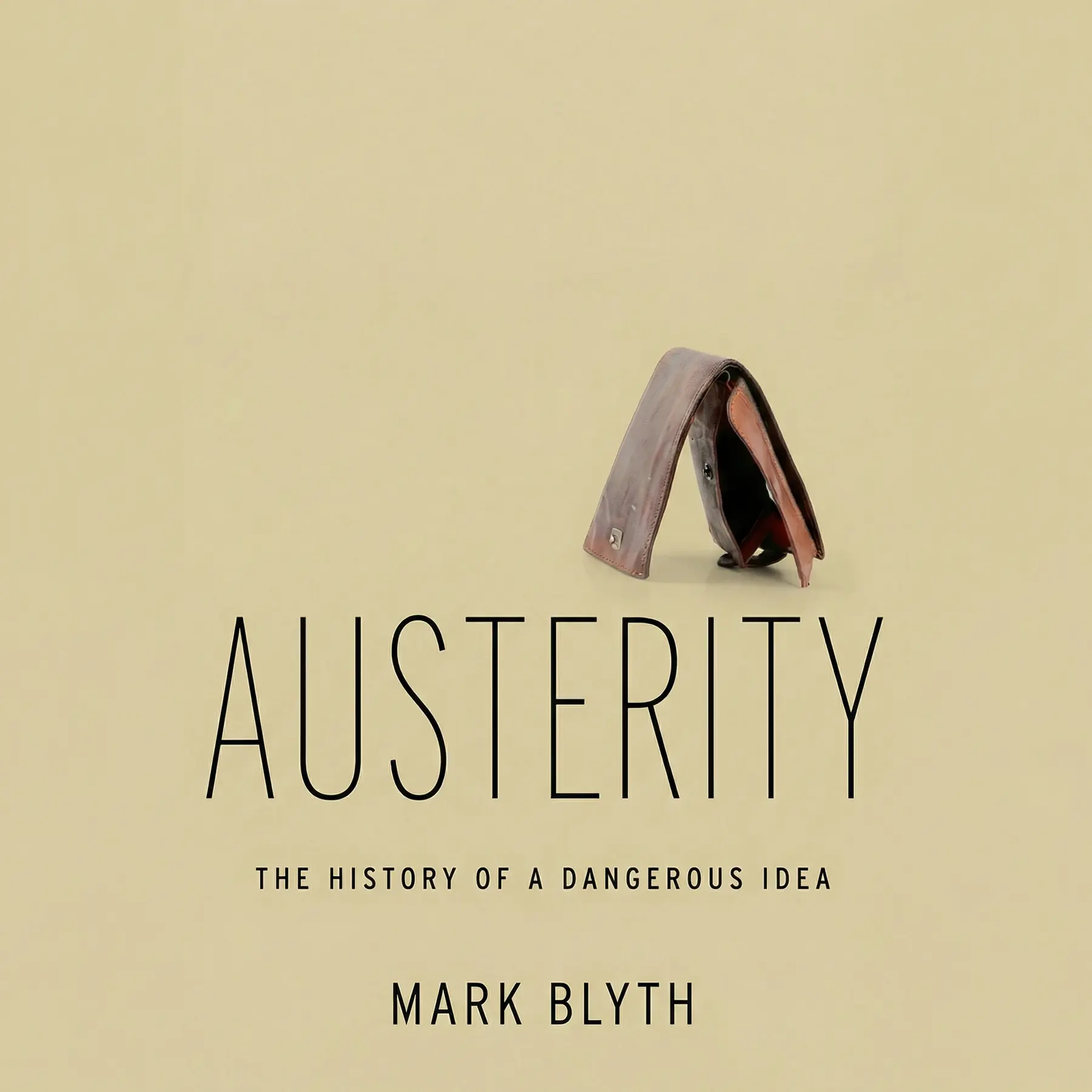
Austerity: The History of a Dangerous Idea
By Mark Blyth
Explains why cutting public spending during a crisis tends to shrink economies and swell debts. It also shows who ends up paying for bank bailouts and what Iceland's very different response suggests governments could do instead.

Table of Content
1. Introduction
1 min 03 sec
If calls for national belt-tightening sound sensible to you but you could not say why, Mark Blyth offers a sharper way to judge them. In Austerity: The History of a Dangerous Idea, the Brown University economist argues that cutting public spending to fix a national debt shrinks the economy and swells the debt. He adds that the people with the least suffer most.
After the 2008 crash, Europe was told that overspending governments in places like Greece and Spain were to blame, and that deep cuts were the cure. Blyth contends that the blame was misplaced, that the burden fell on the wrong people and that the cure did not even work. His throughline is direct: private banks caused the crisis, governments turned it into public debt, and austerity made ordinary citizens pay, even though better options existed.
By the end, the next time a leader asks a country to tighten its belt, you will know which questions to ask. You will also know whose belt is really being tightened.
2. See how one family's thrift can sink a nation
1 min 59 sec
Cutting back is exactly what a sensible household does when money runs short. So why does the same move, made by a whole country, so often leave everyone poorer and more indebted than before?
3. Spot the flaw in austerity's success stories
2 min 06 sec
Defenders of spending cuts can name countries where cutting supposedly worked. Look closely at when those cuts happened, and a very different picture appears, one that stretches back to the Great Depression and to Germany’s darkest decade.
4. Trace the 2008 crash back to the banks
1 min 56 sec
Overspending governments took most of the blame for the global crash. Follow the money instead, through mortgage bundles and bets on failure, and you reach an insurer that sold promises it could never keep.
5. Learn how Europe turned bank losses into public debt
1 min 56 sec
Southern Europe was already struggling when the crisis landed, and its new currency had taken away the usual escape route. Then its leaders made one decision that, Blyth argues, committed them to cuts with no end date.
6. Two islands that show the better path
2 min 12 sec
One island rescued its banks and was praised as a model. The other let its banks collapse while international experts predicted disaster. A few years later, the numbers told a story few had expected.
7. A recovery plan that protects the majority
1 min 56 sec
Letting banks collapse sounds reckless, and taxing the rich sounds like politics. Blyth argues that together they offer a faster, fairer route out of a debt crisis, and he puts numbers on what they could raise.
8. Conclusion
1 min 11 sec
Blyth’s history leaves a simple picture. A private industry gambled on American mortgages, lost, and handed its losses to the public. Governments then told the unemployed, the low paid and everyone who relied on public services that the country had lived beyond its means. In his telling, austerity is the policy that makes that transfer look like prudence. It feels like common sense because it borrows the logic of a family budget. It fails because a nation is not a family: when everyone cuts together, the income that would pay down the debt disappears.
The book gives you a few tests to carry into the next crisis. When the cure on offer is cuts, check whether they come in a boom or a slump, since the celebrated successes mostly came in good years. When a bank is called too big to fail, consider whether it has become too big to save, and what service a rescue really protects. And whenever a debt crisis is announced, follow the debt back to whoever ran it up, then notice who is being asked to pay.
Iceland let its banks fall and protected its people. Ireland did the reverse. The next crisis will offer the same choice.
About this book
What is this book about?
After the 2008 financial crash, Europe settled on a story: governments in countries like Greece and Spain had spent recklessly, so deep cuts were the cure. Mark Blyth argues that the story got the cause, the victims and the remedy all wrong. His case begins with a simple paradox. A family that tightens its belt can recover, but when a whole nation cuts at once, nobody is left spending, so the economy shrinks and the debt grows. Blyth backs this with a century of history, from Hoover's tax rise in 1931 to Germany's bitter years after Versailles. He then traces the 2008 crisis to American banks, mortgage bundles and credit default swaps rather than to government overspending. Finally, he shows how the euro and huge bank bailouts locked southern Europe into permanent cuts. The sharpest part of the book compares two islands. Ireland rescued its banks and suffered soaring unemployment and debt. Iceland let its banks fail, protected its people and returned to growth. Readers come away with a clear account of who caused the crisis and who paid for it. They also get a set of questions for judging the next call to tighten the national belt.
Book Information
Who it's for
Professionals following economic news
Professionals who follow economic news and want to judge calls for spending cuts with clear questions.
Students curious about 2008
Students of economics, politics or finance looking for a sharp account of the 2008 crash and the euro crisis.
Citizens uneasy about bailouts
Citizens who sense that ordinary people paid for the bank bailouts and want to know how.
About the Author
Mark Blyth
Mark Blyth, born in Dundee, Scotland, in 1967, is the William R. Rhodes Professor of International Economics at Brown University, where he directs the William R. Rhodes Center for International Economics and Finance. He earned his doctorate in political science at Columbia University in 1999 and taught at Johns Hopkins University from 1997 to 2009. His research covers ideas in politics, institutional change, political parties and finance, and he also wrote Great Transformations: Economic Ideas and Institutional Change in the 20th Century.
Ratings & Reviews
Ratings at a glance
What people think
Listeners find the book both accessible and meticulously researched, with one noting that it is easy for non-economists to follow. The analysis is built upon a carefully argued foundation of significant historical data, leading listeners to view it as highly educational; one listener specifically outlines the core debates regarding austerity. Additionally, the well-crafted writing style makes the work engaging and vital for comprehending contemporary economic problems. However, the strength of the central argument receives mixed reactions, as some find the reasoning plausible while others disagree.
Top reviews
Gabriel
Mark Blyth is the 'bullshit police' we desperately need in modern economics. This book provides a devastating deconstruction of how private sector failures in 2008 were magically rebranded as public sector profligacy. I was particularly impressed by the detailed explanation of repo markets and collateral deals, which are usually ignored in favor of simpler narratives about 'lazy' governments. While the subject matter is dense, Blyth’s dry wit keeps the pages turning, making complex theories about debt and derivatives surprisingly digestible for the layperson. He effectively argues that austerity is not just a policy but a dangerous ideology that ignores the actual data. If you want to understand why the world feels broken, this is essential reading. It’s rare to find an economics book that is both intellectually rigorous and genuinely entertaining.
Show moreBella
After hearing Blyth speak in an interview, I realized how little I understood about the actual mechanics of the 2008 crash. This book fills those gaps by explaining how the 'expansionary fiscal contraction' myth became the dominant logic in Europe despite its miserable track record. The contrast between how Iceland handled their crisis versus how Ireland was forced to shoulder the burden is a brilliant piece of analysis. Blyth’s tone is sharp and uncompromising, which is refreshing in a field that often hides behind jargon. He successfully exposes the fallacy of composition—the idea that if one person saves money, it's good, but if everyone does it at once, the economy collapses. It is an intellectual tour de force that should be required reading for every politician.
Show moreJonathan
Blyth has a sharp, dry wit that makes a normally boring subject actually entertaining to read. He explains the 2008 financial crash not as a failure of government spending, but as a quintessentially private sector phenomenon involving repo markets and derivatives. The way he traces the 'dangerous idea' of austerity through history is brilliant, especially his critique of the Bocconi School’s faulty research. I loved the section on Japan’s economic history, which proved that government spending can actually lead to falling debt burdens under the right conditions. This book completely changed how I view the news and the constant talk about 'national debt.' It’s a powerful, well-crafted argument that reveals the ideological machinery behind our current economic struggles. Truly a fantastic read.
Show moreKaen
Finally got around to reading this and it’s arguably the most important book for understanding the post-2008 world. Blyth masterfully explains how the 'too big to fail' banks essentially held the world hostage, forcing a massive transfer of debt to the public. The logic he uses to dismantle the myth of 'expansionary fiscal contraction' is flawless and deeply satisfying to read. I particularly appreciated the discussion on how the gold standard acted as an amplifier for economic misery in the past. The writing is accessible but never feels like it's talking down to you, which is a rare feat in economic literature. It’s a wake-up call that exposes how 'common sense' belt-tightening is often anything but sensible. If you only read one book on the financial crisis, make it this one.
Show moreDream
Ever wonder why policy makers keep doubling down on strategies that clearly fail the average citizen? Blyth’s exploration of the 'intellectual history' of austerity is eye-opening, tracing the idea back to the likes of Locke, Hume, and Smith. He manages to show how these centuries-old ideas still haunt our modern debates about the fiscal cliff and the Eurozone. To be fair, some of the middle chapters on European economic theory are a bit of a slog and might be tough sledding for those without a background in the field. However, the 'bait and switch' argument—where private bank debt was transferred to the taxpayer—is worth the price of admission alone. It’s a well-researched, angry, and necessary book that challenges the status quo. I just wish the formatting was a little more concise.
Show moreSom
This book offers a devastating critique of the belief that you can cut your way to growth during a recession. Blyth’s 'natural history' of austerity is the strongest part of the work, showing how these policies failed in 20th-century Japan, Germany, and the UK. He makes a compelling case that austerity actually paved the way for more radical political movements by gutting the social safety net when people needed it most. The prose is punchy and clever, though he does get bogged down in the minutiae of German ordoliberalism at times. It is a bit of a commitment to get through, but the insights into how the ECB operates are worth the effort. Even if you don't agree with all his conclusions, his data-driven approach is hard to ignore.
Show moreSaowalak
Truth is, the most shocking part for me was the section on German ordoliberalism and the history of hyperinflation. Blyth shows that the German obsession with stability isn't just a quirk, but a deliberate policy choice with deep historical roots. The book is incredibly well-researched, with copious references that allow you to dive deeper into the econometric work if you choose. My only real gripe is that he can be a bit strident at times, which might turn off readers who aren't already sympathetic to his worldview. Still, the analysis of why austerity fails during a global downturn is logically sound and backed by significant evidence. It’s an essential guide for anyone trying to navigate the messy politics of the Eurozone and the PIIGS countries.
Show moreAria
The core argument here is vital, but the delivery is occasionally pedantic and repetitive. Blyth makes an excellent case that austerity rests on weak theoretical foundations, but he says it over and over again until the point is blunted. Personally, I found the section on the REBLL countries and Latvia to be the most enlightening, as it directly counters the 'success stories' often touted by the media. However, the writing style can be quite dense and academic, making it hard to recommend to a casual reader looking for a quick summary. It's an important contribution to the debate, no doubt, but it could have benefited from a much tighter edit. I’d suggest watching one of his talks first to see if you can handle the complexity before committing to the full text.
Show moreEmily
Picking this up was a bit of a mixed bag for me. On one hand, Blyth is a fantastic communicator who can make the most complex topics feel urgent and vital. On the other hand, the book feels like it’s trying to do too much at once, jumping from philosophy to history to modern econometrics. I found the point about Greece being the only country that was actually 'ill' before the crisis to be a crucial distinction that most media outlets miss. However, I agree with other reviewers that the text is unnecessarily long-winded in the middle sections. It’s an important book, but it requires a lot of patience to get to the core gems of wisdom scattered throughout.
Show moreIsabelle
Not what I expected from a book that many reviewers called 'accessible.' Frankly, unless you have a degree in economics or a very deep interest in European fiscal policy, this is going to be a very difficult read. The author spends an exhaustive amount of time on the history of economic thought, which felt like a distraction from the actual impact of the 2008 crisis. While I agree with his premise that the poor shouldn't pay for the mistakes of the rich, the book is incredibly one-sided and lacks any real engagement with counter-arguments. It feels more like a 300-page polemic than a balanced analysis. I struggled to finish it and honestly think most people would be better off reading a long-form article on the topic instead.
Show moreQuestions about this book
What is the main argument of Austerity by Mark Blyth?
Blyth argues that cutting public spending to fix a national debt is dangerous. When a whole country cuts at once, spending dries up, the economy shrinks and the debt grows. He also argues that the 2008 crisis was caused by private banks, not overspending governments, yet bailouts and the austerity that followed made ordinary citizens, especially the poorest, pay for it.
Why does austerity not work, according to Blyth?
He uses a household comparison. One family cutting back can recover, but if every household cuts at the same time, local businesses lose customers, borrow to survive and pile up debt. At national scale the result is less spending, a smaller economy and higher debt. He adds historical cases, including Hoover’s 1931 tax rise and Germany after Versailles, where cuts deepened the damage.
What happened in Iceland versus Ireland after 2008?
Ireland spent 70 billion euros on its banks, then cut public pay and benefits. Unemployment rose from 4.5 percent to almost 15 percent, and debt went from 32 to 108 percent of GDP. Iceland let its banks fail, supported welfare, taxed top earners, devalued its currency and imposed capital controls. After two years of contraction, it returned to 3 percent growth in 2011.
What alternatives to austerity does Blyth propose?
He suggests letting failing banks go under, as Iceland did when it used 20 percent of its GDP to set up new domestic banks instead of rescuing the old ones. He also backs taxing the wealthy, citing a 2012 German study of a one-time wealth levy and work by Peter Diamond and Emmanuel Saez on raising the top income tax rate.
Who should read Austerity: The History of a Dangerous Idea?
It suits readers who want to understand the 2008 crash and the European debt crisis without heavy jargon. It also suits anyone who hears politicians compare a nation’s budget to a family’s. Students of economics and politics get a clear historical argument, and general readers get practical questions for judging the next round of proposed cuts.
Readers also enjoyed

A River in Darkness: One Man’s Escape from North Korea
Masaji Ishikawa

A Splendid Exchange: How Trade Shaped the World
William J. Bernstein

A Theory of Justice
John Rawls






A Warning
Miles Taylor
AUDIO SUMMARY AVAILABLE
Listen to Austerity in 15 minutes
Get the key ideas from Austerity by Mark Blyth, plus 5,000+ more nonfiction titles.
- 5,000+ titles
- Listen as much as you want
- 7-day free trial
- Cancel anytime









