

14 min 19 sec
Available in: English
Are You Fully Charged?: The 3 Keys to Energizing Your Work and Life
By Tom Rath
Shows why chasing happiness or more money leaves people drained, and how small daily choices about meaningful work, positive interactions, food, movement and sleep restore steady energy at work and at home.
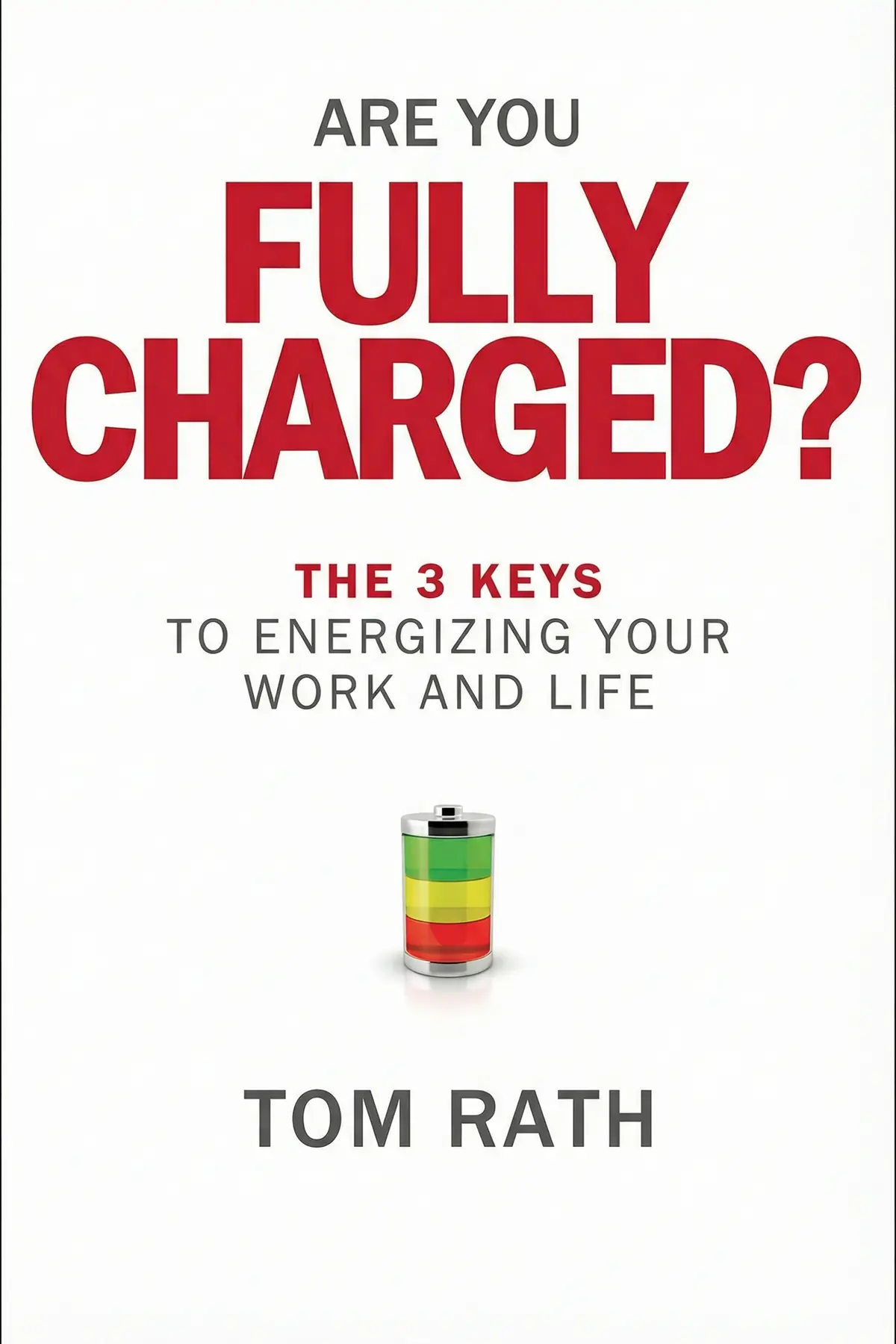
Table of Content
1. Introduction
1 min 09 sec
Most people who feel drained try to fix it with a total life overhaul, and most of those overhauls collapse within weeks. In Are You Fully Charged?, Tom Rath, a former senior scientist at Gallup, argues that the big plan is the wrong one. You don’t need to rebuild your life, and you shouldn’t even aim straight at happiness, because happiness arrives as a side effect of a meaningful day.
That idea leads to three areas you can work on. The first is meaning, the sense that what you do helps someone. The second is your interactions, the brief exchanges that charge or drain you and the people around you. The third is physical energy, built from how you eat, move and sleep. All three improve through small daily choices rather than grand resolutions.
Along the way, Rath shows why doubling your income barely changes how satisfied you feel, how often the average phone gets checked, and how much sleep top performers really get. Each finding comes with a change small enough to try tomorrow morning.
2. Find meaning in the job you already have
1 min 32 sec
Most of us were taught that a bigger paycheck and a better title would finally make us content. A national survey on income suggests otherwise, and points to a source of satisfaction hiding inside ordinary work.
3. Take your day back from notifications
1 min 45 sec
The average smartphone gets checked far more often than its owner would guess. One study links that constant checking to poor sleep and sick days, and the fix begins with telling being busy apart from moving forward.
4. Turn brief exchanges into a positive charge
1 min 50 sec
A stranger spills your coffee and walks off without a word. How you explain that moment to yourself can color the rest of your day, and the same logic shapes every meeting and every compliment you give.
5. Invest in the people who lift you
1 min 42 sec
Busy weeks make time with friends feel like a guilty luxury. A study of concerts, trips and dinners shows the payoff is bigger than people predict, and part of it arrives before the event even happens.
6. Stop sweet cravings with a protein breakfast
1 min 43 sec
Fad diets promise everything and leave most people confused. This approach needs no makeover, just a ratio you can check on any label and one change at breakfast that calms the pull toward sugar.
7. Build movement into a sitting workday
1 min 39 sec
Most people now spend more hours in a chair than in bed, and the body reacts within the hour. Moving a printer and counting steps can undo much of the harm without finding extra time.
8. Sleep more to get more done
1 min 45 sec
In many offices, a full night’s sleep looks like a lack of ambition. The habits of elite performers and a cost measured in billions point the other way, and the final hour before bed matters most.
9. Conclusion
1 min 14 sec
Rath’s book makes a reassuring case: feeling energized does not require a new life, only better small choices in three places at once. The meaning you build into a task, the tone you bring to a conversation, and the food, movement and sleep that keep your body running each add charge or drain it, and each is in your hands today. He also rejects the old trade-off between health and work. Looking after your well-being and your relationships, he argues, makes you more organized and more productive.
Begin wherever the drain is worst. If your phone runs your day, switch off its notifications, keep it in your bag at dinner and set it aside an hour before bed. If your energy fades by the afternoon, try protein at breakfast and move the printer across the room. If work feels empty, find the one task tomorrow that plainly helps someone, then give a colleague the specific praise you would like to hear yourself.
None of this is dramatic. A call center worker who solves one stranger’s problem with real warmth will never make the news. Yet that is exactly the kind of charge Rath means, and it is there for the taking on an ordinary Tuesday.
About this book
What is this book about?
In trying to be happier and more successful, many people reach for a grand plan to change everything about how they live, and that approach never works. Tom Rath, a former senior scientist at Gallup, argues that the overhaul is the wrong goal, and that aiming straight at happiness is part of the problem. Happiness, in his account, follows from days that feel meaningful. He organizes the fix around three areas. Meaning comes from seeing how your work helps someone, since even a doubled income barely raises life satisfaction. Interactions, however brief, either charge or drain you, so he offers rules for assuming good intentions, keeping conversations mostly positive and giving specific praise. Energy depends on how you eat, move and sleep, and here he brings numbers: phones opened 110 times a day, the damage done by long hours of sitting, and the eight hours and 36 minutes elite professionals sleep each night. Readers get small, concrete changes: switching off notifications, checking the carbohydrate to protein ratio on food labels, moving the printer out of reach and putting devices away an hour before bed.
Book Information
Who it's for
Drained professionals
Professionals who end most workdays drained and keep abandoning big self-improvement plans.
Leaders wanting well-rested teams
Managers who want more positive meetings and a team that rests instead of boasting about short nights.
Office workers losing energy
Desk workers whose phones, snacks and long hours of sitting are wearing down their energy.
About the Author
Tom Rath
Tom Rath was born in Lincoln, Nebraska, and studied at the University of Michigan and the University of Pennsylvania. He led the workplace business at Gallup and worked there as a senior scientist, and he co-founded CareerSight. His first book, How Full Is Your Bucket?, went straight to number one on the New York Times bestseller list, and his other bestsellers include StrengthsFinder 2.0 and Wellbeing.
Ratings & Reviews
Ratings at a glance
What people think
Listeners find this work to be a swift and straightforward read that offers useful guidance and incorporates scientific insights. They also value the encouraging subject matter, with one listener observing how adding purpose to your week can affect your physical well-being. Additionally, the book shares an engaging personal account, and listeners call it remarkably functional, with one person emphasizing its research-grounded method for staying fully energized.
Top reviews
Chan
Ever wonder why some days you feel invincible while others you're just dragging yourself through the mud? Rath’s framework provides a clear answer without the fluff found in typical self-help. I was particularly moved by the chapter on 'Meaning' and how doing something that benefits another person is a primary driver of our own vitality. Not gonna lie, I’ve started asking myself if my work helps anyone else at the end of every day now. The book is backed by serious research, which I appreciate, but it never feels like a dry academic text. His personal story regarding his battle with VHL syndrome adds a layer of weight to his advice; he isn't just theorizing about life—he’s fighting for his. This is a practical, life-affirming guide that reminds us that small choices, like puting away your smartphone during dinner, actually matter.
Show moreSeksan
Tom Rath has a way of distilling complex social science into bite-sized, actionable steps that don't feel overwhelming. I’ve read a lot of his stuff, and while there is some overlap here with his previous titles, this feels like his most 'human' work yet. The way he links our physical health to our sense of meaning is profound. If you don't have a reason to get up, your body feels it. I found the advice on creating positive 'charge' through tiny interactions to be a game-changer for my leadership style. It’s not just about being 'happy'; it’s about being effective and useful to others. This book is a short, sharp shock to the system that reminds you that you have more control over your daily energy than you think. Highly recommended for anyone feeling stuck in a rut.
Show moreOm
The chapter on the three-to-five positive interactions ratio really stuck with me and changed how I approach my morning meetings. Rath suggests that we need a massive surplus of good moments to outweigh a single bad one, and honestly, seeing that data laid out was eye-opening. I also loved the specific mention of how just having a smartphone on the table can kill the intimacy of a conversation. It’s those tiny, practical takeaways that make this worth the read. The book moves at a clipping pace, which fits the 'fully charged' theme perfectly. I did feel like the section on physical energy was a little light, mostly because I’ve read deeper dives into sleep science elsewhere. Still, as a holistic look at how to improve your daily experience, it’s a very effective and motivating tool.
Show moreKenji
Finally got around to reading this after hearing Rath's personal story about his chronic health struggles, and his perspective is truly humbling. When a guy who faces cancer every year tells you to make the most of your '500 million moments,' you tend to listen. The truth is, most of us spend our days in a fog of 'okay' instead of being fully charged. I found the '45 + 15' work-rest cycle advice particularly easy to implement immediately. It isn't a book about massive life overhauls or running marathons. Instead, it’s about those small, incremental shifts in how we eat, move, and interact with colleagues. It’s a very grounded, research-based approach to staying energized. My only minor gripe is that some of the reflection questions at the end felt a little like filler, but the core content is excellent.
Show moreKwame
Picked this up during a long layover and finished it before my flight even landed, which speaks to how engaging Rath’s prose is. He manages to weave together diverse topics like material spending versus 'experience-oriented' products and the physiological impact of our daily commutes. I particularly enjoyed the section arguing against the myth that you can be 'anything you want to be' if you just try hard. Instead, he argues for doubling down on your natural talents, which feels much more realistic and less exhausting. The book is incredibly practical, providing a framework that you can start using the very next morning. It might be brief, but the density of useful tips is high. It’s the kind of book you’ll want to pass to a friend who’s feeling burnt out at work.
Show moreEarn
After hearing about Rath's annual week-long hospital stays, I found his perspective on 'daily' living far more credible than most authors in this space. He isn't some bio-hacker trying to live forever; he’s a man trying to make every single day count because he knows how fragile life is. The 'Meaning, Interactions, Energy' trio is a simple but powerful way to audit your life. I appreciated the specific studies he cited, like the one about how negative exchanges carry so much more weight than positive ones. It made me rethink how I speak to my kids after a long day at work. While some of the health advice is basic, the integration of all three elements into one cohesive strategy is what makes this book stand out from the crowd.
Show moreNarumon
Not what I expected, but I mean that in a good way. I thought this would be another dry business book about maximizing output, but it’s actually much more focused on well-being and social connection. Rath argues that we are 'fully charged' only when our work benefits someone else, which is a refreshing take in a world obsessed with self-optimization. The book is very concise—no fluff, just research and application. I particularly liked the section on 'experience-oriented products' and how spending money on books or instruments actually contributes to long-term happiness. It’s a quick, easy read that serves as a great reminder to focus on what actually brings us life. Some parts are definitely common sense, but the reminders are necessary in our distracted, high-stress world.
Show moreKrisada
As someone who follows a lot of productivity gurus, I found the core concepts here a bit redundant, yet still quite grounding. Tom Rath focuses on three main pillars: Meaning, Interactions, and Energy. To be fair, most of this advice—like getting enough sleep or focusing on strengths—is stuff we’ve heard before in various forms. However, the way he integrates scientific research makes the common-sense tips feel more urgent and valid. It is an incredibly fast read, which is great for busy professionals, but I found myself wishing he’d gone deeper into the 'Meaning' section specifically. If you have already read 'Eat Move Sleep,' you might find the energy chapter feels like a summary of his previous work. It’s a solid refresher for your daily habits, but don't expect a groundbreaking revelation that changes the fabric of your reality.
Show moreTuck
Does the world really need another book on energy management that tells us to sleep more and eat better? To be perfectly honest, I was expecting something a bit more revolutionary given the hype surrounding Rath’s other work like StrengthsFinder. The writing style is punchy and accessible, but the depth just isn't there for a seasoned reader of this genre. I liked the focus on 'Interactions' as a source of energy, which is something many productivity books ignore. However, the 'Energy' section felt like a quick summary of things everyone already knows. It’s a decent enough book to keep on your desk for a quick shot of motivation when you’re feeling sluggish, but it doesn't provide the deep-dive analysis I was hoping for. It’s more of a 'reminder' book than a 'teacher' book.
Show moreChiw
Look, if you have ever picked up a self-help book or a health magazine in the last decade, you probably already know everything in here. Rath is a talented writer, but this felt more like a collection of blog posts than a fully realized book. Did I really need a book to tell me that sleep improves my mood or that I should have more positive interactions than negative ones? The '3 Keys' are essentially common sense repackaged with some citations to make them look more authoritative. Frankly, it’s a bit superficial for the price point. I finished the entire thing in about forty-five minutes and felt like I hadn't learned a single piece of novel information. It might be helpful for someone who is completely new to personal development, but for everyone else, it’s just a rehash of the basics.
Show moreQuestions about this book
What is the main idea of Are You Fully Charged?
Tom Rath argues that you don’t need a total life overhaul to feel energized, and that chasing happiness directly backfires. Happiness follows from meaningful days. He focuses on three areas: creating meaning in the work you already do, making your daily interactions positive, and building physical energy through how you eat, move and sleep. Small changes in each area add up to steady energy at work and at home.
Does making more money make you happier, according to Tom Rath?
Only slightly. Rath cites surveys across the United States showing that a sudden doubling of income raised life satisfaction by just nine percent. He treats money and success as external motivators that cannot sustain meaning or happiness for long. Internal motivation, the sense that your actions help other people, lasts much longer, and he argues almost any job offers it, from running a charity to helping a caller in a call center.
How much sleep do top performers get in Are You Fully Charged?
Rath cites research finding that elite professionals average eight hours and 36 minutes of sleep a night, and that frequent rest improves their performance. He also notes a Harvard Medical School estimate that poor sleep costs the American economy $63 billion a year in lost productivity. His advice is to put electronic devices away at least an hour before bed, since late-night phone use lowers sleep quality.
How can I apply Are You Fully Charged? at work?
Rath suggests switching off automatic notifications and checking email at set times, keeping about 80 percent of your conversation positive, and giving colleagues specific, sincere praise. He recommends breaking up long periods of sitting, for example by moving the printer out of reach, and tracking your steps toward 10,000 a day. He also advises keeping your phone out of sight in conversations, since a visible phone makes them less fulfilling.
What does Tom Rath recommend for eating better?
He avoids fad diets and suggests gradual swaps: fewer fried foods, less processed sugar and fewer carbohydrates, with meals built around vegetables and whole fruit and water, tea or coffee instead of energy drinks. A handy rule is to skip foods whose carbohydrates exceed protein by more than five to one. A protein-rich breakfast, according to a University of Missouri study, raises dopamine and reduces cravings for sweets.
Readers also enjoyed




A Guide to the Good Life: The Ancient Art of Stoic Joy
William B. Irvine


A High-Performing Mind: Strengthen Your Mind and Live Your Best Life
Andrew D. Thompson


Abundance: The Inner Path to Wealth
Deepak Chopra

AUDIO SUMMARY AVAILABLE
Listen to Are You Fully Charged? in 15 minutes
Get the key ideas from Are You Fully Charged? by Tom Rath, plus 5,000+ more nonfiction titles.
- 5,000+ titles
- Listen as much as you want
- 7-day free trial
- Cancel anytime









