

15 min 49 sec
Available in: English
Americana: A 400-Year History of American Capitalism
A four-century tour of American business, from the investor-funded Mayflower to Silicon Valley, showing how private fortunes have always grown alongside government help, government limits and the democracy that set the rules.
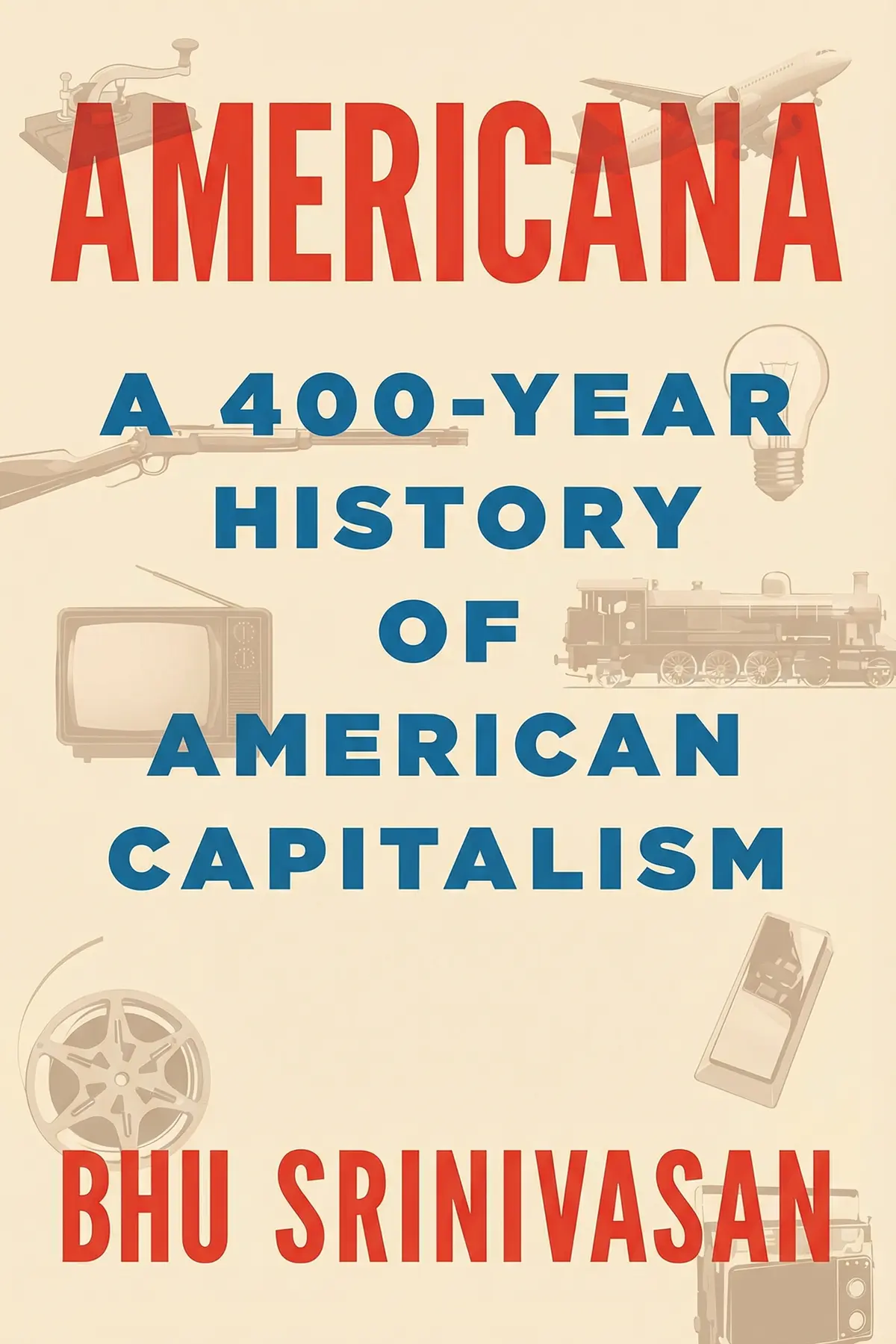
Table of Content
1. Introduction
1 min 05 sec
American business history can feel like a blur of tycoons and dates, but one idea pulls it into a shape you can remember: the country’s capitalism has never worked without government at its side. In Americana, Bhu Srinivasan, who came to the United States from India at age eight, retells four hundred years of American history as a story about money. Even the Mayflower, he points out, sailed on pooled investor cash, raised the way venture funds now back tech startups.
From there he follows tobacco, steamboats, slavery, oil, steel, suburbs, highways and microchips. At every turn, private ambition either leaned on public help or ran into public limits. That is the throughline here: American capitalism and American democracy grew up as partners and as checks on each other. Hold on to it, and today’s arguments about tariffs, bailouts, regulation and tech fortunes start to sound like new verses of a very old song.
2. See how the Mayflower was funded like a startup
1 min 39 sec
The pilgrims’ famous voyage depended on a money question that most history lessons skip. Its answer links 1620 to modern tech funding, and it puts a less noble motive behind the fight for independence.
3. Discover how public money built private fortunes
1 min 42 sec
The steamboat, the canal and the railroad made some Americans spectacularly rich. Behind each one sat a partner that the usual rags-to-riches story leaves out, and the arrangement set a pattern that never went away.
4. Follow the money behind the Civil War
1 min 53 sec
One set of numbers from 1859 explains why the South would risk everything rather than change. It also explains why all that wealth collapsed so fast once the North found its weak point.
5. Big fortunes came from scale, ideas and protection
2 min 03 sec
A shopkeeper who invented nothing became fabulously rich, and the era’s steel king still could not beat foreign prices on his own. Their stories show what really sat beneath the Gilded Age’s fortunes.
6. Understand government's growing role as economic referee
2 min 11 sec
In 1892 the state sent troops to side with a steel magnate. Within a few decades it was regulating trusts, inspecting meat and briefly closing every bank in the country. Here is how that reversal happened.
7. Highways that ruined some businesses and built others
1 min 57 sec
A government road program shut down a Kentucky roadside diner and, by the same stroke, helped turn fried chicken and hamburgers into national chains. The suburbs born in those years carried a darker story.
8. Spot the Mayflower model inside Silicon Valley
2 min 06 sec
The first tech billionaire made his money from someone else’s machines, and a venture firm once earned a 10,000 percent return. The tech boom looks new, yet its funding method is four centuries old.
9. Conclusion
1 min 13 sec
Americana’s argument fits in a sentence: the American economy has always been a joint project. The market supplied the ambition, from beaver traders to venture funds. Government supplied canals, eminent domain, tariffs and highways, and later the trust regulators, meat inspectors and crisis powers that kept that ambition in check. Neither side ever ran the country alone, and democracy decided, election by election, where the line between them should sit.
That gives you a useful habit of mind. When you hear that a company succeeded purely on its own merits, look for the public road, rule or contract underneath it, the way Carnegie’s mills sat behind a tariff wall. When you hear that government only gets in the way, remember that New York state paid for the Erie Canal and Congress passed a law to inspect meatpacking. And when a new technology promises instant fortunes, recall how fast Netscape and AOL rose and fell.
The Mayflower and Silicon Valley sit four centuries apart, yet both ran on the same bargain: many small bets on a long shot, made inside rules that a public had a say in writing.
About this book
What is this book about?
Most people learn American history as a parade of wars and presidents, and business history as a parade of tycoons. Bhu Srinivasan joins the two. In Americana he tells four hundred years of the nation's story through the money that drove it, starting with the English investors who spread their risk to pay for the Mayflower in 1620. From there he moves through tobacco and beaver pelts and the steamboats and canals that opened up the interior. He shows the brutal economics of slavery that made enslaved people the country's most valuable asset, then the oil and steel fortunes of the Gilded Age. The twentieth century brings highways, suburbs, franchises and computer companies. His central claim is that American capitalism was never a pure free market. Government granted monopolies, paid for canals, protected steel with tariffs, reined in trusts, inspected meat and took charge of the economy after 1929. Readers get one clear thread through four centuries. They also get a sharper eye for the public support and public limits behind any private success story today.
Book Information
Who it's for
Professionals wanting connected history
Professionals who want one clear story linking American history, business and politics.
Curious founders and investors
Founders and investors curious how venture funding, tariffs and regulation shaped earlier booms.
Wanting the long view
Readers who follow debates about big tech, inequality and government and want the long view.
About the Author
Bhu Srinivasan
Bhu Srinivasan moved from India to the United States at age eight, and his family went on to travel widely around the country. He started his career by founding a news aggregation startup and later moved on to work in gaming, publishing and data. He lives in Connecticut with his wife and children. Americana is his first book.
Ratings & Reviews
Ratings at a glance
What people think
Listeners find this work exceptionally accessible and expertly crafted, presenting a structured overview of U.S. commercial history packed with data. Furthermore, they value the narrative style, as one listener points out the way it integrates different financial eras. The title also earns praise for being informative for experts and beginners alike while maintaining a neutral stance on the capitalist system.
Top reviews
Ryan
This book provides a masterclass in how to synthesize four centuries of economic evolution into a single, cohesive narrative. Bhu Srinivasan manages to take complex financial shifts and turn them into a series of gripping tales that feel more like a biography of a nation than a dry economic text. I was especially struck by the way he traces the line from early colonial tobacco exports all the way to the modern digital era. It’s rare to find an author who can balance cold facts and figures with such a fluid, engaging storytelling style. While some might argue it covers too much ground too quickly, I found the pace perfectly suited for a general reader looking to understand the 'why' behind the American experience. Truth is, the book offers an unbiased perspective that is sorely missing from most modern discussions about capitalism today.
Show moreAkosua
Ever wonder how a single plant like tobacco could lay the foundation for a global superpower? Srinivasan answers this and so much more in a book that feels incredibly relevant to our current technological age. He doesn't just list dates; he weaves together a tapestry of innovation, greed, and genius. I loved how he compared the Gilded Age's robber barons to the modern titans of Silicon Valley, making the past feel like a mirror to the present. The writing is punchy, with short, sharp sentences that keep the momentum high even when discussing tax codes or trust-busting. It’s an educational journey that doesn’t feel like schoolwork. Not gonna lie, I haven’t enjoyed a non-fiction book this much in years. It is a vital read for anyone trying to make sense of the modern American landscape.
Show moreHannah
Finally got around to reading Americana, and frankly, it changed how I view the 'American Dream' entirely. Srinivasan’s perspective as an immigrant who moved here at a young age adds a layer of appreciation for the system that a native-born author might take for granted. The way he explores the 'sharing economy' companies like Uber and Airbnb in the final chapters really ties the whole 400-year journey together. He shows that the spirit of venture has always been about disruption, for better or worse. The book is packed with data, yet it never feels bogged down by it because the narrative arc is so strong. It is an accessible, well-written, and deeply insightful look at how capitalism is baked into the very DNA of the United States. A must-read for any business enthusiast.
Show moreOlivia
Wow, Srinivasan really nailed the narrative arc here. This isn't just a book about money; it’s a book about the relentless drive to build something new. The author treats the founding of the colonies and the founding of a tech startup with the same level of intellectual curiosity. I found the section on the 'sharing economy' especially thought-provoking, as it forced me to reconsider the cost of convenience in our modern lives. The prose is elegant and the research is clearly extensive, yet it reads with the speed of a novel. It’s rare to find a book that can explain the mechanics of a market economy while keeping you emotionally invested in the people behind the trades. This is an essential addition to the library of anyone interested in American history or global economics.
Show moreClaire
What a refreshing and vivid exploration of the forces that actually built the modern world we inhabit. Srinivasan avoids the usual political bickering and instead focuses on the tangible innovations and economic structures that defined different eras. I loved the way he organized the book by industry—Food, Roads, Computing—as it made the progression of the country feel logical and inevitable. The storytelling is top-notch, turning what could have been a slog of statistics into a fascinating drama. Personally, I think this should be required reading for anyone in the tech industry to understand the historical shoulders they are standing on. It’s an excellent, unbiased overview that manages to be both educational and entertaining. A truly impressive debut that doesn't disappoint.
Show moreOak
Picked this up because the premise of looking at the Mayflower through the lens of venture capital seemed incredibly clever. For the most part, the author delivers on that promise by showing how money and markets have always been the silent engines of American history. The chapters on the Industrial Revolution and the rise of the automobile were particularly well-researched and full of little-known vignettes that kept me turning pages late into the night. My only real gripe is that the book occasionally glosses over the deeper sociological impacts of these economic shifts, especially regarding the workforce. To be fair, it’s a massive undertaking to condense 400 years into 500 pages, so some nuance is bound to be lost. Still, it is a highly readable account that makes the 'dismal science' feel anything but boring.
Show moreOksana
As someone who usually finds economic history as dry as dust, I was pleasantly surprised by how much this felt like a collection of propulsive short stories. The author does a fantastic job of highlighting how government intervention and private enterprise have always been awkwardly danced together. I particularly enjoyed the sections on the Civil War and how it paved the way for the industrial boom that followed. Sometimes the transition between chapters feels a bit abrupt, and I wish he had spent more time on the environmental consequences of all this growth. Look, it’s not a perfect academic history, but it’s a fantastic overview for the average person. It manages to be pro-business without being a cheerleader, which is a very difficult line to walk. Definitely worth the time if you want a big-picture view.
Show moreCharles
The chapter on Levittown and the post-war suburban boom was a particular highlight for me. It perfectly illustrated how economic policy and consumer desire combined to reshape the physical map of the country. Srinivasan has a knack for finding the human element within the macro-economic shifts. However, I did notice that some of the later chapters on the internet era seemed to lean heavily on existing narratives from other popular business books. While those sections were still informative, they didn't feel quite as fresh as the earlier colonial and 19th-century history. Still, the breadth of topics—from oil and steel to radio and TV—is staggering. It’s a great introductory text that makes the complex history of American business feel approachable and exciting. I’d recommend it to anyone looking for a solid historical foundation.
Show moreSuphan
I’ll admit the concept is brilliant, but the execution felt a bit uneven in places. Srinivasan is clearly a gifted writer with a background in venture capital, and his personal reflections on the market add a nice touch to the early chapters. However, as the book progressed toward the 20th century, I felt the narrative became a bit jumbled and oversimplified. For instance, the section on the development of the Midwest retail scene contained a factual error regarding Target’s origins that pulled me out of the experience entirely. If you are already well-versed in US economic history, you might find yourself wishing for more depth instead of the quick 'punchline' style used here. It functions better as a gateway for novices than a definitive resource for history buffs. It's a decent effort, but it lacks the analytical bite I was hoping for.
Show moreScarlett
Truth is, I have mixed feelings about how much ground this book tries to cover in just 500 pages. On one hand, the writing is lively and the author’s passion for the subject is undeniable. On the other hand, the 'big picture' approach often leaves the pixels a bit blurry. I was disappointed that certain social justice issues and the long-term impact of slavery on Northern industrialization were handled so briefly. The book is very confident in its delivery, but that confidence sometimes masks a lack of nuance in the more controversial periods of US history. It’s a good general history with a strong emphasis on entrepreneurial events, but it feels more like a collection of essays than a deep-dive analysis. If you want a quick, engaging overview, this is it, but don’t expect a definitive scholarly work.
Show moreQuestions about this book
What is Americana by Bhu Srinivasan about?
Americana tells four hundred years of American history through business and money. Srinivasan starts with the investors who funded the Mayflower in 1620 and moves through tobacco, steamboats, slavery, oil, steel, suburbs, highways and computing. His main argument is that American capitalism drove the country’s development but was never a pure free market, because government kept helping industry, limiting its excesses and protecting consumers.
How was the Mayflower funded according to Americana?
The voyage was paid for by a group of English investors through the Virginia Company of London. Many people each put in small sums, so their individual risk was limited, while a big success would bring large returns. Srinivasan compares this to venture capital, and he later shows Silicon Valley firms such as Kleiner Perkins and Sequoia using much the same model.
Does Americana argue for free markets or for government control?
Neither extreme. Srinivasan shows government and business working together and checking each other. The state granted a steamboat monopoly, paid for the Erie Canal and protected steel with a tariff. It also reined in trusts under Theodore Roosevelt, passed the Federal Meat Inspection Act and took responsibility for the economy during the New Deal. In his view, capitalism and democracy shaped the nation together.
What can business readers learn from Americana?
The book trains you to look for the public side of private success: the canal, the tariff, the highway or the regulation a market depends on. It also offers cautionary cases, such as Microsoft’s free browser sinking Netscape and the Time Warner and AOL merger arriving just as broadband replaced dial-up. Even simple ideas can win big, as A.T. Stewart showed by moving goods in front of the counter.
Who should read Americana?
It suits readers who want a single thread through American history rather than separate stories of wars, presidents and tycoons. Founders and investors will recognize today’s venture funding in the Mayflower story. People following debates about inequality, regulation and big tech will find long precedents, from Roosevelt’s fight with the trusts to Occupy Wall Street protesters mourning Steve Jobs.
Readers also enjoyed






Adults in The Room: My Battle With Europe’s Deep Establishment
Yanis Varoufakis

A Spy Among Friends: Philby and the Great Betrayal
Ben Macintyre


AUDIO SUMMARY AVAILABLE
Listen to Americana in 15 minutes
Get the key ideas from Americana by Bhu Srinivasan, plus 5,000+ more nonfiction titles.
- 5,000+ titles
- Listen as much as you want
- 7-day free trial
- Cancel anytime









