

A History of Iran: Empire of the Mind
Michael Axworthy
 English
Graham Hancock argues that puzzles in America's deep past, from a 130,000-year-old mastodon to earthworks aligned with the moon, point to a seafaring Ice Age civilization destroyed by a comet. Many scholars dispute this.
1 min 00 sec
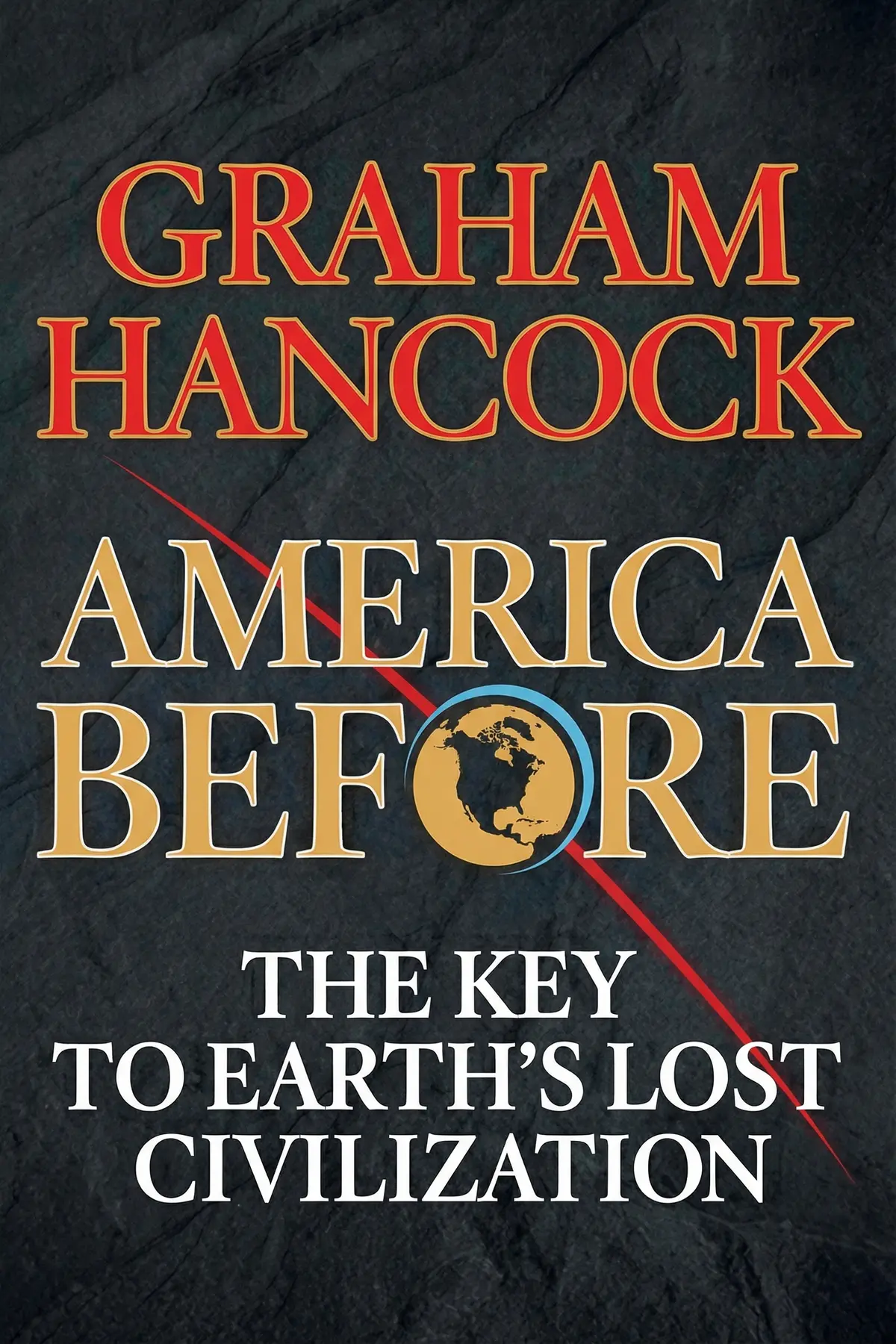
If you learned that the first Americans walked in from Asia around 13,000 years ago, Graham Hancock wants you to look again. In America Before, the former journalist points to a mastodon found near San Diego. Its bones were broken by human hands and later dated to 130,000 years ago. To Hancock, that single fossil is the first crack in a story the experts have guarded too fiercely.
His own answer is far bolder, and he offers it as his interpretation. A seafaring civilization, he argues, thrived in the Americas during the last Ice Age. It was wiped out when comet fragments struck the Earth about 12,800 years ago, but first it passed its knowledge of geometry and the sky to the hunter-gatherers who survived. Mainstream scholars reject much of this. What follows sets out each clue he relies on, from Amazon soil to Egyptian temple walls, so you can weigh the case and explain it to someone else.
1 min 36 sec
For decades, one powerful scholar made a whole topic too dangerous to study. The view that replaced his became just as rigid, and the people who doubted it were openly laughed at.
2 min 02 sec
Twenty-two years after a set of broken bones was found, a museum scientist had them dated, and the result changed everything. When it came, the number was ten times larger than anyone expected, and a strange genetic signal soon deepened the puzzle.
1 min 41 sec
A Spanish friar described gleaming cities and fine porcelain deep in the jungle, and historians called it fantasy. A laser survey and a strange black soil suggest his story deserves a second hearing.
1 min 53 sec
Earthworks in the Amazon and Ohio share a style, and Egyptians and Native Americans sent their dead toward the stars of Orion’s belt. The two peoples never met, which leaves a puzzle Hancock refuses to drop.
1 min 37 sec
For two decades, fragments of a breaking comet may have rained on the Earth. The fires, floods and long winter that followed help explain why one advanced American culture vanished without a trace.
1 min 57 sec
An Egyptian temple tells of survivors sailing out from a drowned island to rebuild the world. Hancock pairs that story with medieval maps that seem to show coastlines as they were thousands of years earlier.
1 min 50 sec
Giant stones in Lebanon defy easy explanation, and Amazon shamans describe experiences science cannot measure. Hancock links the two in his most speculative idea, drawn partly from his own experience.
1 min 20 sec
America Before asks you to hold two things at once. The first is a set of real puzzles: a mastodon whose bones were broken by people and dated to 130,000 years ago, Australasian genes deep in the Amazon, a soil that may have been invented rather than stumbled upon, and earthworks tuned to the moon. On both sides of the Atlantic, the dead were sent toward Orion. The second is Hancock’s answer, which he offers as his own reading. A seafaring, sky-watching civilization lived in America until the Younger Dryas, and it survives only as faint echoes in later peoples from Egypt to the Mississippi. By the book’s own account, there is no clear evidence of the civilization itself.
That gap is what makes the book worth your time. The next time you hear that a question about the past is closed, remember Clovis First and the Yukon archeologist who was laughed at. When you meet a grand theory, separate the anomaly from the explanation and ask what each one rests on. Then picture the Edfu survivors sailing out from a drowned island to rebuild the world. Hancock’s lost civilization may never be found, but he has made it harder to treat the story of the first Americans as finished.
The usual account says people first reached America about 13,000 years ago, walking over an icy land bridge from Asia. Graham Hancock thinks that story is too narrow, and he points out that archeologists have defended earlier versions of it fiercely and then been proved wrong. In America Before, he gathers what he sees as anomalies. A mastodon near San Diego has bones broken by people and dated to 130,000 years ago. Some Amazon peoples carry genes linked to Aboriginal Australasians. The Amazon also holds a man-made soil of unusual fertility, and earthworks in the Amazon and Ohio appear aligned with the sun and moon. Egyptian and Native American beliefs both place the doorway to the afterlife at Orion's belt. To explain all of this, Hancock proposes a lost civilization of sailors and astronomers, wiped out when comet fragments set the world on fire about 12,800 years ago. Readers get a clear map of that case, clue by clue, along with the objections the book itself records. That is enough to judge Hancock's theory for yourself and to explain why it remains so disputed.
Curious readers who enjoy prehistory and want the full case for a lost civilization, clue by clue.
Viewers of Ancient Apocalypse who want to know what the argument rests on before judging it.
Skeptics and students who like testing bold theories against the evidence.
Graham Hancock was born in Edinburgh in 1950, studied sociology at Durham University and worked as a journalist, including as East Africa correspondent of The Economist. His early books, such as Lords of Poverty, examined international aid. With Fingerprints of the Gods and Magicians of the Gods he turned to prehistory, arguing that an advanced Ice Age society was destroyed by a cataclysm almost 13,000 years ago, a view many archeologists dispute. He also presented the Netflix series Ancient Apocalypse.

Listeners describe this work as an engaging experience, noting the well-documented research and accessible prose. They value the exploration of antiquity and archaeological findings, where one listener points out how the author skillfully merges thorough scientific data with logical reasoning. This title earns praise for its intriguing subject matter and high production standards, even if some feel the pacing is occasionally sluggish.
Graham Hancock has a remarkable gift for weaving complex scientific data into a narrative that feels like a high-stakes detective novel. This book is essentially the culmination of his life’s work, focusing on the staggering possibility of a lost civilization in the Americas that predates everything we were taught in school. Personally, I found the sections on the Younger Dryas Impact Hypothesis and the 'terra preta' in the Amazon to be the most compelling parts of the entire volume. He challenges the 'Clovis First' orthodoxy with such vigor that it’s hard not to question why this isn't more mainstream. While the book is undeniably dense and requires a significant time investment, the payoff is a completely shifted worldview. The way he connects the Serpent Mound in Ohio to astronomical alignments is nothing short of brilliant. Even if you don't buy into every single conclusion, the sheer volume of verifiable facts makes it a mandatory read for anyone interested in our ancient past.
Show moreAfter hearing Hancock on a podcast, I knew I had to read his latest evidence for myself. This book is a masterpiece of alternative history that feels increasingly less 'alternative' with every new archaeological discovery. The evidence from the Cerutti Mastodon site in San Diego is particularly hard to dismiss, placing humans in America over 130,000 years ago. Franky, it makes the mainstream insistence on a 13,000-year timeline look increasingly fragile. I loved how he connected the dots between the mounds of the Mississippi Valley and the star-aligned temples of the ancient world. The book is well-researched and presented with a passion that is infectious. It’s not just a collection of theories; it’s a call to keep an open mind about who we are and where we came from. For me, the section on the cataclysmic comet fragments was the most chilling and persuasive part of the book. Absolutely essential reading.
Show moreEver wonder why there are so many 'anomalies' in the archaeological record that just get ignored? This book tackles that head-on. Hancock takes us on a journey across 'Turtle Island,' showing us evidence of advanced knowledge that has been buried or dismissed for decades. I was captivated by the descriptions of the Mound Builders and the sophisticated geometry they used in their earthworks. It’s a beautiful, well-written book that feels like a labor of love. Not gonna lie, the sheer scale of the floods he describes—scouring the landscape and changing the world overnight—is terrifying to think about. He bridges the gap between myth and science in a way that very few authors can. It’s a thick read, but every chapter opened my eyes to a new way of seeing the Americas. If this truly is his last major work, he’s going out on a high note.
Show moreFinally got around to finishing this massive tome and I’m left reeling from the implications. The genetic evidence alone should be enough to trigger a massive re-evaluation of American prehistory. How do we explain Australasian DNA in the heart of the Amazon? Hancock argues that our ancestors were far more mobile and sophisticated than we give them credit for. The book is comprehensive, scientific, and yet deeply emotional. He writes with a sense of urgency, especially given his recent health scares mentioned in the end. I found his description of the Serpent Mound and its relationship to the constellations to be particularly moving. It’s a reminder that the ancient people were not 'primitive' but were observers of the cosmos in ways we’ve forgotten. This is easily his best work since Fingerprints of the Gods. Do yourself a favor and get the audiobook—he narrates it himself and his passion really shines through.
Show moreThe chapter on the Serpent Mound in Ohio completely changed how I look at my own backyard. I’ve lived near these sites my whole life and never realized the level of mathematical precision involved in their construction. Hancock does an amazing job of pulling together disparate threads—genetics, geology, astronomy, and mythology—to create a unified theory of a lost past. The book is a compelling read, even if it’s a bit slow in the technical sections. I appreciated how he addressed the backlash from the academic community; it adds a layer of 'forbidden history' that makes the book hard to put down. Whether you believe in a global lost civilization or not, the evidence for a much earlier human presence in America is becoming undeniable. This book is a bold, well-researched challenge to the status quo. It’s the kind of work that stays with you long after you’ve turned the final page.
Show moreAs someone who has always been skeptical of the standard 'Out of Africa' timeline, this book provided a lot of food for thought. Hancock’s exploration of the genetic links between Amazonian tribes and Australasian populations is genuinely mind-blowing. It suggests a history of migration that is far older and more complex than the Bering Strait theory allows for. The writing style is easy to follow, though I’ll admit it gets a bit slow-paced during the deep dives into Egyptian metaphysics. Truth is, the middle section could have used a tighter edit to keep the momentum going. However, the work quality is evident in the bibliography alone. He’s clearly done his homework, even if he interprets the data through a very specific lens. It’s a compelling read that asks the right questions about our collective human amnesia. Just be prepared for a bit of a slog through the technical calculations.
Show moreThis book is a bit of a marathon, but the scientific data woven throughout makes it worth the effort. I was particularly struck by the discussion on the Younger Dryas impact proxies. Hancock presents a very strong case for a world-changing event that wiped the slate clean around 12,800 years ago. While some of his comparisons between Native American myths and Egyptian beliefs felt a bit forced, the underlying thesis is solid. Why are we so afraid to admit that we might have lost a massive chunk of our history? The writing is accessible, and he does a great job of explaining complex geological shifts without sounding like a textbook. I did feel like he cherry-picked some of the data to fit his lost-civilization narrative, but the questions he raises are important. It’s a thought-provoking piece of work that deserves a place on any history buff's shelf, even if you remain a skeptic.
Show moreLook, the research into the Amazonian civilizations and the sophisticated agriculture they practiced is absolutely fascinating. Hancock is at his best when he’s describing these forgotten ruins and the 'terra preta' soil that shouldn't exist. However, the book is incredibly bloated. It easily could have been edited down by 200 pages without losing any of the core arguments. I found myself skimming through pages of dense calculations about solstice alignments that didn't feel vital to the narrative. To be fair, he makes some interesting points about the 'Clovis-first' wall in academia, but his constant defensive tone gets old after a while. I appreciate the effort to bring these sites to light, but the logic-jumps toward the end—especially regarding psychotropic drugs and 'supernaturals'—lost me. It’s a good book for data mining, but you definitely need to read it with a bucket of salt.
Show moreTo be fair, Hancock is a brilliant storyteller, even when his logic makes some pretty massive leaps. I enjoyed the first half of the book immensely, especially the parts about the submerged landmasses like Beringia and Sundaland. It provides a great visual of how different the world looked during the Ice Age. But then we get into the more 'fringe' territory, and I started to lose the thread. He relies heavily on unsubstantiated assumptions once he leaves the geological evidence behind. The comparison between the Inca and the ruling classes of Egypt was interesting but felt speculative at best. I also think he’s a bit too hard on mainstream archaeologists; science is supposed to be conservative. It’s an entertaining read and great for sparking curiosity, but I wouldn't take it as gospel. It’s more of a starting point for your own research than a definitive history.
Show moreThe first half of this book actually had me interested, but then it took a sharp turn into the absurd. I picked this up hoping for a rigorous look at pre-Clovis archaeological sites, which is a fascinating topic on its own. Instead, Hancock spends an exhausting amount of time complaining about 'institutional' scientists trying to silence him. Then, just when you think he’s grounding his theories in genetics and geology, he hits you with the telepathy. In the final stretch, he suggests that ancient Americans were using ESP and telekinetics to build monuments. Look, I’m all for questioning the status quo, but the jumps in logic here are too massive to ignore. It felt like I was watching a late-night History Channel special that started with archaeology and ended with Ancient Aliens. I wanted to like this, but I can't get past the wild, unsubstantiated claims in the later chapters.
Show moreHancock argues that an advanced, seafaring civilization developed in America between about 130,000 and 12,000 years ago. Comet fragments that set off the Younger Dryas cold period destroyed it, he says, but survivors passed their knowledge of geometry and astronomy to hunter-gatherers. He believes faint traces of that knowledge appear in later cultures, from ancient Egypt to the mound builders of North America.
His main exhibits are a mastodon found near San Diego in 1992, with bones broken on an anvil stone and dated to 130,000 years ago, and a 2015 genetic study by Pontus Skoglund and David Reich. That study found that some Amazon peoples share ancestry with Aboriginal Australasians. Hancock reads both as signs that people arrived far earlier than the Clovis First view allowed, possibly by sea.
For the scale of the damage, Hancock draws on a 2018 study by Wendy Wolbach and colleagues in the Journal of Geology. One theory holds that comet fragments struck Earth for 21 years about 12,800 years ago, and the study argues that around 9 percent of the world’s plant matter burned. Smoke brought a long freeze and melting ice raised sea levels. Mammoths and the Clovis culture disappeared, while hunter-gatherers survived.
No. The book itself describes mainstream scholars rejecting the idea of advanced Stone Age peoples, and it records objections such as Eske Willerslev’s view that there is no evidence of early ocean crossings. Hancock’s own conclusion admits there is no clear evidence of the lost civilization itself, only what he sees as traces of its heritage in later cultures.
Michael Axworthy

Tom Standage

Ishmael Beah




William J. Bernstein

Ben Macintyre


AUDIO SUMMARY AVAILABLE
Get the key ideas from America Before by Graham Hancock, plus 5,000+ more nonfiction titles.









