

16 min 02 sec
Available in: English
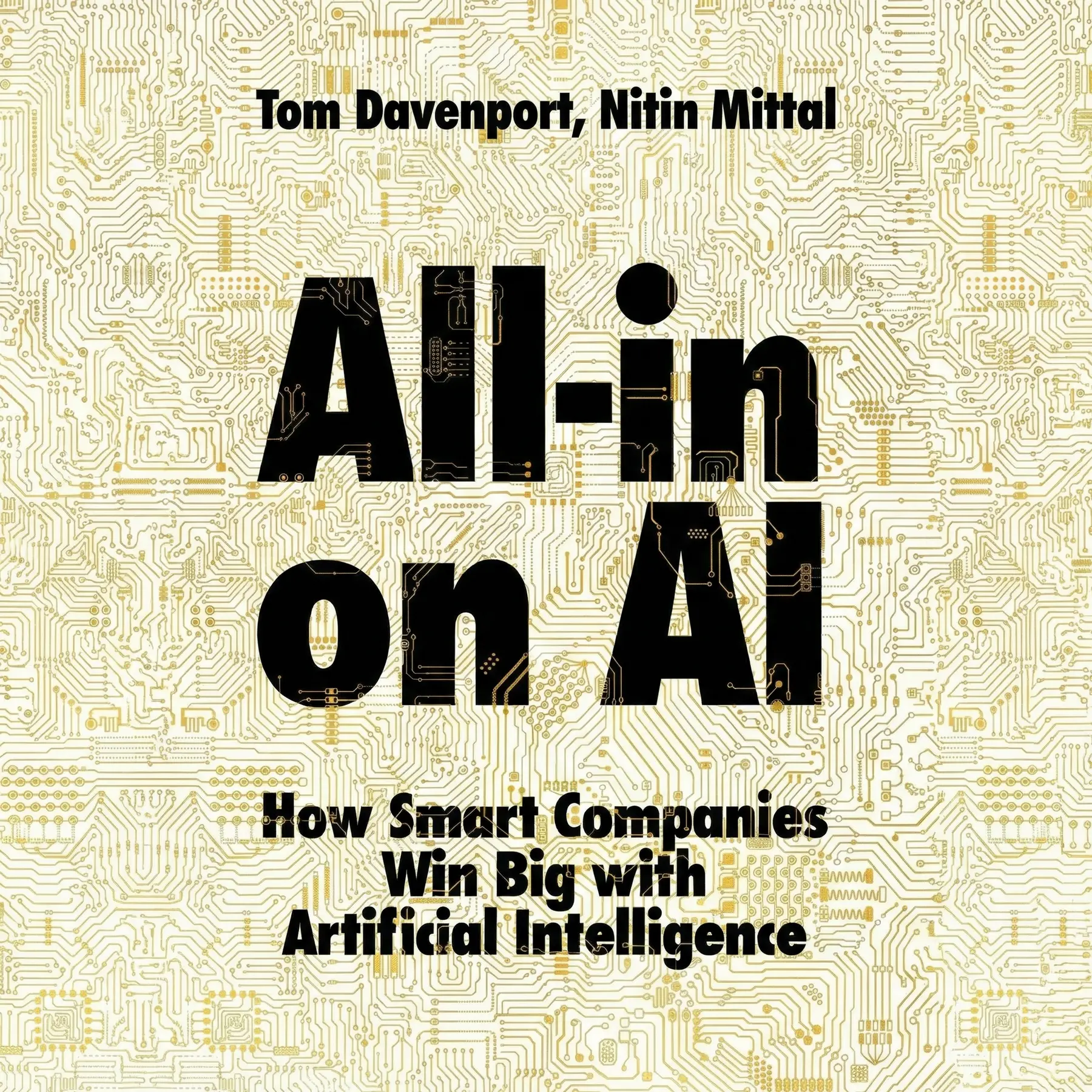
All-in On AI: How Smart Companies Win Big with Artificial Intelligence
Shows how a small group of long-established companies put AI at the center of their strategy, and what any large organization needs in leadership, data, skills and deployment to stop dabbling and start benefiting.

Table of Content
1. Introduction
1 min 05 sec
If your company has run a few AI pilots and has little to show for them, you are in the majority. In All-in On AI, Babson College professor Tom Davenport and Deloitte principal Nitin Mittal studied the rare exceptions: large, long-established firms that put AI at the center of everything they do. By the authors’ count, fewer than one percent of large companies have gone this far, and the publisher describes them as leaders that make better decisions and products and command higher prices.
The book’s argument is that these winners did not get there on clever technology alone. They picked a clear strategic aim, funded AI early and heavily, built the data and systems to deploy it widely, and raised people who were eager to learn. The cases range from a Singapore bank to China’s largest private-sector company and an aircraft maker. Each move they made can be studied and copied, and by the end you will be able to place your own organization on the path and name its next step.
2. Get AI out of the pilot stage
1 min 56 sec
Most large companies can point to impressive AI experiments, yet their business looks much the same as before. A handful of old firms broke that pattern, and the authors think the gap between the two groups is about to widen.
3. See what going all in really looks like
1 min 57 sec
One company settles claims, checks identities, treats patients remotely and values used cars with the same core technology. It is not a software firm, and its growth since its founding is hard to ignore.
4. Choose one of three ways AI creates value
2 min 04 sec
A strategy that amounts to doing more AI tends to scatter money across unrelated projects. The authors offer a sharper choice, and one of its options traces back to a credit score from the 1950s.
5. Turn your company into a learning machine
2 min 02 sec
The leading AI adopters share a trait that sounds almost mechanical, and the authors mean it in more than one sense. One grocer’s subsidiary has taken the idea further than most people would expect.
6. Fund experiments before you demand returns
1 min 48 sec
A bank in Singapore gave its staff time to play with AI and asked its senior managers to join hackathons. Its CEO also has a blunt warning about what kills that kind of effort.
7. Teach your people to work with data
1 min 57 sec
Advanced tools sit unused when staff are unsure how to handle them. The leading firms solved this with surprisingly familiar methods, plus one role that most organizations have never thought to create.
8. Find your AI level and climb one step
1 min 57 sec
Ten years ago, no company ran on AI at all. The authors offer a way to measure where yours stands today, and a short set of moves that the leaders made to rise.
9. Conclusion
1 min 16 sec
A reviewer for E&T points out that all in is a poker phrase: pushing your whole stack of chips into the middle of the table. The image fits the book better than any slogan about technology. Davenport and Mittal describe companies that placed a large, deliberate bet and then did the patient work of making it pay, through strategy, data, systems and, above all, people who wanted to learn.
The surprise is how ordinary many of these firms are. A bank, an insurer and an aircraft maker built their lead by shipping many useful systems, retraining them as conditions shifted, and refusing to judge curiosity by its early returns.
For a leader, the book supports a few concrete moves. Decide which of the three aims your AI serves and tie every project to it. Plan deployment before the pilot begins. Give people regular time to experiment, a translator who connects them with the builders, and a budget that pays for both the trying and the scaling.
The firms that stay on the sidelines, the authors predict, will lose ground. The ones that keep learning, steadily and without tiring, will keep widening the gap.
About this book
What is this book about?
Most large companies have tried artificial intelligence. Few have much to show for it beyond a handful of pilots that never reach daily operations. Tom Davenport and Nitin Mittal set out to study the exceptions: old, established firms such as DBS Bank, Ping An, Airbus, Anthem and Capital One, which have reorganized themselves around AI and now lead their industries. The authors call these firms AI-fueled, and they found only about thirty of them, under one percent of large companies. What sets them apart is a combination of choices. They start early and fund heavily. They pick a clear strategic aim, whether creating new businesses, transforming operations or shaping customer behavior. They build the data and systems to deploy AI at scale, and they invest at least as much in leadership, culture and skills as in technology. Readers get a practical picture of what going all in demands: three strategic archetypes to choose from, a five-level maturity model to place their own company, and concrete examples of training programs, translator roles and experimentation habits that turned AI from a side project into a core part of the business.
Book Information
Who it's for
Executives and founders
Executives and founders whose AI pilots never seem to reach daily operations.
Team and learning leads
Team leads and learning managers asked to build data skills and a culture of experimentation.
Strategy and IT staff
Strategy and IT professionals who need a clear picture of what large-scale AI adoption demands.
About the Author
Tom Davenport
Tom Davenport is a distinguished professor of information technology and management at Babson College, a visiting professor at the UVA Darden School of Business, a fellow of the MIT Initiative on the Digital Economy and a senior advisor to Deloitte's program for chief data and analytics officers. He has written, co-written or edited 23 books and more than 300 articles. Nitin Mittal is a principal with Deloitte Consulting who has led its US AI strategic growth offering and was named AI Innovator of the Year at the 2019 AI Summit in New York.
Ratings & Reviews
Ratings at a glance
What people think
Listeners find that perspectives on the level of detail differ, as some feel the long sequences of examples can seem redundant or too broad. At the same time, many value the thorough look at how established firms such as Shell and Capital One effectively incorporate AI into their primary operations. Furthermore, they appreciate the emphasis on leadership and corporate culture, with one listener highlighting that the work offers "incredible amounts of valuable information" for anyone aiming to keep pace with evolving technology. The organized layout is also often lauded as an approachable introduction for students and non-technical leaders who are starting to investigate the real-world uses of machine learning.
Top reviews
Chan
Finally, a book that addresses the cultural shift required for technological transformation. Too many AI books focus on the algorithms, but Davenport and Mittal correctly identify that people are the real obstacle. I found the analysis of how legacy companies like Shell have evolved into AI-first organizations absolutely fascinating. This isn't just about the technology; it's about the leadership, behavior, and mindset needed to stay competitive in a changing market. Truth is, the transition to AI is expensive and difficult, yet this book provides a much-needed blueprint for those willing to take the leap. Every chapter builds on the last, providing a comprehensive look at the successes and setbacks of those who went all-in. It’s an essential guide for any leader who doesn’t want their company to become a relic of the past.
Show moreBook
Wow, this was exactly what I needed to help my team understand the scope of the transition we’re facing. The book is incredibly thorough when it comes to illustrating how AI recalibrates an entire organization’s identity. I loved the emphasis on how successful companies have been working with data analytics and RPA for years before ever touching AI. It reminds us that there are no shortcuts to becoming an intelligent enterprise. Gotta say, the writing style is very polished and easy to digest, which is rare for a business book these days. It provides a clear vision of the future of work and encourages readers not to give up despite the inevitable failures. This is a must-read for anyone who wants to ride the wave instead of being buried by it.
Show moreJulian
As a business student looking for a foothold in the machine learning space, this was a helpful roadmap. Davenport and Mittal don't get bogged down in the math, which I appreciated. Instead, they focus on how legacy giants like Shell and Capital One have restructured their entire internal culture to support automation. To be fair, some of the lists of potential use cases felt like filler after a while. I found myself skimming the middle sections where it felt more like a Deloitte brochure than an academic text. However, the overarching message about leadership mindset is crucial for anyone trying to stay relevant. It’s a solid entry point for managers who are just beginning to navigate the AI landscape before diving into more technical resources.
Show moreCharles
Does your company actually have an AI strategy, or are you just running a few disconnected experiments? This book forces you to confront that question head-on. It’s well-structured for anyone in the early years of their career or managers who need to understand the business implications of machine learning. The authors do a great job explaining why data availability and storage are the foundations of any 'all-in' approach. To be fair, the section detailing 40 pages of use cases was a bit much, but the surrounding chapters on talent and culture made up for it. It’s a very accessible read that demystifies the path from traditional business to an AI-powered organization. While it’s not a technical manual, it’s a great strategic overview.
Show moreYuki
After hearing several mentions of this book in my professional circle, I finally sat down with it. It offers a decent high-level view of how large corporations integrate AI into their core operations rather than just treating it as a side project. The case studies on Capital One are particularly insightful because they show the long-term commitment required for success. Look, the writing is clear and well-structured, which makes it an easy read for a busy executive. But the 40-page list of applications across different sectors felt incredibly repetitive and lacked any real 'how-to' depth. I think it’s a fair 3-star read that functions well as an introductory survey. It just lacks that extra punch needed to make it truly extraordinary for those already working in the field.
Show moreWyatt
Picked this up because I wanted to see what 'all-in' really looked like in a corporate setting. The insights into how large corporations leverage data are interesting, particularly the parts regarding continuous employee learning and ethical policies. However, the book often becomes tedious due to its extensive cataloging of potential applications. It feels like the authors were trying to hit a word count by listing every possible way a computer could help a business. Personally, I expected more practical advice for startups or mid-sized companies rather than just focusing on the giants with infinite budgets. It’s an okay read if you’re looking for high-level examples, but don't expect to walk away with a specific implementation plan.
Show morePang
The chapter on organizational culture was the highlight for me. It’s refreshing to see authors acknowledge that the human element—leadership and mindset—is just as important as the code. While the book is well-tailored for non-experts, it can be a bit dry in the middle. Specifically, the lengthy sections categorizing companies and their various strategies felt a bit clinical. In my experience, these types of business books often struggle to balance breadth and depth, and this one leans heavily toward breadth. It’s a decent resource for college students or entry-level managers who need a broad survey of the field. Just be prepared to skim through some of the more repetitive use-case lists to find the real gems regarding strategy and talent management.
Show moreNiramai
The title promised a deep dive, but I walked away feeling like I'd just sat through a very long PowerPoint presentation. Published right before the generative AI explosion, the content feels slightly dated despite the late 2022 timestamp. I've followed Davenport for years, so I expected more rigorous analysis than a repetitive catalog of industry use cases. It jumps around quite a bit, making the second half feel like a total drag to finish. Not gonna lie, I could have gotten the same value from a few well-researched blog posts or a ChatGPT summary. While the section on ethics was okay, the sheer volume of 'what if' scenarios for various industries became tedious. It’s probably fine for a complete novice, but if you have any existing AI knowledge, you might find it underwhelming.
Show moreKae
Not what I expected. The title 'All-in On AI' suggests a revolutionary look at the future, but the content is actually quite basic. Most of the examples are high-level summaries of what big companies have already been doing for the last five years. It’s especially frustrating that it was published right before the massive breakthroughs of 2023, making much of the advice feel a step behind. The second half was a total drag because it repeated the same core concepts over and over again. To be honest, it should have remained a white paper or a short presentation. If you’re already familiar with ML or work in the tech space, you won’t find anything shattering or even remotely interesting here. It’s definitely more suited for those who are completely new to the topic.
Show moreBam
I felt like I was reading a 200-page promotional pamphlet for Deloitte. One of the authors is a leader there, and it shows in the way the text focuses so heavily on their internal practices. Frankly, the book is a slog of repetitive lists that provide very little actionable advice for someone actually trying to implement these systems. It lacks clarity and feels like it was rushed to print to capitalize on the AI hype. The narration doesn't follow a logical pattern, jumping from industry to industry without ever digging beneath the surface. If you want to know which companies are using AI, you can find a better list for free on the internet in five minutes. This was a massive disappointment from a writer I usually respect.
Show moreQuestions about this book
What is All-in On AI about?
Tom Davenport and Nitin Mittal study the small group of long-established companies, under one percent of large firms, that have put AI at the center of their strategy. Examples include DBS Bank, Ping An, Airbus, Anthem and Capital One. The book explains what separates these AI-fueled firms from companies stuck running pilots, covering leadership, culture, strategy, data, technology and the steps toward full adoption.
What are the three AI strategies described in All-in On AI?
The authors name three strategic archetypes. AI can create something new, such as a business or business model. It can transform operations, as at Shell, where AI-guided drones cut a six-year piping inspection to a few days. Or it can influence customer behavior, an aim with roots in FICO’s 1958 credit score and seen today in insurers nudging customers toward healthier habits.
What does it mean that AI-fueled companies are organizational learning machines?
The phrase has several senses. Their models are retrained continually, so predictions adapt as the world changes, which depends on collecting and sharing data widely and analyzing it in real time. They also pursue AI with machine-like steadiness, building many deployable applications. Capital One may run thousands of fairly simple ones, and Kroger’s subsidiary 84.51° automates the creation of huge numbers of models.
How can a company start going all in on AI?
The book suggests knowing your AI goals, starting with analytics and reducing technical debt with a modular IT architecture. Plan deployment from the start instead of piling up pilots. Fund both experimentation and scaling, and avoid demanding returns too early, as DBS CEO Piyush Gupta warns. A five-level maturity model helps a company see where it stands before choosing its next move.
Does All-in On AI say AI will eliminate jobs?
In their research, the authors found no company in their study where AI or automation had caused large-scale job loss. At DBS, AI has not cost anyone a job so far, and some staff moved into new roles after retraining. Airbus trained more than a thousand employees in data science and analytics. Deloitte, with almost 350,000 people, says it is not abandoning its workforce.
Readers also enjoyed




A Year with Peter Drucker: 52 Weeks of Coaching for Leadership Effectiveness
Joseph A. Maciariello




Acting with Power: Why We Are More Powerful Than We Believe
Deborah Gruenfeld

21 Lessons for the 21st Century
Yuval Noah Harari
AUDIO SUMMARY AVAILABLE
Listen to All-in On AI in 15 minutes
Get the key ideas from All-in On AI by Tom Davenport, plus 5,000+ more nonfiction titles.
- 5,000+ titles
- Listen as much as you want
- 7-day free trial
- Cancel anytime









